
Skip to content

News and Insights

Page 77 of 105 · 523 articles

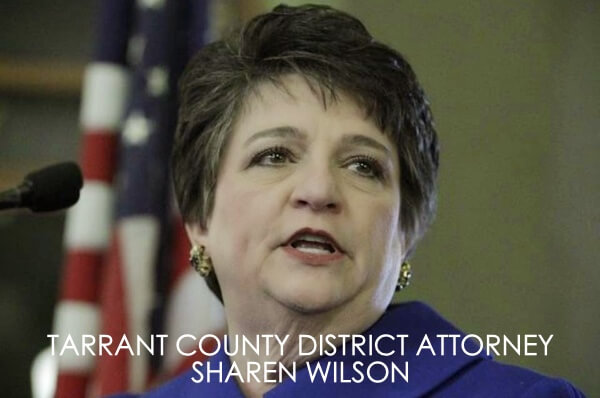
Sharen Wilson Tarrant County District Attorney

Tarrant County District Attorney Sharen Wilson Oversees all Fort Worth Prosecutors

By Brandon Barnett · Criminal Defense

Tarrant County District Attorney Sharen Wilson

Sharen Wilson Tarrant County District Attorney

Sharen Wilson, who took office in 2015, is the elected Tarrant County District Attorney. She is the top of all Fort Worth prosecutors, managing a large office of Assistant District Attorneys, investigators, support staff, and even a therapy dog.  Prior to assuming her new role as the Tarrant County District Attorney, Sharen Wilson presided over Criminal District Court Number 1 as a District Judge.  Her office receives cases from the various police departments across Tarrant County, investigates the cases, and files misdemeanor or felony criminal cases.  The Assistant District Attorneys under Sharen Wilson present cases to grand juries and manage dockets in the 20 Tarrant County criminal courts and the Courts of Appeals.  If you are interested in observing a criminal trial in Tarrant County, check out the Tarrant County Trial Board for a list of cases each week.

Fort Worth Prosecutors | Tarrant County DA

The Tarrant County District Attorney office has over 150 Fort Worth prosecutors and over 50 investigators. The office has a budget of $38 million dedicated to criminal prosecutions and investigations in Tarrant County.  Colloquially, every Assistant District Attorney is referred to as a "Tarrant County DA" or "prosecutor," but the ultimate authority over criminal prosecutions is retained by Sharen Wilson.  Fort Worth prosecutors are known across the state as fair and collegial attorneys.  They have a reputation for taking a fair look at each case and providing all available information to the defense bar in a timely manner.  Although the Tarrant County District Attorney office is one of the largest in the state, in one of the largest counties in the state, the office and its staff carry themselves with small-town values.  While each criminal case is different and may have its own challenges, our criminal defense attorneys have always been satisfied with the professionalism of the Tarrant County DA office.

Free Consultation of Tarrant County Criminal Cases

Our Fort Worth criminal defense attorneys square off every day with the Tarrant County DA office. We have a proven track record of favorable results for our clients. We understand that every case and every client are different. We take a personal approach to every client and pursue every option to address our clients' individual needs. For a FREE consultation of your Tarrant County criminal case, contact our team at (817) 993-9249.

Read full article

Is That Your Final Answer? Double Jeopardy and Partial Verdicts

By Brandon Barnett · Double Jeopardy

United States Supreme Court case highlight: Blueford v. Arkansas

The case dealt with the double jeopardy clause and whether it applies to partial or informal verdicts.

In Blueford, the defendant was being tried for capital murder.  The trial judge instructed the jury that if it did not find the defendant guilty of capital murder, it should consider the lesser included offense of first degree murder.  The court further instructed that if the jury did not find the defendant guilty of first degree murder, it should consider manslaughter...and so on and so forth.  After several hours of deliberations, the jury reported that it could not reach a unanimous verdict.  The judge inquired into how the voting was going and the jury reported that it had decided that the defendant was not guilty of capital murder or first degree murder, but that it could not agree on manslaughter.  The judge instructed the jury to go back and keep trying, but they were unable to break the impasse.  Accordingly, the trial judge declared a mistrial.

During the retrial for the same offense, the defendant objected on double jeopardy grounds to the charge of capital murder, arguing that the jury's informal verdict that he was not guilty of capital or first degree murder precluded him being retried for that same charge at a later trial.  The trial court disagreed, as did the appellate courts.

In a 6-3 opinion (Majority: Roberts, Scalia, Kennedy, Thomas, Breyer, Alito), the Supreme Court held that :

The Double Jeopardy Clause does not bar retrying Blueford on charges of capital murder and first-degree murder.  The jury did not acquit Blueford of capital or first-degree murder.  Blueford contends that the foreperson's report that the jury was unanimous against guilt on the murder offenses represented a resolution of some or all of the elements of those offenses in his favor.   But the report was not a final resolution of anything.  When the foreperson told the court how the jury had voted on each offense, the jury's deliberations had not yet concluded.  The jurors in fact went back to the jury room to deliberate further, and nothing in the court's instructions prohibited them from reconsidering their votes on capital and first-degree murder as deliberations continued.  The foreperson's report prior to the end of deliberations therefore lacked the finality necessary to amount to an acquittal on those offenses.  That same lack of finality undermines Blueford's reliance on Green v. United States, 355 U. S. 184, and Price v. Georgia, 398 U. S. 323.  In both of those cases, the verdict of the jury was a final decision; here, the report of the foreperson was not.

This holding appears to be consistent with Texas law, in that a jury foreperson must sign a verdict form and the court must accept the verdict, before it is given any legal significance.

Justices Sotomayer dissented (joined by Ginsberg and Kagan), and would hold that partial verdicts should be required before a mistrial is granted on the grounds of a deadlock.

Read full article

How Court-Appointed Defense Lawyers are Like Drill Instructors

By Brandon Barnett · Indigent Defense

I'll never forget something I heard back when I was going through Marine Corps Officer Candidate's School.  After somebody said "thank you" to a Drill Instructor, the Drill Instructor looked at the person (in a way only a Drill Instructor can) and responded "Don't thank me.  The government thanks me every two weeks!"

I felt a little like my former Drill Instructor recently as I was talking to a couple of my court-appointed clients.  For court-appointed cases, the county pays me to represent indigent defendants.  This doesn't mean that I have any obligation to help the county move cases or plead my clients guilty.  My only loyalty is to my client, regardless of who is paying the bill.

However, on two separate occasions last week, a court-appointed client offered to give me a little cash if I could help them get a better deal.  Like my former Drill Instructor, I did my best to explain there is no need to give me anything.  You'll get my very best even though the county is footing the bill.

Misconceptions abound when a defendant spends any amount of time in jail.  The jailhouse lawyers love dispensing their "legal knowledge."  One of the first "CLE's" that the jailhouse lawyers hold is the primer on court-appointed lawyers.  About how we are in cahoots with the State and how we are only interested in pleading the clients out at the first setting.  Not true.  At least not true in our criminal defense firm.

Of course there are times when the very best plea offer from the State comes at the first setting (as it should) and it is in the defendant's best interest to take it.  But not always.  And if we need to expand our investigation and do a little more negotiating with the prosecutor, or if we need to prepare for trial, then we'll do it.  No need to pay me any more money and no need to thank me (but a thank you is nice from time to time).

Read full article
Fort Worth criminal investigation

Private Investigator: An Indispensable Criminal Defense Asset

By Brandon Barnett · Criminal Defense

Investigating Every Case to Uncover the Real Truth | Fort Worth Criminal Defense Lawyers

Fort Worth criminal investigationEvery criminal allegation exists in a gray area. If one were to focus solely on the police report, a criminal case might seem black and white. But it's not. There are secrets, personalities, motivations, half-truths, unnamed witnesses, and much more lurking in the shadows of every case. One of the keys to a successful defense is to uncover those facts not articulated in the police report and give the case a context. This is why we use a private investigator as part of our defense team.

A good private investigator is indispensable to a full and complete criminal defense. You would be surprised to hear what people will tell an investigator (while being recorded). Perhaps it's because people like to feel important, or maybe some folks just aren't completely aware of what they are saying, but a good private investigator can blow a case wide open simply by hitting the streets to interview witnesses and others connected to the case.

Our investigator is a retired police officer that spent over 30 years on the force in the Dallas Fort Worth Metroplex, including many years as an undercover narcotics officer. He can look at a police report and spot errors in the investigation at the drop of a hat.

If you have been charged with a criminal offense in Tarrant County, Texas and you know that there is more to your case than what is contained in the police report, give us a call and we will coordinate with our investigator to get started uncovering "the rest of the story." Contact us today for a free consultation.

Read full article

Jessica's Law: Continuous Sexual Abuse of a Child

By Brandon Barnett · Sex Crimes

A Review of Jessica's Law in Texas | Sex Crimes Defense Attorneys

The 80th Texas legislature enacted the "Jessica Lunsford Act" (H.B. 8) to create a criminal offense of Continuous Sexual Abuse of a Child (Texas Penal Code 21.02).  The chart below details the particulars of the offense of Continuous Sexual Abuse of a Child under Section 21.02.

The elements of Jessica's Law:

  • The sexual abuse may be committed against 1 or more victims. (Texas Penal Code 21.02 (b)(1))
  • The complaining witness must be a child younger than the age of 14. (Texas Penal Code 21.02(b)(2))
  • This offense does not apply to juvenile offenders. (Texas Penal Code 21.02(b)(2))
  • A jury is not required to agree unanimously on which specific acts of sexual abuse the defendant committed or the exact date when those acts were committed. (Texas Penal Code 21.02(d))
  • The jury must agree unanimously that the defendant committed 2 or more acts of sexual abuse during a duration of 30 days or more. (Texas Penal Code 21.02(d))
  • An affirmative defense does exist for the offense. If the defendant was not more than 5 years older than the complaining witness; did not use duress, force, or threat; and was not a registered sex offender, then the defendant may raise these points as an affirmative defense. (Texas Penal Code 21.02(g))

Punishment:

  • For a first time offense, regardless of prior criminal history, the range of punishment is 25 to 99 years or life in prison. (Texas Penal Code 22.02(h))
  • Any subsequent offense will result in life in prison without parole (Texas Penal Code 12.42(c)(4))
  • Even for a first time offense, there is no deferred adjudication community supervision (Texas Code of Criminal Procedure Art. 42.12, Section 5(d) (3)), no judge-ordered community supervision (Texas Code of Criminal Procedure Art. 42.12, Section 3(e)(1)), or no jury-recommended community supervision (Texas Code of Criminal Procedure Art. 42.12, Section 4(d)(1)).
  • Essentially, probation in any form or fashion is not an option under Jessica's Law.
  • Additionally, a defendant convicted under this law has no eligibility for parole. (Texas Government Code Section 508.145 (a)).

Aside from a capital murder charge, the offense of Continuous Sexual Abuse of a Child is now considered the highest level of offense a person in Texas can be charged with. We've had several years to watch juries handle these types of cases and we've seen that juries tend to punish severely when presented with continuous sexual abuse of a child.

If you or a loved one is facing a serious criminal charge in Tarrant County, Texas, please call our experienced criminal defense attorneys today at (817) 993-9249. We offer free consultations.

Read full article

Speak with a Fort Worth attorney

Call (817) 993-9249 or send us a message to discuss your case.