Short answer: If a driver in a rental car hits you in Texas, the claim usually runs against the driver and the insurance that covers the driver, not the rental company. A federal law known as the Graves Amendment bars holding a rental company liable just because it owns the car. Rental companies can still be liable for their own negligence, such as renting a car with known defects. Texas law also gives you a way to sue an out-of-state renter who has already flown home.
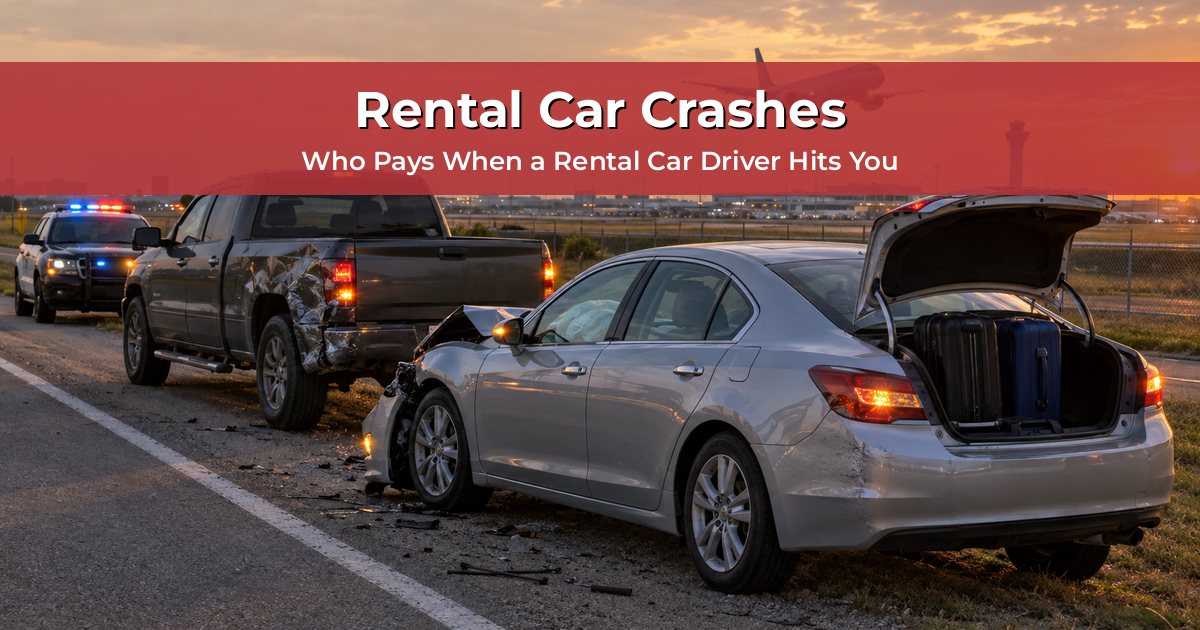
With two major airports, DFW International and Dallas Love Field, Dallas-Fort Worth sees a steady stream of out-of-town drivers on unfamiliar roads like the airport's spur highways, Highway 114, Highway 183, and I-635, often tired and relying on GPS. When one of them causes a crash, injured people usually face the same questions: Who pays? Does the rental company's insurance apply? What if the driver lives in another state?
At Howard Lotspeich Alexander & Williams, PLLC (HLAW), our Fort Worth trial lawyers handle personal injury claims throughout Tarrant, Dallas, Denton, Collin, Johnson, and Parker counties. This guide explains how rental car crash claims work in Texas, whether you were hit by a renter or were driving a rental yourself.
Key Takeaways
- The Graves Amendment generally shields rental companies from owner-based liability. A company in the rental business "shall not be liable... by reason of being the owner of the vehicle" for harm arising from the renter's use, if there is "no negligence or criminal wrongdoing" by the company (49 U.S.C. §30106).
- Direct negligence is a different story. Federal courts in Texas have held that the Graves Amendment bars vicarious liability but "does not preempt theories of direct liability" (N.D. Tex. 2025 opinion).
- Texas minimum liability coverage is 30/60/25: $30,000 per person, $60,000 per crash for bodily injury, and $25,000 for property damage (Tex. Transp. Code §601.072).
- Out-of-state drivers can still be sued here. The chair of the Texas Transportation Commission is the agent for service of process on a nonresident in a suit arising from a Texas collision (Tex. Civ. Prac. & Rem. Code §17.062).
- Your own coverage may matter most. UM/UIM and PIP can fill gaps when the renter's coverage is low or missing.
Who Is Liable When a Rental Car Driver Hits You in Texas?
The starting point is the same as any Texas car wreck: the driver who caused the crash is responsible for the harm caused by their negligence. Texas assigns fault by percentage, and you can recover as long as you're not more than 50% responsible. Our guide to how fault works in Texas personal injury cases explains those rules.
What's different in a rental car case is the question of who else might be responsible, and whose insurance pays.
What the Graves Amendment says
Before 2005, some states made rental companies liable for their customers' crashes simply because the companies owned the cars. Congress ended that with the Graves Amendment. It provides that an owner that rents or leases a vehicle "shall not be liable under the law of any State... by reason of being the owner of the vehicle... for harm to persons or property that results or arises out of the use, operation, or possession of the vehicle during the period of the rental or lease," as long as the owner is "engaged in the trade or business of renting or leasing motor vehicles" and "there is no negligence or criminal wrongdoing on the part of the owner" (49 U.S.C. §30106(a)).
Courts in Texas apply this rule regularly. In a 2025 Dallas federal case involving a leased trailer, the court held that the Graves Amendment barred the plaintiff's vicarious liability and respondeat superior claim against the leasing company, while noting that the statute "does not preempt theories of direct liability, like negligent hiring and training" (N.D. Tex. 2025).
The law also has a carve-out for financial responsibility. It doesn't override state laws "imposing financial responsibility or insurance standards on the owner of a motor vehicle," or liability on rental businesses "for failure to meet the financial responsibility or liability insurance requirements under State law" (§30106(b)).
When Can a Rental Car Company Be Held Responsible?
Because the Graves Amendment protects only against liability based on ownership, a rental company can still be responsible for its own negligence. Potential claims include:
- Negligent maintenance. Renting out a car with bad brakes, bald tires, or a known defect, including an unrepaired safety recall.
- Negligent entrustment. Renting to someone the company knew, or should have known, was unlicensed, incompetent, or reckless.
- Criminal wrongdoing by the company or its employees.
These claims are hard to win. Under Texas law, negligent entrustment requires proof of "(1) entrustment of a vehicle by the owner; (2) to an unlicensed, incompetent, or reckless driver; (3) that the owner knew or should have known to be unlicensed, incompetent, or reckless; (4) that the driver was negligent on the occasion in question; and (5) that the driver's negligence proximately caused the accident" (O'Donnell v. Diaz, N.D. Tex.). Federal courts applying Texas law have also said a company that entrusts a vehicle "has no duty to investigate a driver's competency when a valid, unrestricted driver's license is presented" (Marr v. Croxton, W.D. Tex.).
Causation is another hurdle. In Allways Auto Group v. Walters, the Supreme Court of Texas held that a dealership that gave a customer a loaner car wasn't liable when the customer drove drunk and caused a crash eighteen days later, because the loan was not a proximate cause of the crash (Tex. 2017).
In practice, the rental company is most often a defendant when there's evidence of a mechanical failure. That makes it critical to preserve the vehicle and its maintenance records before the company repairs, resells, or returns the car to the fleet.
Whose Insurance Pays After a Rental Car Crash?
Several layers of coverage may be involved, and the order in which they apply depends on the policies and the rental contract. Common sources include:
| Coverage source | What it may cover | Notes |
|---|---|---|
| Renter's personal auto policy | Liability for injuries the renter causes | Many personal policies extend to rental cars; check the policy language |
| Rental company coverage | Liability up to the limits the company provides | Often limited; Texas minimums are 30/60/25 (§601.072) |
| Supplemental liability insurance bought at the counter | Additional liability limits | Only if the renter purchased it |
| Your own UM/UIM coverage | Your injuries when the at-fault driver has no or too little insurance | See our UM/UIM and PIP guide |
| Your own PIP | Medical bills and lost income regardless of fault | Covers the named insured, household members, and authorized drivers and passengers of the named insured's vehicle (Tex. Ins. Code §1952.151) |
| Credit card rental benefits | Usually damage to the rental car itself | Generally not a source of payment for your injuries |
Because rental crashes often involve minimum or uncertain coverage, your own UM/UIM policy can become the most important coverage in the case. If the renter fled the scene or had no valid coverage, see our article on what to do after an uninsured driver accident in Fort Worth.
What If the Rental Car Driver Lives in Another State?
Many renters at DFW and Love Field are visitors who are back home within days. That doesn't put them beyond the reach of a Texas court. Under Section 17.062 of the Civil Practice and Remedies Code, the chair of the Texas Transportation Commission is an agent for service of process on a nonresident "in any suit against the person or agent that grows out of a collision in which the person or the person's agent is involved while operating a motor vehicle in this state." The same rule applies to a driver who lived in Texas at the time of the crash and later moved away.
Section 17.063 sets out the mechanics: a certified copy of the process must be served on the chair at least 20 days before the return date, and the chair then mails the papers to the nonresident by registered or certified mail (§17.063). In other words, an out-of-state renter can be sued in Tarrant or Dallas County, close to where the crash happened, rather than forcing you to file in another state.
International renters raise added issues, such as foreign insurance and serving papers abroad. Those cases call for early legal advice.
What If I Was Driving the Rental Car When I Got Hurt?
If you were driving or riding in a rental car and someone else caused the crash, your claim is against the at-fault driver, just like any other wreck. A few rental-specific issues often come up:
- Damage to the rental car. The rental company may bill you or your insurer for repairs, loss of use, and administrative fees. Don't sign anything admitting responsibility for the crash.
- The rental company's own crash report. Rental counters often ask you to fill out an incident form. Stick to the facts and keep a copy.
- Your PIP and UM coverage. Depending on the policy terms, your own PIP and UM/UIM coverage may apply even though you were in a rental. Read the policy or have a lawyer review it.
- Rideshare rentals. If you rented a car to drive for a rideshare app, different coverage rules may apply. See our guide to Uber and Lyft accidents.
What Should You Do After a Crash With a Rental Car in DFW?
- Call 911 and get a police report. In a crash with an out-of-town driver, the police crash report is often the best record of who was involved and their insurance.
- Photograph the rental car's identifiers. Photograph the plate, VIN sticker, and any barcode or fleet number, plus the renter's driver's license and insurance information.
- Get the renter's home address and phone number, and ask whether they bought coverage at the counter.
- Write down the rental company and location (for example, the airport rental center or a neighborhood branch).
- See a doctor promptly, even if you feel fine. Our article on seeing a doctor after a minor car accident explains why.
- Send a preservation letter early if a mechanical defect may have played a role, so the rental company keeps the car and its maintenance records.
- Be cautious with multiple adjusters. You may hear from the renter's insurer, the rental company's claims administrator, and your own carrier. Read about insurance adjuster tactics before giving a recorded statement.
- Watch the deadline. Most Texas injury lawsuits must be filed within two years. See our Texas statute of limitations guide.
Frequently Asked Questions
Can I sue the rental car company if its customer hit me?
Usually not just because the company owns the car. The Graves Amendment bars ownership-based liability for companies in the rental business, but it doesn't protect a company from liability for its own negligence or criminal wrongdoing (49 U.S.C. §30106). Evidence of poor maintenance or a known defect can support a direct claim.
Does the rental company's insurance cover my injuries?
It may, depending on the coverage the company provides and the rental agreement. Coverage is often limited, and Texas minimum liability limits are $30,000 per person and $60,000 per crash for bodily injury (Tex. Transp. Code §601.072). The renter's own auto policy or a supplemental policy bought at the counter may also apply.
The driver who hit me flew home to another state. Can I still sue in Texas?
Yes. Texas law makes the chair of the Texas Transportation Commission the agent for service of process on nonresident drivers involved in collisions in Texas (CPRC §17.062).
Is a rental company liable for renting to a bad driver?
Only in limited situations. A negligent entrustment claim requires proof that the company knew or should have known the driver was unlicensed, incompetent, or reckless (O'Donnell v. Diaz), and courts have said there is no duty to investigate further when a valid, unrestricted license is presented (Marr v. Croxton).
What if the renter didn't have enough insurance?
Your own uninsured/underinsured motorist coverage may pay the difference, up to your policy limits. PIP can also pay medical bills and lost income regardless of fault (Tex. Ins. Code §1952.151).
How long do I have to file a claim?
Most Texas personal injury claims must be filed within two years of the crash. Claims involving government vehicles can have much shorter notice deadlines.
Talk to a Fort Worth Car Wreck Lawyer
Rental car crashes add layers of insurance, out-of-state drivers, and federal law to an already stressful situation. HLAW can identify every available policy, preserve the vehicle evidence, and serve a driver who has already left Texas. Call (817) 993-9249 or contact us online for a free consultation.
This article is for general informational purposes only and is not legal advice. Reading it does not create an attorney-client relationship. Every case depends on its specific facts, and the laws discussed here may change.