
Short answer: In a Texas personal injury case, you can recover the wages you've already lost and the loss of your future capacity to earn, but you have to prove both with evidence, not estimates. Texas law requires lost earnings to be presented as a net loss after federal income taxes. Courts let juries consider your past earnings, stamina, efficiency, ability to work with pain, and work-life expectancy when measuring future losses. Pay stubs, tax returns, employer statements, medical work restrictions, and, in bigger cases, vocational and economic experts are what turn a lost paycheck into a recoverable claim.
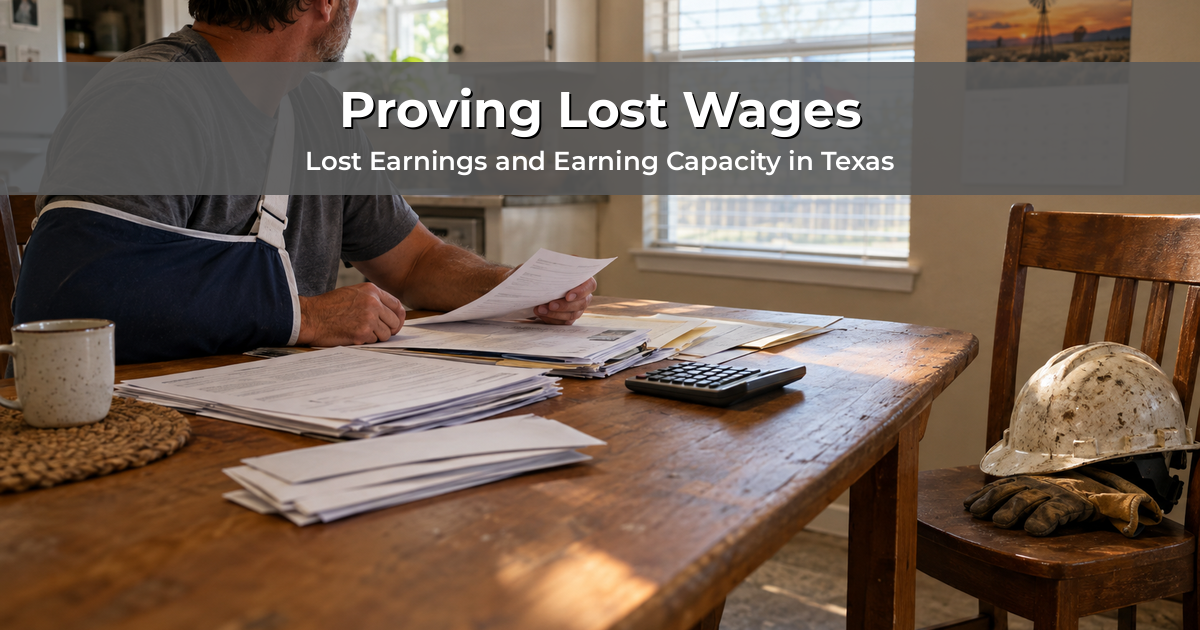
After a wreck on I-30 or a fall at a Fort Worth job site, the bills that hurt most are often not the medical bills. They're the missed paychecks. Missed shifts, used-up PTO, a lost promotion, or a career you can no longer do are all real economic losses under Texas law, but insurance companies routinely discount them when they aren't documented well.
At Howard Lotspeich Alexander & Williams, PLLC (HLAW), our Fort Worth trial lawyers handle personal injury cases throughout Tarrant, Dallas, Denton, Collin, Johnson, and Parker counties. This guide explains how Texas law treats lost wages and lost earning capacity, what evidence works, and the mistakes that shrink these claims.
Key Takeaways
- Two different claims. Past lost earnings cover income you've already missed. Loss of earning capacity covers your diminished ability to earn in the future, even if you were paid the same or more after the injury.
- Net, after taxes. Evidence of lost earnings or earning capacity "must be presented in the form of a net loss after reduction for income tax payments" under federal income tax law (Tex. Civ. Prac. & Rem. Code §18.091).
- Reasonable measurement in dollars. You must give the jury evidence "sufficient to permit a jury to reasonably measure earning capacity in monetary terms" (Big Bird Tree Service v. Gallegos, Tex. App.—Dallas 2012).
- Lost wages are economic damages. Texas defines economic damages as compensation for "actual economic or pecuniary loss" (CPRC §41.001(4)).
- PIP can help right away. Personal injury protection coverage pays "replacement of income lost as the result of the accident" for income producers, regardless of fault (Tex. Ins. Code §1952.151).
What Is the Difference Between Lost Wages and Lost Earning Capacity?
Texas law treats these as related but distinct damages.
Past lost earnings (lost wages) are the income you actually lost between the injury and trial or settlement: missed hours, missed shifts, unpaid leave, lost overtime, lost commissions, and lost bonuses that were reasonably certain.
Loss of earning capacity looks at something broader: your ability to earn money. Texas courts describe it as an assessment of the plaintiff's capacity to earn a livelihood before the injury and the extent to which the injury impaired that capacity. It "is not measured by what a person actually earned before an injury, but by the person's capacity to earn, even if he had never worked in that capacity in the past" (Tex. App.—Houston [1st Dist.] 2013).
That second point matters. Courts "have consistently upheld judgments for reduced earning capacity, even though the plaintiff was making as much or even more money after the injury than before," where pain, weakness, or diminished functional ability impaired the person's capacity to get and hold a job, or the duration, consistency, or efficiency of their work (Kelsey-Seybold Medical Group v. Roberts, Tex. App.—Houston [1st Dist.] 2024).
| Past lost earnings | Loss of future earning capacity | |
|---|---|---|
| Time period | Injury to trial or settlement | After trial, for the rest of your work life |
| What it measures | Income actually lost | Diminished ability to earn |
| Typical proof | Pay stubs, W-2s, tax returns, employer letter, timesheets | Medical restrictions, vocational testimony, economist, past earnings history |
| Tax rule | Net after federal income tax (§18.091) | Net after federal income tax (§18.091) |
How Do You Prove Lost Wages in a Texas Injury Claim?
For an hourly or salaried employee, the proof is usually straightforward, but it has to be complete:
- A doctor's work restriction. A note or record showing you were taken off work or placed on light duty, and for how long. Without it, insurers will argue you chose not to work.
- Pay records. Recent pay stubs and W-2s showing your rate, typical hours, and overtime history.
- An employer verification letter. A letter from HR or a supervisor confirming your position, pay rate, the dates you missed, and any lost overtime, bonuses, or promotion.
- Tax returns. Usually two to three years, especially if your income varies.
- PTO and sick leave records. If you used paid leave to cover missed days, document it.
What if I'm self-employed or a gig worker?
Self-employed claims require more proof, but they're recoverable. Courts recognize that "when the plaintiff seeks special damages for loss of earning capacity in a particular business, the amount of his earnings or the value of his services in that business must be shown with reasonable certainty" (Perez v. Perez, Tex. App.—Corpus Christi 2013). Useful evidence includes:
- Schedule C or business tax returns for several years
- 1099 forms and app earnings statements for rideshare and delivery drivers
- Bank deposits, invoices, and canceled contracts or jobs you had to turn down
- The cost of hiring someone to cover your work while you recovered
- Testimony from regular customers or business partners
When income has been irregular, an accountant or economist can help show average earnings and what you would likely have earned during your recovery.
How Do Texas Courts Measure Lost Future Earning Capacity?
Future losses are uncertain by nature, and Texas law accepts that. "Proof of loss of earning capacity is always uncertain and is left largely to the discretion of the jury" (Big Bird Tree Service v. Gallegos). But the jury's award must rest on evidence, not speculation. Courts have said an award "must be based on something more than mere conjecture" (Durham Transportation Co., Tex. App.).
The Dallas Court of Appeals lists non-exclusive factors juries may consider: "evidence of past earnings, the plaintiff's stamina, efficiency, and ability to work with pain, and the plaintiff's work-life expectancy" (Big Bird Tree Service). Other Texas courts add "the weaknesses and degenerative changes that will naturally result from the plaintiff's injury" (Durham Transportation).
In practice, strong future-earnings claims usually include:
- Treating doctor testimony on permanent restrictions (for example, no lifting over 20 pounds, no repetitive overhead work).
- A vocational expert who explains which jobs you can still do and what they pay in the DFW labor market.
- An economist who calculates the difference over your expected work life, adjusts for taxes as §18.091 requires, and reduces future amounts to present value.
- Your own testimony and co-workers' testimony about how the injury affects your stamina and performance.
Will My Lost Wage Award Be Taxed?
Generally, damages for personal physical injuries aren't taxable as income under federal law, which is the reason for Texas's net-of-tax rule. Section 18.091(b) also requires the court to "instruct the jury as to whether any recovery for compensatory damages sought by the claimant is subject to federal or state income taxes" (CPRC §18.091). The practical effect: your lost earnings must be calculated on take-home pay, not gross pay. Tax questions about a specific settlement should go to a tax professional.
Can PIP Pay My Lost Income After a Car Wreck?
Yes, if you have it. Texas personal injury protection coverage pays, for an income producer, "replacement of income lost as the result of the accident," for expenses incurred within three years of the accident (Tex. Ins. Code §1952.151). Insurers aren't required to offer more than $2,500 per person in PIP, though many people buy more (§1952.153). The insurer must pay benefits no later than the 30th day after it receives satisfactory proof of the claim (§1952.156).
PIP applies regardless of fault, so it can help cover the gap while the liability claim is pending. Our guide to UM/UIM and PIP coverage explains how these policies fit together.
If you were hurt on the job, the rules may be different. Workers' compensation, or the lack of it with a non-subscriber employer, changes how lost income is handled. See our page on workplace accidents.
What Mistakes Hurt Lost Wage Claims?
- Returning to work against medical advice, then trying to claim the time later.
- Gaps in treatment, which insurers use to argue you were well enough to work.
- Unreported cash income. If income wasn't reported on tax returns, it's very difficult to prove and can create other problems.
- Posting on social media about physical activities or side jobs while claiming you can't work.
- Giving the adjuster a recorded statement that downplays your limitations. Read about insurance adjuster tactics in Fort Worth.
- Settling before you know your restrictions. If a surgeon hasn't released you, you may not yet know whether you can return to your trade.
- Missing the deadline. Most Texas injury lawsuits must be filed within two years. See our Texas statute of limitations guide.
Lost earnings are only part of the picture. Our article on what compensation is available in a Texas personal injury lawsuit covers medical expenses, pain and suffering, and other damages. Noneconomic damages are defined separately in Texas law and include "physical pain and suffering, mental or emotional pain or anguish... physical impairment," and similar losses (CPRC §41.001(12)).
Frequently Asked Questions
Can I recover lost wages if I used PTO or sick days?
It may be possible. Paid leave you were forced to use because of the injury is a benefit you can no longer use for other purposes, and it is commonly presented as part of the earnings claim. Whether it is recoverable depends on the facts, so keep the payroll records showing the leave you used and the dates.
Can I claim lost earning capacity if I went back to the same job?
Possibly. Texas courts have upheld earning-capacity awards even when the plaintiff earned as much or more after the injury, where pain or diminished function impaired the ability to get and hold work or to work consistently and efficiently (Kelsey-Seybold v. Roberts).
Do I need an expert to prove future lost earnings?
Not always, but in cases involving permanent injury or a career change, a vocational expert and an economist are often the most persuasive way to give the jury a reasonable dollar measure, which the law requires (Big Bird Tree Service).
Are lost wages calculated before or after taxes in Texas?
After. Section 18.091 requires lost earnings and earning-capacity evidence to be presented as a net loss after federal income taxes (CPRC §18.091).
I'm self-employed. How do I prove what I lost?
Use tax returns, 1099s, invoices, bank deposits, and evidence of jobs you lost or turned down. The earnings or value of your services must be shown with reasonable certainty (Perez v. Perez).
Will my own insurance pay lost income while I wait?
If your auto policy includes PIP, it covers lost income for income producers regardless of fault, and the insurer must pay within 30 days of satisfactory proof (Tex. Ins. Code §§1952.151, 1952.156).
Talk to a Fort Worth Personal Injury Lawyer
If an injury has cost you paychecks, or your career, the way that loss is documented can make a substantial difference in what you recover. HLAW can gather your employment records, work with your doctors on restrictions, and bring in vocational and economic experts when needed. Call (817) 993-9249 or contact us online for a free consultation.
This article is for general informational purposes only and is not legal advice. Reading it does not create an attorney-client relationship. Every case depends on its specific facts, and the laws discussed here may change.