Short answer: After a DWI arrest in Texas, you generally have just 15 days from the date you are served with a notice of suspension to request an Administrative License Revocation (ALR) hearing. If you miss that deadline, the Texas Department of Public Safety (DPS) will automatically suspend your driver's license on the 40th day: 90 days for a failed breath or blood test, or 180 days for a refusal, and longer if you have a prior alcohol- or drug-related contact in the last 10 years. A timely request keeps your license valid until a judge decides the case, and it gives your lawyer an early chance to question the arresting officer under oath.
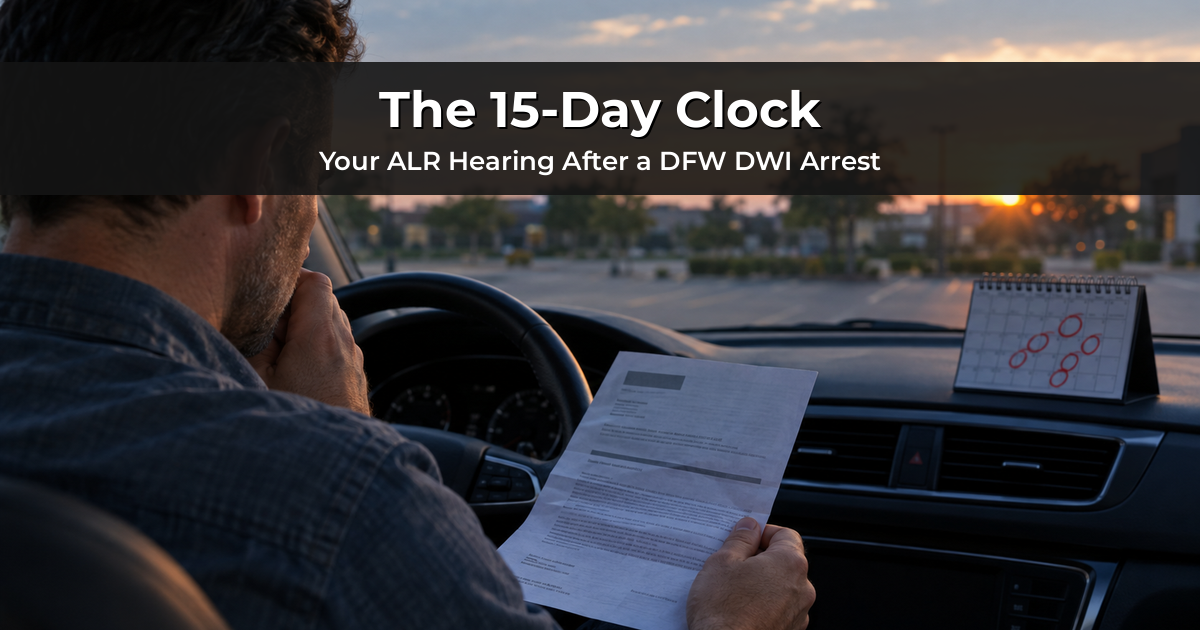
Most people arrested for DWI in Fort Worth, Arlington, Dallas, or anywhere in North Texas think about the criminal case first: the jail release, the bond conditions, the first court date. But there is a second case running at the same time, and it moves much faster. It is a civil case against your driver's license, and the clock on it starts the moment the officer hands you the paperwork.
At Howard Lotspeich Alexander & Williams, PLLC (HLAW), requesting the ALR hearing is one of the first things we do for a new DWI client. This guide explains how the 15-day deadline works, what happens at the hearing, and why it matters for both your license and your criminal defense.
Key Takeaways
- Two separate cases. A DWI arrest triggers a criminal case in court and a separate administrative case against your license, handled by DPS and the State Office of Administrative Hearings (SOAH).
- 15 days. The hearing request must reach DPS within 15 days of being served notice. In some blood-test cases where DPS mails the notice later, DPS gives 20 days from the mailing date.
- Automatic suspension if you do nothing. Without a hearing request, the suspension takes effect on the 40th day after notice.
- Suspension lengths. For adults: 90 days for a failed test, 180 days for a refusal, and 1 or 2 years if you have a prior alcohol- or drug-related contact within 10 years.
- The request protects you. A timely request stays the suspension until the judge's final decision.
- The hearing is a discovery tool. Your lawyer can subpoena the arresting officer and cross-examine them under oath, often months before the criminal trial.
- Losing isn't the end. You may still qualify for an occupational driver's license, and you can appeal within 30 days.
What Is an ALR Suspension in Texas?
The Administrative License Revocation program is a civil process. Under it, DPS can suspend your license after a DWI or BWI arrest if you refuse a breath or blood test, or if you test at 0.08 or higher (0.04 or higher in a commercial vehicle). DPS says plainly that the ALR action is separate from the criminal court case.
So the ALR suspension can happen even if your criminal case is still pending, gets reduced, or is dismissed. Under Texas Transportation Code §524.015, the outcome of the criminal charge generally does not affect the ALR suspension. The main exception is an acquittal: if a jury or judge finds you not guilty of DWI arising from the same arrest, DPS must rescind the suspension and remove it from your driving record.
Breath or blood "failure" vs. refusal
The officer's paperwork will put you in one of two categories:
| Situation | Governing law | First-offense adult suspension | With a prior contact in the past 10 years |
|---|---|---|---|
| Test result of 0.08 or higher | Tex. Transp. Code §524.022 | 90 days | 1 year |
| Refused breath or blood test | Tex. Transp. Code §724.035 | 180 days | 2 years |
| Driver under 21 with any detectable alcohol | §524.022(b) | 60 days | 120 days to 180 days, depending on prior convictions |
Refusing a test does not end the matter. Under the implied consent warnings in §724.015, the officer can apply for a warrant to take your blood, and the refusal itself may be used as evidence. We cover that in more detail in our article on the penalties for refusing a breath test and in our guide to no-refusal weekends in Texas.
How Does the 15-Day Deadline Work?
Transportation Code §524.031 requires that DPS receive your hearing request at its Austin headquarters no later than the 15th day after you receive the notice of suspension. In a breath-test or refusal case, the officer usually serves that notice at the time of arrest, often on a form called the DIC-25, and may take your physical license.
Three practical points trip people up:
- The deadline is about when DPS receives the request, not when you send it. Waiting until day 14 to mail a letter is a risk you don't need to take.
- Blood-test cases can run on a different clock. When the officer draws blood, the results often aren't back at the time of arrest. DPS mails a notice of suspension later, and DPS's ALR page gives 20 days from the mailing date in those cases. Under §524.013, mailed notice is considered received on the fifth day after mailing, so watch your mail closely.
- Late requests are denied. DPS states that requests made after the deadline will be denied, and the suspension then takes effect on the 40th day (DPS ALR hearing request page).
How do you request the hearing?
DPS accepts ALR hearing requests online, by mail, email, phone, or fax. Its online form is the fastest route. A request should include your name, date of birth, license number and state, contact information, the date and county of arrest, the arresting agency and officer, and whether the test was failed or refused. If you have a lawyer, the lawyer's information goes on the request too, so DPS sends hearing notices to your attorney.
There is no strategic reason to wait. In our practice, the request is usually submitted within a day or two of being hired.
What Happens After You Request the Hearing?
Your license stays valid in the meantime
Under §524.032(d), a request for a hearing stays the suspension until the administrative law judge issues a final decision. In other words, a timely request keeps you driving while the case is pending, unless something else (like a bond condition) restricts you.
DPS notes that it may take 30 to 60 days for a hearing to be scheduled. You'll receive a letter with the date, time, and location. The statute also allows one continuance at the driver's request if it's received at least five days before the hearing.
Where are DFW ALR hearings held?
ALR hearings are heard by an administrative law judge from the State Office of Administrative Hearings (SOAH), not by the criminal court judge. Under §524.034, if the arrest happened in a county with 300,000 or more people, the hearing is held at a location SOAH designates in the county of arrest. That covers the core Metroplex counties: Tarrant, Dallas, Denton, and Collin. SOAH's rules also allow it to hold ALR hearings by videoconference with proper notice, and many are now held on Zoom.
What Does DPS Have to Prove at an ALR Hearing?
The issues are narrow. Under §524.035, DPS must prove by a preponderance of the evidence (more likely than not):
- That reasonable suspicion existed to stop you, or probable cause existed to arrest you; and
- In a test-failure case, that you had an alcohol concentration of 0.08 or more while operating a motor vehicle in a public place. In a refusal case, the issues include whether you were properly asked for a specimen and refused.
If the judge doesn't find in DPS's favor on every required issue, DPS must reinstate your license. The judge also can't sustain a test-failure suspension if the breath or blood analysis showed an adult below the legal limit. If you tested under 0.08 but were still arrested, see our article on DWI arrests below 0.08 in Texas.
The judge does not decide guilt or innocence, and there is no jury. The hearing is about the stop, the arrest, and the test.
Why the ALR Hearing Matters for Your Criminal DWI Case
Many people assume the ALR hearing isn't worth fighting because suspensions are often upheld. That overlooks the hearing's biggest value: it is often the only chance before trial to question the arresting officer under oath.
DPS can usually rely on the officer's sworn written report, which is admissible as a public record. But SOAH Rule §159.211 gives the driver the right to subpoena the officer. If an officer who was timely subpoenaed fails to appear without good cause, information from that officer is not admissible. SOAH warns self-represented drivers that DPS does not have to bring the officer unless you subpoena them.
When the officer testifies, that sworn testimony is recorded. Our attorneys can use it to:
- Pin down the stated reason for the traffic stop, such as weaving, failing to signal, or speeding.
- Lock in the officer's account of the field sobriety tests, including how they were explained, where they were done, and what the lighting and road surface were like.
- Compare the testimony with dash-cam and body-cam video, and with the written report.
- Find inconsistencies that support a motion to suppress or a cross-examination at the criminal trial.
The subpoena process has strict timing. Under SOAH Rule §159.101, certain subpoena requests, including for breath test operators or technical supervisors, must be filed at least 10 days before the hearing and must show good cause. These deadlines are one reason it helps to have a DWI lawyer from the start.
What If You Lose the ALR Hearing?
Losing the hearing doesn't mean you can't drive.
Occupational driver's license
Under Transportation Code §521.242, a person whose license is suspended under the ALR statutes is generally eligible to petition for an occupational driver's license. The petition is filed in a justice, county, or district court where you live or where the arrest occurred. The court sets hours, purposes, and routes, typically up to four hours of driving in any 24 hours, or up to 12 hours on a showing of necessity. If the court requires an ignition interlock device, §521.248(d) removes those time, reason, and route restrictions. An occupational license never authorizes driving a commercial vehicle. Our occupational driver's license guide walks through the process.
Appeal
Under §524.041, you may appeal a sustained suspension by filing a petition in the county court at law in the county of arrest within 30 days after the judge's decision becomes final. DPS's appeal guidance explains the filing requirements. Appeals are reviewed on the record from the hearing, which is another reason to build that record carefully.
Reinstatement
When the suspension ends, DPS charges a $125 reinstatement fee before it will issue or renew your license, plus any other outstanding fees.
Special Situations
- Commercial driver's license (CDL) holders. DPS may also disqualify your CDL, and an occupational license can't be used to drive a commercial vehicle. For professional drivers, the ALR hearing can decide whether you keep working.
- Drivers under 21. Texas suspends minors' licenses for any detectable alcohol, so the ALR case can apply even well below 0.08.
- Out-of-state drivers arrested in DFW. Texas can deny your privilege to drive in Texas, and your home state may act on the Texas suspension. Request the hearing anyway.
- A suspension from the criminal case, too. A DWI conviction can carry its own license suspension. DPS notes that you can receive both from the same arrest, though Texas law provides credit for ALR suspension time in many cases. See our overview of Texas DWI license suspensions and occupational licenses.
A Simple 15-Day Action Plan After a DFW DWI Arrest
- Day 1 to 2: Find your notice of suspension (DIC-25 or similar) and any temporary paperwork. Write down the arrest date.
- Day 1 to 3: Talk with a DWI defense attorney. Don't wait for the first court date.
- As soon as possible: Request the ALR hearing through DPS, either yourself or through your attorney.
- After the hearing is set: Your attorney decides whether to subpoena the arresting officer and other witnesses and files the requests before SOAH's deadlines.
- Meanwhile: Keep driving lawfully. Follow any bond conditions, such as an ignition interlock, which DFW courts frequently order.
- After the hearing: If the suspension is sustained, consider an occupational license and an appeal right away.
For a broader look at how a DWI case unfolds in Tarrant County, see DWI laws in Texas explained for Fort Worth residents and our breakdown of the real costs of a DWI in Texas.
Frequently Asked Questions
Is the 15-day deadline counted from the arrest date?
In most breath-test and refusal cases, yes, because the officer serves the notice of suspension at arrest. The legal trigger is the date you receive (or are presumed to receive) the notice. In blood-test cases where DPS mails the notice later, DPS allows 20 days from the mailing date. If you aren't sure which applies, treat the earliest possible date as your deadline.
Can I still drive after a DWI arrest in Texas?
Usually, for a while. The suspension doesn't take effect until the 40th day after notice. If you request a hearing on time, the suspension is stayed until the judge decides. Bond conditions in your criminal case, such as an ignition interlock requirement, still apply.
If my DWI charge is dismissed, does the ALR suspension go away?
Not automatically. Under Texas Transportation Code §524.015, the disposition of the criminal case generally doesn't affect the ALR suspension. An acquittal is the main exception and requires DPS to rescind the suspension. Whether a dismissal helps depends on the facts.
Do I need a lawyer for an ALR hearing?
You can represent yourself, and SOAH publishes a guide for self-represented drivers. But a DPS attorney presents the case for the state, and the most valuable part of the hearing, cross-examining the officer, depends on properly subpoenaing them. A lawyer also uses the hearing to build the record for your criminal defense.
What if I refused the breath test?
A refusal leads to a proposed 180-day suspension for a first offense (two years with a prior contact in the past 10 years). At the hearing, the issues include whether the stop and arrest were lawful and whether you were properly asked for a specimen and refused. Officers often seek a blood warrant after a refusal, so you may face both a refusal suspension and blood evidence in the criminal case.
How long does it take to get an ALR hearing?
DPS says it may take 30 to 60 days for a hearing to be scheduled. Hearings may be in person in the county of arrest or by videoconference.
What if I miss the 15-day deadline?
DPS will deny a late request, and the suspension will take effect on the 40th day. You may still be eligible for an occupational driver's license, and the criminal case continues on its own track. Talk with a lawyer about your options right away.
Talk to a Fort Worth DWI Attorney About Your ALR Hearing
The 15-day window is short, and what happens in it can shape both your driving privileges and your criminal case. HLAW's Fort Worth DWI attorneys represent drivers throughout Tarrant, Dallas, Denton, Collin, Johnson, and Parker counties in ALR hearings and DWI cases. Call (817) 993-9249 or contact us online for a free consultation. If your arrest was recent, call today so we can make sure your hearing request is filed on time.
This article is for general informational purposes only and is not legal advice. Reading it does not create an attorney-client relationship. DWI and license laws change, and every case depends on its facts. Consult a licensed Texas attorney about your situation.