Short answer: Yes. In Texas you can be charged with DWI without drinking any alcohol at all. The Penal Code defines "intoxicated" to include losing the normal use of your mental or physical faculties because of a controlled substance, a drug, a dangerous drug, a combination of substances, or "any other substance," and having a valid prescription "is not a defense." Unlike alcohol, Texas has no fixed legal limit for THC or other drugs, so in a drug DWI case the State generally has to prove actual impairment, not just that a drug showed up in your blood.
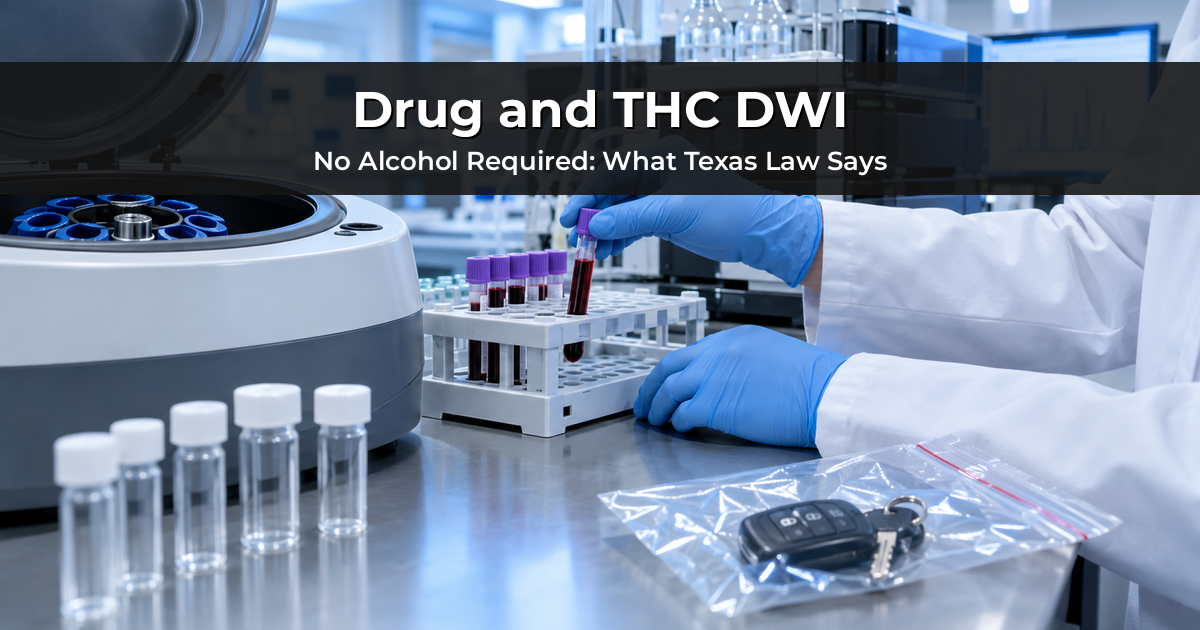
Many people are surprised to be arrested for DWI after a stop where the breath test showed little or no alcohol. In Tarrant, Dallas, Denton, Collin, Johnson, and Parker counties, officers often follow up with a blood warrant, a drug recognition evaluation, and a lab analysis for marijuana, prescription medications, or other drugs. Those cases look different from a typical alcohol DWI, and they are often defended differently.
At Howard Lotspeich Alexander & Williams, PLLC (HLAW), our Fort Worth DWI attorneys defend drug-related DWI charges across the Dallas-Fort Worth area. This guide explains what Texas law says about DWI by drugs, THC, and prescription medications, how the State tries to prove these cases, and the questions that often decide them.
Key Takeaways
- Drug DWI is the same offense as alcohol DWI. Texas Penal Code §49.01(2)(A) defines intoxication to include impairment from "a controlled substance, a drug, a dangerous drug, a combination of two or more of those substances, or any other substance" (Tex. Penal Code §49.01).
- A prescription is not a defense. Under §49.10, the fact that a person "is or has been entitled to use" the drug "is not a defense" (Tex. Penal Code §49.10).
- There is no per se limit for drugs. The 0.08 rule in §49.01(2)(B) applies only to alcohol concentration. For drugs, the State must prove loss of normal use of mental or physical faculties.
- THC in blood is a poor measure of impairment. NHTSA has reported that "THC level in blood (or oral fluid) does not appear to be an accurate and reliable predictor of impairment from THC" (NHTSA Report to Congress).
- Jury instructions must match the evidence. The Texas Court of Criminal Appeals held in Burnett v. State (2017) that a trial court must submit "only the portions of the statutory definition of 'intoxicated' that are supported by the evidence" (Burnett opinion).
- Refusing a test still has license consequences. Implied consent covers testing for drugs as well as alcohol, and a refusal generally leads to a 180-day license suspension for a first refusal (Tex. Transp. Code ch. 724).
Can You Get a DWI in Texas Without Drinking Alcohol?
Yes. Texas Penal Code §49.04(a) makes it an offense to be "intoxicated while operating a motor vehicle in a public place" (Tex. Penal Code §49.04). The key word is "intoxicated," and §49.01(2) gives two separate ways to prove it:
- Loss of normal use: "not having the normal use of mental or physical faculties by reason of the introduction of alcohol, a controlled substance, a drug, a dangerous drug, a combination of two or more of those substances, or any other substance into the body"; or
- Per se alcohol: "having an alcohol concentration of 0.08 or more."
Only the first definition applies to drugs. That means a DWI can be based on marijuana or THC products, prescription painkillers, anti-anxiety medications, sleep aids, muscle relaxers, stimulants, over-the-counter medications that cause drowsiness, or a mix of alcohol and any of these. A first DWI is generally a Class B misdemeanor with a minimum of 72 hours of confinement, regardless of which substance is alleged.
Is a Prescription a Defense to DWI in Texas?
No. Texas Penal Code §49.10 says that in a DWI prosecution, "the fact that the defendant is or has been entitled to use the alcohol, controlled substance, drug, dangerous drug, or other substance is not a defense" (Tex. Penal Code §49.10).
That does not mean anyone taking a prescription is guilty of DWI. The legal question is still whether the medication caused you to lose the normal use of your mental or physical faculties while you were driving. Many people take prescribed medications every day at stable doses and drive normally. A prescription can still matter as evidence. It can explain why a drug was in your system, show how long you had been taking it, and show that you were used to its effects. What it cannot do is serve as a complete legal excuse if impairment is proven.
Is There a Legal Limit for THC or Drugs in Texas?
No. Texas has no per se limit for THC or any other drug. The 0.08 threshold in §49.01(2)(B) is specifically an "alcohol concentration," which the statute defines as grams of alcohol per volume of breath, blood, or urine (Tex. Penal Code §49.01).
This matters because drug test results are often less meaningful than people assume. NHTSA's report to Congress on marijuana-impaired driving explained that, in the studies that have been conducted, "the consistent finding is that the level of THC in the blood and the degree of impairment do not appear to be closely related," and that "peak impairment does not occur when THC concentration in the blood is at or near peak levels" (NHTSA Report to Congress). NHTSA has also noted that THC metabolites "can be detected in the blood and urine for days to weeks after consumption, long after any impairing effects of the drug have concluded" (NHTSA Countermeasures That Work).
In other words, a lab report showing THC or a metabolite proves that the substance was present at some point. On its own, it may not prove that you were impaired at the time you were driving. For more on Texas marijuana law generally, see our guide to marijuana laws in Texas.
How Does the State Try to Prove a Drug DWI?
Because there is no drug equivalent of a 0.08 breath test, prosecutors usually build drug DWI cases from several pieces of evidence:
| Type of evidence | What the State uses it for | Common defense questions |
|---|---|---|
| Driving behavior | Shows impairment on the road | Was there a traffic violation, or an innocent explanation such as weather, road design, or fatigue? |
| Officer observations | Slurred speech, pupil size, unsteadiness, confusion | Are these signs consistent with the specific drug alleged, or with a medical condition, nerves, or fatigue? |
| Field sobriety tests | Divided-attention performance | Were the tests designed and validated for alcohol, and were they given correctly? |
| Drug recognition evaluation | An officer's opinion on the drug category causing impairment | Was the evaluator properly certified, and did he follow the full protocol? |
| Blood test | Shows which substances were present | Does the level show impairment at the time of driving, or only past use? Was the blood properly collected, stored, and tested? |
| Statements | Admissions about what was taken and when | Were the statements voluntary, and are they consistent with the lab results? |
Why expert testimony often matters
Texas courts have long treated drug intoxication differently from alcohol intoxication. Describing the Court of Criminal Appeals' decision in Smithhart v. State, 503 S.W.2d 283 (Tex. Crim. App. 1973), the Dallas Court of Appeals explained that while alcohol intoxication is common enough that "its recognition requires no expertise," intoxication by drugs requires expert testimony or evidence connecting the symptoms to a conclusion that the person was under the influence of a drug to the point of impairment (Waller v. State, Tex. App. Dallas 2009).
The Waller court also made clear that modern sufficiency review considers all of the evidence, including an officer's opinion and a refusal to test. So the absence of an expert does not automatically end a case. But the quality of the State's drug evidence is often the central battleground.
Drug recognition evaluators
Many DFW agencies use officers trained as drug recognition experts (DREs). These officers follow a standardized evaluation to form an opinion about whether a person is impaired and which drug category is involved. Texas appellate courts have admitted DRE testimony in a number of cases, including where the officer explained his training and methodology (Sanders v. State, Fort Worth Court of Appeals 2020). That does not make every DRE opinion reliable. The evaluator's training, whether each step was completed, and whether the opinion matches the toxicology results are all fair subjects for cross-examination.
What Happens When Alcohol and Drugs Are Combined?
Many DWI cases involve a small amount of alcohol plus a medication. Texas law allows the State to rely on the combined effect. In Gray v. State, 152 S.W.3d 125 (Tex. Crim. App. 2004), the Court of Criminal Appeals upheld a "synergistic effect" jury instruction where there was evidence that the defendant's prescription antidepressants made him more susceptible to the effects of alcohol. As the Texas District and County Attorneys Association summarizes it, the court "concluded that the substance that causes intoxication is not an element of the offense. Instead, it is an evidentiary matter" (TDCAA case law summary). We have written about this issue before in our posts tagged synergistic effect.
There is an important limit. In Burnett v. State (Tex. Crim. App. 2017), pills were found in the driver's jacket and an officer thought some might be hydrocodone. The Court of Criminal Appeals held that the jury charge was erroneous because it included the full drug definitions of "intoxicated" without evidence supporting them. The court explained that the trial court must submit "only the portions of the statutory definition of 'intoxicated' that are supported by the evidence. To do otherwise is error." There was no evidence showing what kind of drug hydrocodone is, whether it can cause intoxicating effects, or whether the driver's symptoms were consistent with it (Burnett opinion).
The practical lesson is that the State cannot simply point to pills in a car and ask a jury to assume they caused impairment. It needs evidence tying the substance to the person's condition.
Do You Have to Give Blood for a Drug DWI Test?
Texas's implied consent law covers drugs as well as alcohol. A person arrested for DWI "is deemed to have consented" to a breath or blood specimen "to determine the alcohol concentration or the presence in the person's body of a controlled substance, drug, dangerous drug, or other substance" (Tex. Transp. Code §724.011). A breath test only measures alcohol, so if an officer suspects drugs, he will usually ask for blood.
You can refuse, but refusal has consequences. Under §724.035, a refusal generally results in a 180-day license suspension for a first refusal. Officers in DFW also frequently obtain blood search warrants after a refusal, especially on no-refusal weekends. Our guide to refusing field sobriety tests covers the separate question of roadside tests.
If your license is suspended after a refusal, you have only 15 days from receiving notice to request an Administrative License Revocation hearing. See our guide to the ALR hearing and the 15-day deadline. At that hearing, the issues include whether there was reasonable suspicion or probable cause for the stop or arrest and whether you refused a specimen request (Tex. Transp. Code §724.042).
What Defenses Apply in a Drug or THC DWI Case?
Every case depends on its facts, but common issues in DFW drug DWI cases include:
- The stop. Was there reasonable suspicion of a traffic violation or criminal activity before the officer pulled you over?
- Probable cause for the arrest. Did the officer have enough evidence of impairment, not just a smell, a statement, or a medication bottle?
- Timing. How long after driving was blood drawn, and what does that mean for any opinion about impairment at the time of driving?
- The lab work. Chain of custody, storage, testing methods, and whether the lab reported active drug or only inactive metabolites.
- The DRE evaluation. Whether every step of the protocol was completed and documented, and whether the officer's drug-category opinion matches the toxicology.
- Alternative explanations. Medical conditions, injuries, fatigue, anxiety, or disabilities that can mimic signs of impairment.
- The jury charge. Whether the evidence actually supports a drug or combination theory under Burnett.
Video from dash cameras and body cameras is often the most important evidence in these cases, because it shows how you actually spoke, walked, and responded. For a related issue, see our article on being arrested for DWI under 0.08.
Frequently Asked Questions
Can I get a DWI for driving after using legal hemp or THC products?
Possibly. The DWI statute applies to impairment from "any other substance," so the legal status of a product does not control whether you can be charged with DWI. The question is whether it caused you to lose the normal use of your mental or physical faculties while driving. Because THC levels correlate poorly with impairment, these cases often turn on the officer's observations, video, and expert testimony.
Can I be convicted of DWI for taking my prescribed medication?
You can be charged, and a prescription is not a legal defense under Penal Code §49.10. But the State still has to prove that the medication caused you to lose the normal use of your mental or physical faculties. Evidence that you took it as prescribed and were used to it can be relevant to that question.
Does a positive blood test for marijuana mean I was impaired?
Not necessarily. NHTSA has reported that blood THC levels are not a reliable predictor of impairment, and that THC metabolites can be detected for days to weeks after use. A positive result shows presence, which is different from proving impairment at the time of driving.
Is a drug DWI punished differently than an alcohol DWI?
Generally no. A first DWI is a Class B misdemeanor with a minimum of 72 hours of confinement under §49.04(b), whether the alleged intoxicant is alcohol or a drug. The 0.15 Class A enhancement in §49.04(d) is based on alcohol concentration, so it does not apply to a drug-only case. Prior convictions and other factors can raise the level of the offense.
Will a drug DWI arrest suspend my license?
If you refused a breath or blood test, your license can be suspended for 180 days for a first refusal. The test-failure suspension in Chapter 724 is tied to alcohol concentration. A conviction can also bring separate license consequences. Request an ALR hearing within 15 days of receiving notice to protect your rights.
What should I do after a drug DWI arrest in Fort Worth?
Write down everything you remember, including what you took, when, and in what dose. Gather your prescription records. Do not discuss the case on social media. Then talk to a DWI defense lawyer quickly, since the ALR deadline is short and video evidence should be requested early.
Talk to a Fort Worth DWI Defense Lawyer
A drug or THC DWI charge often involves different evidence, and different defenses, than a typical alcohol case. The sooner a lawyer reviews the stop, the video, and the lab work, the more options you may have.
Call HLAW at (817) 993-9249 or contact us online for a free consultation about your Dallas-Fort Worth DWI case.
This article is for general informational purposes only and is not legal advice. Reading it does not create an attorney-client relationship. Laws change, and every case depends on its specific facts.