Skip to content
Tag

Deferred Adjudication

Page 2 of 2 · 8 articles

Pre Sentence Investigation PSI Texas

What is a Pre-Sentence Investigation (PSI) in a Texas Criminal Case?

By Luke A. Williams · Criminal Defense

Making an “Open Plea” in a Criminal Case

Pre Sentence Investigation PSI Texas
*This article relates to State cases only. It does not apply to Federal cases.

In Texas, when a defendant pleads guilty to a criminal offense, the sentencing is most often agreed upon by both the State Prosecutor and defendant prior to the plea. But, there are situations that arise wherein a defendant wishes to enter a plea of guilty, but does not agree to accept the sentencing recommendation that is being made by the State. The defendant may request that the judge assess an appropriate sentence, believing that the judge might be more fair-minded than the DA in this particular case. This situation is referred to as an “Open Plea.” In an open plea, after a defendant pleads guilty, both parties may put evidence on for the judge in order for the court to determine an appropriate sentence.

Pre-Sentence Investigation (PSI) as Part of an Open Plea

In addition to witness testimony, prior to sentencing a defendant, Texas Law (Texas Code of Criminal Procedure Art. 42A.252) requires a community supervision officer to prepare and submit a written report to the court. The report should include:

  • the circumstances of the offense with which the defendant is charged;
  • the amount of restitution necessary to adequately compensate victims of the offense;
  • the criminal and social history of the offender; and
  • any other information relating to the offender or the offense requested by the judge.”

The probation officer gathers this information during a pre-sentence investigation or PSI.

The Law Regarding PSIs in Texas | When is a PSI Required?

The law requires a pre-sentence investigation in every case, UNLESS:

In a misdemeanor case:

  1. The defendant requests that a report not be made and the judge agrees;
  2. The judge finds that there is sufficient evidence in the record to permit sentencing without the report; and
  3. The judge explains this finding on the record.

In a felony case:

  1. Punishment is to be assessed by a jury;
  2. The defendant is convicted of or enters a plea of guilty to capital murder;
  3. The only available punishment is imprisonment; or
  4. The judge is informed that a plea bargain exists, under which the defendant agrees to a punishment of imprisonment, and the judge intends to follow that agreement.

Unless one of these scenarios are present, the court is required to conduct a pre-sentence investigation. For agreed pleas to probation or deferred adjudication, the practice by the Tarrant County courts is that pre-sentence investigation is not often conducted, even though the law would seem to dictate otherwise.

The Mechanics of a Pre-Sentence Investigation

The PSI is an interview conducted by a specialized probation officer who – along with a defendant’s attorney – gathers as much information as possible to aid in a Judge’s decision on punishment. The officer gathers the police agency’s version of the facts and the defendant’s version of the facts regarding the underlying offense. The officer will also contact the victims named in the case to obtain a victim impact statement. The probation officer also does an extensive search of the defendant’s prior criminal record as well as his or her family, financial, and education history. The officer can also include other items in the PSI such as additional physical and mental health history.

At the pre-sentence investigation interview, the attorney representing the defendant can also submit other extraneous materials to be included in the officer’s report to the court. These items can include character reference letters, additional psychological evaluations that have been conducted prior to the investigation, and additional statements by the defendant related to his or her version of the case. It is prudent for the defense attorney to contact all of the people that have submitted character letters that ensure that their letter is an accurate reflection of their feelings regarding the defendant. Many times, the probation officer, and/or the prosecutor will also reach out to these folks, so it is best to confirm their character statements at the outset.

At the conclusion of the PSI, the officer in charge prepares a written report which includes his or her assessment of the defendant’s risk to re-offend, positive and negative factors to consider, and a supervision plan should the Court choose to place the defendant on probation. For cases involving restitution, the PSI will also include a restitution recommendation.

Taking Responsibility in an Open Plea

Defendants entering an open plea to the court waive their right to a jury trial. So, when conducting the pre-sentence investigation, the probation officer will confirm that the defendant is taking responsibility for his or her crime. This is an important part of the process. If the defendant has entered a plea of guilty to the crime in court but then denies the offense at the PSI, the officer will stop the investigation and return the case to court. One of the primary advantages, from a strategic standpoint, of entering an open plea is to communicate to the court that the defendant is taking on full responsibility for the crime. This is done in hopes that the court will take that into consideration when determining an appropriate sentence. It is this attitude of acceptance that typically garners the best results in an open plea. This is sometimes referred to in layman’s terms as throwing oneself on the “mercy of the court.”

Getting the Most Out of the PSI

Defense attorneys whose clients have opted for an open plea and a pre-sentence investigation can help their cause by supplementing the officer with as much positive information as possible. As mentioned above, it’s important for an attorney to gather additional character letters and to explore outside mental and psychological evaluations that might be conducted to be included in the report to the court. Additionally, if the defendant has already been serving community service, taking rehabilitative classes, or saving toward restitution, you should explain that and provide records to back it up.

Once the PSI is completed and submitted to the judge, the court will set the case for a sentencing hearing. At the sentencing hearing, testimony from both the defendant and character witnesses will be taken into consideration. But, it’s the pre-sentence investigation report that will typically be the most important item that the court reviews.

Not all cases involve a pre-sentence investigation. But, when a PSI is conducted, it can provide the most thorough review of a case and defendant’s background aiding in a court to assess a fair and just punishment.

Read full article
Child Sexual Assault Deferred Adjudication Sentence

Is Deferred Adjudication an Authorized Sentence if Victim is 3 Years-Old?

By Brandon Barnett · Sex Crimes

Trial Judge Properly Imposed Deferred Adjudication in Sexual Assault Case, says CCA

Child Sexual Assault Deferred Adjudication SentenceAnthony v. State (Texas Court of Criminal Appeals, 2016)

Note: This article contains sensitive subject matter dealing with the sexual assault of a minor.

Defendant Pleads Guilty to Sexual Assault Allegations in Exchange for Deferred Adjudication

In 2009, John Anthony was indicted for aggravated sexual assault of a child under fourteen years old. In a plea agreement, Anthony pleaded guilty to the charge in exchange for the prosecution’s recommendation of deferred-adjudication with community supervision. Generally speaking, deferred-adjudication is a type of probation in which a defendant enters a plea of guilty, but the judge defers the ruling for a set amount of time. If the set amount of time passes without further criminal activity or other technical violations by the defendant, the judge sets aside the plea and dismisses the case. For Anthony, the trial judge ordered a deferred period of eight years.  During this time, the defendant would remain on community supervision, under the watch of a probation officer. The judge listed the victim’s age as three years old on the official trial judge’s order for deferred adjudication—not "under fourteen years old" as was listed on Anthony’s indictment.

Several years passed until 2013, when the State moved to adjudicate because Anthony allegedly violated his community supervision directives. Finding the new allegations to be true, the judge adjudicated Anthony guilty and sentenced him to life in prison. Once again, the judgment listed the victim’s age as three years old, not fourteen years old as was listed on Anthony’s original indictment.

Age Discrepancy on Judge’s Orders Leads to Sentence Reversal

Anthony appealed his adjudicated sentence with court-appointed counsel, who eventually filed an Anders brief. See Anders v. California, 386 U.S. 738 (1967). While reviewing the Anders brief, the court of appeals became concerned about the discrepancy in the victim’s age listed on the judge’s orders and on the original indictment. Specifically, the court of appeals was concerned that the trial court’s “finding” that the victim was three years old meant that under section 42.12 of the Texas Code of Criminal Procedure, the trial judge was entirely precluded from imposing deferred adjudication in the first place. TEX. CODE CRIM. PROC. Art. 42.12, § 5(d)(3)(B) (West 2006 & Supp. 2015). Additionally, the court of appeals was concerned that the age discrepancy error led to a potential flaw in sentencing. Further, the sentencing flaw potentially pointed to the fact that Anthony’s trial counsel could have been ineffective, possibly inducing Anthony into pleading “guilty” to a deal that should have never been made at all. Accordingly, the court of appeals reversed the trial court’s judgment. The State petitioned the Court of Criminal Appeals to review the case.

Can the Trial Court Place a Defendant on Deferred Adjudication for a Sexual Offense involving a 3 Year-Old Victim?

Now, the Court of Criminal Appeals must determine whether the potential age discrepancy error on the original indictment and on the trial judge’s orders created a procedural error during sentencing, possibly leading to ineffective assistance of counsel. If the age discrepancy is problematic procedurally, what should happen to Anthony’s original sentence?

Here, the Court of Criminal Appeals says that the trial judge properly imposed deferred adjudication. Because the indictment read that the victim was “younger than fourteen years old” and because there is nothing in the trial record to indicate that the State intended to prosecute under more stringent statutes with more stringent punishment guidelines, the CCA holds that the original sentence is proper. Further, the CCA deems Anthony’s previous trial counsel to be effective. Accordingly, the CCA strikes the “three year old” victim language in the trial court’s order, amending the language to reflect that the victim, “was younger than fourteen years of age at the time of the offense.” TEX. CODE CRIM. PROC. art. 42.015(b); TEX. R. APP. P. 78.1(c). Anthony’s sentence of life imprisonment stands because his deferred adjudication was properly imposed in 2009.

Read full article
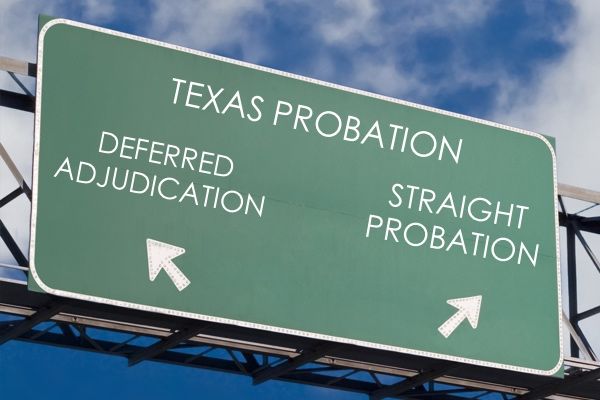
Difference in Deferred Adjudication Straight Probation in Texas

What is the Difference Between Deferred Adjudication and Straight Probation?

By Jason H. Howard · Criminal Defense

Probation in Texas: Make Sure You are Headed Down the Right Path. What is Deferred Adjudication?

Difference in Deferred Adjudication Straight Probation in TexasWhen we are counseling new clients, we routinely address the punishment range that is available for the charged offense and whether probation is an option in their case.  It is important to note that all criminal offenses (except class C citations) are punishable by incarceration. However, first-time offenders and those charged with misdemeanors and non-aggravated felonies will often receive probation when prosecutors, judges, and juries agree that community supervision (probation) is a better alternative to jail time in the given situation.  For some offenses, however, probation is not an option (see our previous article on 3g offenses in Texas).

For those of you that prefer the bullet points up front, here is the short answer regarding the difference between straight probation and deferred adjudication:

Straight Probation in Texas

  • A person on Straight Probation in Texas must report to probation and complete required terms as set by the judge
  • In a straight probation, the case results in a Criminal Conviction
  • In straight probation, there is no option have the case expunged or non-disclosed upon completion of probation
  • If revoked on a straight probation, the penalty range is limited to the underlying jail term (see more below).

Deferred Adjudication in Texas

  • A person on Deferred Adjudication in Texas must report to probation and complete required terms as set by the judge
  • A Deferred Adjudication Case Does NOT result in a Criminal Conviction
  • In a Deferred Adjudication in Texas, there is an option to have the case non-disclosed upon completion (in most cases)
  • Under a Deferred Adjudication, If revoked, the judge may sentence anywhere in the full punishment range for the offense.

Deferred Adjudication vs. Straight Probation

In Texas, there are two types of community supervision in criminal cases: regular community supervision (or what is typically referred to as “straight probation”) and deferred adjudication (or “deferred probation.”) The difference between them is significant.  Chapter 42.12 of the Texas Code of Criminal Procedure covers with both types of probation in Texas.

Straight Probation in Texas

Let’s discuss straight probation first. As an example, assume someone is facing a charge for a Class A Misdemeanor. The penalty range is 0-365 days in jail. A straight probation offer from the state might look like this:

180 days in jail probated for 12 months.

If you agree to this offer and decide to take it, at the time of the plea the judge would ask for your plea of guilty, find you guilty and assess punishment at 180 days in jail. However, he would not require you to actually serve the jail time. Rather, he would probate the jail time and place you on community supervision for a period of 12 months. If you successfully complete the straight probation by reporting as directed and abiding by the terms and conditions, you would not be required to serve jail time for the conviction.

Straight Probation Comes With a Criminal Conviction

With straight probation, the most significant consequence is the conviction itself. When you plead guilty, the judge finds you guilty and a conviction is rendered. You avoid jail time by the sentence being probated, but the conviction remains on your record. A conviction, even if probation, can never be expunged from your record (regardless of the passage of time), so it is important to be wise with your decision to take a plea agreement in which straight probation is offered.

If you receive straight probation and fail to comply with the terms and conditions, the state can seek to have your probation revoked. At a revocation hearing or sentencing, the judge’s sentencing ability is limited by the underlying sentence received at the time of your original plea. So, in the above example, if you received a sentence for 180 days in jail probated for 12 months and are later revoked, the judge cannot sentence you beyond the 180 days (even though the penalty range for a class A misdemeanor is up to 365 days.)

Deferred Adjudication in Texas

Chapter 42.12 section 5 offers a different type of probation than the straight probation discussed above. It’s called deferred adjudication. Let’s go back to our example and say your facing a Class A Misdemeanor with a penalty range of 0-365 days. A deferred adjudication offer might look like this:

18 months probation

If you agree to this offer, you would plead guilty at the time of the plea. However, the judge would withhold finding you guilty and instead place you on probation for a period of 18 months. The reporting and terms and conditions would mirror those of a straight probation. If you successfully complete the probation and are discharged, you would not be required to serve jail time and you would not receive a criminal conviction.

Deferred Adjudication Does Not Come With a Criminal Conviction

With deferred adjudication, the most significant benefit is the case is dismissed upon discharge and no conviction rendered. You not only avoid jail time, but a conviction as well. You also may be eligible to file for a non-disclosure after discharge in most cases. Section 411.081 of the Texas Government Code is the law covering when and if you can file for a non-disclosure after discharge from deferred adjudication.

As with straight probation, if you receive deferred adjudication and fail to comply with the terms and conditions, the state can seek to have your probation revoked. However, there are some significant distinctions at a revocation hearing or sentencing on a deferred adjudication case. First, the judge’s sentencing ability is unlimited. This means he can use the entire penalty range. In our example, if you receive deferred adjudication for 18 months for a class A misdemeanor and are later revoked, the judge can sentence you anywhere in the penalty range of 0- 365 days. Also and more importantly, if revoked, the judge will find you guilty resulting in a conviction.

Contact Our Fort Worth Criminal Defense Firm if You Have Questions About Deferred Adjudication or Straight Probation in Texas

This was a rough overview of the different types of probation in Texas on criminal cases. Of course, there are always factors that can effect if and which type of probation is available as an option to you. The attorneys at Barnett Howard & Williams PLLC would be glad to discuss your situation and provide more information about these options. Please feel free to give us a call at (817) 993-9249.

NOTE:
→ DWI offenses are not eligible for deferred adjudication in Texas. If you’d like to see that changed, contact your state representatives’ offices and voice your opinion

Read full article

Speak with a Fort Worth attorney

Call (817) 993-9249 or send us a message to discuss your case.