
Skip to content
Tag

Fort Worth Criminal Defense

Page 14 of 17 · 81 articles

The World Needs More Andy Taylors

By Brandon Barnett · Domestic Violence

I grew up with Sheriff Andy Taylor. And his trusty sidekick Deputy Barney Fife. If you've never seen the Andy Griffith Show, shame on you. It is an American classic about life in the small rural town of Mayberry, North Carolina. I would venture to say I've seen every episode (the black & white ones) at least four times each (syndicated reruns of course, because the show originally aired in the '60s).

One of the things I loved about Sheriff Andy Taylor was his innate sense of right and wrong. While Barney Fife was out there trying to arrest jaywalkers and moonshiners and everyone else who broke a minor municipal code, Andy saw the big picture. Andy may have very well been justified to make arrests or detain citizens for investigation, but he was more concerned with what was right and decent. And when he suspected or observed actual criminal activity he took action.

As criminal defense lawyers in Fort Worth, Texas, we read police reports every single day. In many of the police reports we read, the officer's actions are more akin to Barney Fife than Andy Taylor. I get the feeling that many officers have the mindset of "arrest everybody and let the DA sort it out." When officers are called out on a family assault or domestic violence call, somebody is getting arrested. Period. The officers don't try to deescalate the situation or truly figure out what the couple needs. They generally listen to the parties and arrest the one that has fewer injuries (regardless of which person may have called the police).

We've also seen numerous arrests of young people for committing youthful hijinks, such as trespassing on school property. Sheriff Taylor would have taken the kid home and made him tell his parents what he was doing. He wouldn't arrest the kid. But officers in DFW are making arrests in these scenarios.

Of course, we only see the cases where there are arrests. There may indeed be officers out there that are getting it right. But, we still see too many arrests when something less would have achieved the right result. Don't get me wrong.  We're not against law and order. We are champions of justice, and justice does not always mean arrest and prosecution. Perhaps the police academy training should begin with a rerun of The Andy Griffith Show. Personally, I recommend the episode where the cow thief was putting shoes on the cows.
Read full article
Sharen Wilson Tarrant County District Attorney

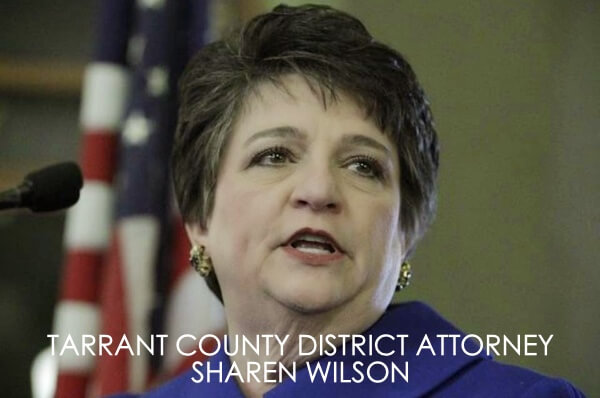
Tarrant County District Attorney Sharen Wilson Oversees all Fort Worth Prosecutors

By Brandon Barnett · Criminal Defense

Tarrant County District Attorney Sharen Wilson

Sharen Wilson Tarrant County District Attorney

Sharen Wilson, who took office in 2015, is the elected Tarrant County District Attorney. She is the top of all Fort Worth prosecutors, managing a large office of Assistant District Attorneys, investigators, support staff, and even a therapy dog.  Prior to assuming her new role as the Tarrant County District Attorney, Sharen Wilson presided over Criminal District Court Number 1 as a District Judge.  Her office receives cases from the various police departments across Tarrant County, investigates the cases, and files misdemeanor or felony criminal cases.  The Assistant District Attorneys under Sharen Wilson present cases to grand juries and manage dockets in the 20 Tarrant County criminal courts and the Courts of Appeals.  If you are interested in observing a criminal trial in Tarrant County, check out the Tarrant County Trial Board for a list of cases each week.

Fort Worth Prosecutors | Tarrant County DA

The Tarrant County District Attorney office has over 150 Fort Worth prosecutors and over 50 investigators. The office has a budget of $38 million dedicated to criminal prosecutions and investigations in Tarrant County.  Colloquially, every Assistant District Attorney is referred to as a "Tarrant County DA" or "prosecutor," but the ultimate authority over criminal prosecutions is retained by Sharen Wilson.  Fort Worth prosecutors are known across the state as fair and collegial attorneys.  They have a reputation for taking a fair look at each case and providing all available information to the defense bar in a timely manner.  Although the Tarrant County District Attorney office is one of the largest in the state, in one of the largest counties in the state, the office and its staff carry themselves with small-town values.  While each criminal case is different and may have its own challenges, our criminal defense attorneys have always been satisfied with the professionalism of the Tarrant County DA office.

Free Consultation of Tarrant County Criminal Cases

Our Fort Worth criminal defense attorneys square off every day with the Tarrant County DA office. We have a proven track record of favorable results for our clients. We understand that every case and every client are different. We take a personal approach to every client and pursue every option to address our clients' individual needs. For a FREE consultation of your Tarrant County criminal case, contact our team at (817) 993-9249.

Read full article

Search & Seizure: Officer's Mistake of Law

By Brandon Barnett · Search & Seizure

United States Supreme Court | Search and Seizure Update

We expect that police officers know the law.  After all, they are charged with upholding the law.  But what happens when an officer makes a traffic stop based on an incorrect understanding of the law and then finds evidence of another crime during his improper stop?  The Supreme Court recently considered this scenario in the case outlined below:

In Heien v. North Carolina, a North Carolina police officer stopped a man for driving with one broken brake light.  The driver later gave consent to the officer to search his vehicle. The officer discovered cocaine charged the driver with trafficking cocaine. The driver argued that the officer made a mistake of law for stopping him on one faulty brake light and not two (which is what NC law requires) therefore evidence should be suppressed.  The NC vehicle code makes clear that the officer was mistaken when making the traffic stop.

The Supreme Court granted cert to review the case and the question of whether an officer who makes a mistake of law still gives rise to reasonable suspicion. They Court ruled that the officer's mistake of law was objectively reasonable and that ultimately, the Officer had reasonable suspicion to conduct the traffic stop.  In so holding, Chief Justice Roberts wrote "The Fourth Amendment requires government officials to act reasonably, not perfectly, and gives those officials 'fair leeway for enforcing the law.'"

While not dealing with specific state law in Texas, the ruling in this case did address reasonable suspicion as it relates to unreasonable searches prohibited by the 4th Amendment.  Article 38.23 of the Texas Code of Criminal Procedure states:

No evidence obtained by an officer or other person in violation of any provisions of the Constitution or laws of the State of Texas, or of the Constitution or laws of the United States of America, shall be admitted in evidence against the accused on the trial of any criminal case.

While Article 38.23 of the Texas Code of Criminal Procedure provides an exception if an officer is acting in objective good faith reliance on a warrant, it does not give a reasonable suspicion exception to conduct a search.  Clearly, the Heien opinion will be cited by the State to support searches even when the initial stop is conducted illegally.  We will just have to wait and see how our Texas Courts will react in light of Heien v. North Carolina.

Read full article

Our Greatest Achievement

By Brandon Barnett · Criminal Defense

We were asked this week to name our law firm's greatest achievement.  Hmm... We've experienced quite a few successes over the past several years; acquittals, dismissals, no bills.  We've built strong relationships with people in the Fort Worth community.  We've been fortunate enough to help many clients.  But our greatest achievement...

After some thought, we knew our greatest achievement.

Our greatest achievement is the warm hug or firm handshake of a grateful client.

Just the other day we completed a criminal case in Tarrant County where the client's parents had come to court to watch.  After the case was over we had a chance to speak with the parents in the hallway of the courthouse.  Our client's mother was so thankful and through her tears asked if she could give us a hug.  That was the biggest compliment we could ever receive.  It was the overflow of her heart and in that moment, we knew we had made a difference in their lives.

We absolutely love what we do.  We get to help real people.  We are thankful for the opportunities to be a blessing.  We know that it is no accident when a client walks into our office.  Praise God for His plans and His purposes.

Read full article

US Supreme Court Decides Restitution Issue in Child Pornography Case

By Brandon Barnett · Computer Crimes

In any criminal case involving sexual exploitation of a child in the making, possessing, or distributing of child pornography, there is an issue of restitution to consider.  More specifically, if the child suffered monetary damages, who is responsible to pay restitution to the child to make him/her whole?  Is it the person that created the images, the person that distributed them on the internet, the end user that downloads and possesses the images, or everyone?  The courts were split on this issue.   Some held that every person along the way should pay their share of the damages.   Other courts held that each person is responsible for the total damages.

The Supreme Court has now weighed in the issue and has held that every offender is liable for their share of the damages, not more.   Below is the synopsis of the case wherein the Supreme Court considered this issue.

Issue: Is a person who was convicted of possession of child pornography liable to pay full restitution to the victim (the child subject) or should the court limit damages to only that which was proximately caused by the convicted person's actual role in the exploitation?

Paroline v. United States, 134 S. Ct. 1710 (2014)- Petitioner Randall Paroline pled guilty to possessing 150 to 300 images of child pornography, including two images of a girl named "Amy" being abused by her uncle at the age of eight or nine years old.  Amy's uncle took a number of photographs depicting her in sexually abusive poses, and distributed the materials over the Internet.   However, Amy first learned that images of her abuse were being trafficked on the Internet when she was 17.  This new information caused renewed trauma from the events that took place when she was a young girl and it made it difficult for her to recover from the abuse.

Amy then sought restitution under 18 U.S.C. §2259 from Paroline even though he was not the originator of the pictures. Paroline argued that a victim's damages must be proximately caused by the defendant's conduct because any other result would turn child exploitation restitution proceedings into a procedural nightmare. Amy argued that §2259 did not require proximate causation for a victim to be entitled to full damages; otherwise, the victims of child abuse would bear the burden of collecting tiny shares of restitution from several defendants and might never receive full recovery.

The District Court declined to award restitution because the Government had failed to meet its burden of proving what losses, if any, were proximately caused by the Paroline's offense. The Fifth Circuit held that §2259 did not limit restitution to losses proximately caused by the defendant, and each defendant who possessed the victim's images should be made liable for the victim's entire losses from the trade in her images, even though other offenders played a role in causing those losses.

The Supreme Court vacated and remanded the Fifth Circuit's decision and held that restitution is proper under §2259 only to the extent the defendant's offense proximately caused a victim's losses. Victims should be compensated and defendants should be held accountable for the impact of their conduct on those victims, but defendants should only be made liable for the consequences and gravity of their own conduct, not the conduct of others. Where it can be shown both that a defendant possessed a victim's images and that a victim has outstanding losses caused by the continuing traffic in those images but where it is impossible to trace a particular amount of those losses to the individual defendant by recourse to a more traditional causal inquiry, a court applying §2259 should order restitution in an amount that comports with the defendant's relative role in the causal process that underlies the victim's general losses. Therefore, in determining the proper amount of restitution, a court must assess as best it can from available evidence the significance of the individual defendant's conduct in light of the broader causal process that produced the victim's losses.

In short: each defendant pays his or her fair share of the victim's losses in a child pornography matter.

Read full article

Speak with a Fort Worth attorney

Call (817) 993-9249 or send us a message to discuss your case.