Short answer: If you were hurt on an electric scooter in Dallas-Fort Worth because a driver, property owner, or city was negligent, you can generally bring a Texas personal injury claim. You can recover as long as you were not more than 50 percent responsible, and your recovery is reduced by your share of fault. Texas law treats a motor-assisted scooter much like a bicycle, not a motor vehicle. Where you were allowed to ride, whether city rules were followed, and which insurance applies often decide these cases. Claims against a city can require written notice within six months or less, and most lawsuits must be filed within two years.
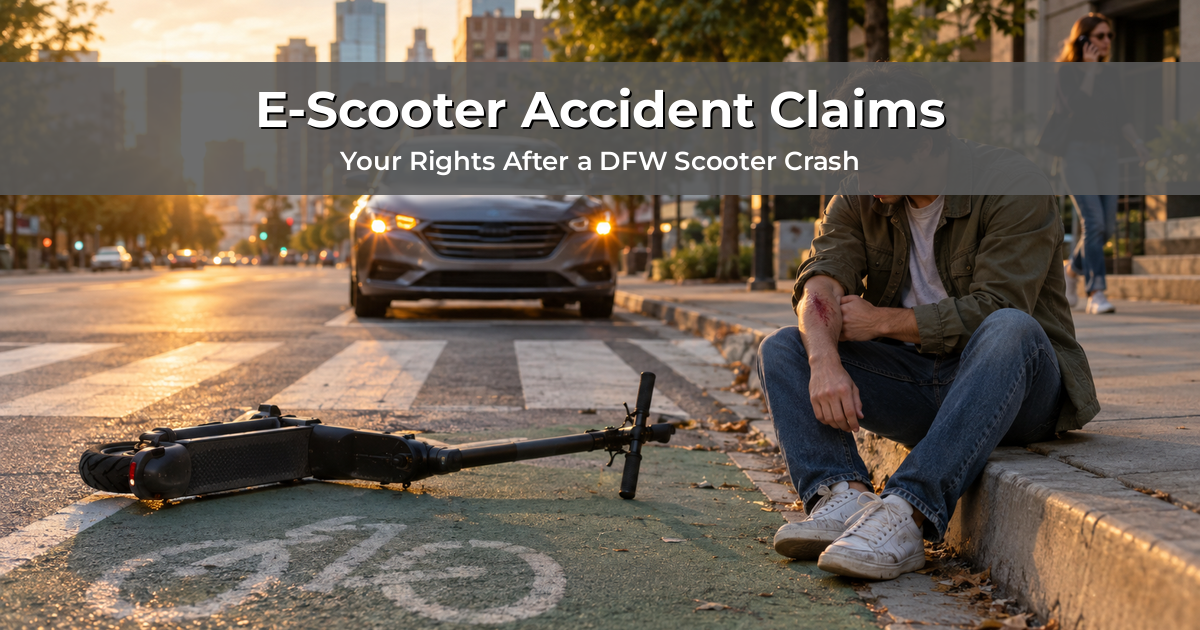
Electric scooters are now part of daily traffic in Deep Ellum, downtown Fort Worth, Arlington's entertainment district, and college areas across the Metroplex. They are convenient, but a rider has almost no protection in a collision with a car or a fall caused by a pothole. The legal rules are also less familiar than those for a typical car wreck.
At Howard Lotspeich Alexander & Williams, PLLC (HLAW), our Fort Worth trial lawyers handle personal injury claims across Tarrant, Dallas, Denton, Collin, Johnson, and Parker counties. This guide explains how Texas law applies to e-scooter crashes, who may be responsible, and what to do to protect a claim.
Key Takeaways
- Scooters follow bicycle rules, not motor vehicle rules. Under Texas Transportation Code §551.352, bicycle provisions generally apply to a motor-assisted scooter, and "a provision of this title applicable to a motor vehicle does not apply to a motor-assisted scooter" (Tex. Transp. Code §551.352).
- State law limits scooters to streets with posted speed limits of 35 mph or less, though riders may cross faster roads at intersections. Cities can add their own restrictions.
- Dallas bans sidewalk riding. The City of Dallas says scooters "may not be ridden on or in: sidewalks, trails, parks, plazas, on roads with a speed limit of 35 MPH or higher," with a 20 mph citywide speed limit (City of Dallas).
- Fault is shared under the 51 percent bar. A claimant "may not recover damages if his percentage of responsibility is greater than 50 percent," and any recovery is reduced by the claimant's percentage (Tex. Civ. Prac. & Rem. Code ch. 33).
- Claims against a city have short notice deadlines. The Texas Tort Claims Act requires notice within six months, and city charters can set shorter periods (Tex. Civ. Prac. & Rem. Code §101.101).
- Injuries are rising nationally. The CPSC estimates 380,000 emergency department visits involving e-scooters from 2017 through 2024 (CPSC micromobility report).
What Does Texas Law Say About Electric Scooters?
Texas regulates motor-assisted scooters in Chapter 551 of the Transportation Code. A "motor-assisted scooter" is a self-propelled device with at least two wheels, a braking system, a gas or electric motor, a deck designed for the rider to stand or sit, and "the ability to be propelled by human power alone" (Tex. Transp. Code §551.351). Most rental and privately owned stand-up e-scooters in DFW fall into this category.
The key operating rules are in §551.352 (Tex. Transp. Code §551.352):
- A scooter "may be operated only on a street or highway for which the posted speed limit is 35 miles per hour or less," but may cross a faster road at an intersection.
- A person may ride "on a path set aside for the exclusive operation of bicycles or on a sidewalk," unless a city or county prohibits it.
- A county or city may prohibit scooters on a street, highway, or sidewalk "in the interest of safety."
- Rules for bicycles generally apply to scooters, while rules for motor vehicles do not.
That last point matters in an injury case. A scooter rider generally has the rights and duties of a bicyclist on the road. Drivers owe scooter riders the same care they owe cyclists. For more on those rules, see our guide to bicycle accident claims in DFW.
How Do Dallas and Fort Worth Rules Differ?
Local rules vary across the Metroplex, and they can affect both safety and fault.
| Issue | Texas state law | City of Dallas | City of Fort Worth |
|---|---|---|---|
| Sidewalk riding | Allowed unless a city or county prohibits it | Not allowed, except to start or end a ride | Generally follows state law; riders may use sidewalks and paths unless posted otherwise |
| Road speed limit | Streets posted 35 mph or less | Not on roads posted 35 mph or higher | Streets posted 35 mph or less |
| Scooter speed | No speed cap stated in §551.352 | 20 mph citywide; 10 mph in slow-ride zones | City code does not directly address e-scooters |
| Rental age | Not addressed in §551.352 | No rentals to people under 16 | City code does not directly address e-scooters |
Sources: Tex. Transp. Code §551.352; City of Dallas Dockless Vehicle Program; Fort Worth Star-Telegram; Government Technology.
In Dallas, the city also lists no-ride zones, including parks, plazas, and most trails, and says riders who break the rules can be fined up to $200 under Section 28-41.1.1 of the Dallas City Code (City of Dallas). The Fort Worth Star-Telegram reported that Fort Worth police say e-scooters "can be ridden on bike paths and sidewalks, but they are restricted to streets with a posted speed limit of 35 mph or less" (Star-Telegram). Arlington, Denton, Plano, Irving, and other cities have their own rules, so the location of a crash matters.
Who Is Liable for an E-Scooter Accident in Texas?
Most scooter injury claims fall into one of four categories.
A driver who hit the rider
The most serious scooter injuries often involve cars. CPSC staff have reported that "the top hazards in e-scooter and e-bike fatalities were incidents with motor vehicles and user-control issues" (CPSC). Common scenarios include right hooks at intersections, left turns across a bike lane, drivers opening doors into a rider's path, and drivers backing out of driveways or parking spaces. A claim against the driver is a negligence claim, usually paid through the driver's liability insurance.
A property owner or business
Falls on private property, such as a parking garage, apartment complex, or shopping center, may involve premises liability if a dangerous condition caused the crash. Our article on parking lot and sidewalk injuries in Texas explains how those claims work.
A city or other government entity
Potholes, broken pavement, missing signs, and road construction can cause serious scooter falls. Claims against a city fall under the Texas Tort Claims Act, which has special rules. For a premise defect, the government generally owes only the duty a private person owes a licensee, but that limit does not apply to the duty to warn of "special defects such as excavations or obstructions on highways, roads, or streets" (Tex. Civ. Prac. & Rem. Code §101.022). The Act also caps a city's liability at $250,000 per person for bodily injury. If a city vehicle hit you, see our guide to government vehicle accident claims in DFW.
The scooter company or manufacturer
Brake failures, throttle malfunctions, battery fires, and other defects can support a product liability or negligence claim against a manufacturer or operator. Rental apps usually require riders to accept terms of service, which may include arbitration clauses or liability waivers. Whether those terms are enforceable depends on their wording and the facts, so they should be reviewed before you assume a claim is barred.
Can You Recover if You Were Partly at Fault?
Often, yes. Texas uses proportionate responsibility. Under Civil Practice and Remedies Code §33.001, a claimant "may not recover damages if his percentage of responsibility is greater than 50 percent." If you are 50 percent or less at fault, §33.012 reduces your damages by your percentage of responsibility (Tex. Civ. Prac. & Rem. Code ch. 33).
Insurers often argue that a scooter rider was at fault for riding on a Dallas sidewalk, riding on a road posted above 35 mph, riding at night without lights, carrying a passenger, or wearing headphones. These facts can reduce a claim, but they do not automatically defeat it. A driver who runs a red light or turns into a rider's path still bears responsibility. Our guide to how fault works in Texas personal injury cases explains how juries allocate responsibility.
What Insurance Pays for a Scooter Accident?
Insurance in a scooter case can come from several sources:
- The at-fault driver's liability coverage. Texas requires minimum limits of $30,000 per person for bodily injury (Texas Department of Insurance).
- Your own auto policy. Personal injury protection (PIP) is defined by statute as coverage for the named insured, "members of the insured's household," and authorized operators or passengers of the insured's vehicle for medical expenses and lost income arising from an accident (Tex. Ins. Code §1952.151). Whether your policy covers a scooter crash depends on its specific language, so review it before assuming it does not apply.
- Uninsured/underinsured motorist coverage. If the driver who hit you had no insurance or not enough, your own UM/UIM coverage may help. See our guide to UM/UIM and PIP auto insurance.
- Health insurance. Health insurance may pay medical bills, but it may claim reimbursement from any settlement.
- Homeowner's, renter's, or business policies, in some cases involving private property or a commercial defendant.
If the driver left the scene, our article on hit-and-run crashes in Texas explains next steps.
What Should You Do After an E-Scooter Crash in DFW?
- Get medical care right away. CPSC reports that fractures, followed by contusions and abrasions, are the most common micromobility injuries, and that the head and neck are among the most frequently injured areas (CPSC). Some head injuries are not obvious at first.
- Call the police if a vehicle was involved or anyone was hurt, and ask for the report number.
- Photograph everything: the scooter, the vehicle, the road surface, the lane markings, posted speed limit signs, and your injuries.
- Screenshot the rental app. Save the ride history, the start and end times, and the route. Rental companies may keep GPS and speed data that can show where and how fast you were riding.
- Keep the scooter if you own it, and do not repair it. If it was a rental, report the crash to the operator in writing and ask them to preserve the device and its data.
- Collect witness names and look for cameras. Businesses, buses, and doorbell cameras often capture crashes, but footage may be overwritten quickly.
- Be careful with insurance adjusters. Do not give a recorded statement about fault before you understand your rights.
- Note the deadlines. Notice to a city may be due within six months or less, and most personal injury lawsuits must be filed within two years. See our guide to the Texas statute of limitations.
What Compensation Is Available After a Scooter Injury?
Depending on the facts, a scooter rider may seek medical expenses, lost wages and loss of earning capacity, physical pain and mental anguish, physical impairment, disfigurement, and property damage. Because riders have little protection, scooter crashes can cause broken wrists and arms, facial injuries, dental injuries, and traumatic brain injuries. These injuries can require surgery and long recovery periods.
Frequently Asked Questions
Is it legal to ride an electric scooter on the sidewalk in Texas?
State law allows scooters on sidewalks and bike paths, but cities can prohibit sidewalk riding. Dallas prohibits riding scooters on sidewalks except to start or end a ride. Fort Worth police have said scooters can be ridden on sidewalks and bike paths. Check the rules for the city where you are riding.
Can I sue if a car hit me while I was riding a rental scooter?
Generally, yes. A driver who causes a crash through negligence, such as failing to yield or turning into a bike lane, can be held responsible. The claim usually goes through the driver's liability insurance. Your own fault, if any, can reduce the recovery under Texas's proportionate responsibility rules.
Does a scooter rental waiver stop me from suing?
Not necessarily. A rental company's terms may limit claims against the company, and some require arbitration. Those terms generally do not protect a negligent driver or property owner who is not a party to the agreement. Whether a waiver applies to a claim against the company depends on its language and the facts.
What if a pothole caused my scooter crash?
You may have a claim against the city or other government entity responsible for the road, but the Texas Tort Claims Act limits these claims. You must give notice within six months, or less under some city charters, and there are damage caps and special rules for road defects.
Do I need to wear a helmet on an e-scooter in Texas?
The state scooter statute, §551.352, does not include a helmet requirement. Some cities set their own rules for children; for example, a Dallas ordinance makes it an offense for a parent to allow a child to ride a scooter without a helmet (Dallas Ordinance 20-0468). Not wearing a helmet may be raised by an insurer, but it does not by itself bar a claim against a negligent driver.
How long do I have to file a scooter accident claim in Texas?
Most personal injury lawsuits must be filed within two years. Claims against a government entity require much earlier notice, often within six months. It is best to talk to a lawyer as soon as possible.
Talk to a Fort Worth Scooter Accident Lawyer
If you or a family member was hurt in an electric scooter crash in Dallas-Fort Worth, HLAW can help you identify who was responsible, which insurance applies, and which deadlines matter.
Call HLAW at (817) 993-9249 or contact us online for a free consultation.
This article is for general informational purposes only and is not legal advice. Reading it does not create an attorney-client relationship. Laws change, and every case depends on its specific facts.