Short answer: In Texas, if another driver caused your wreck, you can generally seek diminished value from that driver's liability insurance. Diminished value is the loss in your car's market value even after it is fully repaired. Your own insurance policy is different. The Texas Supreme Court held in 2003 that the standard Texas personal auto policy does not require your insurer to pay diminished value when the car is fully and adequately repaired. Texas law also allows loss-of-use damages, such as a rental car, even when a vehicle is totaled. A property damage lawsuit generally must be filed within two years.
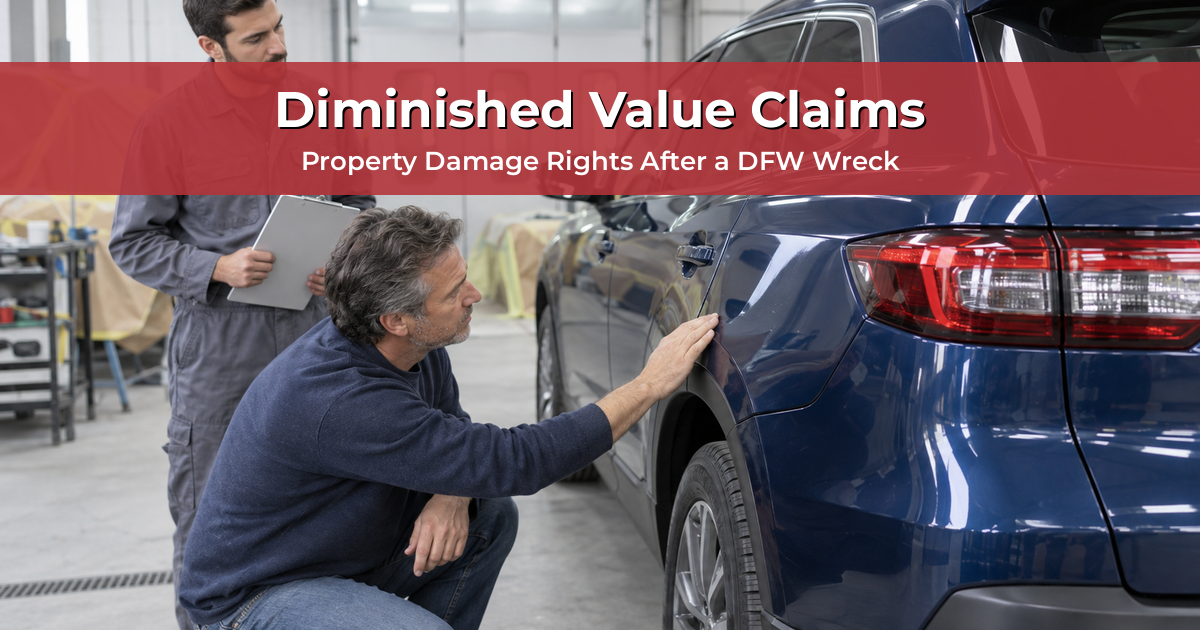
After a wreck on I-30, I-35W, or Highway 121, most people in Dallas-Fort Worth focus on getting the car repaired and back on the road. But a vehicle with an accident history often sells or trades in for less than an identical car that was never damaged, even when the repair is excellent. That gap is real money, and many people never ask for it.
At Howard Lotspeich Alexander & Williams, PLLC (HLAW), our Fort Worth trial lawyers handle car wreck and personal injury claims throughout Tarrant, Dallas, Denton, Collin, Johnson, and Parker counties. This guide explains what Texas law allows you to recover for damage to your vehicle, and how to document a diminished value and loss-of-use claim.
Key Takeaways
- Third-party diminished value claims are allowed in Texas. The Texas Department of Insurance has stated that an insurer "may be obligated to pay a third party claimant for any loss of market value of the claimant's automobile, regardless of the completeness of the repair" (TDI Bulletin B-0027-00).
- Your own collision coverage generally does not pay diminished value. In American Manufacturers Mutual Insurance Co. v. Schaefer, 124 S.W.3d 154 (Tex. 2003), the Texas Supreme Court held the standard policy "does not require payment for diminished value when a vehicle has been fully and adequately repaired" (Schaefer opinion).
- UM/UIM coverage may be different. TDI's bulletin says an insurer may be obligated to pay its own policyholder for loss of market value under uninsured/underinsured motorist coverage, "regardless of the completeness of the repair."
- Loss-of-use damages are recoverable even for a totaled car. The Texas Supreme Court held in 2016 that an owner of totally destroyed property "may recover loss-of-use damages in addition to the fair market value of the property immediately before the injury" (J&D Towing v. American Alternative Insurance Corp.).
- You choose the body shop. An insurer settling a third-party property damage claim "may not require the third-party claimant to have repairs made by a particular repair person or facility" (Texas Insurance Code §1952.301).
- The deadline is two years. Suits for injury to property generally must be filed within two years (Tex. Civ. Prac. & Rem. Code §16.003).
What Is Diminished Value?
Diminished value is the difference between what your vehicle was worth immediately before the wreck and what it is worth after repairs. Buyers and dealers often pay less for a vehicle with a reported accident, especially one with structural or frame damage, airbag deployment, or major body work.
There are generally three ways people describe it:
- Inherent diminished value: the loss in market value caused by the accident history itself, even after a complete and proper repair. This is the most common type of claim.
- Repair-related diminished value: additional lost value caused by poor or incomplete repairs, such as mismatched paint or parts that do not fit correctly.
- Immediate diminished value: the drop in value right after the crash, before repairs. This mostly matters in calculating a total loss or a settlement before repair.
Texas courts have long measured damage to personal property using market value. When property is partially damaged, the general rule is "the difference in the market value immediately before and immediately after the injury to such property at the place where the damage was occasioned," as the Texas Supreme Court summarized in J&D Towing (opinion).
Who Pays Diminished Value in Texas?
Who pays depends on whose insurance you are claiming against.
| Type of claim | Is diminished value available? | Source |
|---|---|---|
| Claim against the at-fault driver's liability insurance (third-party claim) | Generally yes, regardless of the completeness of the repair | TDI Bulletin B-0027-00 |
| Claim under your own collision or comprehensive coverage (first-party claim) | Generally no, when the car is fully and adequately repaired | Schaefer (Tex. 2003) |
| Claim under your own UM/UIM coverage when the at-fault driver is uninsured or underinsured | May be available, regardless of the completeness of the repair | TDI Bulletin B-0027-00 |
Why your own collision coverage usually will not pay
In Schaefer, the policyholder's car was repaired and he did not dispute the quality of the repairs, but he claimed it was still worth $2,600 less. The Texas Supreme Court looked at the policy's "Limit of Liability" language, which caps the insurer's obligation at the lesser of the vehicle's actual cash value or the amount needed "to repair or replace" it. The court held that "repair" connotes "something tangible, like removing dents or fixing parts," and does not include compensation for "the market's perception that a damaged but fully and adequately repaired vehicle has an intrinsic value less than that of a never-damaged car" (Schaefer opinion).
The court left open other situations. It noted that if repairs were faulty, incomplete, or inadequate, the insurer might be liable for breaching its obligations under the policy. TDI's bulletin similarly says loss of market value can still be used to settle a dispute where a vehicle "was repaired properly but the vehicle still does not function as it did before the accident."
Why the at-fault driver's insurer is different
A claim against the at-fault driver is not a contract claim under your policy. It is a negligence claim, and the at-fault driver is responsible for the full harm caused to your property. That is why TDI's position is that a liability insurer may owe a third-party claimant for loss of market value "regardless of the completeness of the repair." In practice, many adjusters will not offer diminished value unless you ask for it and support it with evidence.
If you are still sorting out who caused the crash, our guide to how fault works in Texas personal injury cases explains the comparative fault rules that also apply to property damage.
Can You Get Paid for a Rental Car or Loss of Use?
Yes. Loss-of-use damages compensate you for the time you cannot use your vehicle. They are often measured by the reasonable cost of a comparable rental, or by lost income for a work vehicle.
For years, many Texas courts said loss-of-use damages were available only when a vehicle could be repaired, not when it was totaled. The Texas Supreme Court rejected that rule in J&D Towing, LLC v. American Alternative Insurance Corp., 478 S.W.3d 649 (Tex. 2016). The court held that "the owner of personal property that has been totally destroyed may recover loss-of-use damages in addition to the fair market value of the property immediately before the injury" (J&D Towing opinion).
The court also set limits. Loss-of-use damages must be foreseeable and directly traceable to the wreck, they cannot be speculative, and a plaintiff may not recover them for a period longer than reasonably needed to repair or replace the vehicle. As the court put it, permitting these damages "is not a license for unrestrained raids on defendants' coffers."
TDI's auto insurance guide explains how this usually works in practice: if another driver caused the accident, that driver's insurance company will pay for you to rent a car for the time it believes is reasonable for repairs, and "if the company totals your car, it might stop paying for the rental a few days after telling you." Tell the adjuster about parts delays or newly discovered damage, because the company may extend the rental.
What If Your Car Is Totaled?
If the cost to repair is close to or more than the car's value, the insurer will usually declare it a total loss. In a total loss, the measure is generally the fair market value immediately before the wreck, plus reasonable loss-of-use damages under J&D Towing. TDI explains that insurers pay actual cash value, which reflects depreciation, so a 10-year-old car is valued as a 10-year-old used car (TDI auto insurance guide).
To push back on a low total-loss valuation, gather listings for comparable vehicles in the DFW market with similar year, mileage, trim, and options. Also gather records of recent upgrades, new tires, or major maintenance. If you want to keep the car, TDI notes that the insurer will subtract its salvage value from the settlement.
How Do You Prove a Diminished Value Claim?
Insurers rarely pay diminished value without documentation. The strongest claims usually include:
- The final repair invoice, showing the extent of the damage and the parts replaced. Structural, frame, or airbag repairs tend to support larger claims.
- Photos of the damage before repair, from multiple angles.
- A written appraisal from an independent vehicle appraiser who explains the pre-accident value, the post-repair value, and how the difference was calculated.
- Dealer statements or trade-in offers showing what dealers will pay for the vehicle now compared with a similar vehicle without accident history.
- The vehicle's history report, if it shows the accident.
- The police crash report, to establish fault. Our article on how to get and use a Texas car wreck police report explains the process.
Send a written demand to the at-fault driver's insurer with these documents, and keep copies of every communication. If the adjuster uses a formula that produces a very low number, ask how it was calculated and respond with your own evidence. Our guide to insurance adjuster tactics in Fort Worth covers common approaches insurers use.
Do You Have to Use the Insurance Company's Body Shop?
No. Texas law protects your choice. In settling a third-party property damage claim, an insurer "may not require the third-party claimant to have repairs made by a particular repair person or facility" or require particular parts (Texas Insurance Code §1952.301(b)). For your own policy, §1952.302 prohibits an insurer or adjuster from stating or suggesting that you "must use a specific repair person or facility" or one on a preferred list for the repair to be covered.
Choosing a shop that documents its work thoroughly can also help a later diminished value claim, because detailed repair records show exactly what was damaged and replaced.
What Are the Deadlines for a Property Damage Claim in Texas?
A lawsuit for injury to property generally must be filed within two years after the claim accrues (Tex. Civ. Prac. & Rem. Code §16.003). The same two-year period applies to personal injury claims from the same wreck. Claims against government entities can involve much shorter notice deadlines. Our guide to the Texas statute of limitations explains the exceptions.
Insurers also have deadlines. TDI explains that a company must acknowledge your claim within 15 days, accept or reject it within 15 business days after receiving everything it needs (with up to 45 more days if it explains why), and pay within five business days after agreeing to pay (TDI auto insurance guide).
Should You Settle Your Property Damage Claim Separately From Your Injury Claim?
Often, yes. Many people resolve the vehicle claim first so they can get back on the road, while their injury claim continues as medical treatment progresses. Before signing anything, read the release carefully. A property damage release should be limited to property damage and should not release bodily injury claims. If the at-fault driver has only minimum coverage, the property damage limit is $25,000 under Texas's 30/60/25 requirement (TDI), and your own UM/UIM coverage may need to fill the gap.
Frequently Asked Questions
Can I claim diminished value from my own insurance company in Texas?
Generally not under collision or comprehensive coverage when the car is fully and adequately repaired. The Texas Supreme Court held in Schaefer (2003) that the standard Texas personal auto policy does not require it. A claim under your UM/UIM coverage may be different, and disputes over faulty or incomplete repairs are treated differently.
How much is a diminished value claim worth?
It depends on the vehicle's age, mileage, pre-accident value, and the severity of the damage. Newer, higher-value vehicles with structural damage tend to lose the most value. An independent appraisal and dealer trade-in comparisons are the best evidence of the actual loss.
Does the at-fault driver's insurance have to pay for my rental car?
If the other driver caused the wreck, that driver's insurer typically pays for a rental for the time reasonably needed to repair the car. Under J&D Towing, loss-of-use damages are also available when a vehicle is totaled, but only for a reasonable period to replace it.
What if the repair shop did a bad job?
Poor or incomplete repairs can increase your loss. In a first-party claim, Schaefer noted that an insurer might be liable for breaching its policy obligations if repairs are faulty, incomplete, or inadequate. Document the problems with photos and a second shop's written evaluation.
Do I need a lawyer for a property damage claim?
Many vehicle-only claims are resolved without a lawyer. If you were also injured, if the insurer denies fault, or if the vehicle had high value or serious damage, a lawyer can help coordinate the property and injury claims and make sure a release does not give up more than it should.
How long do I have to file a diminished value claim in Texas?
A lawsuit generally must be filed within two years of the wreck under Civil Practice and Remedies Code §16.003. It is best to start the claim right away, while repair records and appraisals are fresh.
Talk to a Fort Worth Car Wreck Lawyer
If another driver damaged your vehicle and hurt you or your family, you may be entitled to more than the repair bill. That can include lost market value, loss of use, and compensation for your injuries.
Call HLAW at (817) 993-9249 or contact us online for a free consultation about your Dallas-Fort Worth car wreck claim.
This article is for general informational purposes only and is not legal advice. Reading it does not create an attorney-client relationship. Laws change, and every case depends on its specific facts.