


Skip to content
Tag

Texas Criminal Law Updates Archive | HLAW

Page 3 of 4 · 20 articles

Texas Police Protection Act

New Law To Increase Penalties for Violence Against Police Officers

By Brandon Barnett · Legislative Update, Police Violence

Texas Governor, Greg Abbott, Proposes Police Protection Act, Which Would Stiffen the Punishment for Violence Against Law Enforcement

Texas Police Protection ActOn Monday, Governor Greg Abbott called on both citizens and Texas lawmakers to get behind his proposed Police Protection Act in the 2017 legislative session. “While our state and the nation continue to mourn the heroes lost in Dallas, it is time for us to unite as Texans to say no more,” says Governor Abbott. The proposed legislation will strengthen penalties against those who are convicted of crimes where police officers are the target. Just this month alone, five Dallas police officers have been fatally shot and nine others injured when a shooter targeted police following a public demonstration. This past weekend, three Baton Rouge police officers were gunned down by a shooter who was also targeting law enforcement officers.

The purpose of the Police Protection Act (the “Act”) is to “make clear to anyone targeting law enforcement officials that their actions will be met with severe justice.” Under the proposed Act, Governor Abbott will extend hate crime protections to law enforcement officers, increase criminal penalties for any crime in which the victim is a law enforcement officer, whether or not the crime qualifies as a hate crime, and create a culture of respect for law enforcement by organizing a campaign to educate young Texans on the value that law enforcement officers bring to their communities, among other provisions. “At a time when law enforcement officers increasingly come under assault simply because of the job they hold, Texas must send a resolute message that the State will stand by the men and women who serve and protect our communities,” says Governor Abbott.

Governor Abbott’s proposed Act would make the police a protected class, where penalties for those perpetrating crimes against law enforcement would be increased incrementally. For example, assaults on police officers could be reclassified from Class C felonies to Class B felonies, and so on. Further, the Act will support efforts by Texas State Senator, John Coryn, and his proposed “Back the Blue Act,” which makes it a federal crime to kill, attempt to kill, or aspire to kill a police officer.

In recent weeks, lawmakers in other states have also made legislative provisions that protect police in the wake of the officer-targeted shootings. In North Carolina, Governor Pat McCrory signed a bill into law this week that makes dashcam video and bodycam footage exempt from public record, except under narrow sets of circumstances. In May, Louisiana Governor John Bel Edwards signed the “Blue Lives Matter” bill into law that makes an assault on veterans, police officers, emergency responders, and firefighters a possible hate crime. Louisianans convicted of misdemeanor hate crimes against officers will be fined $500 and face an additional sentence of up to six months.

In Texas, word of Governor Abbott’s proposed Act is already gaining favorable ground. Grimes County Sheriff Donald Sewell emphatically states, "The Sheriff's Association of Texas is very pleased to hear our Governor is behind an effort to protect peace officers across our state…and we support our Governor. We look forward to working with the Governor during the 2017 legislative session to pass these important protections." Dallas Police Association President, Rob Pinkston, echoes Sewell, saying “The Dallas Police Association applauds Governor Abbott’s bold plan in response to the recent wave of attacks on police officers.”

About the violence on law enforcement, Governor Abbott tweeted, “Texas is saying no more,” and, “We must unite and strengthen our commitment to protect law enforcement.” Ray Hunt, President of the Houston Police Officer’s Association says, “Governor Abbott’s solution is the right approach for Texas law enforcement officers and the people of Texas who support them.” Texas lawmakers will review the Police Protection Act in the 2017 legislative session, which begins January 10, 2017.



Read full article
Texas Campus Carry

Explaining the New Campus Carry Law in Texas

By Brandon Barnett · Open Carry

What is the New Campus Carry Law in Texas and What Does it Mean to Me?

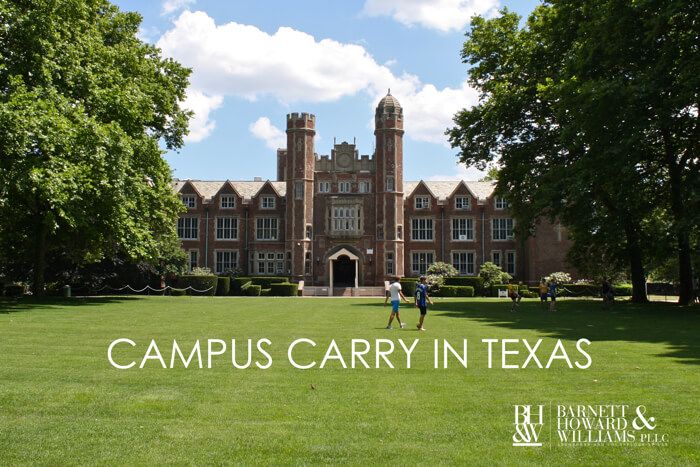
Texas Campus CarryWhether you love it or hate it, Campus Carry is coming to a college campus near you, and if you are a CHL holder, you need to know how to comply with the law. After lengthy debates in both houses of the Texas Legislature, Governor Greg Abbott signed Senate Bill 11 (“Campus Carry”) into Texas law on June 1, 2015. Campus Carry will go into effect on August 1, 2016 on the 50th anniversary of the University of Texas sniper shooting— one of the first mass murders on a college campus in the United States.

Who Can Carry a Handgun on a College Campus Under the Campus Carry Law?

Campus Carry permits all Concealed Handgun Licensees who are at least 21 years old, have passed state and federal criminal background checks, have successfully completed a firearms proficiency test and have completed Department of Public Safety-mandated training and education, to carry firearms inside of buildings belonging to public universities and some private institutions of higher education. The new legislation, however, does not mean open carry by anyone, anywhere, any time on all property owned by a public or private university. CHL licensees must take great care to research and to understand the limits of the Campus Carry law and how it impacts the way handguns are carried and stored, or potentially face legal consequences.

Can the Universities in Texas Make Their Own Rules With Campus Carry?

Campus Carry allows institutions of higher education to establish policies governing the storage of handguns by CHLs in dorms and residential facilities. Public universities may also create policies around athletic venues and events, deeming them off-limits to CHL licensees. Under current Texas law, bars, hospitals, churches, and public schools K-12 are off-limits to CHL licensees and will remain off-limits under Campus Carry—and it is important to note that most large public university systems have a teaching hospital, a K-12 practicum experience at public school, a chapel, or are near campus bars. Moreover, schools may create “no-gun zones” or “exclusion zones,” but must provide effective notice about such zones. Therefore, it is extremely important for those with a CHL to know exactly which areas are permitted to have handguns, which are not, and to make plan for storage it if the CHL licensee needs to go into an off-limits area. Students should carefully read their university’s Student Handbook and Campus Code of Conduct for more information.

Campus Carry removes criminal prohibitions in the Texas Penal Code on the possession of concealed handguns by concealed handgun licensees on the campuses. The new law provides institutions of higher education with immunity from liability for actions of CHLs on campus. Campus Carry mandates that an institution of higher education widely distribute the rules to the institution’s students, staff and faculty, including prominently publishing such provisions on the school’s website, and provide effective notice of the areas that are “exclusion zones.” Parents of college students may feel concerned with the new law and campus procedures.

The legislature granted rule-making authority to the presidents of the university system to create campus rules and policies pursuant to S.B. 11, with the only stipulation being that public institutions of higher learning may not “circumvent the intent” of Campus Carry by “imposing administrative bans and sanctions on CHLs on their campuses.” In order to comply with S.B.11, institutions of higher learning must submit a report every other year to the state legislature and to the standing committees that describe the campus rules and policies concerning CHL licensees and the schools must explain the reason the administration has established the provisions. Residents who live in college towns (even if they are not students) should also learn about Campus Carry and the implications of being a CHL at a campus library, sporting event, artistic venue, or even the university hospital.

This is no doubt a very interesting time for policy-making in Texas. Please note that this article is intended for informational purposes only and is subject to change as each public university system and private university determines campus policies based on S.B. 11. This article does not constitute or substitute legal advice. If you need legal advice, please contact our office at (817) 993-9249 for a free consultation.

For more information, see also the full Campus Carry Law, including a Bill Analysis and Fiscal Note or see our Frequently Asked Questions below.

Frequently Asked Questions About Texas Campus Carry


What is Campus Carry?

Campus Carry refers to legislation, Senate Bill 11, signed into law last summer. Campus Carry will make it possible for licensed gun owners, over 21, to carry handguns onto public (and some private) institutions of higher education, in compliance with individual university policies.


When will Campus Carry Take Effect?

Campus Carry will take effect on August 1, 2016—at the beginning of the 2016-2017 academic year.


Do I have to have a Concealed Handgun License (“CHL”) to carry my handgun?

Yes. Campus Carry mandates that all gun owners must:
(1) pass federal and state background checks;
(2) be 21 years old (unless in the military);
(3) complete a firearms proficiency test; and,
(4) complete Department of Public Safety-mandated training and education.

It will be extremely important for every student with a CHL, to know exactly where to go with your handgun and to plan for where you will be able to legally store it if you must go into an off-limits area. Read your Student Handbook and Campus Code of Conduct for more information.


Will Professors be able to carry guns?

Yes. Professors, administrators, faculty, staff and visitors may carry under the Campus Carry law, provided they are in compliance with the law and campus policies.


Does a private school have to follow Campus Carry?

Maybe. Private institutions may establish policies that prohibit CHLs. So far, the following schools have “opted out” of Campus Carry.

  • Rice University
  • Texas Christian University (TCU)

NOTE: This information is subject to change and it is up to each student, to know if your school has opted out.


Can a student at a public university take a gun anywhere on campus?

Not necessarily. Campus Carry allows institutions of higher education to establish policies governing the storage of handguns by CHLs in dorms and residential facilities. The public university may also create policies around athletic venues and events, as off-limits to CHLs. Under current Texas law, bars, hospitals, churches, and public schools K-12 are off-limits to CHLs and will remain off-limits under Campus Carry—and most large public university systems have a teaching hospital, a K-12 practicum experience at public school, a chapel, or are near campus bars. Schools may create “no-gun zones” or “exclusion zones,” but must provide effective notice about such zones.


Fort Worth Criminal Defense Attorneys

Barnett Howard & Williams PLLC is a criminal defense law firm located in Fort Worth, Texas. Our attorneys handle all felony and misdemeanor charges in the Fort Worth, Tarrant County area. If you have questions about this post or need more information about Campus Carry, please contact us at (817) 993-9249.

Read full article

Locked and Loaded: What You Need to Know About Texas’ New Open Carry Laws

By Brandon Barnett · Open Carry

Texans love their guns and many folks in Texas are excited about the new “Open Carry” laws that were passed this year. Some people imagine a wild west where handguns are worn on the hips of everyone in town. Other are terrified that gun-related incidents will increase. Well, the new open carry laws do not come without their rules.

With the passage of House Bill 910, beginning January 1, 2016, Texans in possession of a concealed carry license (CHL) will be allowed to openly carry a holstered handgun. While “open carry” sounds simple enough, there is much more to it. This article explains some of the rules that Texans need to know if they plan to openly carry a handgun in 2016.

Who is eligible to openly carry a handgun?

Only CHL holders may open carry. Subchapter H of Chapter 411 of the Texas Government Code sets out the basic requirements for a person to be eligible to apply for a handgun license and openly carry a firearm.

To open carry in Texas, a person MUST:

1) Be a legal resident of the State of Texas for the preceding six months before applying for his or her handgun license;
2) Be at least 21 years of age*;
3) Have never been convicted of a felony;
4) Not be charged with the commission of:
• Class A or B Misdemeanor or equivalent offense
• the offense of Disorderly Conduct or equivalent; or
• a felony offense;
5) Not be a fugitive from justice for a felony, Class A or B Misdemeanor or equivalent offense;
6) Not be a chemically dependent person;
7) Not be incapable of exercising sound judgment with respect to the proper use and storage of a handgun;
8) Have not, in the prior five years before applying, been convicted of a Class A or B Misdemeanor or equivalent offense or of the offense of Disorderly Conduct or equivalent offense;
9) Be fully qualified under applicable federal and state law to purchase a handgun;
10) Have not been finally determined to be delinquent in making child support payments or collected by the attorney general;
11) Have not been finally determined to be delinquent in the payment of taxes or other money collected by the State;
12) Not be currently restricted under a court protective order or subject to a restraining order affecting the spousal relationship, other than a restraining order solely affecting property interests;
13) Have not, in the 10 years preceding the date of application, been adjudicated as having engaged in delinquent conduct violating a penal law of the grade of felony; or
14) Have not made any material misrepresentation, or failed to disclose any material fact, in an application submitted pursuant to Section 411.174. (Perjury).

*The age restriction is lowered down to 18 for honorably discharged military veterans who meet all other qualifications.

What types of firearms can be openly carried in Texas?

Currently, under Texas Penal Code Section 46.03, a person cannot carry, either openly or by concealment, a handgun unless that person is on the person’s own premise or inside of a motor vehicle that is owned or under the person’s control (the weapon must still be concealed if carried in a vehicle under 46.03 (a-1)). There is no language in Texas Penal Code 46.03 regarding firearms other than handguns. Therefore, there are no laws prohibiting openly carrying rifles and shotguns (subject to the “where” restrictions to be addressed below). The exception to Texas Penal Code 46.03 is that the provision doesn’t apply to those in possession of a license issued under Subchapter H, Chapter 411 of the Texas Government Code.

In addition to carrying a concealed handgun under Subchapter H, the new House Bill 910 now grants the opportunity for Texans in possession of a concealed carry to openly carry a holstered “handgun.” A “handgun” is defined by Texas Penal Code 46.01 (5) as “any firearm that is designed, made or adapted to be fired by one hand.” Shotguns can be openly carried now in addition to holstered handguns as long as a person is in possession of a license granted under Subchapter H, Chapter 411 of the Texas Government Code.

How can handguns be openly carried?

Use a holster. Under Texas Penal Code 46.15(b) (6), a person carrying a valid CHL may carry a handgun either in a concealed manner or in a shoulder or belt holster. Under these new provisions, if the handgun is carried any other way, a person would be unlawfully carrying the handgun.

Where can handguns be openly carried?

In general, even if a person possesses a CHL, Texas Penal Code 46.03 strictly prohibits the carrying of a handgun or firearm from the following places:
1) School or educational institutions;
2) An election site during regular or early voting;
3) Government or court offices;
4) At a racetrack;
5) Airports (in the restricted section); or
6) Within 1,000 feet of premises of an execution site on the day of an execution.

In addition to the locations listed above, Texas Penal Code 30.06 prohibits individuals, and creates a criminal offense of trespass, for those who hold a license to carry a handgun when notified that their presence on the property with a handgun is expressly forbidden. To provide notice, a property owner must display written notice on the property that specifically complies with the notice requirements of Texas Penal Code 30.06.

With the new Open Carry law, those that wish to prohibit others from carrying a handgun on their premises, must also post a notice in accordance with section 30.07 of the Texas Penal Code.  This notice is in addition to the 30.06 sign.

Conclusion

The term “open carry” has been loosely thrown around as new legislation has been debated and ultimately passed regarding openly carrying handguns. It is important to remember that “open carry” isn’t a free-for-all regarding handguns. “Open Carry” is still highly regulated and a person considering openly carrying a handgun should be familiar with all of these new laws and regulations, so that they do not end up needing our services.

Luke Williams is a criminal defense attorney with Barnett Howard & Williams PLLC in Fort Worth, Texas.

Barnett Howard & Williams PLLC
500 Main Street, Suite 610
Fort Worth, Texas 76102
www.bhwlawfirm.com

Read full article

Texas Broadens Eligibility for Veterans Treatment Courts

By Brandon Barnett · Veterans

Tarrant County Veterans Court Programs | Fort Worth Criminal Defense Lawyers

Texas has more military veterans than any other state. In the wake of the recent wars in Iraq and Afghanistan, many have difficulty transitioning from military service to civilian life. Some veterans suffer from PTSD or Traumatic Brain Injuries and others fall into addiction. Plagued by these ailments, some Texas veterans find themselves in the criminal justice system.

Recognizing a need, Texas has led the nation in addressing veteran criminal issues through special courts. Beginning in 2009, these court were designed to provide treatment and accountability for veterans in an effort to keep them out of the criminal justice system. There are currently 20 veterans courts in the state.

Under current law, which created the veterans courts programs, only veterans who suffer from an injury received while serving in a combat zone or other similar hazardous duty area are eligible to participate in a veterans court. Some veterans that have suffered similar injuries the occurred outside of a combat zone are not eligible despite the fact that the struggle for rehabilitation remains the same.

This has been a point of frustration for Fort Worth criminal defense attorneys who regularly handle cases involving Texas veterans.  We were often met with opposition when trying to admit a veteran to the specialty court program.

New Legislation Expands Veterans Court Eligibility

S.B. 1474, which takes effect on 9/1/15, broadens the eligibility for veteran participation in these special courts. The bill would provide the courts with more flexibility over who was admitted into the program by removing the requirement that any illness or injury have occurred "in a combat zone or other similar hazardous duty area." There is also another provision that gives courts discretion to admit a veteran if he/she does not fit any of the other categories. Finally, the amendments allow a veteran who is being supervised by a veterans' court program to transfer counties to another program if desired. These are all good changes that will help veterans and make these specialty courts worthwhile.

See the 2015 Veteran's Court Update.

Read full article

Coming Soon: DWI Videos Releasable to Defendant

By Brandon Barnett · DWI

Legislative Changes to Texas DWI Laws | Fort Worth DWI Defense Attorneys

DWI Update:  Some clients want to see their DWI video.  Some don't.  Some want to take it home and show their friends and some want to dig a deep hole and bury it away forever.  Since the passing of the Michael Morton act, regardless of their clients' wishes, criminal defense lawyers could not provide a copy of the DWI video without first obtaining a court order or prosecutor permission.  This all changes on 9/1/15.

This past legislative session, the Texas legislature passed House Bill 3791 which amends Chapter 2 of the Texas Code of Criminal Procedure by adding the following paragraph:

Art. 2.139. VIDEO RECORDINGS OF ARRESTS FOR INTOXICATION OFFENSES.
A person stopped or arrested on suspicion of an offense under Section 49.04, 49.045, 49.07, or 49.08, Penal Code, is entitled to receive from a law enforcement agency employing the peace officer who made the stop or arrest a copy of any video made by or at the direction of the officer that contains footage of:
(1) the stop;
(2) the arrest;
(3) the conduct of the person stopped during any interaction with the officer, including during the administration of a field sobriety test; or
(4) a procedure in which a specimen of the person's breath or blood is taken.

Now (beginning 9/1/15) DWI defendants are entitled to receive a copy of the DWI video (if they want it).  There is no clarification regarding whether the defense attorney, or the DA may provide the copy, but at a minimum it may come from the police agency.

DWI Trial Lawyers | Free Consultations

Barnett Howard & Williams PLLC practices DWI defense in Fort Worth, Texas.  Our office is located in Sundance Square in downtown Fort Worth.  Call (817) 993-9249 for free consultation of your DWI case.

Read full article

Speak with a Fort Worth attorney

Call (817) 993-9249 or send us a message to discuss your case.