Short answer: If you are hurt in a Texas store by falling merchandise, an unstable display, or a hazard in the aisle, the store may be liable under premises liability law. To recover, you generally must prove that the store knew or should have known of a condition that posed an unreasonable risk of harm, failed to use reasonable care to reduce or eliminate it, and that this failure caused your injury. You usually have two years from the date of injury to file suit, and your recovery can be reduced or barred if you are found more than 50 percent responsible.
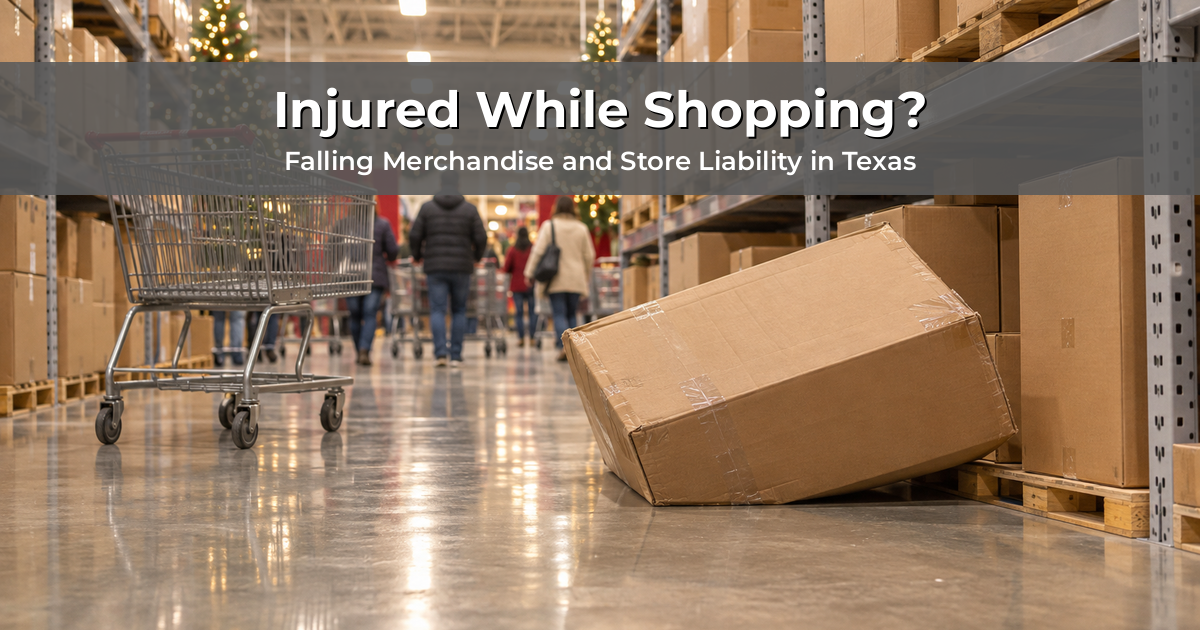
Black Friday and the holiday shopping season bring crowded aisles, overstocked shelves, pallets of merchandise in walkways, and seasonal displays set up in a hurry. Most shopping trips end without a problem, but every year shoppers in Dallas-Fort Worth stores are hurt by boxes that fall from high shelves, display fixtures that tip, and products left in the path of foot traffic.
At Howard Lotspeich Alexander & Williams, PLLC (HLAW), our Fort Worth personal injury lawyers represent injured people in Tarrant, Dallas, Denton, Collin, Johnson, and Parker counties. This guide explains how Texas law treats store injury claims, what you have to prove, why "how long was it there" matters so much, and what to do in the first hours and days after you are hurt.
Key Takeaways
- Shoppers are invitees. A store owes customers a duty to make the premises reasonably safe or warn of concealed, unreasonably dangerous conditions it knows or should know about (Keetch v. Kroger Co., Tex. 1992).
- Four elements: Knowledge of the condition, an unreasonable risk of harm, failure to use reasonable care, and proximate cause (Corbin v. Safeway Stores, Inc., Tex. 1983).
- Timing evidence is critical. To prove the store "should have known" about a hazard, Texas generally requires some evidence of how long the hazard existed (Wal-Mart Stores, Inc. v. Reece, Tex. 2002). The Supreme Court of Texas reaffirmed that rule in April 2026 (H-E-B, LP v. Peterson).
- Displays can be the hazard. A store that knows a display method creates an unusually high risk may be liable even without knowing about the specific item that caused the injury (Corbin).
- Shared fault matters. Under Texas proportionate responsibility, you cannot recover if you are more than 50 percent responsible, and your damages are reduced by your percentage (Tex. Civ. Prac. & Rem. Code § 33.001, § 33.012).
- Two-year deadline. Most personal injury suits must be filed within two years after the cause of action accrues (§ 16.003).
Can You Sue a Store for Falling Merchandise in Texas?
Yes, in many situations. When you walk into a store to shop, Texas law treats you as an invitee, a person who enters with the owner's knowledge and for the mutual benefit of both. Stores owe invitees the highest duty Texas premises law imposes on property owners: a duty to use ordinary care to reduce or eliminate unreasonable risks of harm from conditions the store knows about or, in the exercise of ordinary care, should know about.
Falling merchandise cases come up in several ways:
- Heavy boxes stacked on top shelves that slide off when a shopper reaches for a nearby item;
- Overloaded or improperly secured shelving that collapses;
- Display boards, fixtures, or end caps that tip when touched;
- Items falling from forklifts or carts during restocking while customers are in the aisle; and
- Merchandise, pallets, or packaging left in walkways that customers trip over.
Texas courts have recognized that customers are expected to handle merchandise. In Ceiling Fan Warehouse, Inc. #3 v. Morgan, 723 S.W.2d 195 (Tex. App. 1986), a lava-rock display board fell on a customer's heel when he pulled it away from the wall to look at it. The court explained that the store had "a duty to either warn its customers of the hazard or to secure each display in such a manner as to protect the customer who, unsuspectingly, may examine it and injure himself in the process." The court also held that pulling the board away to examine it was not contributory negligence as a matter of law.
What Do You Have to Prove in a Texas Store Injury Case?
The Supreme Court of Texas set out the elements in Corbin v. Safeway Stores, Inc. and restated them in Keetch v. Kroger Co.. An injured invitee must prove:
- Actual or constructive knowledge of some condition on the premises by the owner or operator;
- That the condition posed an unreasonable risk of harm;
- That the owner or operator did not exercise reasonable care to reduce or eliminate the risk; and
- That the failure to use such care proximately caused the plaintiff's injuries.
The knowledge element is where most store cases are won or lost.
How can you prove the store knew about the hazard?
Texas courts recognize three main ways to prove knowledge. According to Wal-Mart Stores, Inc. v. Reece, a plaintiff can show that the defendant placed the hazard there, that the defendant actually knew of it, or that "it is more likely than not that the condition existed long enough to give the premises owner a reasonable opportunity to discover it."
For falling merchandise, the first route often matters most. If store employees stacked the boxes, built the display, or left a pallet in the aisle, the store created the condition. In Keetch, the Court said that the fact that an owner created a dangerous condition "may support an inference of knowledge," although the jury still must find that the owner knew or should have known of it.
Why Does "How Long Was It There" Matter So Much?
If the store did not create the hazard and did not actually know about it, you must prove constructive knowledge. Texas follows what the Supreme Court calls the "time-notice rule."
In Reece, the Court held that an employee's proximity to a spill, without more, was not enough. "Without some temporal evidence, there is no basis upon which the factfinder can reasonably assess the opportunity the premises owner had to discover the dangerous condition." The Court rendered a take-nothing judgment because there was no evidence of how long the liquid had been on the floor.
The Court applied the same rule this year. In H-E-B, LP v. Peterson, No. 24-0310 (Tex. Apr. 10, 2026), a shopper slipped on a puddle, and the evidence pointed to rain and a possible roof drip. The Court explained that constructive knowledge turns on three things: how long the dangerous condition existed, how close the owner or its employees were to it, and how conspicuous it was. It reinstated summary judgment for the store because nothing showed how long the puddle had been there.
The practical lesson is simple: evidence of time often decides these cases. Surveillance video, employee sweep logs, restocking schedules, and witness statements can show when a box was placed precariously or when an item fell into the aisle.
Can the Display Itself Be the Dangerous Condition?
Sometimes. In Corbin, a shopper slipped on a grape in front of a self-service grape bin. Safeway admitted it knew the display carried an "unusually high risk" of customers falling. The Court held that proof of the store's failure to use reasonable care against the known risks of a self-service display "establishes a right to have a jury determine the storeowner's liability, even in the absence of evidence showing the storeowner's actual or constructive knowledge of the presence on the floor of the specific object causing the fall."
Later courts have described Corbin as a narrow rule. It generally applies to conditions that are dangerous from the moment they are used, not to conditions that become dangerous over time. Still, if a store stacks heavy items above head height on a shelf that customers must reach into, or builds a display that tips with ordinary handling, Corbin and Ceiling Fan Warehouse may support the argument that the setup itself was unreasonably dangerous.
What If the Hazard Was Open and Obvious?
Stores often argue that the danger was "open and obvious." The Supreme Court of Texas has held that a premises owner generally has no duty to protect invitees from conditions that are "open, visible and obvious to any reasonably careful person" (JMI Contractors, LLC v. Medellin, No. 24-0846, Tex. June 26, 2026).
There is an important exception for shoppers. Under the "necessary-use" exception, an owner may still be liable "if the invitee must necessarily confront the hazardous condition and the owner or occupier 'should have anticipated that the invitee is unable to take measures to avoid the risk'" (JMI Contractors). For example, a customer who must reach into a crowded shelf to get an advertised item may not have a safe way to avoid the risk. Whether a hazard was truly obvious, and whether the shopper could avoid it, depends on the facts.
Premises Liability vs. Negligent Activity: Which Applies?
Texas separates claims about dangerous conditions from claims about ongoing conduct. The table below summarizes the difference.
| Issue | Premises liability | Negligent activity |
|---|---|---|
| What caused the injury | A condition on the property, such as an unstable stack or item in the aisle | Something an employee was doing at that moment, such as operating a forklift or tossing boxes from a ladder |
| Key proof | Store knew or should have known of the condition | Employee failed to use ordinary care during the activity |
| Typical store examples | Box falls from a shelf stocked hours earlier | Worker drops merchandise on a customer while restocking |
| Source | Keetch | Keetch: recovery requires injury "by or as a contemporaneous result of the activity itself" |
Choosing the right theory matters because each has different elements and jury questions. In Keetch, the Court held that a slippery spot created by an earlier spray of plant-shining product sounded in premises liability, not negligent activity.
How Does Shared Fault Affect a Store Injury Claim?
Stores frequently argue that the shopper was distracted, pulled an item carelessly, or ignored a warning. Texas uses proportionate responsibility. Under Civil Practice and Remedies Code § 33.001, "a claimant may not recover damages if his percentage of responsibility is greater than 50 percent." If you are 50 percent or less responsible, § 33.012(a) reduces your damages by your percentage. For example, if a jury finds $100,000 in damages and assigns you 20 percent of the responsibility, the recovery would be reduced to $80,000.
What Should You Do After an Injury in a Store?
- Report the incident before you leave. Ask a manager to prepare an incident report and request a copy or at least the report number.
- Photograph everything. Take pictures of the shelf, the item that fell, the floor, any warning signs (or the lack of them), and your injuries.
- Get names. Write down the names of employees and contact information for other shoppers who saw what happened.
- Ask the store to keep the video. Surveillance footage may be overwritten. A lawyer can send a written preservation letter quickly, which matters given the time-notice rule.
- Get medical care. Head, neck, and shoulder injuries from falling objects may not feel serious at first. Medical records also document the link between the incident and your injuries.
- Keep the evidence. Save your receipt, the clothes and shoes you wore, and any packaging involved.
- Be careful with insurance calls. Large retailers often have claims administrators who call quickly. You do not have to give a recorded statement before talking with a lawyer.
For related situations, see our guides on slip and fall injuries and parking lot and sidewalk injuries in Texas. If you were hurt by a criminal act in a store parking lot, our article on negligent security claims in DFW explains a different set of rules.
What Damages Can You Recover?
If liability is proved, an injured shopper may seek compensation for medical expenses, lost wages and lost earning capacity, physical pain, mental anguish, physical impairment, and disfigurement. The amount depends on the evidence, the severity and permanence of the injury, and any reduction for shared responsibility. No lawyer can promise a particular result.
Frequently Asked Questions
Is a store automatically responsible if something falls on me?
No. Texas does not make stores insurers of customer safety. You must prove the four premises liability elements, including that the store knew or should have known about the dangerous condition (Keetch v. Kroger Co.).
What if another customer knocked the item down?
The store may still be liable if it knew or should have known about the hazard and failed to use reasonable care. In Corbin, the store's knowledge of the risks of its self-service display satisfied the knowledge requirement even though the store did not know about the specific grape on the floor.
How long do I have to file a lawsuit against a store in Texas?
Generally two years after the cause of action accrues under § 16.003. Some exceptions apply, so it is best to talk with a lawyer early. See our guide to time limits for personal injury claims in Texas.
Will surveillance video help my case?
Often, yes. Video can show who stacked the merchandise, when the hazard appeared, and how close employees were. Because Texas requires temporal evidence for constructive knowledge (Reece), video is frequently the most important evidence in the case.
Can I still recover if I was partly at fault?
Yes, as long as your share of responsibility is not greater than 50 percent. Your damages are reduced by your percentage of responsibility (§ 33.012).
Does it matter whether an employee was restocking when I was hurt?
It can. If an employee's ongoing activity caused the injury, a negligent activity claim may apply. If a condition left earlier caused it, the claim is usually premises liability.
Talk With a Fort Worth Personal Injury Lawyer
If you were hurt by falling merchandise, a collapsing display, or another hazard in a Dallas-Fort Worth store, prompt action can help preserve video and other evidence. HLAW represents injured people in Tarrant, Dallas, Denton, Collin, Johnson, and Parker counties.
Call (817) 993-9249 or contact us online for a free consultation.
This article provides general information about Texas law and is not legal advice. Reading it does not create an attorney-client relationship. Every case depends on its specific facts, and past results do not guarantee a similar outcome.