
Short answer: Retrograde extrapolation is a calculation a prosecution expert uses to estimate what a person's blood alcohol concentration (BAC) was at the time of driving, working backward from a breath or blood test taken later. The Texas Court of Criminal Appeals has held that the science "can be reliable in a given case," but only if the expert applies it correctly and explains it clearly, and courts look closely at how long after driving the test was taken, how many tests were done, and what the expert actually knew about the person. A test result without extrapolation can still be used as evidence, but by itself it is not enough to prove someone was intoxicated at the moment they were driving.
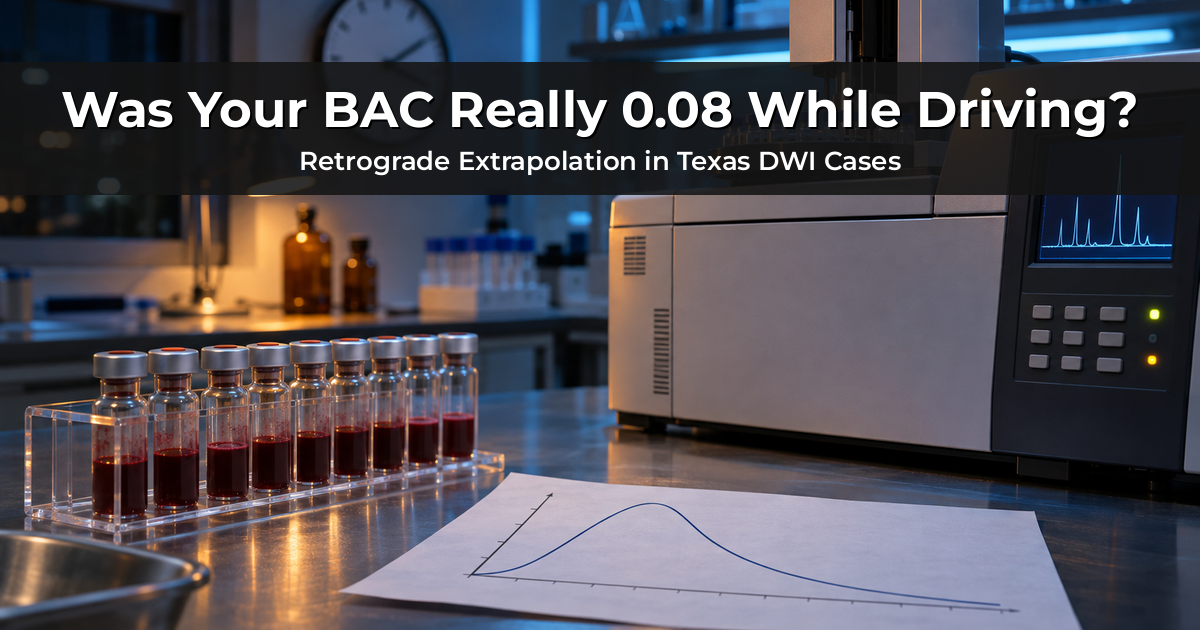
A Texas DWI case turns on a person's condition while driving, not an hour or two later at the jail or hospital. That gap in time is where retrograde extrapolation comes in, and it is one of the most technical and most contested issues in Dallas-Fort Worth DWI cases. At Howard Lotspeich Alexander & Williams, PLLC (HLAW), our Fort Worth DWI defense lawyers regularly review breath and blood evidence for timing problems, missing data, and expert opinions that go further than the science allows.
This guide explains what retrograde extrapolation is, what Texas courts require before a jury can hear it, how prosecutors try to prove intoxication without it, and the questions a defense lawyer asks when the State's case depends on a number taken long after the traffic stop.
Key Takeaways
- Intoxication is measured at the time of driving. Texas defines "intoxicated" as either losing the normal use of mental or physical faculties or "having an alcohol concentration of 0.08 or more" (Tex. Penal Code § 49.01(2)), and the offense requires being intoxicated "while operating a motor vehicle in a public place" (§ 49.04(a)).
- Retrograde extrapolation estimates BAC backward in time. The Court of Criminal Appeals defined it as "the computation back in time of the blood-alcohol level" based on "a test result from some later time" (Mata v. State, Tex. Crim. App. 2001).
- It can be reliable, but not automatically. Under Mata, courts consider the time between driving and testing, the number of tests and the intervals between them, and the defendant's individual characteristics known to the expert.
- A test result alone is not enough. In Kirsch v. State (Tex. Crim. App. 2010), the court held that "a BAC-test result, by itself, is not sufficient to prove intoxication at the time of driving."
- The 0.15 enhancement is different. For Class A DWI, the State must show 0.15 or more "at the time the analysis was performed," not at the time of driving (Ramjattansingh v. State, Tex. Crim. App. 2018).
- Flawed science can be harmful error. In Bagheri v. State, the court noted "the powerful persuasive effect that 'scientific' evidence has on the average juror" and agreed a flawed extrapolation was not harmless (Texas Court of Criminal Appeals, 2003).
What Is Retrograde Extrapolation in a Texas DWI Case?
When a police officer stops a driver in Fort Worth, Arlington, or Dallas, the breath or blood test almost never happens on the roadside at the moment of driving. The driver is arrested, transported, and observed, and the breath test is given at a jail or the blood is drawn later, sometimes after a warrant is obtained. That delay can be well over an hour.
Retrograde extrapolation tries to close that gap. A prosecution expert, often a forensic scientist or toxicologist, takes the later test result and estimates what the person's alcohol concentration would have been at the earlier time of driving. In Mata v. State, the leading Texas case, the Court of Criminal Appeals described the technique as "the estimation of the level at the time of driving based on a test result from some later time."
The calculation depends on how the body handles alcohol. After someone drinks, alcohol is absorbed into the bloodstream, so BAC can keep rising for a period after the last drink. Later, the body eliminates alcohol and BAC falls. If the person was still absorbing alcohol at the time of driving, their BAC while driving could have been lower than the later test. If they were fully absorbed and eliminating, it could have been higher. The direction and size of that change depend on facts that are often unknown, and that uncertainty is the heart of most retrograde extrapolation disputes.
Why Does the Timing of the Test Matter So Much?
Texas law is clear that the question is the driver's condition while operating the vehicle. Under Penal Code § 49.04(a), "A person commits an offense if the person is intoxicated while operating a motor vehicle in a public place." A 0.09 result two hours after a stop does not, on its face, prove what the number was at the wheel.
The State has two ways to prove intoxication under § 49.01(2):
- The impairment theory: the person did not have "the normal use of mental or physical faculties" because of alcohol or another substance.
- The per se theory: the person had "an alcohol concentration of 0.08 or more."
Retrograde extrapolation matters most to the per se theory, because the per se definition is tied to a number. When the test is close to the legal limit, or taken long after driving, the per se theory becomes harder for the State to prove without some way of relating the result back to the time of driving.
What Did Mata v. State Require Before an Expert Can Testify?
In Mata, the State's expert testified that a breath test taken a little more than two hours after the stop showed the driver was intoxicated while driving. The Court of Criminal Appeals held that the testimony did not meet the reliability standards for scientific evidence and that the trial court abused its discretion by admitting it. The court pointed to the expert's "inconsistent testimony, along with the single breath test conducted over two hours after the driving."
The court did not reject the science outright. It concluded that "the science of retrograde extrapolation can be reliable in a given case," but only when the expert can apply it and "explain it with clarity" and understands its complexities and risks. Texas appellate courts applying Mata, such as the court in Peden v. State, summarize the factors this way:
The three Mata reliability factors
- The length of time between the offense and the test or tests.
- The number of tests given and the time between each test.
- Whether, and to what extent, the expert knew the person's individual characteristics, including:
- weight and gender;
- typical drinking pattern and tolerance for alcohol;
- how much the person drank that day;
- what the person drank;
- how long the drinking lasted;
- the time of the last drink; and
- how much and what the person ate before, during, or after drinking.
According to the Fulenwider v. State opinion's summary of Mata, if more than one test is given at reasonable intervals and the first is taken within a reasonable time of the offense, an expert could potentially produce a reliable estimate with limited knowledge of personal characteristics. When there is a single test taken long after driving, the expert usually needs to know much more about the person.
How Do the Mata Factors Play Out in Real Cases?
The table below shows how common DFW arrest scenarios line up against the Mata factors. It is a general illustration, not a prediction about any case.
| Scenario | Time to test | Number of tests | Personal facts known | Reliability concern |
|---|---|---|---|---|
| Breath test at jail, two samples minutes apart | Often 1 to 2 hours | Two, close together | Usually little beyond weight | Close samples do not show a rising or falling trend |
| Blood draw after a search warrant | Often 1.5 to 3 hours | One | Often unknown | Single, delayed test is the pattern Mata criticized |
| Hospital blood after a crash | Varies | Sometimes more than one | Medical records may add detail | Hospital testing methods and timing need review |
| Driver tells officer about drinks and food | Varies | Varies | Some, but self-reported | Statements may be vague, inconsistent, or incomplete |
Two breath samples taken minutes apart help confirm the instrument result, but they do not show whether the person was absorbing or eliminating alcohol while driving.
Can the State Prove DWI Without Retrograde Extrapolation?
Yes, often it can. The Court of Criminal Appeals has repeatedly held that test results can be admitted and used even when no expert extrapolates them. In Kirsch v. State, the court explained that "BAC-test results, even absent expert retrograde extrapolation testimony, are often highly probative to prove both per se and impairment intoxication."
But Kirsch also set an important limit: "a BAC-test result, by itself, is not sufficient to prove intoxication at the time of driving. There must be other evidence in the record that would support an inference that the defendant was intoxicated at the time of driving as well as at the time of taking the test."
The court held that a per se jury charge is supported if the evidence includes either "(1) expert testimony of retrograde extrapolation, or (2) other evidence of intoxication that would support an inference that the defendant was intoxicated at the time of driving as well as at the time of taking the test." Texas courts, including the Fort Worth Court of Appeals in an opinion quoting Kirsch (Second Court of Appeals), have listed examples of that other evidence, such as erratic driving, stumbling, swaying, slurred speech, poor performance on field sobriety tests, bloodshot eyes, and admissions.
In practice, that means the State's case usually combines a test number with the officer's observations, video, and statements. A defense lawyer looks at each piece, not just the number.
How close to the limit and how long after driving?
The Houston court of appeals opinion in the Kirsch case (Kirsch v. State, Tex. App. 2008) explained that the probative value of an unextrapolated test depends mainly on "the degree to which the test result exceeds the legal limit of 0.08%" and "the amount of time elapsed between driving and the taking of the test." The higher the result and the shorter the delay, the stronger the inference. When a test is taken long after the arrest and the result is at or below the legal limit, that court said the inference may be so weak that a judge can exclude the result under Rule 403 without extrapolation testimony.
Does Retrograde Extrapolation Matter for a 0.15 Class A DWI?
Not for the 0.15 element itself. Under Penal Code § 49.04(d), a DWI becomes a Class A misdemeanor if an analysis "showed an alcohol concentration level of 0.15 or more at the time the analysis was performed." In Ramjattansingh v. State, the Court of Criminal Appeals confirmed that this element "only requires that the State prove that the defendant had an alcohol concentration level of at least 0.15 at the time the analysis was performed," not at or near the time of the offense.
The State still has to prove the underlying DWI, meaning intoxication while driving. So timing and extrapolation issues can still matter in a 0.15 case, just not to the enhancement number. Our guide to 0.15 BAC DWI charges in Texas explains the Class A penalties in more detail.
What Happens If a Jury Hears Unreliable Extrapolation Testimony?
Because scientific testimony can carry great weight, admitting a flawed extrapolation can lead to reversal on appeal. In Mata, the Court of Criminal Appeals held the trial court abused its discretion and sent the case back for a harm analysis. When the same issue returned to the court in Bagheri v. State, the court looked at the record and observed "the powerful persuasive effect that 'scientific' evidence has on the average juror." It agreed with the court of appeals that the erroneous admission of the extrapolation testimony was not harmless (Texas Court of Criminal Appeals, 2003).
The lesson for defense lawyers is to raise reliability challenges before trial, usually through a motion and a hearing outside the jury's presence, so the judge can decide whether the expert's opinion meets the standards set in Mata. We have written before about a case where a court rejected BAC evidence from an unqualified expert.
How Does a Defense Lawyer Challenge Retrograde Extrapolation?
Every case is different, but these are the questions we typically work through when the State's case depends on a delayed test:
- Build the timeline. When was the driving, the stop, the arrest, the breath test or blood draw? Dispatch logs, body camera, dash camera, jail records, and warrant timestamps can establish the gap.
- Count the tests. Was there one breath test event or one blood draw? Was there any second test at a meaningful interval?
- Identify what the expert actually knew. Did the expert know the person's weight, the drinks, the time of the last drink, and what the person ate? Or did the expert assume those facts?
- Look for the absorption problem. Is there evidence of drinking shortly before driving? If so, the person's BAC may have been rising, and an extrapolation that assumes elimination may point in the wrong direction.
- Test the expert's consistency. Mata emphasized the expert's ability to explain the science "with clarity." Inconsistent answers, rounded assumptions, or a formula applied without explanation are grounds for challenge.
- Evaluate the rest of the evidence. Under Kirsch, the State also needs other evidence of intoxication at the time of driving. Video that shows normal driving and normal speech can be just as important as the lab report.
- Review the test itself. For blood, that includes the warrant, the draw, chain of custody, and lab procedures. For breath, it includes the instrument and the observation period. See our article on warrantless DWI blood draws for one way blood evidence can be challenged.
The license side of the case also moves quickly. Many arrests trigger an administrative license suspension, and the deadline to request a hearing is short. Our guide to the 15-day ALR hearing deadline explains that process.
Frequently Asked Questions
Is retrograde extrapolation accepted science in Texas?
The Court of Criminal Appeals has held that it "can be reliable in a given case" when the expert applies it correctly and explains it clearly (Mata v. State). Reliability is decided case by case, based on timing, the number of tests, and what the expert knew about the person.
Does the State have to use retrograde extrapolation to convict me of DWI?
No. Texas courts have held that test results can be probative without extrapolation. But under Kirsch v. State, a test result alone is not enough; there must be other evidence supporting an inference that you were intoxicated at the time of driving.
My breath test was 0.09 two hours after I was stopped. Was I over the limit while driving?
Not necessarily. Depending on when you last drank and ate, your BAC may have been rising, falling, or level during that time. Whether the State can connect the later number to the time of driving depends on the expert's data and the other evidence in the case.
What information does an expert need for a reliable extrapolation?
Mata lists factors including the time between driving and testing, the number of tests and intervals between them, and personal facts such as weight, gender, drinking pattern and tolerance, what and how much was consumed, the duration of drinking, the time of the last drink, and food eaten.
Does extrapolation affect a 0.15 Class A charge?
The 0.15 element is measured "at the time the analysis was performed," so the State does not need extrapolation for that number (Ramjattansingh v. State). The State must still prove you were intoxicated while driving.
Talk With a Fort Worth DWI Defense Lawyer
If your DWI case in Tarrant, Dallas, Denton, Collin, Johnson, or Parker County depends on a breath or blood test taken long after you were stopped, the timing may be one of the most important issues in your defense. The DWI defense team at HLAW reviews test records, video, and expert reports to look for gaps the State cannot fill. Learn more about our Fort Worth DWI attorneys or contact us for a free consultation at (817) 993-9249.
This article is for general information only and is not legal advice. Reading it does not create an attorney-client relationship. Results depend on the facts of each case.