Short answer: In Texas, possessing a vape cartridge containing THC oil that is not legal hemp is generally charged as a felony, not a marijuana misdemeanor. THC concentrates fall under Penalty Group 2 of the Texas Controlled Substances Act, where less than one gram is a state jail felony and one to four grams is a third-degree felony. Products that meet the Texas definition of hemp, with no more than 0.3 percent delta-9 THC, are excluded, but since July 31, 2026, manufactured delta-8 THC is treated as a controlled substance, so many cartridges once sold openly in DFW shops can now lead to a felony charge.
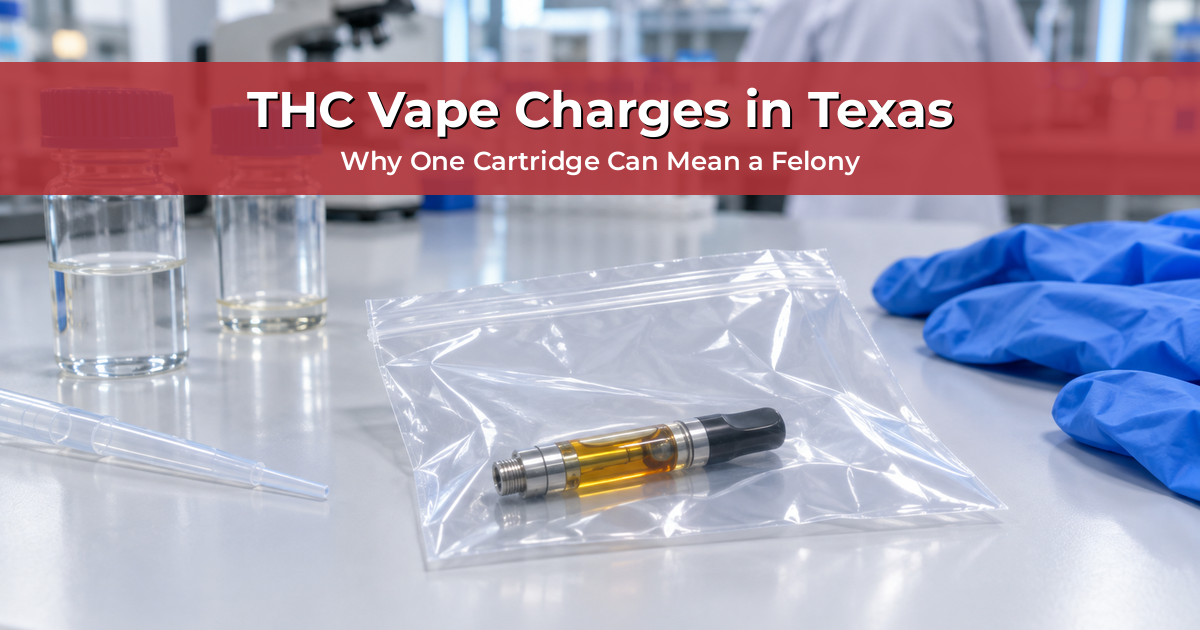
A THC vape arrest often starts with something minor: a traffic stop on I-30, a search after an officer smells something, or a school or campus encounter. Many people are shocked to learn that a single cartridge, small enough to fit in a pocket, can carry more serious penalties than a bag of marijuana.
At Howard Lotspeich Alexander & Williams, PLLC (HLAW), our Fort Worth drug crimes defense lawyers defend people charged with THC and drug offenses in Tarrant, Dallas, Denton, Collin, Johnson, and Parker counties. This guide explains how Texas classifies THC vapes, the penalty ranges, how recent changes in hemp law affect these cases, and the defenses that often matter.
Key Takeaways
- THC oil is Penalty Group 2. Texas lists "Tetrahydrocannabinols, other than marihuana," in Penalty Group 2, which covers THC concentrates such as vape oil (Tex. Health & Safety Code §481.103).
- Small amounts are still felonies. Possession of less than one gram is a state jail felony, and one gram to less than four grams is a third-degree felony (Tex. Health & Safety Code §481.116).
- Weight includes the whole mixture. Penalty Group 2 amounts are measured "by aggregate weight, including adulterants or dilutants" (§481.116).
- Legal hemp is excluded. The definition of a controlled substance "does not include hemp" or "the tetrahydrocannabinols in hemp" (§481.002(5)).
- Delta-8 changed on July 31, 2026. After the Supreme Court of Texas ruled for the state in Sky Marketing, the Department of State Health Services says the schedule treating delta-8 THC as a controlled substance became effective July 31, 2026 (Texas DSHS).
- First-time small possession often means mandatory probation. For many people convicted of state jail felony possession under §481.116(b), the judge "shall suspend the imposition of the sentence and place the defendant on community supervision" (Tex. Code Crim. Proc. art. 42A.551).
Why Is a THC Vape a Felony in Texas When Marijuana Is a Misdemeanor?
The difference comes from how Texas defines marijuana. Under Health and Safety Code §481.002(26), "marihuana" means the cannabis plant and its seeds, but the term does not include "the resin extracted from a part of the plant or a compound, manufacture, salt, derivative, mixture, or preparation of the resin." Extracted THC, including the oil in a vape cartridge, falls outside the marijuana definition.
Instead, Penalty Group 2 includes "Tetrahydrocannabinols, other than marihuana, and synthetic equivalents of the substances contained in the plant, or in the resinous extractives of Cannabis" (Tex. Health & Safety Code §481.103).
The result is a sharp contrast:
| Item | Statute | Small-amount offense level |
|---|---|---|
| Marijuana plant material, 2 ounces or less | §481.121(b)(1) | Class B misdemeanor |
| Marijuana, more than 2 and up to 4 ounces | §481.121(b)(2) | Class A misdemeanor |
| THC concentrate (vape oil, wax), less than 1 gram | §481.116(b) | State jail felony |
| THC concentrate, 1 gram to less than 4 grams | §481.116(c) | Third-degree felony |
| THC concentrate, 4 grams to less than 400 grams | §481.116(d) | Second-degree felony |
For more on plant-material charges, see our guide to marijuana laws in Texas.
What Are the Penalties for THC Vape Possession?
The punishment ranges come from the Texas Penal Code (Tex. Penal Code ch. 12):
- State jail felony (less than 1 gram): 180 days to two years in a state jail and a fine of up to $10,000.
- Third-degree felony (1 to 4 grams): 2 to 10 years in prison and a fine of up to $10,000.
- Second-degree felony (4 to 400 grams): 2 to 20 years in prison and a fine of up to $10,000.
- First-degree felony (400 grams or more): 5 to 99 years or life and a fine of up to $50,000 under §481.116(e).
How much does a vape cartridge weigh?
This is often the most important number in the case. Because §481.116 measures "aggregate weight, including adulterants or dilutants," the weight of the entire liquid mixture counts, not only the THC in it. Many cartridges are sold in roughly half-gram or one-gram sizes, so a single cartridge can fall just under or just over the one-gram line between a state jail felony and a third-degree felony. Several cartridges can push the total above four grams. How the lab measured the substance, and whether the reported weight reflects only the oil rather than the hardware, can matter a great deal.
Is probation mandatory for a small THC vape case?
Often, yes. Under Article 42A.551(a), on conviction of a state jail felony under §481.116(b) punished under Penal Code §12.35(a), "the judge shall suspend the imposition of the sentence and place the defendant on community supervision." That rule has exceptions, including when the person has a prior felony conviction or the conviction follows an adjudication after deferred adjudication (Tex. Code Crim. Proc. art. 42A.551).
A court may also impose Class A misdemeanor punishment for a state jail felony under Penal Code §12.44(a), and at the prosecutor's request may allow the case to be prosecuted as a Class A misdemeanor under §12.44(b) (Tex. Penal Code §12.44). Many DFW counties also offer diversion programs for some first-time drug cases. See our overview of Tarrant County diversion programs.
Is a Hemp or Delta-8 Vape Legal in Texas?
This is where the law has changed the most, and where many people are caught off guard.
Hemp is excluded from the Controlled Substances Act
Texas excludes hemp from the definition of a controlled substance. Under §481.002(5), the term "does not include hemp, as defined by Section 121.001, Agriculture Code, or the tetrahydrocannabinols in hemp." According to the Texas Department of State Health Services, consumable hemp products "may contain delta-9 tetrahydrocannabinol at a concentration of not more than 0.3 percent on a dry weight basis" (Texas DSHS).
Delta-8 THC is now treated as a controlled substance
On May 1, 2026, the Supreme Court of Texas decided Texas Department of State Health Services v. Sky Marketing Corp. The court held that the commissioner "acted within her broad statutory discretion and followed proper procedures" when amending the state schedules to treat manufactured delta-8 THC as a Schedule I controlled substance, and it rendered judgment for the department (Justia summary of Sky Marketing; Supreme Court of Texas opinion).
DSHS states that "only trace amounts of delta-8 THC naturally produced by the hemp plant from which the consumable hemp product was manufactured are permissible" and that "the Texas schedule affecting delta-8 THC becomes effective July 31, 2026." DSHS also says products labeled as containing delta-8 THC or shown to contain more than trace amounts "may be detained and referred to law enforcement" (Texas DSHS).
Selling cannabinoid vapes is a separate crime
Since September 1, 2025, Health and Safety Code §161.0876, as amended by Senate Bill 2024, makes it an offense to market, advertise, sell, or offer for sale an e-cigarette product that "contains, is mixed with, or is marketed as containing or being mixed with any cannabinoids," among other substances. That offense is a Class A misdemeanor (S.B. 2024, 89th Leg.; Texas Comptroller FAQ). The sales ban targets sellers, but it means legitimate hemp vapes should no longer be sold in Texas stores, which can make a vape found during a stop look more suspicious to police.
What about the new federal hemp law?
Federal law is also changing. According to WFAA, a federal funding bill, H.R. 5371, targets cannabinoids that cannot be naturally produced by hemp and sets "a 0.4-milligram THC limit on hemp products, per container," with part of the restrictions in effect and a second round scheduled for December 11. Fort Worth police told WFAA, "We will enforce state law restrictions on hemp products" (WFAA). Texas lawmakers are also expected to debate cannabis and hemp policy in the next session (KUT). Because these rules are moving quickly, the law on the date of the alleged offense matters.
How Do Lawyers Defend THC Vape Charges in DFW?
Every case depends on its facts, but common defense issues include:
- Was the search lawful? Many vape cases start with a traffic stop or a search based on odor. Whether the officer had a legal basis to stop and search is often the first question. See our article on the smell of marijuana and warrantless searches.
- Did you knowingly possess it? The State must prove knowing or intentional possession. A cartridge found in a shared car or a borrowed jacket can raise real questions. Our guide to drug possession in a car explains how Texas courts analyze this.
- What exactly is in the cartridge? The lab must identify the substance. A product that qualifies as hemp, with no more than 0.3 percent delta-9 THC, is excluded from the Controlled Substances Act, so whether and how the lab tested THC type and concentration can be critical.
- Is the weight accurate? Because the felony level depends on weight, the lab's method, the number of items tested, and whether the weight reflects only the substance can change the charge.
- When was the offense? For delta-8 products, whether the alleged offense occurred before or after the July 31, 2026, scheduling change can matter.
- Is diversion or a reduction available? Even when the evidence is strong, options such as diversion, a §12.44 reduction, or deferred adjudication may protect your record.
Can a THC Vape Charge Be Removed From My Record?
Possibly. If the case is dismissed, you may be eligible for an expunction. If you complete deferred adjudication, you may be eligible to seek an order of nondisclosure, depending on the offense and your history. Learn more in our Texas expunction and nondisclosure guide.
Frequently Asked Questions
Is one THC vape cartridge a felony in Texas?
Usually, if the oil contains THC that does not qualify as hemp. Possession of less than one gram of a Penalty Group 2 substance is a state jail felony, and one gram or more but less than four grams is a third-degree felony under §481.116.
Is a delta-8 vape legal in Texas now?
Since July 31, 2026, Texas DSHS treats manufactured delta-8 THC as a controlled substance, with only naturally occurring trace amounts permitted. A delta-8 vape may therefore support a Penalty Group 2 charge if lab testing confirms it.
What if I bought the vape legally at a smoke shop?
Where you bought it does not automatically make it legal. The question is what the product actually contains and the law in effect on the date of the alleged offense. Purchase records and product testing can still be relevant to your defense.
Does the weight include the cartridge?
The statute measures the "aggregate weight, including adulterants or dilutants" of the substance. How the lab handled and weighed the oil is a common issue in these cases and should be reviewed carefully.
Can I get probation for a THC vape charge?
Often. For many first-time state jail felony possession cases under §481.116(b), Texas law requires the judge to place the person on community supervision, and diversion or deferred adjudication may also be available.
Will a THC vape charge affect my job or school?
A felony charge or conviction can affect employment, professional licenses, financial aid, housing, and firearm rights. Resolving the case in a way that protects your record is often a major goal.
Talk to a Fort Worth Drug Crimes Defense Lawyer
A THC vape charge can turn a moment into a felony record. The lab results, the weight, the search, and the date of the offense can all change the outcome, and the rules are changing quickly.
Call HLAW at (817) 993-9249 or contact us online for a free consultation about a THC or drug charge in Dallas-Fort Worth.
This article is for general informational purposes only and is not legal advice. Reading it does not create an attorney-client relationship. Laws change, and every case depends on its specific facts.