Short answer: When a child or adult drowns or is seriously injured in a swimming pool in Texas, the property owner may be liable if it failed to use reasonable care, and apartment complexes and property owners associations face specific statutory duties. Chapter 757 of the Texas Health and Safety Code requires those owners to fully enclose their pools with a fence at least 48 inches high, use self-closing and self-latching gates, and inspect the enclosure and gates at least once every 31 days. Violations can support claims for actual damages and, in some cases, punitive damages.
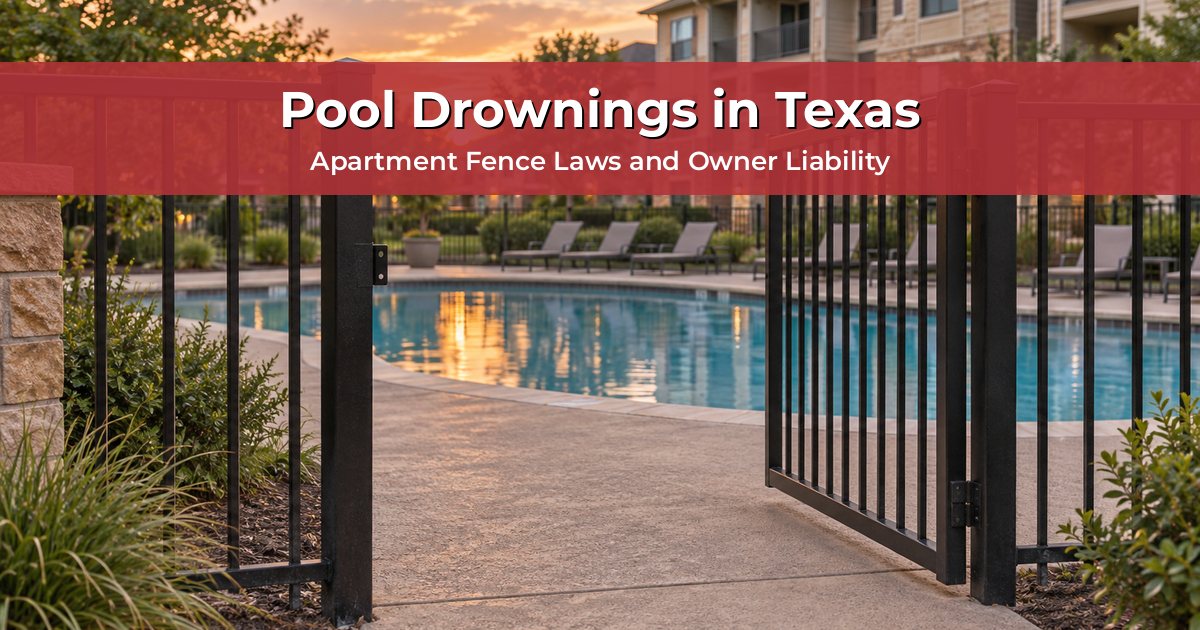
Every summer, Texas families hear about children drowning in backyard, apartment, and community pools. Many of those tragedies are preventable, and when they happen because a gate would not latch, a fence was broken, or a pool was left accessible without supervision, Texas law may hold the property owner responsible.
At Howard Lotspeich Alexander & Williams, PLLC (HLAW), our Fort Worth personal injury lawyers represent injured people and families in Tarrant, Dallas, Denton, Collin, Johnson, and Parker counties. This guide explains who can be liable for a pool drowning or injury in Texas, what the apartment pool fencing law requires, how the rules differ for guests and trespassing children, and what families should do after an incident.
Key Takeaways
- Drowning remains a serious risk for Texas children. The Texas Department of Family and Protective Services (DFPS) reported 68 child drownings in Texas in 2026 as of September 17, 2026, and states that drowning "is a leading cause of accidental death for kids under the age of five" (DFPS Child Drownings).
- Apartments and HOAs must fence their pools. The owner of a multiunit rental complex with a pool, or a property owners association that owns, controls, or maintains a pool, "shall completely enclose the pool yard with a pool yard enclosure" at least 48 inches high (Tex. Health & Safety Code § 757.003).
- Gates must close and latch on their own. Pool gates must have "a self-closing and self-latching device" and open outward away from the pool (§ 757.004).
- Monthly inspections are required. Covered owners must inspect enclosures, gates, and self-closing and self-latching devices "no less than once every 31 days," and that duty "may not be waived under any circumstances" (§ 757.009).
- The statute creates a damages claim. A tenant, association member, or other person may sue for actual damages caused by noncompliance, and for punitive damages when the harm was caused by intentional, malicious, or grossly negligent conduct (§ 757.012).
- Trespassing children may still be protected. Under the attractive nuisance doctrine adopted by the Supreme Court of Texas, an owner may be liable for harm to trespassing children caused by an artificial condition in certain circumstances (Texas Utilities Electric Co. v. Timmons, Tex. 1997).
How Common Are Pool Drownings in Dallas-Fort Worth?
DFPS tracks child drownings statewide by county and location. Its 2026 figures, updated September 17, 2026, list child drownings in Tarrant, Dallas, Denton, Collin, and Johnson counties, including deaths in backyard pools, apartment pools, a community pool, and a pond (DFPS Child Drownings). The agency notes that toddlers are especially at risk, that children are most likely to drown during the summer, and that "it only takes a few minutes for a child to drown."
Those numbers count only children. Adults are also injured and killed in pool incidents, including diving injuries, slip and fall injuries on pool decks, drain and equipment injuries, and drownings at hotels, gyms, and private parties.
Who Can Be Liable for a Pool Drowning or Injury in Texas?
Depending on the facts, potentially responsible parties can include:
- Apartment complex owners and management companies, which have specific statutory duties under Chapter 757
- Property owners associations (HOAs) that own, control, or maintain community pools
- Homeowners who host guests or whose pool is accessible to neighborhood children
- Hotels, gyms, water parks, and clubs that operate pools for customers
- Pool maintenance companies that service gates, drains, or equipment
- Manufacturers of defective pool drains, covers, gates, latches, or alarms
Claims involving equipment failures may also raise product liability issues. Our page on defective products explains how those claims work.
What Does Texas Law Require for Apartment and HOA Pools?
Chapter 757 of the Texas Health and Safety Code sets detailed rules for pool yard enclosures at multiunit rental complexes and pools owned, controlled, or maintained by property owners associations. A "multiunit rental complex" means two or more dwelling units under common ownership or management on the same or adjacent lots, and includes condominium projects. A "pool" includes a permanent swimming pool, wading pool, or hot tub or spa over 18 inches deep (§ 757.001).
The table below summarizes key requirements.
| Requirement | What the statute says |
|---|---|
| Full enclosure | The owner or association "shall completely enclose the pool yard" (§ 757.003(a)) |
| Minimum height | At least 48 inches, measured from the ground on the side away from the pool (§ 757.003(b)) |
| Gaps under the fence | Openings under the enclosure may not allow a 4-inch sphere to pass (§ 757.003(c)) |
| Chain link | Prohibited for new pool yard enclosures built after January 1, 1994 (§ 757.003(f)) |
| Climbing aids | Permanent equipment or structures may not be placed so they are readily available for climbing over the fence (§ 757.003(i)) |
| Gates | Must be self-closing and self-latching, lockable, and open outward away from the pool (§ 757.004(a)) |
| Latch height | Generally at least 60 inches above the ground, with limited exceptions (§ 757.004(b)-(c)) |
| Inspections | At least once every 31 days for enclosures, gates, and self-closing and self-latching devices (§ 757.009(c)) |
The owner must also "exercise ordinary and reasonable care to inspect, maintain, repair, and keep in good working order" the enclosures, gates, and latching devices within its control (§ 757.009(a)). In many apartment drowning cases, the key evidence is a gate that did not close or latch, or a fence with a gap a child could get through.
Can You Sue an Apartment Complex Under the Pool Fencing Law?
Yes. Section 757.012 allows "a tenant of an owner of a multiunit rental complex, a member of a property owners association, a governmental entity, or any other person or the person's representative" to bring an action against the owner or association for failing to comply with Chapter 757. Available remedies include:
- A court order requiring the owner or association to comply
- Actual damages resulting from the failure to comply
- Punitive damages if the actual damages were caused by the owner's or association's "intentional, malicious, or grossly negligent actions"
- Actual damages, and if appropriate punitive damages, even when the owner was technically in compliance, if it "was consciously indifferent to access being repeatedly gained to the pool yard by unauthorized persons"
- A civil penalty of up to $5,000 if the owner fails to comply within a reasonable time after written notice from a tenant or association member
That fourth item matters. An apartment complex cannot simply point to a code-compliant fence if it knew people were repeatedly getting into the pool area and did nothing. Our guide to punitive damages in Texas explains the general proof requirements for exemplary damages.
The pool statute often works alongside other apartment safety duties. For example, our article on negligent security at DFW apartment complexes covers a property owner's duty to protect residents from foreseeable criminal acts.
What if the Injury Happened at a Private Home or Business Pool?
Outside Chapter 757, most pool claims are premises liability claims. The Supreme Court of Texas has explained that "negligence and premises liability claims thus are separate and distinct theories of recovery, requiring plaintiffs to prove different, albeit similar, elements" (United Scaffolding, Inc. v. Levine, Tex. 2017).
For an invitee, such as a paying hotel guest or a gym member, the property owner owes a duty to make safe or warn against concealed, unreasonably dangerous conditions of which it knew or reasonably should have known. To recover, the injured person generally must show that:
- The owner had actual or constructive knowledge of the condition
- The condition was unreasonably dangerous
- The owner did not exercise reasonable care to reduce or eliminate the risk
- That failure proximately caused the injury
Examples include a broken drain cover, a missing depth marker, a deck that stays slick with algae, or an inoperable gate the owner knew about. Our page on slip and fall injuries covers how those premises claims are often proven.
Social guests and the open-and-obvious rule
The duty owed can change depending on why the person was on the property. Texas also recognizes that an owner generally has no duty to warn about dangers that are open and obvious to a reasonably careful person, though exceptions exist. Because these rules can decide a case, the specific facts of how the person came to be at the pool matter.
Can a Property Owner Be Liable When a Child Wanders Into a Pool?
Sometimes. Ordinarily, "the only duty a premises owner or occupier owes a trespasser is not to injure him willfully, wantonly, or through gross negligence" (Texas Utilities Electric Co. v. Timmons). But Texas recognizes an exception for young children, called the attractive nuisance doctrine. In Timmons, the Supreme Court of Texas applied Restatement (Second) of Torts § 339, under which an owner may be liable for physical harm to trespassing children caused by an artificial condition if:
- The owner knows or has reason to know children are likely to trespass where the condition exists
- The owner knows or has reason to know of the condition and realizes or should realize it involves an unreasonable risk of death or serious bodily harm to children
- The children, because of their youth, do not discover the condition or realize the risk
- The utility of maintaining the condition and the burden of eliminating the danger are slight compared with the risk to children
- The owner fails to exercise reasonable care to eliminate the danger or otherwise protect the children
Timmons involved a 14-year-old who climbed an electric transmission tower, and the court held the doctrine did not apply in that case. The doctrine is most often argued for young children who cannot appreciate the danger, which is why the age of the child and how easily the pool could be reached are often central issues.
What Damages Can Families Recover?
Damages depend on whether the person survived and on who brings the claim:
- Non-fatal injuries. Near-drowning incidents can cause brain injuries that require lifelong care. An injured person, or a parent on a child's behalf, may seek medical expenses, future care, lost earning capacity, pain, and impairment. Texas courts must approve many settlements for minors, as explained in our guide to minor injury settlements in Texas.
- Fatal drownings. The surviving spouse, children, and parents may bring a wrongful death claim, and the estate may bring a survival claim. Our guide to survival claims vs. wrongful death claims explains the difference.
- Punitive damages. Under § 757.012, punitive damages are available against a noncompliant apartment owner or association if the harm was caused by intentional, malicious, or grossly negligent conduct.
Deadlines are short. Most Texas injury and wrongful death claims must be filed within two years, with special rules for minors. See our article on time limits for personal injury claims.
What Should You Do After a Pool Drowning or Injury?
- Get emergency care and follow medical advice. Near-drowning injuries can worsen after the person seems fine.
- Photograph the scene. Document the gate, latch, fence, gaps, nearby furniture that could be climbed, signage, and the pool deck as soon as it is safe.
- Note who was responsible for the pool. Write down the apartment complex, management company, HOA, or business that operates the pool.
- Ask for maintenance and inspection records. Chapter 757 requires monthly inspections, so a lawyer can request those records and repair logs.
- Preserve video and witnesses. Many complexes and businesses have cameras that record over footage quickly.
- Avoid recorded statements to insurers before talking with a lawyer.
Frequently Asked Questions
How tall does an apartment pool fence have to be in Texas?
At least 48 inches, measured from the ground on the side away from the pool, under Health and Safety Code § 757.003(b). Some cities may require greater height if their ordinances were in place on January 1, 1994 (§ 757.010(c)).
Do apartment pool gates have to lock automatically?
They must have a self-closing and self-latching device, hardware that allows them to be locked by padlock or a key, card, or combination lock, and they must open outward away from the pool (§ 757.004(a)).
How often must an apartment complex inspect its pool gates?
No less than once every 31 days, under § 757.009(c). That inspection duty cannot be waived.
Does Chapter 757 apply to single-family homes?
The definition of multiunit rental complex excludes a single-family home or adjacent single-family homes that are not part of a condominium project. Claims involving private backyard pools usually proceed under general premises liability rules, though local ordinances may also apply.
Can I sue if my child got into a neighbor's pool without permission?
Possibly. A trespasser is generally owed only a duty not to be injured willfully, wantonly, or through gross negligence, but the attractive nuisance doctrine may apply to young children in certain circumstances.
Can a tenant force an apartment complex to fix a broken pool gate?
Yes. Section 757.012 allows a tenant to seek a court order requiring compliance and, after written notice and a reasonable time to comply, a civil penalty of up to $5,000.
What if the drowning was at a city pool?
Claims against government entities are governed by the Texas Tort Claims Act and have strict notice requirements and damages limits. Talk with a lawyer quickly if a public pool is involved.
Talk With a Fort Worth Pool Injury Lawyer
Pool drownings and injuries are devastating, and the evidence that explains what went wrong, like a faulty gate or missing inspection records, can disappear quickly. If your family was affected by a pool incident anywhere in Dallas-Fort Worth, HLAW can review what happened and explain your options. Call (817) 993-9249 or contact us online for a free consultation.
This article provides general information about Texas law and is not legal advice. Reading it does not create an attorney-client relationship. Every case depends on its specific facts, and past results do not guarantee a similar outcome. Laws change, so consult a licensed Texas attorney about your situation.