Short answer: In Texas, a DWI becomes an "open container DWI" when the State shows that the driver had an open container of alcohol in his or her immediate possession at the time of the offense. It is still a Class B misdemeanor, but the minimum jail term doubles from 72 hours to six days under Texas Penal Code § 49.04(c). Courts have read "immediate possession" to mean within the driver's reach, so a cup in the console can count, while an opened bottle locked in the trunk generally cannot.
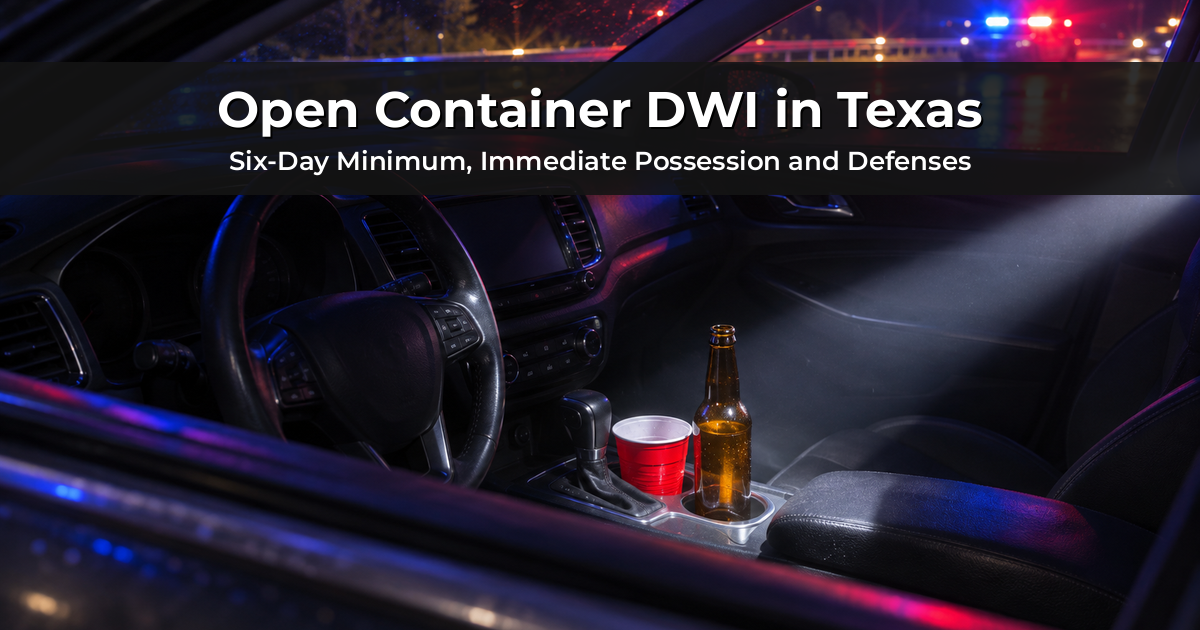
An open can rolling around the floorboard may seem like a minor detail next to a DWI arrest. In Texas, it is not. That one fact can change the punishment range, show up in the police report as evidence of intoxication, and give the prosecutor more leverage in plea negotiations in Tarrant, Dallas, Denton, and Collin County courts.
At Howard Lotspeich Alexander & Williams, PLLC (HLAW), our Fort Worth DWI attorneys defend drivers charged with DWI in Tarrant, Dallas, Denton, Collin, Johnson, and Parker counties. This guide explains what the open container enhancement is, how it differs from a simple open container ticket, what the State has to prove, and where these cases are often defended.
Key Takeaways
- Six-day minimum. A first DWI is a Class B misdemeanor with a 72-hour minimum, but if the driver had an open container in his or her immediate possession, the minimum becomes six days (Tex. Penal Code § 49.04).
- Same fine range. An open container DWI remains a Class B misdemeanor, punishable by up to 180 days in jail and a fine of up to $2,000 (Tex. Penal Code § 12.22).
- "Immediate possession" means within reach. Texas courts have held that the State does not have to prove the driver actually held the container, only that it was within reach (Barton v. State, Tex. App.-Houston (14th Dist.) 2004).
- Open container alone is a ticket. Without intoxication, possessing an open container in the passenger area of a vehicle on a public highway is a Class C misdemeanor, punishable by a fine of up to $500 (Penal Code §§ 49.031, 12.23).
- The trunk is different. A locked glove compartment, the trunk, and the area behind the last upright seat in a vehicle without a trunk are not part of the "passenger area" (§ 49.031(a)(2)).
- Probation may still be possible. The mandatory jail conditions for DWI probation in Article 42A.401 are tied to prior convictions and intoxication assault or manslaughter, not to the open container finding (Tex. Code Crim. Proc. art. 42A.401).
What Is an Open Container DWI in Texas?
Texas does not have a separate crime called "open container DWI." The offense is still driving while intoxicated under Penal Code § 49.04(a), which makes it a crime to be "intoxicated while operating a motor vehicle in a public place." Intoxicated means either not having the normal use of mental or physical faculties because of alcohol, drugs, or another substance, or having an alcohol concentration of 0.08 or more (§ 49.01(2)).
The open container language is a punishment provision. Section 49.04(c) says that if "it is shown on the trial of an offense under this section that at the time of the offense the person operating the motor vehicle had an open container of alcohol in the person's immediate possession, the offense is a Class B misdemeanor, with a minimum term of confinement of six days" (Tex. Penal Code § 49.04(c)).
In practice, the prosecutor usually pleads the open container allegation in the charging document. In Texas county courts, you may see the case described as "DWI with open container" on the docket or in bond paperwork.
How Is an Open Container DWI Different From a Regular First DWI?
The table below compares the most common first-offense DWI categories under § 49.04.
| Charge | Level | Minimum jail if jail is imposed | Maximum jail | Maximum fine |
|---|---|---|---|---|
| DWI, first offense | Class B misdemeanor | 72 hours | 180 days | $2,000 |
| DWI with open container | Class B misdemeanor | 6 days | 180 days | $2,000 |
| DWI with 0.15 or higher | Class A misdemeanor | None stated in § 49.04(d) | 1 year | $4,000 |
| Open container only (no DWI) | Class C misdemeanor | No jail | No jail | $500 |
The six-day minimum is the biggest change, but it is not the only one. An open container in the car also becomes evidence. Prosecutors often argue that a cup or can within reach shows the driver was drinking while driving, and that argument can affect how a jury views field sobriety test results or a breath or blood test. If the test result was 0.15 or higher, the charge may be a Class A misdemeanor instead. Our guide to high BAC DWI charges in Texas covers that enhancement.
What Does "Immediate Possession" Mean?
The statute does not define "immediate possession" or "open container" for purposes of § 49.04(c). Texas courts have said both terms carry their plain and ordinary meaning. In a Denton County case, the court explained that "immediate possession means that the open container is within the reach of the person operating the motor vehicle," and that the record must show "there was a container of alcohol, and the container was open" (De Los Santos v. State, Tex. App.-El Paso 2018). In that case, the officer found a cup in the center console next to an empty bottle, and the defendant had pleaded true to the open container allegation.
Other courts have used the same reach-based test. The Fourteenth Court of Appeals stated that the State "is not required to prove that the person actually held the container while driving," and that "proof that the container was within the person's reach will suffice" (Barton v. State).
That standard makes the location of the container important. Questions that often matter include:
- Was the container in the cupholder, on the driver's seat, or on the driver's floorboard?
- Was it in the back seat, behind the passenger, or out of the driver's reach?
- Was it actually open, or was it a sealed can that rolled out of a store bag?
- Did it contain alcohol, or was it a soda, water, or an empty cup?
- Did the officer photograph it, collect it, or describe it only in a report?
What Counts as an "Open Container" in Texas?
For the separate Class C offense, Penal Code § 49.031 defines an open container as "a bottle, can, or other receptacle that contains any amount of alcoholic beverage and that is open, that has been opened, that has a broken seal, or the contents of which are partially removed" (Tex. Penal Code § 49.031). That definition is broad. A bottle of wine that was opened at dinner and recorked can qualify, as can a nearly empty can.
The same section limits where the offense can occur. It applies to the "passenger area of a motor vehicle," which means the area "designed for the seating of the operator and passengers." It does not include:
- A glove compartment or similar storage container that is locked
- The trunk of a vehicle
- The area behind the last upright seat of the vehicle, if the vehicle does not have a trunk
There is also an exception for passengers in vehicles used primarily to transport people for compensation, such as a bus, taxicab, or limousine, and for passengers in the living quarters of a motor home or RV (§ 49.031(c)). Because § 49.04(c) focuses on the driver's immediate possession rather than the passenger area, these rules are not identical, but they often shape how the open container evidence is argued.
Is an Open Container Alone a Crime in Texas?
Yes, but a minor one. Under § 49.031(b), a person commits an offense if the person knowingly possesses an open container in the passenger area of a vehicle located on a public highway, "regardless of whether the vehicle is being operated or is stopped or parked." It is a Class C misdemeanor, punishable by a fine of up to $500 with no jail (Tex. Penal Code § 12.23).
The statute also tells officers how to handle the charge. An officer charging only this offense "shall issue to the person a written citation and notice to appear" instead of taking the person before a magistrate (§ 49.031(e)). In other words, an open container with no other offense is a ticket, not a jail booking.
For drivers who were not intoxicated, that distinction matters. A sober driver whose passenger left an open beer in the back seat faces a very different situation than a driver arrested for DWI with a cup in the console.
Who Decides Whether the Open Container Allegation Is True?
Section 49.04(c) applies when the open container is "shown on the trial of an offense." If a defendant pleads true to the allegation, that plea is enough to support the finding, as the court noted in De Los Santos. If the case goes to trial, the question of who makes the finding can depend on whether the defendant elects to have the judge or the jury assess punishment. In one Harris County case, the court of appeals rejected a challenge to a judge's open container finding where the defendant had elected to have the trial court assess punishment (Liscum v. State, Tex. App.-Houston (14th Dist.) 2005).
That election is a strategic decision that should be made with your lawyer before trial, because it affects who hears the open container evidence and how the punishment range is applied.
Can You Still Get Probation for an Open Container DWI?
Often, yes. The six-day minimum in § 49.04(c) is the minimum term if the court sentences the person to jail. Texas law also allows community supervision (probation) in many first-offense DWI cases. Article 42A.401 of the Code of Criminal Procedure requires jail as a condition of DWI probation in specific situations, such as when the defendant is punished under the repeat-offense provisions of § 49.09 or was convicted of intoxication assault or intoxication manslaughter (Tex. Code Crim. Proc. art. 42A.401). The open container finding is not on that list.
Other probation conditions still apply in DWI cases. A judge granting probation for a Chapter 49 offense must order an alcohol or drug evaluation (art. 42A.402) and, for offenses under §§ 49.04-49.08, completion of a DWI education program within 180 days (art. 42A.403). For deferred adjudication on a DWI, the judge generally must order an ignition interlock device, though it can be waived if an evaluation shows it is not necessary for community safety (art. 42A.408(e-1), (e-2)). Our page on DWI deferred adjudication explains how that option works.
How Are Open Container DWI Cases Defended?
Every case turns on its facts, and the open container allegation is only one part. Common areas of review include:
- The stop. Did the officer have reasonable suspicion to pull the car over? If not, the evidence that followed, including the container, may be challenged.
- The search. How did the officer find the container? Was it in plain view, found during a consented search, or found after an arrest?
- Location and reach. Body camera and dash camera video can show exactly where the container was. A container in the back seat or a closed cooler may not be within the driver's reach.
- Whether it was open and contained alcohol. A sealed can, an empty cup, or a container that was never tested or photographed can raise doubt.
- Who it belonged to. If there were passengers, the evidence may point to someone other than the driver.
- The intoxication evidence. The open container enhancement only matters if the State proves DWI. Field sobriety tests, breath and blood testing, and the video all deserve close review.
Separate from the criminal case, a DWI arrest usually triggers an administrative license suspension. You generally have only 15 days from the notice to request an ALR hearing. Our guide to the Texas ALR hearing deadline explains that process, and our page on Texas DWI license suspensions and occupational licenses covers driving options during a suspension.
Frequently Asked Questions
What is the minimum jail time for an open container DWI in Texas?
Under Penal Code § 49.04(c), the minimum term of confinement is six days, compared with 72 hours for a first DWI without an open container. The maximum remains 180 days because the offense is still a Class B misdemeanor.
Does the container have to be in my hand?
No. Texas courts have held that the State does not have to prove the driver held the container, only that it was within reach. The location of the container is often a key factual question.
Is an empty can an open container?
It depends. Section 49.031 defines an open container as a receptacle that "contains any amount of alcoholic beverage" and is open or partially emptied. A completely empty can or cup may raise questions about whether it qualifies, which is why photographs and testing matter.
Can my passenger's open beer lead to an enhanced DWI?
The enhancement requires an open container in the driver's immediate possession. A container within the driver's reach may be argued as qualifying even if a passenger was drinking from it, while a container out of the driver's reach is harder for the State to prove.
Is it legal to keep an opened bottle of wine in the trunk?
The trunk is not part of the "passenger area" under § 49.031(a)(2), so an opened bottle stored in the trunk generally does not violate the Class C open container law.
Is a DWI with open container a felony?
No. A first DWI with an open container is a Class B misdemeanor. A DWI can become a felony for other reasons, such as two prior DWI convictions under § 49.09(b).
Can I still get deferred adjudication?
Deferred adjudication may be available in many DWI cases, but it usually comes with an ignition interlock requirement under art. 42A.408(e-1). Eligibility depends on your record and the facts of the case.
Talk With a Fort Worth DWI Lawyer
An open container allegation raises the stakes in a DWI case, but it is an allegation the State must prove, and the facts about where the container was and how it was found matter. If you were arrested for DWI with an open container anywhere in Dallas-Fort Worth, HLAW can review the stop, the video, and the evidence with you. Call (817) 993-9249 or contact us online for a free consultation.
This article provides general information about Texas law and is not legal advice. Reading it does not create an attorney-client relationship. Every case depends on its specific facts, and past results do not guarantee a similar outcome. Laws change, so consult a licensed Texas attorney about your situation.