Skip to content
Category

Texas Personal Injury Articles & Resources – HLAW

Page 2 of 11 · 54 articles

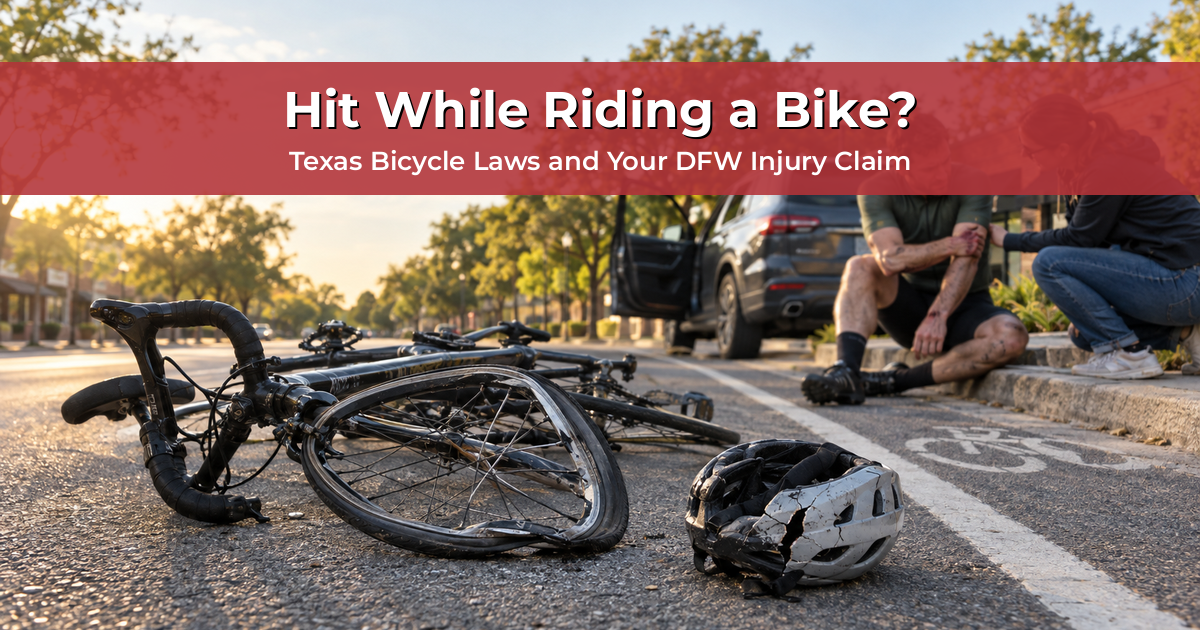
Damaged road bicycle and cracked helmet in a bike lane after a dooring crash, with an injured cyclist on the curb being helped by a passerby

Hit While Riding a Bike in Fort Worth or Dallas? Texas Bicycle Laws and Your Injury Claim

By Jesse Lotspeich · Personal Injury

Short answer: If a driver hits you while you're riding a bicycle in Fort Worth, Dallas, or elsewhere in North Texas, you can usually recover compensation from the at-fault driver's insurance for medical bills, lost income, and pain and suffering. You may also be able to use your own auto policy's PIP and uninsured motorist coverage, even though you weren't in a car. Texas treats a bicycle as a vehicle with the same rights on the road. Fort Worth and Dallas have local "vulnerable road user" ordinances that require drivers to give cyclists safe passing room. You can recover damages as long as you are not more than 50% at fault, so evidence about who caused the crash matters from day one.

Damaged road bicycle and cracked helmet in a bike lane after a dooring crash, with an injured cyclist on the curb being helped by a passerby

Bicycle crashes are some of the most serious collisions we see. A cyclist has no seatbelt, no airbag, and no steel frame, so even a low-speed impact from a right-turning SUV or an opening car door can cause broken bones, a head injury, or worse. According to TxDOT, 80 bicyclists died and another 429 were seriously injured in 2,761 Texas traffic crashes in 2024. Driver inattention, failure to yield the right of way, and speeding were the top contributing factors.

At Howard Lotspeich Alexander & Williams, PLLC (HLAW), we represent injured cyclists across Tarrant, Dallas, Denton, Collin, Johnson, and Parker counties. This guide explains the Texas bicycle laws that matter in an injury claim, how fault is decided, which insurance pays, and what to do after a crash.

Key Takeaways

  • A bike is a vehicle in Texas. Cyclists have the rights and duties of drivers. They must ride with traffic and generally keep to the right, but the law lists several exceptions that let you take the lane.
  • Texas has no statewide 3-foot law. Fort Worth and Dallas have local vulnerable road user ordinances requiring at least 3 feet of clearance for passenger vehicles and 6 feet for trucks.
  • Crosswalk crashes can be crimes. Under Transportation Code §545.428, a driver who negligently injures a cyclist in a crosswalk commits a Class A misdemeanor. It becomes a state jail felony if the cyclist suffers serious bodily injury.
  • The 51% rule. Under CPRC §33.001, you can recover damages if you are 50% or less at fault. Your recovery is reduced by your percentage of fault.
  • Your own auto policy may cover you on a bike. PIP and UM/UIM coverage often protect you as a cyclist, which matters when the driver is uninsured, underinsured, or flees.
  • No helmet doesn't bar your claim. Texas doesn't require adult cyclists to wear helmets, though insurers may still argue about it.
  • The deadline is generally two years. Texas's personal injury statute of limitations is generally two years.

What Texas Bicycle Laws Apply in DFW?

Bicycles have the same rights as cars

The City of Fort Worth's bicycle law guide, drawing on the Texas Driver Handbook, explains that a bicycle is a vehicle. A person riding one has the rights and duties of any vehicle driver, except those that by their nature can't apply to bicycling. Cyclists must obey signs and signals, stop at red lights and stop signs, and ride with traffic, not against it.

When cyclists can take the lane

Drivers and insurance adjusters often assume a cyclist must hug the curb. That's not quite the law. Under Transportation Code §551.103, a cyclist moving slower than traffic must ride "as near as practicable" to the right curb or edge, unless:

  1. They are passing another vehicle;
  2. They are preparing to turn left;
  3. A hazard prevents safe riding at the edge, such as a parked car, debris, a pedestrian, or a poor road surface; or
  4. The outside lane is less than 14 feet wide with no bike lane, or is too narrow for a bike and car to travel safely side by side.

On a one-way street with two or more marked lanes, a cyclist may also ride near the left curb. Many DFW streets have outside lanes narrower than 14 feet, so a cyclist riding in the middle of the lane is often doing exactly what the law allows.

Safe passing: no statewide 3-foot law, but Fort Worth and Dallas have rules

Texas is unusual: it has no statewide minimum passing distance. The Legislature passed a safe passing bill in 2009, but it was vetoed. Statewide, a driver overtaking another vehicle must pass to the left "at a safe distance" under Transportation Code §545.053.

Several North Texas cities have filled the gap. According to the North Central Texas Council of Governments:

City Ordinance Key requirements
Dallas City Code Ch. 28, Sec. 28-58.2 Pass at a safe distance (3 ft for cars, 6 ft for trucks/commercial vehicles); no throwing objects at cyclists; no "right hook" turns in front of a cyclist
Fort Worth City Code Ch. 22, Sec. 22-95 Same as Dallas, plus a ban on maneuvering a vehicle to intimidate or harass a vulnerable road user

BikeTexas reports that Texas cities with safe passing ordinances include Fort Worth, Denton, and Plano. In a civil case, a violation of a safety ordinance like this can be powerful evidence of negligence.

"Dooring" is against the law

One of the most common urban bike crashes happens when a parked driver or passenger opens a door into a cyclist's path. Transportation Code §545.418 says a person may not open a door on the side available to moving traffic unless it can be done "in reasonable safety without interfering with the movement of other traffic." Dooring crashes are common in busy areas like Magnolia Avenue, West 7th, Deep Ellum, and Bishop Arts, where riders pass rows of parked cars.

Crosswalks and the vulnerable road user offense

Under §545.428, a driver commits an offense if they operate a vehicle in a crosswalk with criminal negligence and injure a pedestrian or a person riding a bicycle, scooter, or similar device. It's a Class A misdemeanor, or a state jail felony if the rider suffers serious bodily injury. The statute provides an affirmative defense if the rider was violating traffic laws at the time. A criminal charge doesn't decide your civil case, but it can strengthen your claim.

Helmets and lights

Texas has no statewide helmet requirement for adult cyclists. Fort Worth's guide says wearing an approved helmet is "highly suggested" but "not required by law." At night, Texas law requires a white front lamp and a red rear reflector or lamp, and TxDOT recommends both.

Who Is at Fault in a Texas Bicycle Accident?

Fault is decided under Texas's proportionate responsibility system. A jury or the parties' negotiations assign each person a percentage of responsibility:

  • If you are 50% or less at fault, you can recover, but your damages are reduced by your percentage. For example, 20% fault on a $100,000 claim leaves $80,000.
  • If you are more than 50% at fault, you recover nothing from that defendant.

Insurers know this, so they look for ways to shift blame to the cyclist. Common arguments include riding outside the bike lane, not wearing a helmet, having no lights, wearing dark clothing, or "coming out of nowhere." Many of these arguments fall apart once the facts and the law are examined, such as when §551.103 allowed the cyclist to take the lane. We explain fault in more detail in our article on how fault works in Texas personal injury cases.

Common causes of bike crashes we see in DFW

  • Right hooks: a driver passes a cyclist, then turns right across the cyclist's path.
  • Left crosses: an oncoming driver turns left in front of the cyclist.
  • Unsafe passing: a driver passes too close, sideswipes the cyclist, or forces them off the road.
  • Dooring: a parked car door opens into the cyclist.
  • Driveway and parking-lot exits: a driver pulls out without looking for cyclists on the road or a trail crossing.
  • Distracted driving: texting, using navigation, or using a phone while driving.
  • Road defects: potholes, broken pavement, or debris, which can sometimes support a claim against a government entity, with very short notice deadlines.

Which Insurance Pays After a Bicycle Accident?

Cyclists are often surprised to learn how many coverages may apply:

  1. The at-fault driver's liability insurance. Texas requires minimum liability coverage of $30,000 per person and $60,000 per accident for bodily injury. For a serious bike injury, that's often not enough.
  2. Your own Personal Injury Protection (PIP). PIP is no-fault coverage on Texas auto policies that pays medical bills and lost wages regardless of fault. Depending on your policy language, it may cover you as a cyclist struck by a motor vehicle.
  3. Your own uninsured/underinsured motorist (UM/UIM) coverage. If the driver has no insurance, too little insurance, or leaves the scene, UM/UIM can fill the gap. See our guides on UM/UIM and PIP coverage and hit-and-run crashes in Texas.
  4. Health insurance. Health insurance pays medical bills up front, but it may have a right to be repaid from your settlement. Read more in Who Gets Paid First? Hospital Liens and Your DFW Injury Settlement.
  5. Commercial or employer policies. If a delivery van, work truck, or rideshare vehicle hits you, additional and often larger policies may apply.

Every policy is different. Get a lawyer's review before you give a recorded statement to any insurer, including your own. See insurance adjuster tactics in Fort Worth.

What Compensation Can an Injured Cyclist Recover?

Depending on the facts, damages can include:

  • Past and future medical expenses, including ER care, surgery, physical therapy, and future care.
  • Lost wages and loss of earning capacity.
  • Physical pain and mental anguish.
  • Physical impairment and disfigurement, including scarring and road rash.
  • Damage to your bicycle, helmet, clothing, and gear. High-end bikes and electronics can be expensive.
  • Wrongful death damages for families when a crash is fatal. See wrongful death claims.

In Texas, recoverable medical expenses are generally limited to amounts actually paid or incurred, not the full amount billed, so documenting your medical care carefully matters.

What Should You Do After a Bike Crash in DFW?

  1. Call 911 and get checked out. Adrenaline hides injuries. Head, neck, and internal injuries may not show up right away. Read why you should see a doctor even after a "minor" crash.
  2. Make sure a police report is made. Officers sometimes treat bike crashes as minor. A Texas Peace Officer's Crash Report (CR-3) documents the scene and the driver's information. See how to get your car wreck police report.
  3. Photograph everything. Take photos of the vehicle, its position, the lane, any bike lane markings, skid marks, debris, your bike, and your injuries.
  4. Save your ride data and video. GPS apps (such as Strava or Garmin), helmet cams, and handlebar cameras can show your speed, route, and position on the road. Ask nearby businesses for security footage quickly, and look for dash-cam video. See dash-cam footage in Texas accident cases.
  5. Don't repair or throw away the bike or helmet. Your damaged equipment is evidence.
  6. Get witness names and phone numbers. Independent witnesses are especially valuable when the driver blames the cyclist.
  7. Don't give a recorded statement or post about the crash before talking with a lawyer.
  8. Watch the deadlines. The Texas statute of limitations is generally two years, and claims involving a city or county can require written notice within months.

Frequently Asked Questions

Does Texas have a 3-foot passing law for bicycles?

Not statewide. A statewide safe passing bill was vetoed in 2009. However, Fort Worth (City Code Ch. 22, Sec. 22-95) and Dallas (City Code Ch. 28, Sec. 28-58.2) have vulnerable road user ordinances requiring drivers to pass at a safe distance: 3 feet for passenger vehicles and 6 feet for trucks and commercial vehicles. Statewide, drivers must still pass at a safe distance under §545.053.

Can I recover damages if I wasn't wearing a helmet?

Yes. Texas has no statewide helmet law for adults, so not wearing one isn't illegal. An insurer may argue a helmet would have reduced a head injury, but that doesn't bar your claim. How much it matters depends on the injury and the evidence.

Do I have to ride in the bike lane?

Texas law generally requires a cyclist moving slower than traffic to ride as near as practicable to the right edge, but §551.103 lists exceptions. These include hazards and lanes too narrow to share safely. Riding outside a bike lane isn't automatically negligent, and the specific facts and any local ordinance matter.

Will my car insurance cover me if I was hit while on my bike?

Often, yes. PIP and UM/UIM coverage on a Texas auto policy may protect you as a cyclist struck by a motor vehicle, depending on the policy language. This is especially important in hit-and-run cases and when the driver carries only minimum coverage.

What if the driver says I came out of nowhere?

That's one of the most common defenses in bike crash cases. Evidence often answers it: video, GPS data, lighting, sight lines, crash reconstruction, and witnesses. Under Texas's proportionate responsibility rule, you can still recover if you are found 50% or less at fault.

How long do I have to file a bicycle accident claim in Texas?

Generally two years from the date of the crash for a personal injury lawsuit. Claims against government entities, such as for a road defect or a city vehicle, can require formal notice much sooner. Talk to a lawyer promptly.

Is a bike crash in a crosswalk a crime for the driver?

It can be. Under §545.428, a driver who negligently injures a cyclist within the area of a crosswalk commits a Class A misdemeanor, or a state jail felony if the cyclist suffers serious bodily injury. The criminal case is separate from your civil claim, but a conviction can help prove fault.

Talk to a Fort Worth Bicycle Accident Lawyer

Cyclists are entitled to share the road, and drivers who ignore that should be held responsible. HLAW's personal injury attorneys represent injured cyclists, pedestrians, and drivers throughout Dallas-Fort Worth. We gather the evidence, deal with the insurers, and fight for full compensation. Call (817) 993-9249 or contact us online for a free consultation.


This article is for general informational purposes only and is not legal advice. Reading it does not create an attorney-client relationship. Insurance coverage depends on your specific policy language, local ordinances can change, and every case depends on its facts. Consult a licensed Texas attorney about your situation.

Read full article
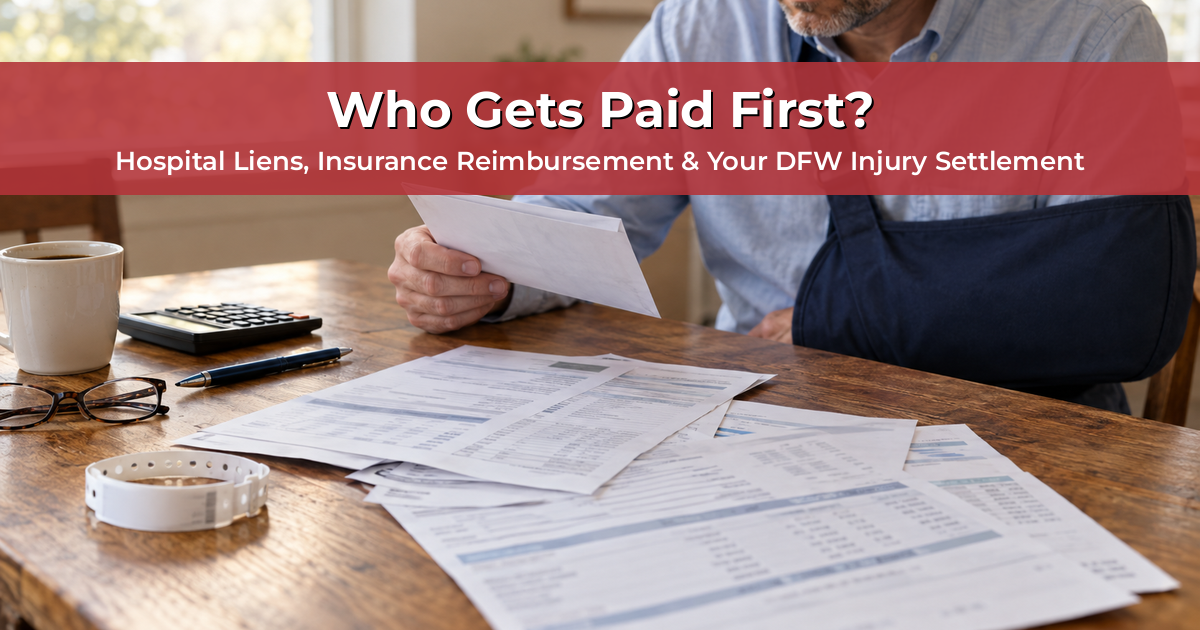
Injured man in an arm sling reviewing hospital bills and a patient wristband at his kitchen table after a Dallas-Fort Worth car wreck

Who Gets Paid First? Hospital Liens, Health Insurance Reimbursement, and Your DFW Injury Settlement

By Luke A. Williams · Personal Injury

Short answer: In Texas, a hospital that treats you within 72 hours of an accident caused by someone else's negligence can place a lien on your injury claim. That lien is capped at the lesser of the hospital's charges for the first 100 days of care or 50% of your recovery. Health insurers, Medicare, and some government plans may also have a right to be repaid from your settlement. The amount you ultimately keep depends heavily on how those claims are identified, challenged, and negotiated before the case closes.

Injured man in an arm sling reviewing hospital bills and a patient wristband at his kitchen table after a Dallas-Fort Worth car wreckMost people injured in a Dallas-Fort Worth car wreck, truck crash, or fall focus on one number: the settlement offer. But the settlement number and the amount that actually reaches you are rarely the same. Between the two sits a layer of liens and reimbursement claims that many injured people never hear about until they are asked to sign a release.

At Howard Lotspeich Alexander & Williams, PLLC (HLAW), lien resolution is part of every personal injury case we handle, and it is often where a meaningful part of a client's net recovery is won or lost. This guide explains how the system works in Texas and what you can do about it.

Key Takeaways

  • Texas hospital liens arise under Chapter 55 of the Texas Property Code. They attach to your claim, judgment, or settlement, not to your home or other property.
  • The 72-hour rule matters. A hospital lien attaches only if you were admitted within 72 hours of the accident, and Texas law treats being allowed into any department of the hospital, including the emergency room, as an admission.
  • There is a 50% cap. A hospital lien cannot exceed half of what you recover, and it does not cover charges above a "reasonable and regular rate."
  • Your recoverable medical damages are limited to what was actually paid or owed. Under Texas's "paid or incurred" rule, the inflated sticker price on a hospital bill is generally not what a jury will see.
  • Health insurers usually have to share attorney's fees and are capped as well. Texas Chapter 140 limits many health plans' reimbursement claims, though self-funded employer plans and Medicare follow different rules.
  • An unresolved lien can delay or invalidate a settlement. A release signed without satisfying a properly filed hospital lien is not valid against the hospital.

What Is a Hospital Lien in Texas?

A hospital lien is a legal claim a hospital holds against the money you recover from the person or company that caused your injury. Under Texas Property Code § 55.002, a hospital has a lien on the cause of action or claim of a person who receives hospital services for injuries caused by an accident attributed to another person's negligence.

According to Section 55.003, the lien attaches to three things:

  1. Your cause of action for damages arising from the injury,
  2. Any judgment you obtain in court, and
  3. The proceeds of any settlement.

Importantly, the hospital lien statute requires the hospital's notice to tell you that the lien does not attach to real property you own. In other words, a Chapter 55 lien follows the injury claim, not your house.

The 72-Hour Requirement

For a hospital lien to attach, you must have been admitted to the hospital no later than 72 hours after the accident, as stated in Section 55.002(a). Many people assume that a trip to the emergency room without an overnight stay is not an "admission." Texas law says otherwise. Since 2019, Section 55.0015 has provided that a person is considered admitted if they are allowed access to any department of the hospital for treatment, care, or service.

Practically, that means if you were taken to an emergency room in Fort Worth, Arlington, Dallas, or anywhere else in Texas within three days of a wreck, you should assume a lien may exist.

The lien also extends to a second hospital if you were transferred for treatment of the same injury, under Section 55.002(b).

How Much Can a Texas Hospital Lien Be?

This is where the statute offers real protection. Under Section 55.004(b), a hospital lien is limited to the lesser of:

  1. The hospital's charges for services during the first 100 days of your hospitalization;
  2. 50% of all amounts you recover through a lawsuit, judgment, or settlement; or
  3. If a jury specifies the amount awarded for hospital charges, that amount minus a pro rata share of your reasonable attorney's fees and expenses.

The lien also may not include charges that exceed a reasonable and regular rate for the services, according to Section 55.004(d). That language is a frequent starting point for negotiating hospital balances that are far above what the same hospital accepts from insurers.

The lien may also include certain emergency physician charges from the first seven days of hospitalization, but not physician charges that were already paid through insurance or that the physician is entitled to collect from your health plan under an assignment of benefits, per Section 55.004(c)–(d).

What About the Ambulance?

Texas also allows emergency medical services (EMS) providers to claim a lien, but only for EMS provided in a county with a population of 800,000 or less, and the lien is capped at $1,000, as provided by Sections 55.002(c) and 55.004(f).

This has a distinctly local effect in North Texas. Tarrant, Dallas, Collin, and Denton counties each had more than 900,000 residents at the 2020 Census, according to North Central Texas Council of Governments population data. Smaller surrounding counties such as Johnson, Parker, Wise, and Hood are well under that threshold. So whether an ambulance company can assert a lien may depend on which side of a county line the wreck happened.

How a Hospital Secures (and Loses) Its Lien

A hospital does not automatically hold an enforceable lien just because it treated you. Under Section 55.005, the hospital must:

  • File a written notice of lien with the county clerk in the county where services were provided, before money is paid to the injured person; and
  • Mail notice to the injured person (or their representative) within five business days after the clerk records it.

The notice must identify the injured person, the date of the accident, the hospital, and the person alleged to be liable, if known.

Once a lien is properly secured, it has teeth. Under Section 55.007, a release of your claim is not valid against the hospital unless the hospital's charges were paid (in full, or to the extent of the consideration paid), or the hospital is a party to the release. This is why liability insurers routinely run county lien searches and add hospitals as co-payees on settlement checks.

For an injured person, this has two consequences:

  • You cannot simply ignore a lien and expect the insurance company to pay you directly.
  • Your lawyer needs to identify liens early, by checking county records in places like Tarrant, Dallas, and Denton counties, so they can be challenged and negotiated before the settlement is finalized, rather than discovered at the last minute.

The "Paid or Incurred" Rule: Why Sticker Prices Don't Control

Texas hospitals often bill at full "chargemaster" rates that few patients or insurers actually pay. Texas law limits what you can recover for past medical expenses to the amount actually paid or incurred.

Texas Civil Practice and Remedies Code § 41.0105 provides that recovery of medical or health care expenses "is limited to the amount actually paid or incurred by or on behalf of the claimant." In Haygood v. De Escabedo, the Texas Supreme Court held that this statute limits both recovery and the evidence presented at trial to expenses that the provider has a legal right to be paid. In that case, roughly $110,000 in billed charges was reduced to about $27,700 after required Medicare adjustments, as summarized by Chamberlain Hrdlicka.

Why does this matter for liens? Because the same gap between "billed" and "owed" that limits what a defendant must pay also gives an experienced attorney leverage to negotiate down hospital balances and reimbursement claims.

A note on 2025 legislation: In 2025, the Texas Legislature considered Senate Bill 30, which would have further changed how medical expenses are proven in injury cases. The bill ended in conference and did not become law, according to Phelps Dunbar, which notes it could return when the Legislature convenes on January 12, 2027. We will continue to monitor any changes.

When Your Health Insurer Wants to Be Repaid

If your own health insurance paid your medical bills after the wreck, your policy very likely contains a subrogation or reimbursement clause. That clause lets the insurer seek repayment from your injury settlement.

For many Texas-regulated health plans, Chapter 140 of the Texas Civil Practice and Remedies Code caps that recovery. When you are represented by an attorney, the payor's share is the lesser of:

  • One-half of your gross recovery, less attorney's fees and procurement costs; or
  • The total benefits the plan paid as a result of the injury, less attorney's fees and procurement costs.

Chapter 140 also states that the common-law "made whole" doctrine does not apply to these payors, according to Section 140.005(d). The statute applies to insurance companies, HMOs, and certain public employee plans listed in Section 140.002.

The important exception: Self-funded employer health plans governed by the federal ERISA statute are often not bound by state anti-subrogation rules like Chapter 140. The U.S. Supreme Court's decision in FMC Corp. v. Holliday is the foundation for that rule. These plans are governed by the specific language in the plan documents, which is why requesting and reviewing the actual plan document is a critical step in any case involving employer-provided coverage.

Medicare and Other Government Payors

If you are a Medicare beneficiary, federal law treats Medicare as a "secondary payer" when liability insurance is responsible for an injury. According to CMS, Medicare can make "conditional payments" for accident-related care, but those payments must be repaid when you receive a settlement, judgment, or award.

CMS guidance on the recovery process explains that a pending liability case must be reported to the Benefits Coordination & Recovery Center (BCRC), and that the settlement date, amount, and attorney's fees and procurement costs must be reported when the case resolves. Medicare's final demand accounts for a proportionate share of those procurement costs, as described in the Medicare Secondary Payer Manual.

Medicare claims are not something to handle casually. Federal law gives the government strong collection rights, so these claims should be resolved through the proper process, with related-versus-unrelated charges carefully reviewed before the final demand is paid. Medicaid, VA, TRICARE, and workers' compensation carriers each have their own separate recovery rules.

A Simple Example

Imagine a Fort Worth driver is rear-ended on I-35W, taken to an emergency room, and later treated with physical therapy. The case settles for $100,000.

  • The hospital files a lien for $40,000 in charges.
  • The driver's health plan paid $15,000 toward therapy and imaging.

Without careful lien work, the driver might assume that roughly $55,000 of the settlement is gone before fees and costs. In practice, the hospital lien is limited to its reasonable and regular rate (and can never exceed $50,000, which is 50% of the recovery), and a Chapter 140-governed health plan must reduce its claim by its share of attorney's fees. Negotiation of each balance can further reduce the amounts owed.

Every case is different, and the actual numbers depend on the type of plan, the bills, and the facts, but the example shows why lien resolution is not a clerical afterthought. It directly determines how much of your settlement you keep.

What You Should Do After a DFW Accident

  1. Keep every bill, explanation of benefits (EOB), and letter you receive from hospitals, ambulance companies, and insurers.
  2. Do not ignore a lien notice in the mail. It is often the first sign that a hospital has recorded a lien with the county clerk.
  3. Give your providers your health insurance information. Hospitals sometimes prefer to file a lien for full charges instead of billing your insurer at negotiated rates. Insisting that your insurance be billed can significantly reduce what is owed.
  4. Tell your attorney if you have Medicare, Medicaid, or an employer health plan, and find out whether your employer plan is fully insured or self-funded.
  5. Do not sign a release or accept a check until every lien and reimbursement claim has been identified and addressed.
  6. Talk to an injury lawyer who handles liens directly, rather than a high-volume firm that hands lien work to a settlement processor. (Learn more about why that difference matters.)

Frequently Asked Questions

Can a Texas hospital put a lien on my house after a car wreck?

No. A Chapter 55 hospital lien attaches to your injury claim, judgment, or settlement. The statute requires the hospital to tell you that the lien does not attach to real property you own, as stated in Texas Property Code § 55.005(d).

Does a hospital lien apply if I only went to the emergency room?

Usually yes. Texas treats access to any department of the hospital, including the ER, as an admission under Section 55.0015, as long as it occurred within 72 hours of the accident.

Can a hospital lien take my entire settlement?

No. A hospital lien under Chapter 55 cannot exceed 50% of the amounts you recover, and it is limited to the lesser of that cap, the first 100 days of charges, or a jury-specified amount reduced by attorney's fees, under Section 55.004(b).

Does a hospital lien attach to my own insurance coverage?

Generally, a Chapter 55 lien does not attach to proceeds of an insurance policy in favor of the injured person, except liability insurance that protects against loss from an accident or collision, according to Section 55.003(b). How this applies to a particular PIP or uninsured/underinsured motorist claim should be reviewed by your attorney. (See our guide to UM/UIM and PIP coverage in Texas.)

Does my health insurance company get paid back out of my settlement?

Often yes, if your policy has a reimbursement clause. For many Texas-regulated plans, Chapter 140 limits the insurer to the lesser of half your recovery or the benefits it paid, each reduced by attorney's fees and costs. Self-funded ERISA plans may follow different rules.

Will lien negotiations delay my settlement?

They can add time, but resolving them correctly protects you. A release given without satisfying a properly secured hospital lien is not valid against that hospital under Section 55.007, which is why insurers insist that liens be addressed before they pay.

Talk to a Fort Worth Personal Injury Attorney

At HLAW, a partner personally handles your case from the first call through the final disbursement, including the lien and reimbursement negotiations that determine how much of your settlement you actually keep. We represent injured people across Fort Worth, Keller, Southlake, Grapevine, Arlington, Dallas, and the greater Dallas-Fort Worth area in car wreck, truck accident, wrongful death, and other personal injury cases.

If you've been hurt and are worried about medical bills or hospital liens, contact Howard Lotspeich Alexander & Williams, PLLC or call (817) 993-9249 for a free consultation.


This article is for general informational purposes only and is not legal advice. Reading it does not create an attorney-client relationship. Lien and reimbursement rules depend on the specific facts, plan documents, and current law; consult an attorney about your situation.

Read full article
Insurance policy terms and conditions document with the headline "If You're Waiting for the Insurance Company to 'Do the Right Thing,' Read This"

If You’re Waiting for the Insurance Company to ‘Do the Right Thing,’ Read This

By Jesse Lotspeich · Personal Injury

Waiting for the Insurance Company to ‘Do the Right Thing’? Your Rights and Legal Options in Texas

Insurance claims should settle problems — not create new ones. When claims drag or are denied, the stress and bills can pile up quickly. This guide explains why insurers delay claims, what “bad faith” means in Texas, and the practical legal steps you can take to protect your rights. We’ll also outline the types of recovery that may be available and how Howard Lotspeich Alexander and Williams, PLLC (HLAW) can stand with you through the process.

What Causes Insurance Claim Delays in Texas — and How They Hurt You

Delays happen for many reasons, and they often leave people with mounting expenses and uncertainty. Knowing the common causes helps you respond more effectively and avoid unnecessary setbacks.

Common Delay Tactics Used by Insurers — What to Watch For

Insurers sometimes slow claims by asking for excessive records, stretching out investigations, or losing paperwork. They might repeatedly request the same medical records or ask for additional proof of loss to buy time. Recognizing these tactics lets you push back and keep your claim moving.

Financial and Emotional Impact on Personal Injury Claimants

Slow claims can force you to cover medical bills, miss work, and dip into savings while you wait. The uncertainty also creates stress that affects recovery and daily life. Understanding the real costs of delay makes it easier to document damages and seek appropriate relief.

What Is Bad Faith Insurance in Texas — and How Do You Spot It?

“Bad faith” describes an insurer’s unfair or unreasonable behavior toward a policyholder. Spotting it early can be crucial to protecting your rights and pursuing a remedy.

How Texas Law Defines Bad Faith Insurance

Under Texas law, bad faith generally means an insurer failed to act in good faith or deal fairly with a policyholder. That can include unreasonable delays, denying valid claims without a reasonable basis, or failing to perform a proper investigation. Texas statutes and case law give policyholders tools to challenge these practices when they occur.

Real-World Examples of Bad Faith Conduct

Bad faith can look like denying a claim on a tenuous technicality, ignoring a claimant’s calls, or failing to explain why a claim was refused. If an insurer denies a car-accident claim without a thorough investigation, that conduct may cross the line into bad faith. Identifying these patterns helps build a stronger case.

What Legal Rights Do You Have When a Claim Is Delayed or Denied in Texas?

If your insurer delays or denies your claim, Texas law offers protections and potential remedies. Knowing these rights helps you decide the best next steps.

Key Texas Statutes That Protect Policyholders

Gavel and paperwork symbolizing insurance consumer protections in Texas

The Texas Insurance Code requires insurers to handle claims fairly and within set timeframes. When carriers ignore those duties, policyholders may have grounds for complaints or lawsuits. Understanding these statutes gives you a foundation for asserting your rights and seeking recovery.

These laws are the legal basis you can use to challenge unfair insurer conduct and pursue relief.

How the Texas Civil Practice and Remedies Code Helps in Insurance Disputes

The Texas Civil Practice and Remedies Code supplies additional tools for pursuing claims against insurers, including the ability to recover certain damages and attorneys’ fees in appropriate cases. Familiarity with this code helps you and your lawyer frame the correct legal theory when challenging insurer misconduct.

How Can You Take Action Against an Insurance Company for Delayed Payment in Texas?

If you’re facing an unwarranted delay, there are practical steps you can take to push your claim forward and protect your legal options.

How to File a Complaint with the Texas Department of Insurance

Filing a complaint with the Texas Department of Insurance (TDI) is a constructive first step. TDI oversees insurer conduct and can investigate consumer complaints. Before filing, collect your policy documents, claim numbers, and all correspondence with the carrier. A formal complaint can prompt TDI review and may speed a resolution.

Complaints to TDI often flag violations of the rules designed to stop improper delays.

When It May Be Time to Sue Your Insurance Company for Bad Faith

If an insurer continues to delay or denies a valid claim without justification, legal action may be necessary. A bad faith suit requires proof that the carrier acted unreasonably or breached its contractual duties. Consulting with an experienced attorney will help you evaluate the evidence and determine if litigation is appropriate.

What Compensation Can You Seek for Insurance Claim Delays in Texas?

Knowing the possible forms of recovery helps you and your lawyer set realistic expectations and document the losses you’ve suffered.

Damages Available in Bad Faith Insurance Cases

In a bad faith case, you may seek compensatory damages for out-of-pocket losses such as medical bills and lost wages caused by the delay. In certain cases, punitive damages are also available to punish particularly egregious conduct, though these require clear and convincing proof of malice or gross negligence. Emotional distress claims are limited under Texas law and are evaluated on a case-by-case basis.

Punitive damages can deter future wrongdoing by insurers when extreme misconduct is proven.

How a Fort Worth Personal Injury Lawyer Can Improve Your Settlement

A Fort Worth personal injury lawyer brings experience with both insurance practices and litigation strategy. An attorney can collect evidence, communicate with the insurer, and, when necessary, file suit to seek full compensation. That advocacy often results in stronger settlements and protects your rights throughout the claim process.

Why Choose Howard Lotspeich Alexander and Williams, PLLC (HLAW) for Your Insurance Dispute?

Insurance disputes are stressful and legally complex. Our firm focuses on helping Texans hold insurers accountable and recover what they are owed. We combine legal experience with practical advocacy to protect our clients’ interests at every step.

Our Experience in Texas Personal Injury and Insurance Law

We provide clear legal advice, strategic representation, and hands-on support for clients facing insurance disputes. With experience in bad faith and personal injury matters, we know how Texas law applies and how to press for fair outcomes. Our goal is straightforward: protect your rights and pursue the recovery you need.

Client Results and a Free Case Review

We’ve helped many clients obtain favorable results against insurers that improperly delayed or denied claims. We offer a free consultation to review your situation and explain your options. Choosing Howard Lotspeich Alexander and Williams, PLLC means partnering with a dedicated legal team focused on results.

Legal Right Description Relevant Statute
Right to Timely Payment Insurers must process claims promptly Texas Insurance Code § 542.051
Right to Fair Treatment Insurers must act in good faith Texas Insurance Code § 541.060
Right to Appeal Denials Policyholders can contest claim denials Texas Civil Practice and Remedies Code § 38.001

Frequently Asked Questions

What should I do if my insurance claim is denied?

Start by reading the denial letter carefully to learn the insurer’s reasons. Gather supporting documents — medical records, bills, photos, and communications — and ask the carrier for clarification in writing. If the denial still seems wrongful, contact an attorney who handles insurance disputes to review your options and decide whether to appeal, file a complaint with TDI, or pursue litigation.

How long does an insurance company have to respond to a claim in Texas?

Texas rules generally require insurers to acknowledge a claim within 15 days and to accept or reject it within 30 days, unless more information is requested. Missing these deadlines can trigger penalties under the Texas Prompt Payment of Claims Act. Exact timelines can vary by claim type and circumstances, so consult the statute or an attorney for specifics.

Can I file a lawsuit against my insurance company for delays?

Yes. If an insurer unreasonably delays or denies a valid claim, you may have a cause of action under Texas law. To succeed, you’ll need to show the carrier failed to meet its obligations without a reasonable basis. An attorney can help assess the strength of your case and guide you through the litigation process if needed.

What evidence do I need to prove bad faith insurance practices?

Useful evidence includes written communications with the insurer, records of repeated delay or denial, medical and financial documentation showing your losses, and any internal insurer documents you can obtain. Witness statements or expert opinions can also strengthen a bad faith claim. A lawyer can help gather and organize the evidence you need to build a compelling case.

What are the potential outcomes of a bad faith insurance lawsuit?

Outcomes vary by case. Successful claims can result in compensatory damages for actual losses, recovery of attorneys’ fees in certain situations, and, when misconduct is especially egregious, punitive damages. Each case depends on the evidence and legal theory, so outcomes are evaluated on an individual basis.

How can I expedite my insurance claim process?

Provide complete and accurate documentation quickly, follow up regularly with the adjuster, and keep detailed records of all communications. If the carrier stalls, file a complaint with the Texas Department of Insurance and consider consulting an attorney who can press the claim and, if necessary, take legal action to move things forward.

Conclusion

You don’t have to wait in silence while an insurer delays or denies a legitimate claim. Know your rights, document your losses, and use the legal tools Texas provides. If you need help, Howard Lotspeich Alexander and Williams, PLLC (HLAW) can review your case, explain your options, and take action to pursue the compensation you deserve. Contact us to start your free consultation and protect your interests.

Read full article
Satirical billboard of a 'Cash Cow' settlement mill lawyer against the Fort Worth skyline, illustrating the dangers of hiring high-volume injury firms.

The Billboard Trap: The Hidden Economics of "Billboard Lawyers" and Why They Cost You Money

By Jesse Lotspeich · Personal Injury

Satirical billboard of a 'Cash Cow' settlement mill lawyer against the Fort Worth skyline, illustrating the dangers of hiring high-volume injury firms.
Don't let a catchy slogan cost you thousands. While 'Settlement Mill' firms spend millions on billboards to process volume, true trial lawyers focus on maximizing value in the courtroom.

They promise "Easy Money" and shout from every billboard on I-35. But behind the marketing budget lies a high-volume factory model that insurance companies have learned to exploit. Here is the in-depth reality of why the lawyer you see the most is often the one the insurance company fears the least.

If you live in Dallas-Fort Worth, you cannot escape them. The "Strong Arms." The "Hammers." The catchy jingles promising instant checks and aggressive representation.

When you are injured, in pain, and watching medical bills pile up, these advertisements are designed to trigger a psychological response: relief. They promise a fast, easy solution to a complex problem.

But before you dial that 1-800 number, you need to understand the business mechanics behind those ads. You are not just hiring a lawyer; you are entering a business ecosystem known in the legal industry as a "Settlement Mill."

Hiring a firm based on a billboard is often the single most profitable thing you can do— for the insurance company.

The Economics of the "Settlement Mill"

To understand why these firms often deliver lower results, you have to look at their balance sheet.

Marketing on television and billboards in a major metroplex like DFW costs millions of dollars per month. To cover that massive overhead, these firms require one thing above all else: Volume.

They cannot survive by handling 50 cases a year with extreme care and precision. They need to sign up 500, 1,000, or 2,000 cases a year to pay their advertising bills.

This creates a factory mentality:

  • The Intake Floor: When you call, you are rarely speaking to a lawyer. You are speaking to a call center trained to sign you up immediately.
  • The Conveyor Belt: Once signed, your case enters a queue. To keep the lights on, the firm needs to move your case from "Open" to "Settled" as fast as possible.
  • The Conflict: Taking a case to trial takes time (often 12-18 months or more) and costs money. Settling a case takes 90 days. For a volume firm, a quick settlement of $15,000 is often more profitable for them than fighting for two years to get you $100,000.

The "Case Manager" Reality

The most common complaint we hear from clients who fire billboard or television commercial firms to hire HLAW is simple: "I never met my attorney."

In the Settlement Mill model, attorneys are expensive. To maximize profit, these firms assign your case to a "Case Manager" or "Pre-Litigation Specialist." These are often non-lawyers with no legal degree. Their job is to gather your medical records and process your claim like data entry.

At Howard Lotspeich Alexander & Williams (HLAW), we reject this model. Our partners are former prosecutors and local attorneys with well over a decade of courtroom and trial experience. When you hire us, you get us. We believe that strategic legal decisions should be made by trial lawyers, not administrative staff.

The "Colossus" Factor: How Insurance Companies Profile Your Lawyer

This is the secret the industry tries to keep quiet: Insurance companies use AI and data profiling to value your case.

Major carriers like Allstate, State Farm, and Geico use evaluation software (such as Colossus) to determine how much to offer you. One of the most heavily weighted inputs in that algorithm is the identity of your lawyer.

The insurance industry maintains vast historical data on law firms. They know exactly which firms:

  1. File lawsuits: (The firms that fight).
  2. Settle pre-litigation: (The firms that fold).

If you hire a billboard lawyer who settles 99% of their cases without ever filing a lawsuit, the software flags your claim as "Low Risk." The computer knows there is no threat of a jury verdict, so it spits out a "Lowball" offer range.

Conversely, when an adjuster sees HLAW on the letterhead, the risk profile changes. They see a firm led by serious litigators who are comfortable in a courtroom. To avoid the cost and risk of a trial, the software—and the adjuster—are forced to increase the offer.

The Missing Weapon: The Stowers Doctrine

Texas law provides a powerful weapon for injury victims called the Stowers Doctrine.

In simple terms, a Stowers demand forces an insurance company to pay their policy limits now, or risk being on the hook for the entire jury verdict later (even if it exceeds the policy). It is the ultimate pressure tactic.

But a Stowers demand is a bluff unless you can back it up.

If a Settlement Mill sends a Stowers demand, the insurance company often laughs it off. They know that firm has no intention of going to trial. They know that if they say "no," the billboard lawyer will likely just convince the client to take the lower amount.

At HLAW, our Stowers demands have teeth. We prepare every case as if it is going to trial. We take depositions. We hire experts. We build the pressure until the insurance company realizes that paying you fairly is their only safe option.

The "Litigation Gap"

Here is a scenario that happens every day in Fort Worth: A client hires a TV lawyer. The insurance company denies liability or makes a tiny offer. Because the TV lawyer relies on "easy" settlements, they don't want to do the hard work of filing a lawsuit.

So, they drop the client. They send a letter saying, "We can no longer represent you."

Now, the client has lost months of time and has to start over. At HLAW, we are Battle-Tested Trial Lawyers. We don't cherry-pick only the easy cases. If the insurance company refuses to be fair, we don't drop you—we sue them.

Don't Be a Statistic. Be a Priority.

Marketing is not the same as legal ability. A catchy jingle doesn't scare a billion-dollar insurance corporation. A billboard doesn't win a cross-examination.

Your injury settlement is likely the only compensation you will ever receive for your pain, your surgery, and your lost future wages. Do not entrust that financial lifeline to a firm that views you as a unit of inventory.

Choose the firm that insurance companies respect—and take seriously.

Contact HLAW today for a free consultation and case evaluation. We don’t need billboards to tell you who we are. We let our results in the courtroom do the talking.

Read full article
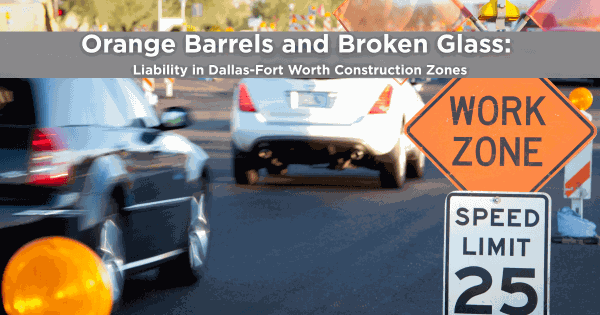
Cars driving through a construction work zone in Dallas-Fort Worth with orange barrels and speed limit signs, illustrating accident liability risks.

Orange Barrels and Broken Glass: Liability in Dallas-Fort Worth Construction Zones

By Jesse Lotspeich · Personal Injury

Cars driving through a construction work zone in Dallas-Fort Worth with orange barrels and speed limit signs, illustrating accident liability risks.
Navigating the maze of orange barrels in Dallas-Fort Worth: When confusion leads to a crash, proving liability often requires looking beyond the driver to the construction company itself.


If you live in Keller or commute through Fort Worth, you know the reality: the orange barrels seem permanent. Whether it is the massive widening projects along I-30 from Linkcrest Drive to I-820, or the perpetual "North Tarrant Express" updates on I-35W, Tarrant County drivers are constantly navigating a shifting maze of concrete barriers.

But here is the hard truth that many drivers overlook: Construction zones do not just cause traffic; they actively create hazards.

When a crash happens in these confused, narrow chutes of highway, the default assumption is "driver error." The police report might simply say "Failure to Control Speed." However, as experienced attorneys, we know that in many cases, the road design was the true culprit.

If you were injured because a construction company created a "trap" on the roadway, who is responsible? The answer lies in a complex intersection of engineering standards and Texas law.

The Anatomy of a "Construction Negligence" Case

It is not enough to say the road was confusing. To win a personal injury claim involving road construction, we must prove that the setup violated the Standard of Care.

In Texas, construction companies are bound by specific safety protocols, usually outlined in the Texas Manual on Uniform Traffic Control Devices (TMUTCD).

Common violations we see in Fort Worth include:

The "Ghost Lane" Phenomenon

When traffic is shifted to a new pavement section, the old white lines must be completely obliterated. Often, contractors do a poor job of grinding them off. When it rains or the sun hits at a certain angle (glare), the old lines reappear. If you drifted into a car because you were following what looked like a valid lane, that is a failure of the contractor's duty to warn.

The "Edge Drop-Off" Hazard

During widening projects (like on I-30), contractors often leave a significant drop-off between the paved lane and the shoulder. If a wheel slips off the edge, a driver’s natural reaction is to jerk the steering wheel back, often causing a rollover or a crossover head-on collision. If that drop-off was not properly marked or shielded with barriers, the contractor may be liable.

Inadequate Signage Spacing

The TMUTCD mandates exactly how far in advance a "Right Lane Closed" sign must be placed based on the speed limit. If the speed limit is 65 MPH but they placed the warning sign only 100 feet before the taper, they effectively deprived you of the reaction time needed to merge safely.

The Legal Hurdle: Sovereign Immunity vs. Private Liability

This is the most critical legal concept for victims to understand.

The Government (TxDOT): Under the doctrine of Sovereign Immunity, the government is generally immune from lawsuits. You generally cannot sue TxDOT for a design decision they made years ago.

The Private Contractor: TxDOT hires private consortiums and construction firms to execute the work. These private companies do not enjoy the same immunity. If a private contractor deviates from the approved Traffic Control Plan (TCP)—for example, if the plan said "place barrels every 20 feet" and they placed them every 50 feet—they can be sued for negligence.

  • The "Derivative Immunity" Defense: Contractors often try to argue, "We were just doing what TxDOT told us to do."
  • How We Defeat It: We subpoena the daily logs and inspection reports. If we can prove the contractor cut corners, ignored the blueprints, or failed to fix a known hazard (like a pothole or missing sign) within a reasonable time, they lose that protection.

The "Proportionate Responsibility" Trap

Insurance adjusters love construction zone accidents because they are chaotic. Their favorite tactic in Texas is to use the Modified Comparative Negligence rule (the "51% Bar").

They will argue: "Sure, the lane lines were confusing, but you were driving 5 MPH over the work-zone speed limit. Therefore, you are more than 50% at fault, and we owe you nothing."

In a construction zone case, fighting this percentage is everything. We counter this by hiring accident reconstruction experts who can prove that no reasonable driver could have navigated that hazard safely, regardless of a minor speed variance. We shift the focus from your driving to the inevitability of the crash caused by the trap they set.

The Investigation: What We Look For

If you hire a generalist lawyer, they might just pull the police report. At Howard Lotspeich Alexander & Williams (HLAW), we dig much deeper for construction-specific evidence:

  1. The Traffic Control Plan (TCP): The literal blueprint of where every cone and sign should have been. We compare this to photos of where they actually were.
  2. The Contractor’s Daily Logs: Site superintendents must keep logs of work performed and inspections made. Did they check the signs that morning? Did they note that a barrier had been knocked over but fail to fix it?
  3. 311 and TxDOT Complaint Logs: Often, other drivers have reported the exact same hazard days before your crash. If the contractor knew about the danger and ignored it, that moves the case from simple negligence to potentially gross negligence.
  4. Body Cam & Dash Cam Footage: Police body cams often capture the officer complaining about the confusing road setup. This is powerful jury evidence.

Steps to Protect Your Claim Immediately

Construction zones change daily. The evidence that exists today will be paved over tomorrow.

  • Take Wide-Angle Photos: Don't just photograph the damage to your car. Photograph the approach to the crash site. We need to see what the signs looked like before you hit the hazard.
  • Check for Witnesses: Did other drivers stop? Ask them if they found the lane configuration confusing.
  • Preserve Your Vehicle: If the crash was caused by a mechanical failure due to road debris or a drop-off, the physical damage to your tires and suspension is evidence. Do not let the insurance company salvage the car until we have inspected it.

Why Local Representation Matters

Navigating a claim against a major construction consortium is not a DIY project. These companies have teams of lawyers whose sole job is to blame the driver.

You need a firm that understands both the Criminal (traffic citations) and Civil (injury) sides of the law to protect your rights fully. If you or a loved one has been injured in a confusing construction zone in Keller or Fort Worth, don't assume it was just "bad luck."

[Contact HLAW Today for a Case Evaluation]

Let our team investigate if a failure in the road design turned your commute into a crisis.

Read full article

Speak with a Fort Worth attorney

Call (817) 993-9249 or send us a message to discuss your case.