Short answer: In Texas, the driver who rear-ends you is usually, but not automatically, the one at fault. Texas law requires following drivers to keep an "assured clear distance," but courts hold that the mere fact of a rear-end collision does not prove negligence by itself. In a chain-reaction crash, a jury divides responsibility among every driver who contributed. You can recover as long as you are not more than 50% at fault, and any defendant found more than 50% responsible can be made to pay the entire judgment.
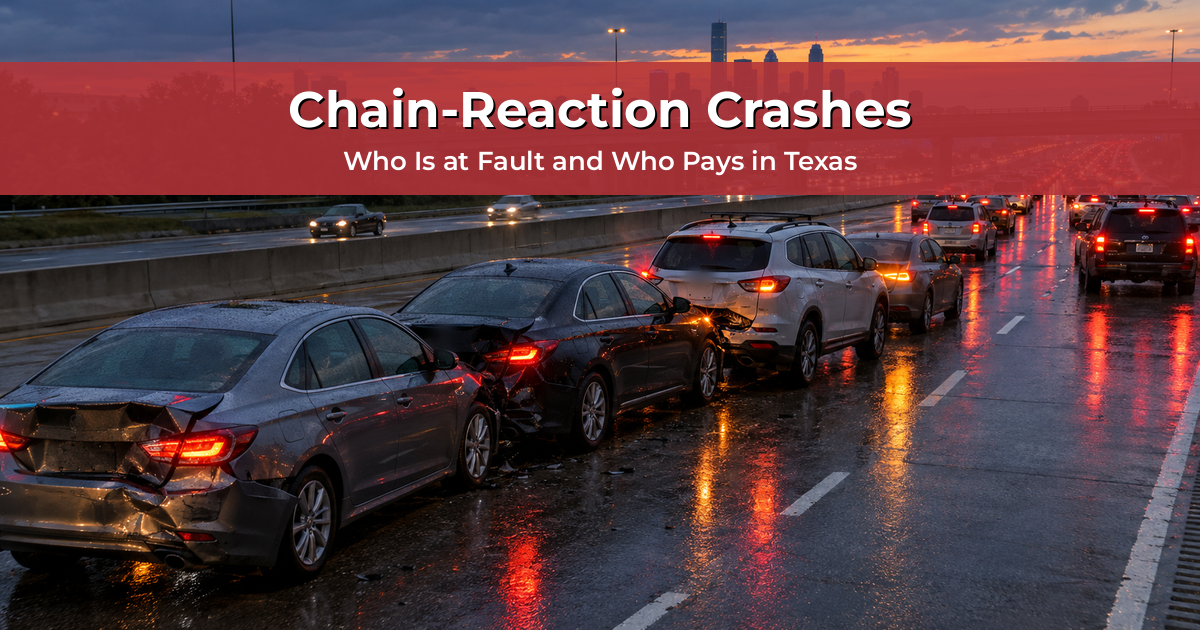
Rear-end and chain-reaction crashes are part of daily life on DFW highways. Traffic on I-35W, I-30, I-20, Loop 820, LBJ (I-635), and Highway 121/183 can go from 70 mph to a dead stop in seconds, and when one driver doesn't stop in time, three, four, or five vehicles can end up in the same crash. In 2025, TxDOT recorded 30,433 reportable crashes in Tarrant County and 43,946 in Dallas County (TxDOT 2025 crashes and injuries by county).
At Howard Lotspeich Alexander & Williams, PLLC (HLAW), our Fort Worth trial lawyers handle personal injury claims across Tarrant, Dallas, Denton, Collin, Johnson, and Parker counties. This guide explains how Texas assigns fault in rear-end and multi-car crashes, what the other drivers' insurers will argue, and what you can do to protect your claim.
Key Takeaways
- Following drivers have a statutory duty. Texas Transportation Code §545.062 requires a following driver to keep an "assured clear distance" so they can stop safely (Tex. Transp. Code §545.062).
- A rear-end crash is evidence of negligence, not automatic proof of it. Texas courts, including the Fort Worth Court of Appeals, hold that the mere occurrence of a rear-end collision is not negligence as a matter of law (Campbell v. Perez).
- Fault is divided by percentages. The jury assigns a percentage of responsibility to each claimant, defendant, settling person, and designated responsible third party (Tex. Civ. Prac. & Rem. Code §33.003).
- The 51% bar applies. You can't recover if you are more than 50% responsible, and your recovery is reduced by your own percentage (§§33.001, 33.012).
- Joint and several liability above 50%. A defendant found more than 50% responsible can be held liable for all recoverable damages (§33.013(b)).
- Evidence disappears fast. Dash-cam footage, vehicle data, and witness memories can be lost within days, so early investigation matters.
Who Is at Fault in a Rear-End Collision in Texas?
Usually the following driver. Section 545.062(a) of the Transportation Code says a driver following another vehicle "shall... maintain an assured clear distance between the two vehicles so that, considering the speed of the vehicles, traffic, and the conditions of the highway, the operator can safely stop without colliding with the preceding vehicle." In other words, the law expects you to leave enough room to stop for whatever happens ahead, including a sudden slowdown on I-30 at rush hour.
But Texas doesn't treat a rear-end collision as automatic liability. Courts have said for decades that "the mere occurrence of a rear-end collision is some evidence of negligence of the rear-ending driver but is not negligence as a matter of law," and that the plaintiff must prove "specific acts of negligence on the part of the following driver as well as proximate cause" (Campbell v. Perez, Tex. App.—Fort Worth 2015). Courts have also held that a violation of §545.062 doesn't create negligence per se. It sets the same reasonable-care standard as the common law and leaves the question to the jury (Arn v. Stuart, Tex. App.—Austin 2010).
That's why "they hit me from behind" is the start of a case, not the end of it. Specific acts of negligence commonly proven in rear-end cases include:
- Following too closely for the speed, traffic, or weather
- Failing to keep a proper lookout
- Speeding or driving too fast for conditions
- Failing to brake in time
- Texting or reading messages while driving, which is a separate traffic offense in Texas (§545.4251)
- Driving while intoxicated
When the lead driver can share fault
The defense will look for ways to shift blame to you. Common arguments include:
- You stopped suddenly and without reason, or "brake-checked" the other driver
- You cut in front of the following driver and then slowed down
- Your brake lights didn't work
- You were stopped in a travel lane without hazard lights
In one Austin case cited often by Texas courts, a jury that believed the lead driver stopped "abruptly" and without explanation was allowed to find the following driver not negligent (Hall v. Moore). These arguments are fact-specific, and evidence like dash-cam video and vehicle data often decides them.
How Is Fault Divided in a Chain-Reaction Crash?
A chain-reaction crash (sometimes called a multi-car pileup) happens when one impact pushes vehicles into each other. A typical DFW example: Car C slams into Car B, which is pushed into Car A, which was stopped in traffic on Loop 820. Sometimes there are two separate impacts: Car B stops in time, and then Car C hits Car B and shoves it into Car A.
Texas handles these crashes under the proportionate responsibility statute, Chapter 33 of the Civil Practice and Remedies Code:
| Rule | What it means for you | Source |
|---|---|---|
| Percentages for everyone | The jury assigns a percentage of responsibility to each claimant, each defendant, each settling person, and each designated responsible third party | §33.003 |
| 51% bar | You can't recover if your share is greater than 50% | §33.001 |
| Reduction for your share | Your damages are reduced by your percentage of responsibility | §33.012(a) |
| Several liability | Each defendant generally pays only its own percentage | §33.013(a) |
| Joint and several above 50% | A defendant found more than 50% responsible can be liable for all recoverable damages | §33.013(b) |
| Responsible third parties | A defendant can ask to put a non-party, such as a driver who fled, on the verdict form, generally by motion at least 60 days before trial | §33.004 |
For a broader look at these rules, see our article on how fault works in Texas personal injury cases.
Why the percentages matter so much
Suppose you're in Car A, stopped in traffic, and you suffer $200,000 in damages. A jury finds Car C's driver 70% responsible and Car B's driver 30% responsible, and assigns you 0%. Because Car C's driver is over 50%, that driver is jointly and severally liable and can be made to pay the full $200,000. If the jury had instead split fault 50/50 between B and C, neither would be over 50%, and each would generally owe only $100,000. That matters if one of them has only minimum insurance.
Which impact caused which injury?
Multi-impact crashes raise a causation question: which collision caused which injury? The insurer for the first car may argue your injuries came from the second impact, and vice versa. Accident reconstruction, vehicle damage photos, airbag control module (event data recorder) downloads, and medical testimony are often needed to connect specific injuries to specific impacts. A thorough police crash report helps, but reports are often incomplete in multi-car crashes, especially when officers arrive after the vehicles have been moved.
What Defenses Will the Insurance Companies Raise?
Beyond blaming the lead driver, expect these arguments:
- Sudden emergency. Texas juries can be instructed that a driver confronted with an emergency "arising suddenly and unexpectedly," which the driver didn't cause, isn't negligent if the driver responded as a reasonably prudent person would (Dillard v. Texas Electric Cooperative, quoting the Texas Pattern Jury Charge). Drivers sometimes claim a car cut them off or debris appeared in the road.
- Unavoidable accident. This instruction tells jurors that an occurrence may not have been caused by any party's negligence, and it is most often raised with fog, ice, wet pavement, or obstructed views (Dillard). The Supreme Court of Texas approved its use in a rear-end crash with a car stopped on the blind side of an overpass in Reinhart v. Young, 906 S.W.2d 471 (Tex. 1995).
- Phantom driver. The defense may blame an unidentified vehicle that caused the chain reaction and then left. Your own uninsured motorist coverage may matter here. Our guide to UM/UIM and PIP coverage explains how it works.
- Minimal damage, minimal injury. Insurers often argue that low bumper damage means no real injury. Medical records, treatment consistency, and expert testimony answer that argument.
Wet pavement doesn't excuse following too closely. Section 545.062 expressly requires drivers to consider "the conditions of the highway." Drivers who know the road is wet are expected to leave more room. A police report that marks "following too closely" helps, but it is not conclusive. In one Texas case, the jury found no negligence despite that notation (Smith v. Central Freight Lines), which is why independent evidence matters.
What Evidence Wins Rear-End and Pileup Cases?
The strongest claims are built in the first few weeks:
- Dash-cam and phone video. Your own camera, other drivers' cameras, and rideshare or commercial fleet cameras. Our article on dashcam footage after a Texas car accident explains how to preserve it.
- Traffic and business cameras. TxDOT and city traffic cameras, toll gantry systems, and nearby business security cameras. Many are overwritten quickly, so preservation requests must go out fast.
- Event data recorders. Most modern vehicles record speed, braking, and throttle data in the seconds before a crash.
- Cell phone records. If distraction is suspected, phone records can show texting or app use at the moment of impact.
- Commercial vehicle data. If a truck or delivery van was involved, electronic logging devices, telematics, and driver files are critical. See our 18-wheeler and commercial truck crash guide.
- Witness statements. Independent witnesses are especially valuable in chain reactions, where each driver tends to blame the next.
What Should You Do After a Rear-End or Chain-Reaction Crash in DFW?
- Get to safety and call 911. On a highway, stay in your vehicle with your seatbelt on if it isn't safe to get out.
- Photograph every vehicle. Take pictures of each vehicle's damage, its position, its license plate, and the driver's insurance card.
- Get names and contact information for every driver and witness. In a chain reaction, you may have claims against more than one driver.
- Don't apologize or guess about fault. Stick to the facts.
- Get medical care promptly. Neck, back, and head injuries from rear impacts often get worse over the following days.
- Save your dash-cam footage immediately. Many cameras record over old footage in a loop.
- Be careful with adjusters. In a multi-car crash, several insurers may call you, each hoping to pin blame on someone else. Read about insurance adjuster tactics in Fort Worth before giving a recorded statement.
- Watch the deadline. Most Texas injury lawsuits must be filed within two years. If a government vehicle was involved, the notice deadline can be as short as six months. See our Texas statute of limitations guide.
Frequently Asked Questions
Is the driver who rear-ends you always at fault in Texas?
No, but usually. Texas law requires following drivers to keep an assured clear distance (§545.062), and a rear-end crash is some evidence of negligence. Still, courts hold it isn't negligence as a matter of law, so you must prove specific negligent acts and causation (Campbell v. Perez).
Who pays in a three-car chain-reaction crash?
Each driver who contributed pays their percentage of responsibility, and any driver found more than 50% at fault can be made to pay the full judgment (§33.013). Often the last car in the chain bears most of the responsibility, but not always. Middle drivers who were also following too closely can share fault.
I was in the middle car. Can I be sued?
Yes. If you were pushed into the car ahead after being hit, the evidence often shows you weren't at fault for that impact. But if you hit the car ahead first and were then struck from behind, you may share responsibility for the first impact. Each impact is analyzed separately.
Can I recover if I was partly at fault?
Yes, as long as you are not more than 50% responsible. Your damages are reduced by your percentage (§§33.001, 33.012).
What if the driver who started the chain reaction drove away?
You may be able to make a claim under your uninsured motorist coverage, and the remaining defendants may try to designate the missing driver as a responsible third party (§33.004). Report the crash to police immediately and preserve any video.
Does rain or ice excuse a rear-end crash?
Not by itself. The assured-clear-distance rule expressly considers "the conditions of the highway" (§545.062), so drivers are expected to leave more room in bad weather. A defendant may still ask for an unavoidable-accident instruction if the evidence supports it.
Talk to a Fort Worth Car Wreck Lawyer
Rear-end and chain-reaction crashes look simple, but the fault fight between multiple drivers and insurers can be complicated, and evidence disappears quickly. HLAW can preserve video and vehicle data, identify every responsible driver and policy, and build the proof Texas law requires. Call (817) 993-9249 or contact us online for a free consultation. You can also read more about what compensation is available in a Texas personal injury lawsuit.
This article is for general informational purposes only and is not legal advice. Reading it does not create an attorney-client relationship. Every case depends on its specific facts, and the laws discussed here may change.