Short answer: In Texas, a driver under 21 commits the offense of Driving Under the Influence by a Minor (DUI) if he or she operates a motor vehicle in a public place with any detectable amount of alcohol in his or her system. A first or second offense is a Class C misdemeanor, but it still carries mandatory community service, an alcohol awareness class, and a separate 60-day administrative license suspension for a first offense. If the State can prove the minor was actually intoxicated, the charge can instead be a regular DWI under Penal Code § 49.04, a much more serious Class B misdemeanor.
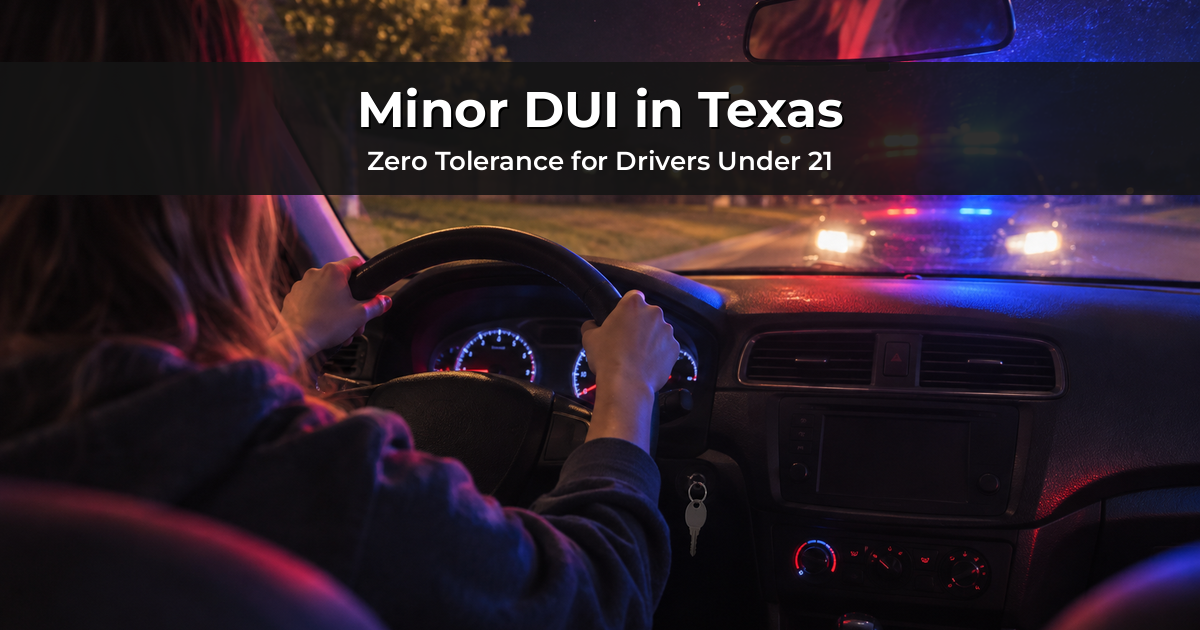
Texas treats underage drinking and driving under a "zero tolerance" rule. That means a college student pulled over on I-35W after one beer, or a high school senior stopped leaving a party in Keller or Southlake, can face criminal charges and lose a driver's license even though the breath or blood result was well below 0.08.
At Howard Lotspeich Alexander & Williams, PLLC (HLAW), our Fort Worth DWI attorneys defend young drivers and their families in Tarrant, Dallas, Denton, Collin, Johnson, and Parker counties. This guide explains what a minor DUI charge is, how it differs from DWI, what penalties and license consequences apply, and what steps a family should take in the first 15 days.
Key Takeaways
- Zero tolerance: A minor (anyone under 21) commits DUI by operating a motor vehicle in a public place, or a watercraft, with "any detectable amount of alcohol" in his or her system (Tex. Alco. Bev. Code § 106.041).
- Class C, but not minor: A first or second offense is a Class C misdemeanor. A third offense by a minor who is not a "child" carries a fine of $500 to $2,000, up to 180 days in jail, or both (§ 106.041(c)).
- Mandatory requirements: A conviction requires 20 to 40 hours of alcohol-related community service for a first offense (§ 106.041(d)) and an alcohol awareness or substance misuse education program (§ 106.115).
- Separate license case: Even before the criminal case is resolved, DPS can suspend a minor's license for 60 days on a first offense, 120 days on a second, and 180 days on a third through the Administrative License Revocation (ALR) program (Tex. Transp. Code § 524.022).
- 15-day deadline: The minor generally has 15 days after receiving notice of suspension to request an ALR hearing (§ 524.031).
- DWI is still possible: A minor who is "intoxicated," meaning he or she has lost the normal use of mental or physical faculties or has an alcohol concentration of 0.08 or more, can be charged with DWI (Tex. Penal Code § 49.01).
- Expunction may be available: A person convicted of only one Alcoholic Beverage Code violation while a minor may apply to have it expunged after turning 21 (§ 106.12).
What Is a Minor DUI in Texas?
Texas uses two different terms that often get confused. "DWI" (Driving While Intoxicated) is the Penal Code offense that applies to drivers of any age. "DUI" in Texas usually refers to the separate Alcoholic Beverage Code offense of Driving or Operating Watercraft Under the Influence of Alcohol by a Minor.
Under § 106.041(a) of the Alcoholic Beverage Code, "a minor commits an offense if the minor operates a motor vehicle in a public place, or a watercraft, while having any detectable amount of alcohol in the minor's system." The Code defines a "minor" as "a person under 21 years of age" (§ 106.01).
In other words, the State does not need to prove 0.08 or impairment; any detectable amount is enough. The statute also covers watercraft, which matters on Eagle Mountain Lake, Lake Grapevine, and Lake Lewisville.
The officer does not have to take the minor to jail. Section 106.041(i) allows a peace officer to issue a citation with a date to appear before a magistrate instead of making a custodial arrest. In practice, though, many minors stopped late at night are arrested and taken to a city or county jail, especially when the officer suspects intoxication.
How Is a Minor DUI Different From a DWI?
The difference is mostly about what the State has to prove and what the punishment is. The table below summarizes the main distinctions.
| Issue | Minor DUI (Alco. Bev. Code § 106.041) | DWI (Penal Code § 49.04) |
|---|---|---|
| Who can be charged | Only drivers under 21 | Drivers of any age |
| What the State must prove | Any detectable amount of alcohol while operating | Intoxication: loss of normal use of faculties or 0.08 or more |
| Offense level (first offense) | Class C misdemeanor | Class B misdemeanor, minimum 72 hours confinement |
| Jail exposure on a first offense | None (fine only) | Up to 180 days |
| Community service | 20 to 40 hours, alcohol-related | Varies with community supervision |
| ALR suspension (first offense) | 60 days for a minor | 90 days for an adult; 60 days for a minor |
Section 106.041(g) also provides that minor DUI "is not a lesser included offense" of DWI, intoxication assault, BWI, or related offenses. That matters in plea negotiations. A prosecutor who files a DWI cannot simply have a jury convict on DUI as a fallback, so reducing a DWI to a minor DUI is usually done through a negotiated agreement rather than at trial.
For drivers 21 and older, Texas DWI law requires proof of intoxication. We explain how that works for adults with lower test results in our article on being arrested for DWI under a .08 BAC.
What Are the Penalties for a Minor DUI in Texas?
First and second offenses
Under § 106.041(b), a first or second offense is a Class C misdemeanor. A Class C misdemeanor is punishable by a fine only, but the court must also order:
- Community service: "not less than 20 or more than 40 hours" for a first offense, or "not less than 40 or more than 60 hours" for a minor previously convicted of DUI (§ 106.041(d)). The service "must be related to education about or prevention of misuse of alcohol" (§ 106.041(e)).
- An alcohol awareness or substance misuse education program: On conviction of a minor with no prior conviction under the listed sections, the court "shall require" the defendant to complete an alcohol awareness program or a substance misuse education program (§ 106.115(a-1)). If the minor is younger than 18, the court may require a parent or guardian to attend with the minor (§ 106.115(a-2)).
Third and later offenses
If the defendant is a minor who is not a "child" and has been previously convicted at least twice of minor DUI, the offense is punishable by a fine of $500 to $2,000, jail of up to 180 days, or both (§ 106.041(c)). A minor in that position is also not eligible for deferred disposition or deferred adjudication (§ 106.041(f)).
What counts as a prior?
Texas counts more than formal convictions. Under § 106.041(h), a juvenile adjudication for the same conduct and an order of deferred disposition both count as prior convictions for enhancement purposes. A family that accepted deferred disposition on a first ticket should know it can be used to raise the stakes on a later one.
Juvenile court for younger drivers
The Texas Family Code defines a "child" for juvenile justice purposes as a person who is 10 or older and under 17, with a limited extension for 17-year-olds whose conduct occurred before age 17 (Tex. Fam. Code § 51.02). A third or subsequent minor DUI by a child is classified as delinquent conduct (§ 51.03(a)(4)), which moves the case into juvenile court. Families in Tarrant County can learn more in our guide to juvenile probation in Tarrant County.
What Happens to a Minor's Driver's License?
License consequences are often the most painful part of a minor DUI case, and they come from more than one direction.
The ALR suspension
Texas runs a civil Administrative License Revocation (ALR) program that is separate from the criminal case. Under Transportation Code § 524.011, an officer must serve a notice of suspension when a minor is arrested for DUI or DWI and either is not asked for a specimen or provides one showing an alcohol concentration "greater than .00" but below 0.08.
The suspension periods for a minor under § 524.022(b) are:
- 60 days if the minor has no prior conviction for DUI, DWI, or a related intoxication offense;
- 120 days if the minor has one prior conviction; and
- 180 days if the minor has two or more prior convictions.
The implied consent warning officers read under § 724.015 tells a person younger than 21 that a license will be suspended for not less than 60 days if he or she has any detectable amount of alcohol, "even if the person submits to the taking of the specimen."
Refusing a breath or blood test
A minor arrested for DUI is deemed to have consented to give a breath or blood specimen (§ 724.011). A refusal leads to a 180-day suspension, or two years if the driving record shows a prior alcohol-related or drug-related enforcement contact within 10 years (§ 724.035). We discuss the consequences of refusal in more depth in our post on criminal penalties for refusing a breath test.
Suspension for skipping the alcohol class
If the defendant does not provide proof of completing the alcohol awareness program or required community service within 90 days of final conviction (extendable once by up to 90 days for good cause), the court "shall order" DPS to suspend the license for up to six months, or up to one year if the defendant has a prior conviction under the listed sections (§ 106.115(c)-(d)). On the other hand, a defendant who finishes on time may have the fine reduced to as little as one-half of the original amount (§ 106.115(c)).
A DWI conviction for a driver under 21
If the case is charged and resolved as DWI rather than DUI, the consequences increase. Transportation Code § 521.342(b) directs DPS to suspend for one year the license of a person under 21 who is convicted of DWI, unless the person is placed on community supervision with an ignition interlock requirement. For more on hardship driving privileges, see our guide to occupational driver's license rules.
How Big Is the Underage Drunk Driving Problem in Texas?
Texas crash data explains why prosecutors and police treat these cases seriously. According to TxDOT's 2025 Texas Motor Vehicle Traffic Crash Facts, 906 people were killed in 2025 in crashes where a driver was under the influence of alcohol, which was 24.04% of all traffic deaths in the state. TxDOT's report on DUI drivers in fatal crashes by driver age shows 80 drivers under 21 statewide among the 836 DUI drivers involved in fatal crashes in 2025, or 9.57%.
Can a Minor DUI Charge Be Defended?
Yes. A "zero tolerance" law lowers the alcohol threshold, but the State still has to prove every element, and the ALR case has its own requirements. Common issues we examine include:
- The stop: Did the officer have reasonable suspicion to pull the car over? At an ALR hearing, DPS must prove "whether reasonable suspicion to stop or probable cause to arrest the person existed" (§ 524.035(a)(2)).
- Operation in a public place: The statute requires operating a motor vehicle "in a public place." A parked car on private property may raise questions.
- Age: The person must have been a minor on the date the specimen was obtained.
- Proof of a detectable amount: If no specimen was taken, the State must rely on other evidence, such as an odor of alcohol, admissions, or open containers. An administrative law judge may not sustain the suspension unless he or she finds the minor "had any detectable amount of alcohol" (§ 524.035(d)(2)).
- Testing and warnings: We review whether the officer gave the statutory warnings correctly and whether breath or blood testing followed required procedures.
- Body camera and dash camera video: Video often shows a different picture than the written report.
Results depend on the facts of each case, and no lawyer can promise a particular outcome. But many minor DUI cases have options short of a conviction, including deferred disposition for eligible first-time defendants (with the program requirements in § 106.115(a)).
What Should a Family Do After a Minor DUI Arrest?
- Calendar the 15-day ALR deadline. Count from the date the notice of suspension was received. Missing the deadline usually means the suspension takes effect automatically. Our article on the ALR hearing 15-day deadline explains the process.
- Find the citation or bond paperwork. Note the court, the appearance date, and whether the charge is DUI under § 106.041 or DWI under § 49.04.
- Do not discuss the facts on social media or with friends. Posts and messages can become evidence.
- Do not simply pay the ticket. Paying a Class C citation is usually treated as a plea and a conviction, which can count as a prior and trigger license and program requirements.
- Gather documents. Collect the driver's license, insurance information, any receipts from that evening, and names of witnesses.
- Talk with a DWI defense lawyer. An attorney can request the ALR hearing, obtain video, and evaluate defenses and deferred disposition options.
Can a Minor DUI Be Removed From a Record?
Often, yes. Under § 106.12 of the Alcoholic Beverage Code, a person "convicted of not more than one violation of this code while a minor" may, on turning 21, apply to the convicting court to have the conviction expunged. A person arrested for not more than one incident who was not convicted may also apply to expunge the arrest records. The court charges a $30 application fee, and this procedure is separate from the general expunction law in Chapter 55A of the Code of Criminal Procedure.
A DWI conviction is treated very differently and generally cannot be expunged. For an overview, see our expunction and nondisclosure guide for Texas.
Frequently Asked Questions
Is one drink enough for a minor DUI in Texas?
It can be. The statute applies when a minor has "any detectable amount of alcohol" while operating a motor vehicle in a public place, so even a small amount of alcohol may be enough if it can be detected (§ 106.041).
Will my child go to jail for a first minor DUI?
A first or second offense is a Class C misdemeanor, which is punishable by fine only. Jail of up to 180 days becomes possible on a third offense by a minor who is not a child. If the State charges DWI instead, the punishment range includes a minimum of 72 hours of confinement (Penal Code § 49.04).
How long is the license suspension for a minor DUI?
Through the ALR program, the suspension is 60 days for a first offense, 120 days with one prior conviction, and 180 days with two or more prior convictions (§ 524.022). A refusal to give a specimen carries a 180-day suspension. Additional suspensions can follow if the alcohol class is not completed on time.
What if my child was 20 but turned 21 before court?
Age is measured at the time of the conduct. For ALR purposes, the question is whether the person "was a minor on the date that the breath or blood specimen was obtained" (§ 524.012(b)(2)).
Can a minor DUI be expunged?
If it was the person's only Alcoholic Beverage Code conviction as a minor, he or she may apply for expunction after turning 21 under § 106.12. A dismissed or acquitted charge may be eligible for expunction as well.
Talk With a Fort Worth DWI Defense Lawyer
A minor DUI can affect a young person's license, insurance, school, and job plans. The time to act is before the 15-day ALR deadline passes and before any plea is entered. HLAW represents young drivers and families across Tarrant, Dallas, Denton, Collin, Johnson, and Parker counties.
Call (817) 993-9249 or contact us online for a free consultation.
This article is for informational purposes only and is not legal advice. Reading it does not create an attorney-client relationship. Laws change, and every case depends on its own facts.