Skip to content
Tag

Texas Felony Law Enhancements During a State of Disaster

4 articles

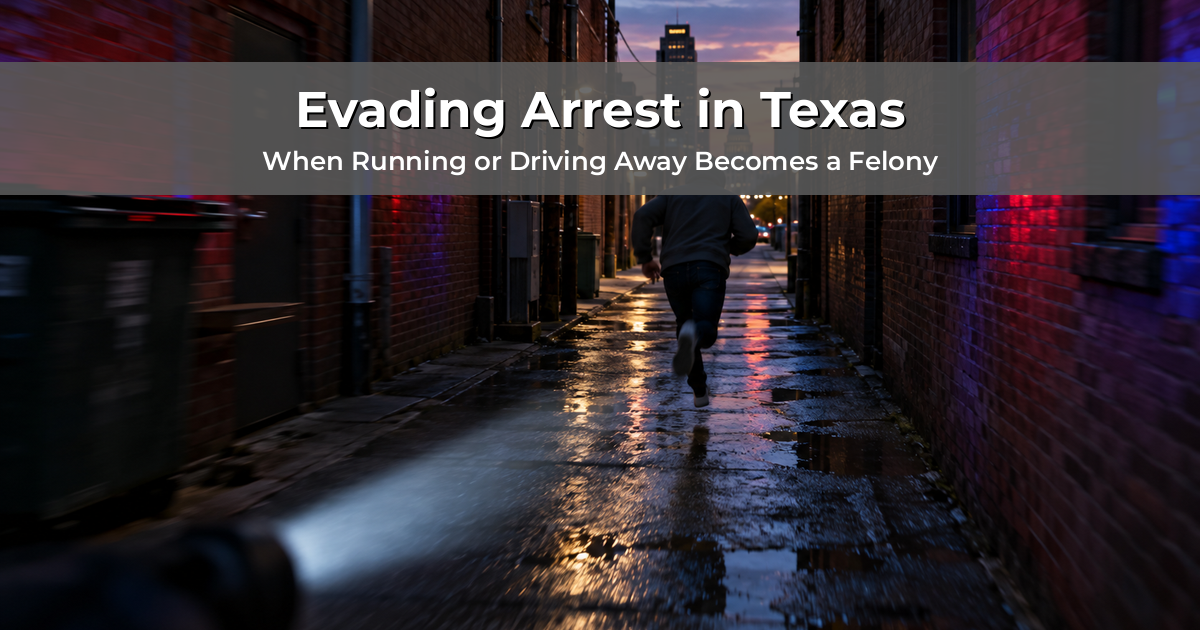
Person running down a wet downtown alley at dusk as a police flashlight beam crosses the pavement

Evading Arrest in Texas: When Running or Driving Away From Police Becomes a Felony

By Luke A. Williams · Criminal Defense

Short answer: In Texas, evading arrest or detention means intentionally fleeing from someone you know is a peace officer who is lawfully trying to arrest or detain you. Running on foot is usually a Class A misdemeanor, punishable by up to one year in jail. Fleeing in a vehicle is generally a third-degree felony, punishable by 2 to 10 years in prison, even on a first offense. The State must prove you knew an officer was trying to stop you, and that the stop itself was lawful. Those two elements are often where the defense begins.

Person running down a wet downtown alley at dusk as a police flashlight beam crosses the pavement

Evading arrest charges are common in Dallas-Fort Worth. A traffic stop on I-35W or Loop 820 turns into a short chase, a passenger runs from a car in an apartment parking lot, or someone panics and drives a few blocks before pulling over. What may feel like a split-second decision can bring a felony charge, a possible deadly weapon finding, and consequences that last far longer than the original stop.

At Howard Lotspeich Alexander & Williams, PLLC (HLAW), our Fort Worth defense lawyers handle criminal defense cases in Tarrant, Dallas, Denton, Collin, Johnson, and Parker counties. This guide explains how Texas defines evading arrest, how the penalties escalate, and what defenses may apply.

Key Takeaways

  • The offense has specific elements. Under Texas Penal Code §38.04(a), a person commits an offense "if he intentionally flees from a person he knows is a peace officer or federal special investigator attempting lawfully to arrest or detain him."
  • Fleeing on foot is generally a Class A misdemeanor, punishable by up to one year in jail and a fine of up to $4,000 (Penal Code §12.21).
  • Fleeing in a vehicle is generally a third-degree felony, even without a prior conviction. Texas courts, beginning with the Fort Worth Court of Appeals in Adetomiwa v. State, have resolved conflicting 2011 amendments that way.
  • Knowledge is an essential element. The accused "must know that the person from whom he flees is a peace officer attempting to arrest or detain him" (Hobyl v. State).
  • A car can be found to be a deadly weapon. A deadly weapon finding can limit probation options and delay parole eligibility (Code of Criminal Procedure art. 42A.054; Government Code §508.145).

What Counts as Evading Arrest in Texas?

The State must prove each part of §38.04(a) beyond a reasonable doubt:

  1. The person intentionally fled. Fleeing can mean running, driving away, or refusing to stop. Texas courts have described the offense as refusing "to yield to a police show of authority" (Redwine v. State).
  2. From a peace officer or federal special investigator. The person must know the pursuer is law enforcement.
  3. Who was attempting to arrest or detain the person. The person must know the officer was trying to stop or arrest him, not just that police were nearby.
  4. Lawfully. The statute requires that the officer was "attempting lawfully" to arrest or detain. If the officer had no legal basis for the stop, that element may fail.

Evading arrest is different from resisting arrest. Resisting arrest under §38.03 involves using force against an officer, and Texas law says it is "no defense" that the arrest was unlawful. Evading arrest is about flight, and the lawfulness of the stop is part of the offense itself. Our article on resisting an unlawful arrest in Texas explains that distinction further.

How Serious Is an Evading Arrest Charge?

The offense level depends on how the person fled, whether anyone was hurt, and the person's history.

Situation Offense level Punishment range
Fleeing on foot, no prior evading conviction Class A misdemeanor Up to 1 year in jail and up to $4,000 fine
Fleeing on foot with a prior evading conviction State jail felony 180 days to 2 years in state jail and up to $10,000 fine
Using a vehicle while in flight Third-degree felony 2 to 10 years in prison and up to $10,000 fine
Another person suffers serious bodily injury as a direct result of the officer's attempt to apprehend Third-degree felony 2 to 10 years in prison and up to $10,000 fine
Another person dies as a direct result of the officer's attempt to apprehend Second-degree felony 2 to 20 years in prison and up to $10,000 fine

Sources: Penal Code §38.04(b) and the punishment ranges in Penal Code §§12.21, 12.33, 12.34, and 12.35.

The statute also makes the offense more serious if the person uses a tire deflation device against the officer, and a 2023 amendment added a third-degree felony provision when the evading occurs during certain smuggling offenses. Section 38.04(d) adds that a person "may be prosecuted under either or both this section and the other law," so evading is often charged alongside DWI, drug possession, or other offenses arising from the same stop.

Is Evading Arrest in a Car Always a Felony?

In practice, yes. In 2011, the Texas Legislature passed three bills amending §38.04. Two of them made vehicle evading a state jail felony for a first offense, and the third made it a third-degree felony. The statute still prints both versions.

The Fort Worth Court of Appeals addressed the conflict in Adetomiwa v. State, 421 S.W.3d 922 (Tex. App.—Fort Worth 2014, no pet.). The court concluded that "Senate Bill 1416 amended the punishment scheme of section 38.04 to provide that evading arrest is a third degree felony if the actor uses a vehicle in flight," and that even if the bills were irreconcilable, the later vote on Senate Bill 1416 would prevail (Adetomiwa opinion). Other Texas appellate courts have agreed, so a first-time vehicle evading case in DFW is typically charged and prosecuted as a third-degree felony.

That matters because a third-degree felony can be enhanced by prior felony convictions, and it carries the full weight of a felony record. Our post on pleading "true" to a felony enhancement discusses how enhancements work in practice.

Can a Car Be a Deadly Weapon in an Evading Case?

Yes. A motor vehicle is not a deadly weapon by itself, but it can be one if "in the manner of its use or intended use" it is "capable of causing death or serious bodily injury" (Penal Code §1.07(a)(17)(B)). The Texas Court of Criminal Appeals uses a two-part test from Sierra v. State, 280 S.W.3d 250 (Tex. Crim. App. 2009). Courts first evaluate the manner in which the defendant used the vehicle, then consider whether, during the felony, it was capable of causing death or serious bodily injury (Sierra v. State).

Factors courts look at include intoxication, speeding, disregarding traffic signs and signals, erratic driving, and failure to control the vehicle. There must also be evidence that others were actually endangered. As the Fort Worth Court of Appeals has noted applying these cases, "a hypothetical potential for danger" is not enough (Wesson v. State).

A deadly weapon finding has major consequences:

  • No judge-ordered probation. Under art. 42A.054(b), judge-ordered community supervision is not available when a deadly weapon was used or exhibited during a felony. A jury may still recommend community supervision in some cases.
  • Delayed parole eligibility. Under Government Code §508.145(d), an inmate with a deadly weapon finding is not eligible for parole until actual time served equals one-half of the sentence or 30 years, whichever is less, and never in less than two years.
  • Future enhancement. Under Penal Code §12.35(c), a prior felony with a deadly weapon finding can cause a future state jail felony to be punished as a third-degree felony.

Because of these effects, whether the State pursues a deadly weapon finding is often one of the most important issues in a vehicle evading case.

What Are Common Defenses to Evading Arrest?

Every case turns on its facts, but these issues come up often.

The person did not know an officer was trying to stop him

Knowledge is "an essential element" of the offense (Hobyl v. State). Evidence that an officer was trying to stop a vehicle generally consists of emergency lights and a siren. In Redwine, the Houston Fourteenth Court of Appeals found the evidence legally insufficient where officer testimony about whether the patrol car's lights were on was uncertain, holding that "the gravamen of the offense is the evasion of an arrest, not the evasion of a police officer" (Redwine v. State). Dash camera and body camera video, the route driven, and the time elapsed before stopping can all matter.

The stop or arrest was not lawful

Because the statute requires that the officer was "attempting lawfully" to arrest or detain, the legal basis for the stop is part of the State's case. If the officer lacked reasonable suspicion for a detention or probable cause for an arrest, the defense can challenge that element.

The person was not "fleeing"

Slowing down, looking for a safe place to pull over, or continuing briefly to a well-lit area is not necessarily intentional flight. The facts of how and when the person stopped are important.

Challenging the enhancement or the deadly weapon allegation

Even when the evading itself is hard to contest, the defense may challenge whether a vehicle was actually used as a deadly weapon under the Sierra test, whether anyone was actually endangered, or whether a prior conviction qualifies for enhancement.

What Should You Do After an Evading Arrest Charge in DFW?

  1. Do not discuss the incident with officers, jail staff, or on recorded jail calls. Statements about why you drove or ran can be used to prove knowledge.
  2. Write down what you remember for your lawyer only: where you were, what you saw in the mirror, when lights or sirens started, and where you stopped.
  3. Ask a lawyer to preserve video quickly. Dash camera, body camera, and nearby business or doorbell footage may be lost if no one requests it.
  4. Understand your bond conditions. If you are released on bond, follow every condition. Our Fort Worth bail bonds guide explains how release works.
  5. Ask about probation and diversion options. Depending on the charge and your history, alternatives may exist. See our overview of probation and diversion options in Tarrant County.

Frequently Asked Questions

Is running from the police on foot a felony in Texas?

Usually not on a first offense. Evading on foot is generally a Class A misdemeanor under Penal Code §38.04(b). It becomes a state jail felony if the person has a prior evading conviction, and it can be a higher felony if someone suffers serious bodily injury or death as a direct result of the officer's attempt to apprehend.

Is evading arrest in a vehicle a third-degree felony even for a first offense?

Generally, yes. Texas appellate courts, including the Fort Worth Court of Appeals in Adetomiwa v. State, have held that evading arrest is a third-degree felony when the person uses a vehicle in flight, regardless of prior convictions. The range is 2 to 10 years in prison and up to a $10,000 fine.

What if I did not see the police lights?

The State must prove you knew a peace officer was trying to arrest or detain you. If the evidence of that knowledge is weak, for example because the lights or siren were not activated or the pursuit was very brief, that may be a defense. The video and the officer's testimony will be important.

Can I be charged with evading arrest if the stop was illegal?

The statute requires that the officer was "attempting lawfully" to arrest or detain you. If the stop or arrest was not lawful, that element may not be met. This is different from resisting arrest, where Texas law says an unlawful arrest is no defense.

Can I get probation for evading arrest?

Often, yes. Probation and deferred adjudication may be available for many evading charges. However, if a deadly weapon finding is made in a felony case, judge-ordered community supervision is not available under art. 42A.054(b), and parole eligibility is delayed if the person is sentenced to prison.

Can evading arrest be expunged or sealed?

It depends on how the case ends. A dismissal or acquittal may qualify for expunction, and some deferred adjudication outcomes may qualify for an order of nondisclosure. Our expunction and nondisclosure guide explains the options.

Talk to a Fort Worth Criminal Defense Lawyer

An evading arrest charge often depends on details: what the officer did, what you could see and hear, and whether the stop was lawful in the first place. Those details are captured on video and in reports that should be reviewed early.

If you have been charged with evading arrest or detention anywhere in Dallas-Fort Worth, call HLAW at (817) 993-9249 or contact us online for a free consultation.

This article is for general informational purposes only and is not legal advice. Reading it does not create an attorney-client relationship. Laws change, and every case depends on its specific facts.

Read full article
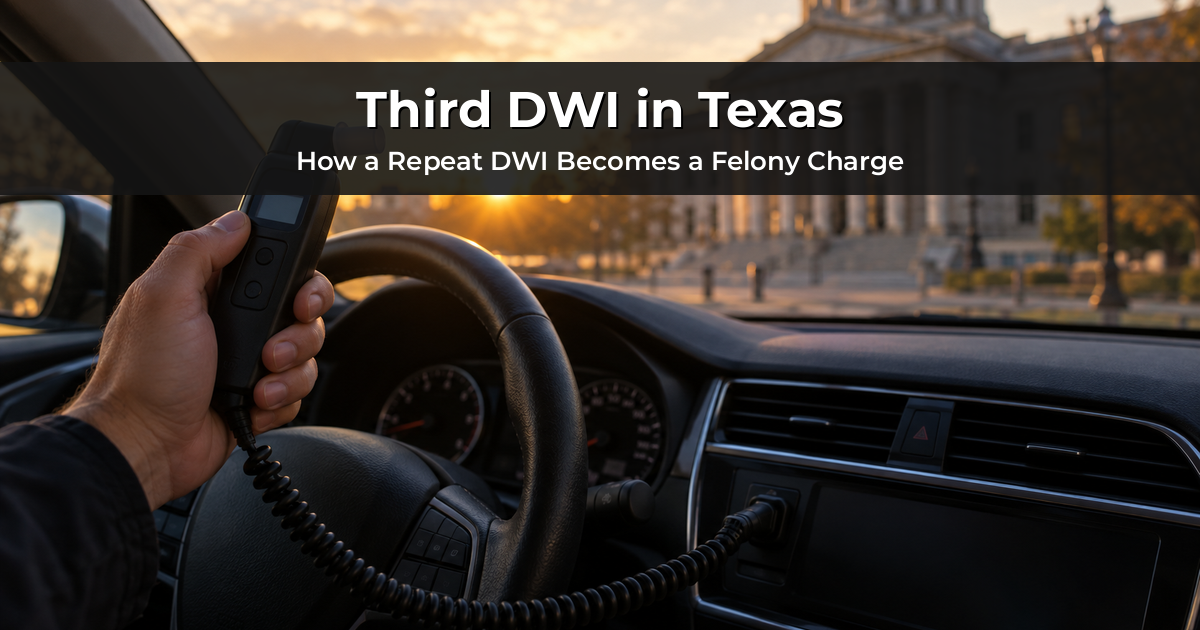
Driver holding an ignition interlock breath device in a car parked outside a courthouse at sunrise

Charged With a Third DWI in DFW? How Felony DWI Works in Texas

By Jason H. Howard · DWI

Short answer: In Texas, a third DWI is usually a third-degree felony, punishable by 2 to 10 years in prison and a fine of up to $10,000. The State must allege and prove two prior intoxication-related driving convictions, and Texas has no "look-back" limit, so a DWI from decades ago can still count. A felony DWI does not automatically mean prison. A judge can grant community supervision (probation) when the sentence is 10 years or less, but it comes with mandatory jail time, an ignition interlock, and a longer license suspension.

Driver holding an ignition interlock breath device in a car parked outside a courthouse at sunrise

A first or second DWI in Dallas-Fort Worth is a misdemeanor handled in a county criminal court. A third DWI changes everything. The case moves to a felony district court, the potential sentence jumps from months in county jail to years in prison, and a conviction leaves you with a permanent felony record that can follow you into employment, housing, professional licensing, and firearm rights.

At Howard Lotspeich Alexander & Williams, PLLC (HLAW), our Fort Worth defense lawyers represent people charged with DWI and felony DWI in Tarrant, Dallas, Denton, Collin, Johnson, and Parker counties. This guide explains how Texas turns a DWI into a felony, what penalties apply, and where the defense opportunities usually are.

Key Takeaways

  • Two prior DWI convictions make a new DWI a third-degree felony. Under Texas Penal Code §49.09(b), a DWI is a felony of the third degree if the person has previously been convicted "two times of any other offense relating to the operating of a motor vehicle while intoxicated." One prior intoxication manslaughter conviction is enough on its own.
  • The punishment range is 2 to 10 years in prison plus up to a $10,000 fine (Penal Code §12.34).
  • Old convictions still count. The subsections that once limited which prior DWIs could be used were repealed in 2005 (§49.09(e) and (f)), so Texas has no 10-year look-back period for felony DWI.
  • Deferred adjudication for a DWI now counts as a conviction for enhancement purposes under §49.09(g).
  • Probation is possible but strict. A judge granting community supervision for a felony DWI must order at least 10 days in county jail (Code of Criminal Procedure art. 42A.401) and must require an ignition interlock device (art. 42A.408).
  • The prior convictions are a key battleground. Texas courts treat the two priors as jurisdictional elements the State must prove, and a defendant may stipulate to them to keep extra prior convictions away from the jury (Tamez v. State).

When Does a DWI Become a Felony in Texas?

A standard first DWI under Penal Code §49.04 is a Class B misdemeanor with a minimum of 72 hours in jail. It becomes a Class A misdemeanor if a breath or blood test shows an alcohol concentration of 0.15 or more. A second DWI is a Class A misdemeanor with a minimum of 30 days in jail (§49.09(a)).

Several paths lead to a felony DWI charge in Texas:

Situation Offense level Statute
DWI with two prior intoxication-related driving convictions Third-degree felony (2 to 10 years) Penal Code §49.09(b)(2)
DWI with one prior intoxication manslaughter conviction Third-degree felony (2 to 10 years) Penal Code §49.09(b)(1)
DWI with a passenger younger than 15 State jail felony Penal Code §49.045
DWI in an active school crossing zone (effective September 1, 2025) State jail felony Penal Code §49.04(e)
DWI causing serious bodily injury (intoxication assault) Third-degree felony Penal Code §49.07
DWI causing death (intoxication manslaughter) Second-degree felony Penal Code §49.08

This guide focuses on the most common felony DWI charge in DFW courts: the "third DWI" under §49.09(b)(2). If a child was in the car, see our guide on DWI with a child passenger in Texas.

What Counts as a "Prior" DWI Conviction?

The statute casts a wide net. Under §49.09(c), an "offense relating to the operating of a motor vehicle while intoxicated" includes:

  • A Texas DWI under §49.04 or DWI with a child passenger under §49.045
  • Intoxication assault or intoxication manslaughter involving a motor vehicle
  • Older Texas DWI offenses under statutes that existed before 1994
  • A DWI conviction from another state, if that state's law prohibits operating a motor vehicle while intoxicated

Three rules make prior convictions easier for the State to use than many people expect.

No look-back limit. Before 2005, Texas law restricted the use of some older priors. Those subsections, §49.09(e) and (f), were repealed effective September 1, 2005. Today a conviction from 20 or 30 years ago can be one of the two priors.

Probated sentences count. Under §49.09(d), a DWI conviction on or after September 1, 1994 "is a final conviction, whether the sentence for the conviction is imposed or probated."

Deferred adjudication counts. Section 49.09(g) states that a person "is considered to have been convicted" of DWI if the person was placed on deferred adjudication for it. Texas began allowing deferred adjudication for many first-time DWI cases in 2019, and the tradeoff is that it can still be used later to raise a future charge. Our article on DWI deferred adjudication in Texas covers how that option works.

There is one limit that helps defendants. Section 49.09(g) says a conviction can be used to enhance under §49.09 "or enhancement under Subchapter D, Chapter 12, but not under both." In other words, the same prior DWI generally cannot be used both to make the case a felony and to push the punishment range even higher.

What Is the Punishment for a Third DWI in Texas?

A third-degree felony carries "any term of not more than 10 years or less than 2 years" in prison, plus a possible fine up to $10,000 (Penal Code §12.34).

The range can climb further if the State also proves unrelated prior felony convictions. Under Penal Code §12.42(a), a third-degree felony is punished as a second-degree felony if the defendant has a prior felony conviction (other than certain state jail felonies). Under §12.42(d), two properly sequenced prior felony convictions can raise the range to 25 to 99 years or life. These "habitual" enhancements are technical, and the sequence and finality of each prior conviction matter. We discuss one aspect in our post on pleading "true" to a felony enhancement.

Other consequences that commonly follow a felony DWI conviction include:

  • Driver's license suspension of 180 days to 2 years for a person punished under §49.09(a) or (b), or 1 to 2 years if the new offense came within five years of the last one (Transp. Code §521.344)
  • A state traffic fine under Transp. Code §709.001 of $3,000 for a first conviction within 36 months, $4,500 for a second or subsequent conviction within 36 months, or $6,000 if the test showed 0.15 or more, which the court must waive on a finding of indigency
  • Ignition interlock requirements at bond, during probation, and potentially as a condition of an occupational license
  • A permanent felony record, which carries collateral consequences such as restrictions on firearm possession

For a broader view of the financial impact, see our breakdown of what a DWI really costs in Texas.

Can You Get Probation for a Felony DWI?

Yes, in many cases. Under Code of Criminal Procedure art. 42A.053, a judge may place a defendant on community supervision after conviction, but a defendant is not eligible for judge-ordered supervision if sentenced to a term of imprisonment that exceeds 10 years. For a felony, the minimum period of supervision equals the minimum prison term for the offense, which is two years for a third-degree felony, and the maximum is generally 10 years.

Felony DWI probation carries mandatory conditions:

  1. Jail time as a condition of probation. A judge granting community supervision to a defendant punished under §49.09(b) must require "not less than 10 days of confinement in county jail" (art. 42A.401(a)(3)).
  2. Ignition interlock. The court "shall require" an interlock on the vehicle the defendant owns or drives most when the defendant is punished under §49.09(a) or (b) (art. 42A.408(c)).
  3. Standard supervision conditions, which often include alcohol evaluation and treatment, community service, reporting, and fees.

Deferred adjudication is not available for a DWI charge "for which punishment may be increased under Section 49.09" (art. 42A.102(b)(1)(C)). That means a felony DWI resolved by probation is usually a conviction, not a deferral.

Tarrant County's Felony Alcohol Intervention Program

Tarrant County has a specialty court for repeat DWI offenders. The Felony Alcohol Intervention Program (FAIP) is a post-adjudication program for eligible high-risk repeat offenders charged with felony DWI, with screening by the program team and the District Attorney's office. It is intensive and is not available in every case, but for the right client it can be an alternative to a prison sentence.

What Happens After a Felony DWI Arrest in DFW?

The early stages of a felony DWI move on two separate tracks: the criminal case and the driver's license case.

Bond and ignition interlock. For a defendant charged with a subsequent DWI, a magistrate "shall require" as a bond condition that an ignition interlock be installed on the defendant's vehicle within 30 days of release, unless the magistrate finds that it "would not be in the best interest of justice" (Code of Criminal Procedure art. 17.441). Violating bond conditions can result in arrest and a higher bond.

The ALR license suspension. Separately from the criminal case, DPS can seek an administrative license suspension after a breath or blood test failure or a refusal. You generally have only 15 days from the notice to request a hearing. Our guide on the 15-day ALR hearing deadline explains the process, and our article on Texas DWI license suspensions and occupational licenses covers how to keep driving legally.

Indictment and district court. A felony DWI must be presented to a grand jury. In Tarrant County, felony cases are heard in the Criminal District Courts. Once an indictment alleging the two prior convictions is presented, the district court has jurisdiction over the case.

How Do Lawyers Defend a Third DWI Charge?

A third DWI is two cases in one. The State must prove the new DWI happened, and it must prove the two prior convictions. Both parts deserve close attention.

Challenging the new arrest

Every defense available in a first DWI is still available in a third. That includes whether the officer had reasonable suspicion for the stop, whether there was probable cause to arrest, how field sobriety tests were administered, and whether a breath or blood test was properly obtained, handled, and analyzed. A prior record does not lower the State's burden to prove intoxication beyond a reasonable doubt.

Scrutinizing the prior convictions

Because the priors are elements of the offense, they must be proven. The Texas Court of Criminal Appeals has held that "the prior convictions are elements of felony DWI" and that the two priors are jurisdictional (Tamez v. State; Robles v. State). Issues worth investigating include:

  • Whether each prior was actually a final conviction and properly documented
  • Whether the State can link the defendant to each prior judgment through fingerprints, photographs, or other identifying evidence
  • Whether an out-of-state conviction was under a law that truly prohibits operating a motor vehicle while intoxicated
  • Whether a prior is really a different offense, such as obstruction or reckless driving, that does not qualify

Using a stipulation strategically

A defendant may offer to stipulate to the two jurisdictional prior convictions. In Tamez, the Court of Criminal Appeals held that when a defendant stipulates, the State may read the indictment mentioning only the two jurisdictional priors, but "prior convictions beyond the two jurisdictional elements should not be read or proven" in the State's case-in-chief. As a later opinion summarized, this is "an offer the State cannot refuse" (Martin v. State). A stipulation can keep a jury from hearing about a long record, but it also concedes an element, so it is a decision to make carefully with counsel.

Negotiating the outcome

Depending on the evidence and the client's history, possible outcomes may include a reduction to a misdemeanor, a probated sentence, placement in a specialty program, or a trial. There is no single formula, and results depend on the facts of each case.

Frequently Asked Questions

Is a third DWI always a felony in Texas?

Generally, yes, if the State can prove two prior intoxication-related driving convictions. A new DWI is a third-degree felony under Penal Code §49.09(b) when the person has two qualifying priors, or one prior intoxication manslaughter conviction. If the State cannot prove both priors, the case may proceed as a misdemeanor instead.

Does Texas have a 10-year look-back for DWI priors?

Not for the felony enhancement. The look-back provisions in §49.09(e) and (f) were repealed in 2005. A 10-year window does still appear in some other parts of the law, such as one exception to the ignition interlock rules in art. 42A.408, but it does not keep an old DWI from being used to make a new one a felony.

Will I go to prison for a third DWI?

Not necessarily. The punishment range is 2 to 10 years, and a judge may grant community supervision when the sentence is 10 years or less. Probation for felony DWI requires at least 10 days in county jail and an ignition interlock. Specialty programs like Tarrant County's FAIP may also be an option for eligible defendants.

Does a DWI from another state count toward a Texas felony DWI?

It can. Section 49.09(c)(1)(F) includes "an offense under the laws of another state that prohibit the operation of a motor vehicle while intoxicated." The details of the out-of-state statute and the conviction records matter, so they should be reviewed closely.

If I got deferred adjudication on an earlier DWI, does it count?

Under §49.09(g), a person placed on deferred adjudication for DWI under art. 42A.102 "is considered to have been convicted" for enhancement purposes. The date and terms of the earlier case should be reviewed with a lawyer.

Can I drive while my felony DWI case is pending?

Often, but with conditions. Bond conditions usually require an ignition interlock for a subsequent DWI charge, and an ALR suspension may also apply. An occupational license may be available in some situations, typically with an interlock requirement.

How long does a felony DWI stay on my record?

Texas's DWI-specific nondisclosure law, Government Code §411.0736, is limited to people convicted under §49.04 who have never previously been convicted of or placed on deferred adjudication for another offense other than a fine-only traffic offense. A person with two prior DWIs does not meet that test, so a felony DWI conviction generally stays on the record. Our article on DWI record sealing in Texas explains who does qualify.

Talk to a Fort Worth Felony DWI Lawyer

A third DWI charge is serious, but it is not a conviction. The State still has to prove the new offense and both prior convictions, and the decisions made in the first weeks, including the ALR hearing request and bond conditions, can shape the rest of the case.

If you or a family member has been charged with felony DWI anywhere in Dallas-Fort Worth, call HLAW at (817) 993-9249 or contact us online for a free consultation. We will review the arrest, the prior convictions, and your options.

This article is for general informational purposes only and is not legal advice. Reading it does not create an attorney-client relationship. Laws change, and every case depends on its specific facts.

Read full article
Empty child booster seat with a stuffed bunny in the back seat of a car at night, lit by police lights from a DWI traffic stop

DWI With a Child Passenger in Texas: Why It Is a Felony and How These Cases Are Defended in DFW

By Luke A. Williams · DWI

Short answer: In Texas, driving while intoxicated with a passenger younger than 15 is a state jail felony under Penal Code §49.045, even on a first offense and even if no one is hurt. A conviction carries 180 days to 2 years in a state jail and a fine of up to $10,000. The judge cannot grant deferred adjudication, and a magistrate must generally order an ignition interlock as a bond condition. The arrest can also trigger a separate Child Protective Services (CPS) investigation and affect custody. These cases are defensible, but the stakes are much higher than a typical DWI, so it's important to get a lawyer involved immediately.

Empty child booster seat with a stuffed bunny in the back seat of a car at night, lit by police lights from a DWI traffic stop

Most first-time DWI arrests in Texas are misdemeanors. That changes the moment a child under 15 is in the car. A parent driving home from a restaurant in Fort Worth, a grandparent picking up kids after a family gathering in Arlington, or a coach giving a ride to a team member in Frisco can all face a felony charge.

At Howard Lotspeich Alexander & Williams, PLLC (HLAW), we defend DWI with child passenger cases throughout Tarrant, Dallas, Denton, Collin, Johnson, and Parker counties. This guide explains the law, the penalties, how it differs from a standard DWI, what happens with CPS, and how these cases are defended.

Key Takeaways

  • It's a felony from the start. DWI with a child passenger under 15 is a state jail felony under Penal Code §49.045, with no prior conviction required.
  • Penalty range. A conviction carries 180 days to 2 years in a state jail and a fine of up to $10,000 under Penal Code §12.35.
  • No deferred adjudication. Code of Criminal Procedure art. 42A.102 bars deferred adjudication for this offense.
  • Interlock on bond. Under art. 17.441, a magistrate must require an ignition interlock as a bond condition, installed within 30 days, unless it isn't in the best interest of justice.
  • Each child can be a separate count. Prosecutors may file one count for each child passenger.
  • CPS may get involved. Law enforcement may refer the case to the Texas Department of Family and Protective Services (DFPS), which runs its own civil investigation.
  • The license case runs separately. You still face the ALR license suspension process and its 15-day deadline.

What Does Texas Law Say About DWI With a Child Passenger?

Under Texas Penal Code §49.045, a person commits the offense if:

  1. The person is intoxicated while operating a motor vehicle in a public place; and
  2. The vehicle is occupied by a passenger younger than 15 years of age.

"Intoxicated" has the same meaning as in any Texas DWI case. Under §49.01, it means either not having the normal use of your mental or physical faculties because of alcohol, drugs, or another substance, or having an alcohol concentration of 0.08 or more. So the State can prove a child passenger case with a breath or blood result at or above 0.08, or without one, by relying on driving behavior, field sobriety tests, and the officer's observations. That includes cases involving prescription medication or THC.

The State doesn't have to prove you knew the child's age, that the child was harmed, or that the child was unrestrained. The child's presence in the vehicle is enough.

How Is It Different From a Regular DWI?

Issue First-offense DWI (§49.04) DWI with child passenger (§49.045)
Offense level Class B misdemeanor; Class A if BAC is 0.15 or more State jail felony
Jail or prison range 72 hours to 180 days in county jail (Class B) 180 days to 2 years in state jail
Maximum fine $2,000 (Class B) $10,000
Deferred adjudication May be available (not if BAC is 0.15+ or CDL holder) Not available
Ignition interlock on bond Discretionary for a first offense Generally mandatory
Felony record No Yes, with consequences for firearms, employment, and professional licenses

Since September 1, 2019, Texas judges have been allowed to grant deferred adjudication for many first-time DWIs. Article 42A.102 specifically excludes §49.045, however, along with DWI cases where the driver had a commercial license or a BAC of 0.15 or more.

Can it be enhanced further?

Yes. Under Penal Code §49.09(b), a DWI with child passenger becomes a third-degree felony if the person has two prior intoxication-related driving convictions, or one prior conviction for intoxication manslaughter. A third-degree felony carries 2 to 10 years in prison.

If a child is injured, the charges can become far more serious, such as intoxication assault (§49.07) or, tragically, intoxication manslaughter (§49.08), along with other possible offenses.

What Happens After the Arrest?

Bond and conditions

Because this is a felony, bond amounts are often higher than for a misdemeanor DWI, and the conditions are more restrictive. Under CCP art. 17.441, a magistrate must require that you install an ignition interlock device on the vehicle you own or drive most often, and that you not drive any vehicle without one. You must have it installed at your own expense within 30 days of release. The magistrate can waive this only by finding that the device "would not be in the best interest of justice." Learn more about how ignition interlock devices work.

Other common bond conditions in DFW include no alcohol, alcohol monitoring, and sometimes conditions related to contact with or transportation of children.

Grand jury and felony court

Felony charges must be presented to a grand jury. In Tarrant County, felony DWI cases are handled in the criminal district courts rather than the county criminal courts. The time between arrest and indictment gives your lawyer a chance to investigate, obtain the video, and sometimes present information to prosecutors before charging decisions are final.

The driver's license case

The child passenger charge doesn't change the administrative license process. If you refused or failed a breath or blood test, DPS will seek to suspend your license through the Administrative License Revocation (ALR) program. You generally have 15 days to request a hearing. See our guide: The 15-Day Clock: How to Request and Fight an ALR Hearing.

Will CPS Get Involved?

Often, yes, especially when the driver is the child's parent or caregiver.

Texas law requires that reports to law enforcement alleging abuse or neglect by a person responsible for a child's care be referred immediately to DFPS. Under Family Code §261.001, "neglect" includes an act or failure to act showing blatant disregard for the consequences that results in harm to the child or "creates an immediate danger to the child's physical health or safety." DFPS explains that its investigation is a civil matter focused on the child's welfare and is separate from the criminal case.

What that can mean for a DFW family:

  • A CPS investigator may contact you, visit your home, or interview your children, often within days.
  • You may be asked to sign a safety plan, which may include not driving the children or supervised contact.
  • A CPS finding can be used in a divorce or custody case, and the other parent may seek temporary orders limiting your possession or requiring you not to drink during visits.

Be careful what you say to a CPS investigator. Statements made in the CPS case can be shared with law enforcement and used in the criminal case. Talk to your criminal defense lawyer before any CPS interview, and coordinate with your family law counsel if custody is at issue.

How Are DWI With Child Passenger Cases Defended?

Every case is different, but the defenses usually focus on the same core questions as any DWI, plus the child passenger element.

Challenging the stop and arrest

  • Was the stop lawful? The officer needs reasonable suspicion of a traffic violation or crime. Weaving within a lane, for example, isn't always enough. If the stop was unlawful, the evidence may be suppressed.
  • Was there probable cause to arrest? Officers often rely on field sobriety tests, which can be affected by fatigue, nerves, medical conditions, footwear, weather, and road surface. They're also hard to perform with a frightened child watching.

Challenging intoxication evidence

  • Breath tests: maintenance records, the 15-minute observation period, and operator certification.
  • Blood tests: the warrant, the chain of custody, lab procedures, retrograde extrapolation, and whether a "no-refusal" warrant was properly obtained. See no-refusal DWI in Texas.
  • Drug and medication cases: the State must prove loss of normal use of faculties. A positive test for a substance alone doesn't prove intoxication.

Challenging the child passenger element

  • Was the passenger actually younger than 15? The State must prove the child's age.
  • Was the person charged actually operating the vehicle?
  • Did the stop happen in a public place?

Negotiating the charge

Depending on the evidence and your history, the defense may negotiate a reduction from §49.045 to a misdemeanor DWI, which can open the door to deferred adjudication or other alternatives. Some defendants may be eligible for specialty or treatment-focused programs. For example, see Tarrant County's misdemeanor DWI court program, though eligibility depends on the final charge. Early action often matters, such as voluntary alcohol evaluations, counseling, and a clean interlock record.

What Are the Long-Term Consequences?

A state jail felony conviction can affect your life well beyond the sentence:

  • Firearms: Federal law generally prohibits people with felony convictions from possessing firearms. See DWI and firearms in Texas.
  • Employment and licenses: Nurses, teachers, CDL holders, and many licensed professionals face reporting obligations and discipline.
  • Record sealing: Texas DWI nondisclosure options are largely limited to misdemeanor DWIs, so a felony conviction generally can't be sealed that way.
  • Custody: A conviction can be powerful evidence in a custody dispute.
  • Costs: The fines, fees, interlock costs, and insurance increases add up quickly. See the real costs of a DWI in Texas.

What to Do Right Now

  1. Don't discuss the facts with police, CPS, or anyone else before talking to a lawyer.
  2. Request your ALR hearing within 15 days, or have your attorney do it.
  3. Comply with every bond condition, especially the interlock deadline.
  4. Write down everything you remember: where you were, what you ate and drank and when, any medical conditions, and where the stop happened.
  5. Identify witnesses and receipts, such as restaurant or bar tabs, that show the timeline.
  6. Talk to a DWI defense lawyer before your first court date and before any CPS interview.

Frequently Asked Questions

Is DWI with a child passenger a felony on the first offense in Texas?

Yes. Under Penal Code §49.045, it's a state jail felony even if you have no prior record, the child wasn't hurt, and your BAC was just above 0.08.

How old does the child have to be?

The passenger must be younger than 15. A 15- or 16-year-old passenger doesn't make the offense §49.045, though the case would still be prosecuted as a regular DWI.

Can I get deferred adjudication for DWI with a child passenger?

No. Code of Criminal Procedure art. 42A.102 specifically bars deferred adjudication for §49.045. Regular (straight) probation may be possible, and sometimes the charge can be negotiated down to a misdemeanor DWI, where deferred adjudication may be available.

Will I have to install an ignition interlock?

Usually, yes. Under CCP art. 17.441, a magistrate must require an interlock as a bond condition for a §49.045 charge, unless the magistrate finds it wouldn't be in the best interest of justice. It must be installed within 30 days of release.

Can I be charged with more than one count if there were several kids in the car?

Prosecutors may file a separate count for each child under 15 in the vehicle. How those counts are resolved depends on the facts and negotiations.

Will CPS take my children?

Removal is not automatic. In many DWI cases, CPS uses safety plans rather than removal. But CPS involvement is common, and your statements matter. Get legal advice before speaking with an investigator.

Does the child passenger charge affect my license suspension?

The ALR license process works the same as in any DWI. You have 15 days to request a hearing after a breath test refusal or failure. A conviction can carry its own license consequences, too.

Talk to a Fort Worth DWI Defense Lawyer

A DWI with a child passenger charge puts your record, your license, and your family at risk all at once. HLAW's Fort Worth DWI attorneys defend these cases across the Dallas-Fort Worth area, coordinating the criminal case, the ALR hearing, and any CPS or custody issues. Call (817) 993-9249 or contact us online for a free, confidential consultation.


This article is for general informational purposes only and is not legal advice. Reading it does not create an attorney-client relationship. Penalties and procedures depend on the facts, your criminal history, and the court. Consult a licensed Texas attorney about your situation.

Read full article
Disaster Declaration Texas Criminal Law

Criminal Law Enhancements During a State of Disaster

By Luke A. Williams · Criminal Defense

Disaster Declaration Texas Criminal Law
On March 13, 2020, Governor Greg Abbott declared a state of disaster in Texas in response to the COVID-19 pandemic. For the purposes of criminal law in Texas, that disaster declaration triggered the provisions of Texas Penal Code (TPC) 12.50.

What are the Criminal Law Implications During a State of Disaster?

In general, TPC 12.50 states that for the offenses listed below, if committed during the declaration of a state of disaster, the punishment level for these offenses is increased to the next higher category for that offense. For example, if a Theft charge would normally be punished as a Class B misdemeanor (0 - 180 days in jail and up to $2,000 fine) then it would be increased to a Class A misdemeanor (0 - 365 days in jail and up to $4,000 fine) if it is committed during the time of the declared disaster.

Specifically, 12.50 applies to the following offenses:

  • Assault and Domestic Violence (TPC 22.01);
  • Arson (TPC 28.02);
  • Robbery (TPC 29.02);
  • Burglary (TPC 30.02);
  • Burglary of Coin-operated or Coin Collection Machines (TPC 30.03)
  • Burglary of Vehicles (TPC 30.04);
  • Criminal Trespass (TPC 30.05); and
  • Theft (TPC 31.03)

TPC 12.50 is limited by the following provisions:

For the offenses of Assault, Burglary of Coin-operated/Coin Collection Machines, Burglary of Vehicles, Criminal Trespass or Theft, if the offense committed would normally punished as a Class A misdemeanor, then during the emergency declaration the minimum term of confinement is increased from 0 to 180 days in a county jail.

For the offenses of Arson, Burglary, and Criminal Trespass, if the offense committed would normally be punished as a First Degree Felony, then there is no enhancement.

Read full article

Speak with a Fort Worth attorney

Call (817) 993-9249 or send us a message to discuss your case.