Short answer: If a city truck, police car, county vehicle, school bus, or DART or Trinity Metro bus hits you in Dallas-Fort Worth, you can usually still recover damages, but the Texas Tort Claims Act changes the rules. You generally must give the government written notice within six months (Fort Worth and Arlington require notice within 180 days under their city charters), and the government's liability is capped at $100,000 to $250,000 per person, depending on the type of entity. If the notice deadline passes, the claim can be thrown out even though the two-year statute of limitations hasn't run, so act quickly.
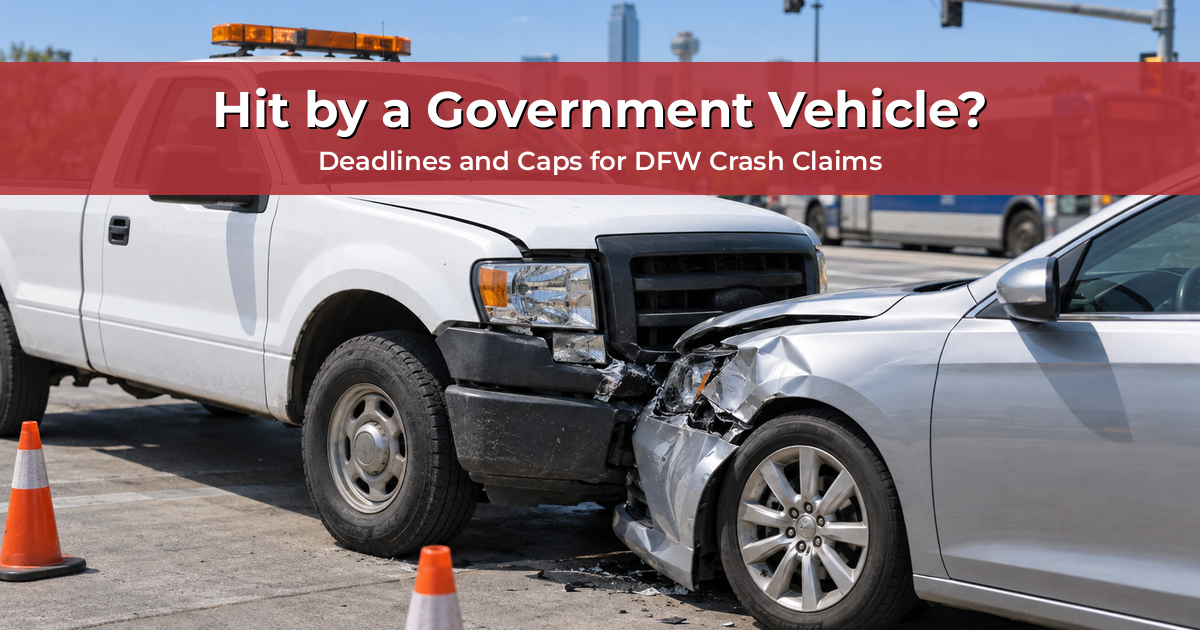
Every week, Dallas-Fort Worth drivers share the road with garbage trucks, water department pickups, police cruisers, fire apparatus, TxDOT maintenance crews, school buses, and hundreds of DART and Trinity Metro buses. When one of those vehicles causes a crash, many people assume the claim works like any other car wreck. It doesn't. Government entities are protected by immunity unless the Legislature has waived it, and the waiver comes with short deadlines, damage caps, and procedural traps that don't apply to a claim against a private driver.
At Howard Lotspeich Alexander & Williams, PLLC (HLAW), our Fort Worth trial lawyers handle personal injury claims across Tarrant, Dallas, Denton, Collin, Johnson, and Parker counties, including claims against cities, counties, and transit agencies. This guide explains how a government-vehicle claim works in Texas, what deadlines apply in DFW, and the mistakes that most often sink these claims.
Key Takeaways
- The Texas Tort Claims Act waives immunity for motor-vehicle crashes. A governmental unit can be liable when an employee acting within the scope of employment negligently operates a motor-driven vehicle (Tex. Civ. Prac. & Rem. Code §101.021).
- Notice is due fast. State law requires notice within six months (§101.101), and city charters can set their own periods. Fort Worth and Arlington require 180 days, and Dallas requires six months.
- Missing notice can end the case. Texas law makes statutory prerequisites, including notice, jurisdictional in suits against a governmental entity (Tex. Gov't Code §311.034).
- Damages are capped. Cities and the state are capped at $250,000 per person and $500,000 per occurrence. Counties, school districts, and transit authorities like DART and Trinity Metro are capped at $100,000 per person and $300,000 per occurrence (§101.023).
- Emergency responses get extra protection. If the officer or firefighter was responding to an emergency, the claim generally requires proof that they broke the law governing emergency driving or acted recklessly (§101.055).
- Who you sue matters. Suing the employee instead of the agency, or suing both, can trigger the Act's election-of-remedies rules (§101.106).
Can You Sue the Government After a Car Wreck in Texas?
Yes, in many cases. Texas governmental entities are generally immune from suit, but the Texas Tort Claims Act carves out a limited waiver. Under Section 101.021, a governmental unit is liable for property damage, personal injury, and death caused by the negligence of an employee acting within the scope of employment if the harm "arises from the operation or use of a motor-driven vehicle or motor-driven equipment" and the employee would be personally liable under Texas law.
In plain English: if a city employee runs a red light on Lancaster Avenue in a city truck, or a county deputy rear-ends you on Loop 820 while driving to an ordinary call, the government can be held responsible the same way a private employer would be, subject to the limits explained below.
The motor-vehicle waiver covers most of the government vehicles you see in DFW:
- City vehicles: police cars, fire trucks, ambulances, sanitation trucks, water and street-maintenance trucks, code-compliance cars
- County vehicles: sheriff's patrol cars, road and bridge equipment, county-owned vans
- State vehicles: TxDOT trucks and maintenance equipment, Department of Public Safety (DPS) trooper cars
- School buses and district vehicles. For school districts, the Tort Claims Act applies only to claims involving motor vehicles (§101.051), so a bus crash is one of the few injury claims that can go forward against a district.
- Public transit: DART buses and light rail in Dallas County, and Trinity Metro buses, TEXRail, and on-demand vehicles in Tarrant County
What Is the Deadline to File a Claim Against a City or County in DFW?
This is the most important section of this guide. Under Section 101.101(a), a governmental unit is entitled to receive notice of a claim no later than six months after the incident. The notice must reasonably describe the injury or damage, the time and place of the incident, and the incident itself. Section 101.101(b) also ratifies city charter provisions that set their own notice periods.
Here is how that plays out in the largest DFW cities and agencies:
| Entity | Notice deadline | Damage cap (bodily injury) | Source |
|---|---|---|---|
| City of Fort Worth | 180 days, filed with the City Council (good-cause exception for late filing) | $250,000 per person / $500,000 per occurrence | Fort Worth City Charter, Ch. XXVII §25 |
| City of Dallas | Six months, written notice stating when, where, and how the injury occurred and the damages claimed | $250,000 / $500,000 | Dallas City Charter, Ch. XXIII §1 |
| City of Arlington | 180 days, filed with the City Secretary, plus a 90-day wait before suit | $250,000 / $500,000 | Arlington City Charter, Art. X §6 |
| Counties, school districts, DART, Trinity Metro | Six months under state law (check for any agency-specific rules) | $100,000 / $300,000 | §101.023(b) |
| State agencies (TxDOT, DPS) | Six months | $250,000 / $500,000 | §101.023(a) |
Every DFW suburb, including Grand Prairie, Irving, Mansfield, Keller, Southlake, and North Richland Hills, has its own charter, and some set different notice requirements. Always check the specific charter for the city whose vehicle was involved, and when in doubt, give notice well inside the shortest possible window.
Why the notice deadline is so dangerous
The general Texas deadline to file an injury lawsuit is two years (see our guide to the Texas statute of limitations). Many people relax because they think they have two years. But in a government case, the notice clock runs out long before then. And because Government Code §311.034 makes statutory prerequisites to suit, "including the provision of notice," jurisdictional, a government defendant can raise late notice to have the case dismissed outright.
What about "actual notice"?
Section 101.101(c) excuses formal notice if the governmental unit had actual notice that someone was injured or property was damaged. Don't count on it. Texas courts read actual notice narrowly, requiring the government's subjective awareness of the injury and its own possible fault. In one Tarrant County case, the Second Court of Appeals reviewed whether a police crash report gave the City of Arlington actual notice and found the city's evidence couldn't be deciphered (City of Arlington v. Evans). That kind of uncertainty is exactly why a formal written notice, sent early, is the safer path.
How Much Can You Recover From a Government Entity?
The Act caps the government's liability, and the cap depends on the type of entity (§101.023):
- State government (TxDOT, DPS, state universities): $250,000 per person and $500,000 per occurrence for bodily injury or death; $100,000 per occurrence for property damage.
- Municipalities (Fort Worth, Dallas, Arlington, and other cities): $250,000 per person and $500,000 per occurrence; $100,000 per occurrence for property damage.
- Other local government (counties, school districts, transit authorities): $100,000 per person and $300,000 per occurrence; $100,000 per occurrence for property damage.
The Act also does not allow exemplary (punitive) damages (§101.024).
DART and Trinity Metro bus crashes
DART and Trinity Metro are regional transportation authorities, and Texas courts treat them under the $100,000-per-person local-government cap. The Dallas Court of Appeals applied that cap to a judgment against DART in Dallas Area Rapid Transit v. Morris. Many transit buses are actually operated by private contractors, but Transportation Code §452.056(d) limits a contractor performing the authority's function to the same liability the authority would have. In a Fort Worth bus case, the Supreme Court of Texas held that the transit authority and its operating contractors were cumulatively limited to a single $100,000 cap (Fort Worth Transportation Authority v. Rodriguez).
Finding other sources of recovery
Because the caps can be far below the true value of a serious injury, a careful investigation looks for every other responsible party and every available coverage:
- Other drivers. Multi-vehicle crashes often involve a private driver who shares fault and whose insurance isn't capped.
- Private contractors outside the transit statute. A private company doing city road work, for example, is not automatically protected by the transit-authority rule.
- Your own coverage. Personal injury protection (PIP) pays regardless of fault, and depending on your policy language, other coverages may help. Our article on UM/UIM and PIP auto insurance explains how these coverages work.
- Comparative fault. Texas's proportionate-responsibility rules still apply, so the government will try to shift blame to you. Our explainer on how fault works in Texas injury cases covers the 51% bar.
What If a Police Car or Fire Truck Hit You During an Emergency?
This is where many claims against cities are won or lost. Section 101.055(2) says the Act does not apply to a claim arising from an employee's action "while responding to an emergency call or reacting to an emergency situation" if the action complied with the laws applicable to emergency action or, absent such a law, if the action was not taken "with conscious indifference or reckless disregard for the safety of others."
The Supreme Court of Texas has set a high bar here. In City of San Antonio v. Maspero, a 2022 police-pursuit case, the Court held the emergency exception applied. It found that the officer's alleged violations of internal department policy weren't violations of "laws and ordinances," and that the family hadn't raised a fact issue of recklessness (Texas Supreme Court opinion summary). Reckless disregard requires more than a momentary lapse in judgment.
That doesn't mean emergency-vehicle claims are hopeless. It means the evidence has to be gathered quickly and thoroughly:
- Was the officer actually responding to an emergency, or driving to a routine call or back to the station?
- Were lights and sirens activated, and when?
- How fast was the vehicle going, and what were the traffic, visibility, and intersection conditions?
- Did the driver slow down at intersections and red lights, as Texas law generally requires of emergency drivers?
- What do dash-cam, body-cam, 911 audio, and computer-aided dispatch (CAD) records show?
Much of this evidence is in the government's own hands, and retention schedules vary. A prompt preservation letter and public-information requests are often the difference between a provable claim and a dismissed one. Our guide on dashcam footage after a Texas car accident explains why video evidence matters so much.
Should You Sue the Driver or the Government Agency?
Usually the agency, and the choice has permanent consequences. Under the Act's election-of-remedies provision (§101.106):
- Filing suit under the Act against the governmental unit "immediately and forever bars" suit against the individual employee for the same subject matter.
- Filing suit against the employee bars suit against the governmental unit unless the unit consents.
- If both are sued, the employee must be dismissed on the government's motion.
- If the employee was acting within the general scope of employment, a suit against the employee is treated as an official-capacity suit and must be refiled against the governmental unit within 30 days of a motion, or it will be dismissed.
Naming the wrong defendant can waste the limited time you have, or forfeit the claim. This is a technical area where getting it right at the outset matters.
What Should You Do After a Crash With a Government Vehicle in DFW?
- Call 911 and get a police report. Ask for the officer's name and report number. If the at-fault vehicle was a police car, a supervisor or another agency may investigate. Our article on reading a car wreck police report explains what to check.
- Record the vehicle details. Note the unit or fleet number on the vehicle, the department name, the route number for a bus, and the time and location. Photograph everything if it is safe to do so.
- Get witness names. Passengers on a bus, nearby drivers, and business employees often see what happened.
- Get medical care right away. Gaps in treatment are used to argue an injury wasn't serious.
- Calendar the shortest possible notice deadline. Assume 180 days for a Fort Worth or Arlington city vehicle and six months for most others, and don't wait until the end.
- Send written notice that complies with the Act and any charter. It should describe the injury, the time and place, and how the incident happened. Fort Worth's charter also asks for the amount of damages, the settlement amount, the claimant's address, and witness names. Fort Worth publishes a risk-management claim form, and Dallas publishes a notice of claim form.
- Be careful with the government's adjuster. Many cities and counties are handled by risk-management departments or risk pools that investigate to limit payouts. Read our tips on insurance adjuster tactics before giving a recorded statement.
- Talk to a lawyer early. Preservation letters, public-information requests, the right defendant, and a compliant notice all need to happen inside the notice window.
Common Mistakes That Sink Government-Vehicle Claims
- Assuming you have two years. The notice deadline is typically six months or 180 days.
- Treating a phone call as notice. Calling the bus agency's customer service line or the city's 311 line usually isn't written notice under the Act or a charter.
- Sending notice to the wrong office. Charters often specify who receives notice (for example, the City Council in Fort Worth or the City Secretary in Arlington). Older Texas cases have rejected notice delivered to the wrong official.
- Leaving out required details. A notice that doesn't describe the injury, the time and place, and the incident may be challenged.
- Suing the employee alone. This can trigger the election-of-remedies bar described above.
- Ignoring other parties. Failing to investigate a private driver or contractor can leave money on the table when the government's cap is low.
Frequently Asked Questions
How long do I have to file a claim after being hit by a Fort Worth city vehicle?
The Fort Worth City Charter requires written notice to the City Council within 180 days of the injury, unless good cause is shown for a late filing (Fort Worth City Charter, Ch. XXVII §25). The lawsuit itself generally must be filed within two years. Don't rely on the good-cause exception; file well before the 180th day.
Can I sue DART or Trinity Metro if a bus hit my car?
Generally yes, if the injury arose from the negligent operation of the bus. These transit authorities are treated as local governmental units, so the Tort Claims Act's six-month notice rule and its $100,000-per-person cap generally apply (§101.023; Fort Worth Transportation Authority v. Rodriguez).
What if I was a passenger on the bus when it crashed?
Passengers can bring claims too, and the same notice rules and caps generally apply. Texas courts have recognized that a common carrier like DART owes its passengers a high degree of care (Dallas Area Rapid Transit v. Morris).
Can I get punitive damages from the city?
No. The Texas Tort Claims Act does not authorize exemplary damages (§101.024).
A police officer hit me while running lights and sirens. Do I have a case?
Possibly, but it is harder. Under the emergency exception, you generally need evidence that the officer violated the laws governing emergency driving or acted with conscious indifference or reckless disregard for public safety (City of San Antonio v. Maspero). The facts, especially video and dispatch records, decide these cases.
What if a TxDOT truck caused my wreck on I-35W or I-30?
TxDOT is a state agency, so the state-government cap of $250,000 per person and $500,000 per occurrence applies, and notice is due within six months (§101.023(a); §101.101). If a private contractor was doing the work, there may be a separate claim against that company.
Talk to a Fort Worth Injury Lawyer Before the Notice Deadline Passes
A crash with a government vehicle is a race against a short clock. HLAW can identify the right government entity, calculate the correct notice deadline, send a compliant notice, preserve video and dispatch records, and look for every other source of recovery beyond the government's cap. Call (817) 993-9249 or contact us online for a free consultation.
This article is for general informational purposes only and is not legal advice. Reading it does not create an attorney-client relationship. Laws and city charters change, and every case depends on its specific facts.