
Skip to content
Tag

Sovereign Immunity

3 articles

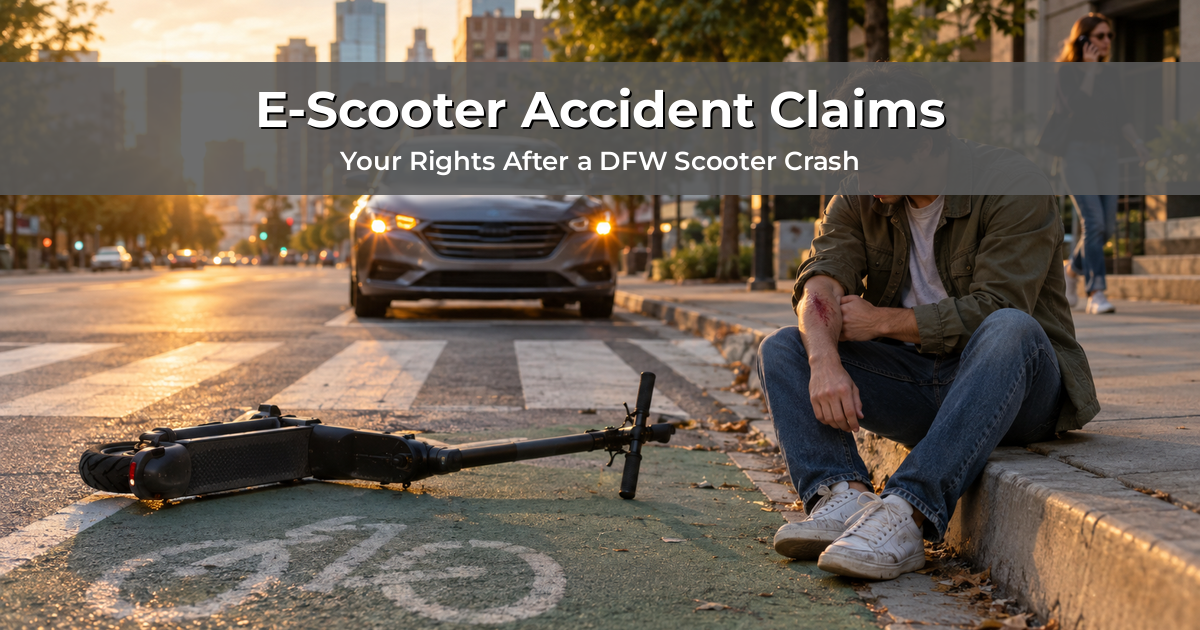
Injured rider sitting on a downtown curb beside a fallen electric scooter in a bike lane, with a stopped car nearby

Hurt on an Electric Scooter in Dallas-Fort Worth? Texas E-Scooter Accident Laws and Your Rights

By Luke A. Williams · Personal Injury

Short answer: If you were hurt on an electric scooter in Dallas-Fort Worth because a driver, property owner, or city was negligent, you can generally bring a Texas personal injury claim. You can recover as long as you were not more than 50 percent responsible, and your recovery is reduced by your share of fault. Texas law treats a motor-assisted scooter much like a bicycle, not a motor vehicle. Where you were allowed to ride, whether city rules were followed, and which insurance applies often decide these cases. Claims against a city can require written notice within six months or less, and most lawsuits must be filed within two years.

Injured rider sitting on a downtown curb beside a fallen electric scooter in a bike lane, with a stopped car nearby

Electric scooters are now part of daily traffic in Deep Ellum, downtown Fort Worth, Arlington's entertainment district, and college areas across the Metroplex. They are convenient, but a rider has almost no protection in a collision with a car or a fall caused by a pothole. The legal rules are also less familiar than those for a typical car wreck.

At Howard Lotspeich Alexander & Williams, PLLC (HLAW), our Fort Worth trial lawyers handle personal injury claims across Tarrant, Dallas, Denton, Collin, Johnson, and Parker counties. This guide explains how Texas law applies to e-scooter crashes, who may be responsible, and what to do to protect a claim.

Key Takeaways

  • Scooters follow bicycle rules, not motor vehicle rules. Under Texas Transportation Code §551.352, bicycle provisions generally apply to a motor-assisted scooter, and "a provision of this title applicable to a motor vehicle does not apply to a motor-assisted scooter" (Tex. Transp. Code §551.352).
  • State law limits scooters to streets with posted speed limits of 35 mph or less, though riders may cross faster roads at intersections. Cities can add their own restrictions.
  • Dallas bans sidewalk riding. The City of Dallas says scooters "may not be ridden on or in: sidewalks, trails, parks, plazas, on roads with a speed limit of 35 MPH or higher," with a 20 mph citywide speed limit (City of Dallas).
  • Fault is shared under the 51 percent bar. A claimant "may not recover damages if his percentage of responsibility is greater than 50 percent," and any recovery is reduced by the claimant's percentage (Tex. Civ. Prac. & Rem. Code ch. 33).
  • Claims against a city have short notice deadlines. The Texas Tort Claims Act requires notice within six months, and city charters can set shorter periods (Tex. Civ. Prac. & Rem. Code §101.101).
  • Injuries are rising nationally. The CPSC estimates 380,000 emergency department visits involving e-scooters from 2017 through 2024 (CPSC micromobility report).

What Does Texas Law Say About Electric Scooters?

Texas regulates motor-assisted scooters in Chapter 551 of the Transportation Code. A "motor-assisted scooter" is a self-propelled device with at least two wheels, a braking system, a gas or electric motor, a deck designed for the rider to stand or sit, and "the ability to be propelled by human power alone" (Tex. Transp. Code §551.351). Most rental and privately owned stand-up e-scooters in DFW fall into this category.

The key operating rules are in §551.352 (Tex. Transp. Code §551.352):

  • A scooter "may be operated only on a street or highway for which the posted speed limit is 35 miles per hour or less," but may cross a faster road at an intersection.
  • A person may ride "on a path set aside for the exclusive operation of bicycles or on a sidewalk," unless a city or county prohibits it.
  • A county or city may prohibit scooters on a street, highway, or sidewalk "in the interest of safety."
  • Rules for bicycles generally apply to scooters, while rules for motor vehicles do not.

That last point matters in an injury case. A scooter rider generally has the rights and duties of a bicyclist on the road. Drivers owe scooter riders the same care they owe cyclists. For more on those rules, see our guide to bicycle accident claims in DFW.

How Do Dallas and Fort Worth Rules Differ?

Local rules vary across the Metroplex, and they can affect both safety and fault.

Issue Texas state law City of Dallas City of Fort Worth
Sidewalk riding Allowed unless a city or county prohibits it Not allowed, except to start or end a ride Generally follows state law; riders may use sidewalks and paths unless posted otherwise
Road speed limit Streets posted 35 mph or less Not on roads posted 35 mph or higher Streets posted 35 mph or less
Scooter speed No speed cap stated in §551.352 20 mph citywide; 10 mph in slow-ride zones City code does not directly address e-scooters
Rental age Not addressed in §551.352 No rentals to people under 16 City code does not directly address e-scooters

Sources: Tex. Transp. Code §551.352; City of Dallas Dockless Vehicle Program; Fort Worth Star-Telegram; Government Technology.

In Dallas, the city also lists no-ride zones, including parks, plazas, and most trails, and says riders who break the rules can be fined up to $200 under Section 28-41.1.1 of the Dallas City Code (City of Dallas). The Fort Worth Star-Telegram reported that Fort Worth police say e-scooters "can be ridden on bike paths and sidewalks, but they are restricted to streets with a posted speed limit of 35 mph or less" (Star-Telegram). Arlington, Denton, Plano, Irving, and other cities have their own rules, so the location of a crash matters.

Who Is Liable for an E-Scooter Accident in Texas?

Most scooter injury claims fall into one of four categories.

A driver who hit the rider

The most serious scooter injuries often involve cars. CPSC staff have reported that "the top hazards in e-scooter and e-bike fatalities were incidents with motor vehicles and user-control issues" (CPSC). Common scenarios include right hooks at intersections, left turns across a bike lane, drivers opening doors into a rider's path, and drivers backing out of driveways or parking spaces. A claim against the driver is a negligence claim, usually paid through the driver's liability insurance.

A property owner or business

Falls on private property, such as a parking garage, apartment complex, or shopping center, may involve premises liability if a dangerous condition caused the crash. Our article on parking lot and sidewalk injuries in Texas explains how those claims work.

A city or other government entity

Potholes, broken pavement, missing signs, and road construction can cause serious scooter falls. Claims against a city fall under the Texas Tort Claims Act, which has special rules. For a premise defect, the government generally owes only the duty a private person owes a licensee, but that limit does not apply to the duty to warn of "special defects such as excavations or obstructions on highways, roads, or streets" (Tex. Civ. Prac. & Rem. Code §101.022). The Act also caps a city's liability at $250,000 per person for bodily injury. If a city vehicle hit you, see our guide to government vehicle accident claims in DFW.

The scooter company or manufacturer

Brake failures, throttle malfunctions, battery fires, and other defects can support a product liability or negligence claim against a manufacturer or operator. Rental apps usually require riders to accept terms of service, which may include arbitration clauses or liability waivers. Whether those terms are enforceable depends on their wording and the facts, so they should be reviewed before you assume a claim is barred.

Can You Recover if You Were Partly at Fault?

Often, yes. Texas uses proportionate responsibility. Under Civil Practice and Remedies Code §33.001, a claimant "may not recover damages if his percentage of responsibility is greater than 50 percent." If you are 50 percent or less at fault, §33.012 reduces your damages by your percentage of responsibility (Tex. Civ. Prac. & Rem. Code ch. 33).

Insurers often argue that a scooter rider was at fault for riding on a Dallas sidewalk, riding on a road posted above 35 mph, riding at night without lights, carrying a passenger, or wearing headphones. These facts can reduce a claim, but they do not automatically defeat it. A driver who runs a red light or turns into a rider's path still bears responsibility. Our guide to how fault works in Texas personal injury cases explains how juries allocate responsibility.

What Insurance Pays for a Scooter Accident?

Insurance in a scooter case can come from several sources:

  1. The at-fault driver's liability coverage. Texas requires minimum limits of $30,000 per person for bodily injury (Texas Department of Insurance).
  2. Your own auto policy. Personal injury protection (PIP) is defined by statute as coverage for the named insured, "members of the insured's household," and authorized operators or passengers of the insured's vehicle for medical expenses and lost income arising from an accident (Tex. Ins. Code §1952.151). Whether your policy covers a scooter crash depends on its specific language, so review it before assuming it does not apply.
  3. Uninsured/underinsured motorist coverage. If the driver who hit you had no insurance or not enough, your own UM/UIM coverage may help. See our guide to UM/UIM and PIP auto insurance.
  4. Health insurance. Health insurance may pay medical bills, but it may claim reimbursement from any settlement.
  5. Homeowner's, renter's, or business policies, in some cases involving private property or a commercial defendant.

If the driver left the scene, our article on hit-and-run crashes in Texas explains next steps.

What Should You Do After an E-Scooter Crash in DFW?

  1. Get medical care right away. CPSC reports that fractures, followed by contusions and abrasions, are the most common micromobility injuries, and that the head and neck are among the most frequently injured areas (CPSC). Some head injuries are not obvious at first.
  2. Call the police if a vehicle was involved or anyone was hurt, and ask for the report number.
  3. Photograph everything: the scooter, the vehicle, the road surface, the lane markings, posted speed limit signs, and your injuries.
  4. Screenshot the rental app. Save the ride history, the start and end times, and the route. Rental companies may keep GPS and speed data that can show where and how fast you were riding.
  5. Keep the scooter if you own it, and do not repair it. If it was a rental, report the crash to the operator in writing and ask them to preserve the device and its data.
  6. Collect witness names and look for cameras. Businesses, buses, and doorbell cameras often capture crashes, but footage may be overwritten quickly.
  7. Be careful with insurance adjusters. Do not give a recorded statement about fault before you understand your rights.
  8. Note the deadlines. Notice to a city may be due within six months or less, and most personal injury lawsuits must be filed within two years. See our guide to the Texas statute of limitations.

What Compensation Is Available After a Scooter Injury?

Depending on the facts, a scooter rider may seek medical expenses, lost wages and loss of earning capacity, physical pain and mental anguish, physical impairment, disfigurement, and property damage. Because riders have little protection, scooter crashes can cause broken wrists and arms, facial injuries, dental injuries, and traumatic brain injuries. These injuries can require surgery and long recovery periods.

Frequently Asked Questions

Is it legal to ride an electric scooter on the sidewalk in Texas?

State law allows scooters on sidewalks and bike paths, but cities can prohibit sidewalk riding. Dallas prohibits riding scooters on sidewalks except to start or end a ride. Fort Worth police have said scooters can be ridden on sidewalks and bike paths. Check the rules for the city where you are riding.

Can I sue if a car hit me while I was riding a rental scooter?

Generally, yes. A driver who causes a crash through negligence, such as failing to yield or turning into a bike lane, can be held responsible. The claim usually goes through the driver's liability insurance. Your own fault, if any, can reduce the recovery under Texas's proportionate responsibility rules.

Does a scooter rental waiver stop me from suing?

Not necessarily. A rental company's terms may limit claims against the company, and some require arbitration. Those terms generally do not protect a negligent driver or property owner who is not a party to the agreement. Whether a waiver applies to a claim against the company depends on its language and the facts.

What if a pothole caused my scooter crash?

You may have a claim against the city or other government entity responsible for the road, but the Texas Tort Claims Act limits these claims. You must give notice within six months, or less under some city charters, and there are damage caps and special rules for road defects.

Do I need to wear a helmet on an e-scooter in Texas?

The state scooter statute, §551.352, does not include a helmet requirement. Some cities set their own rules for children; for example, a Dallas ordinance makes it an offense for a parent to allow a child to ride a scooter without a helmet (Dallas Ordinance 20-0468). Not wearing a helmet may be raised by an insurer, but it does not by itself bar a claim against a negligent driver.

How long do I have to file a scooter accident claim in Texas?

Most personal injury lawsuits must be filed within two years. Claims against a government entity require much earlier notice, often within six months. It is best to talk to a lawyer as soon as possible.

Talk to a Fort Worth Scooter Accident Lawyer

If you or a family member was hurt in an electric scooter crash in Dallas-Fort Worth, HLAW can help you identify who was responsible, which insurance applies, and which deadlines matter.

Call HLAW at (817) 993-9249 or contact us online for a free consultation.

This article is for general informational purposes only and is not legal advice. Reading it does not create an attorney-client relationship. Laws change, and every case depends on its specific facts.

Read full article
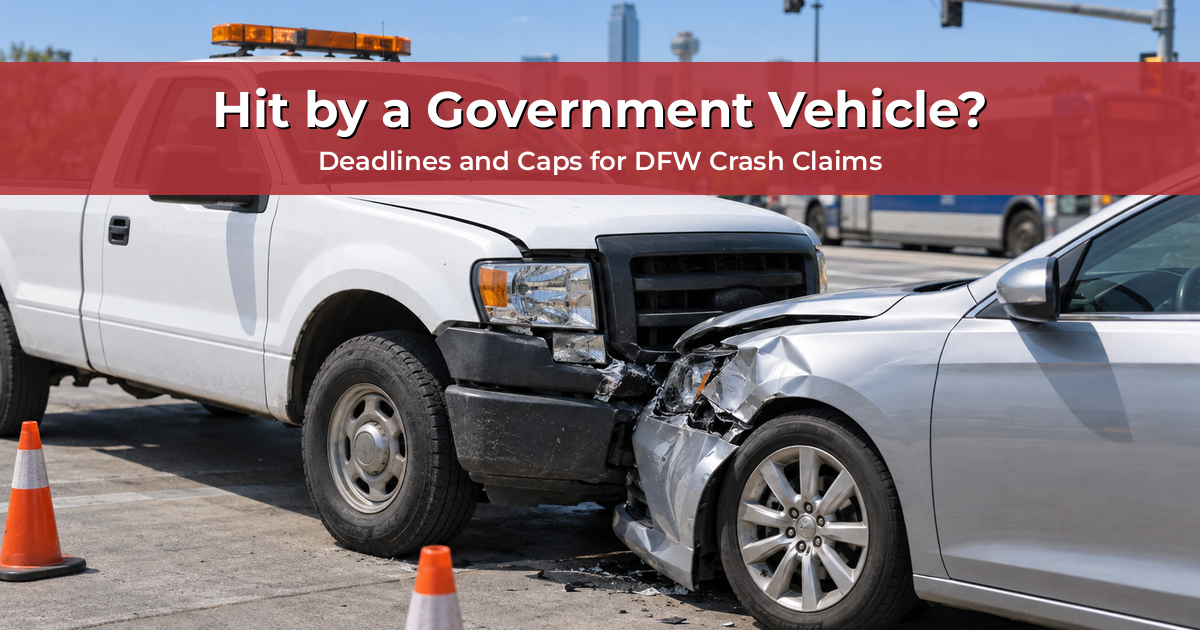
White city utility pickup truck with an amber light bar after a collision with a silver sedan at a DFW intersection, with orange traffic cones

Hit by a City Truck, Police Car, or DART Bus in DFW? Texas Tort Claims Act Deadlines and Damage Caps

By Jesse Lotspeich · Personal Injury

Short answer: If a city truck, police car, county vehicle, school bus, or DART or Trinity Metro bus hits you in Dallas-Fort Worth, you can usually still recover damages, but the Texas Tort Claims Act changes the rules. You generally must give the government written notice within six months (Fort Worth and Arlington require notice within 180 days under their city charters), and the government's liability is capped at $100,000 to $250,000 per person, depending on the type of entity. If the notice deadline passes, the claim can be thrown out even though the two-year statute of limitations hasn't run, so act quickly.

White city utility pickup truck with an amber light bar after a collision with a silver sedan at a DFW intersection, with orange traffic cones

Every week, Dallas-Fort Worth drivers share the road with garbage trucks, water department pickups, police cruisers, fire apparatus, TxDOT maintenance crews, school buses, and hundreds of DART and Trinity Metro buses. When one of those vehicles causes a crash, many people assume the claim works like any other car wreck. It doesn't. Government entities are protected by immunity unless the Legislature has waived it, and the waiver comes with short deadlines, damage caps, and procedural traps that don't apply to a claim against a private driver.

At Howard Lotspeich Alexander & Williams, PLLC (HLAW), our Fort Worth trial lawyers handle personal injury claims across Tarrant, Dallas, Denton, Collin, Johnson, and Parker counties, including claims against cities, counties, and transit agencies. This guide explains how a government-vehicle claim works in Texas, what deadlines apply in DFW, and the mistakes that most often sink these claims.

Key Takeaways

  • The Texas Tort Claims Act waives immunity for motor-vehicle crashes. A governmental unit can be liable when an employee acting within the scope of employment negligently operates a motor-driven vehicle (Tex. Civ. Prac. & Rem. Code §101.021).
  • Notice is due fast. State law requires notice within six months (§101.101), and city charters can set their own periods. Fort Worth and Arlington require 180 days, and Dallas requires six months.
  • Missing notice can end the case. Texas law makes statutory prerequisites, including notice, jurisdictional in suits against a governmental entity (Tex. Gov't Code §311.034).
  • Damages are capped. Cities and the state are capped at $250,000 per person and $500,000 per occurrence. Counties, school districts, and transit authorities like DART and Trinity Metro are capped at $100,000 per person and $300,000 per occurrence (§101.023).
  • Emergency responses get extra protection. If the officer or firefighter was responding to an emergency, the claim generally requires proof that they broke the law governing emergency driving or acted recklessly (§101.055).
  • Who you sue matters. Suing the employee instead of the agency, or suing both, can trigger the Act's election-of-remedies rules (§101.106).

Can You Sue the Government After a Car Wreck in Texas?

Yes, in many cases. Texas governmental entities are generally immune from suit, but the Texas Tort Claims Act carves out a limited waiver. Under Section 101.021, a governmental unit is liable for property damage, personal injury, and death caused by the negligence of an employee acting within the scope of employment if the harm "arises from the operation or use of a motor-driven vehicle or motor-driven equipment" and the employee would be personally liable under Texas law.

In plain English: if a city employee runs a red light on Lancaster Avenue in a city truck, or a county deputy rear-ends you on Loop 820 while driving to an ordinary call, the government can be held responsible the same way a private employer would be, subject to the limits explained below.

The motor-vehicle waiver covers most of the government vehicles you see in DFW:

  • City vehicles: police cars, fire trucks, ambulances, sanitation trucks, water and street-maintenance trucks, code-compliance cars
  • County vehicles: sheriff's patrol cars, road and bridge equipment, county-owned vans
  • State vehicles: TxDOT trucks and maintenance equipment, Department of Public Safety (DPS) trooper cars
  • School buses and district vehicles. For school districts, the Tort Claims Act applies only to claims involving motor vehicles (§101.051), so a bus crash is one of the few injury claims that can go forward against a district.
  • Public transit: DART buses and light rail in Dallas County, and Trinity Metro buses, TEXRail, and on-demand vehicles in Tarrant County

What Is the Deadline to File a Claim Against a City or County in DFW?

This is the most important section of this guide. Under Section 101.101(a), a governmental unit is entitled to receive notice of a claim no later than six months after the incident. The notice must reasonably describe the injury or damage, the time and place of the incident, and the incident itself. Section 101.101(b) also ratifies city charter provisions that set their own notice periods.

Here is how that plays out in the largest DFW cities and agencies:

Entity Notice deadline Damage cap (bodily injury) Source
City of Fort Worth 180 days, filed with the City Council (good-cause exception for late filing) $250,000 per person / $500,000 per occurrence Fort Worth City Charter, Ch. XXVII §25
City of Dallas Six months, written notice stating when, where, and how the injury occurred and the damages claimed $250,000 / $500,000 Dallas City Charter, Ch. XXIII §1
City of Arlington 180 days, filed with the City Secretary, plus a 90-day wait before suit $250,000 / $500,000 Arlington City Charter, Art. X §6
Counties, school districts, DART, Trinity Metro Six months under state law (check for any agency-specific rules) $100,000 / $300,000 §101.023(b)
State agencies (TxDOT, DPS) Six months $250,000 / $500,000 §101.023(a)

Every DFW suburb, including Grand Prairie, Irving, Mansfield, Keller, Southlake, and North Richland Hills, has its own charter, and some set different notice requirements. Always check the specific charter for the city whose vehicle was involved, and when in doubt, give notice well inside the shortest possible window.

Why the notice deadline is so dangerous

The general Texas deadline to file an injury lawsuit is two years (see our guide to the Texas statute of limitations). Many people relax because they think they have two years. But in a government case, the notice clock runs out long before then. And because Government Code §311.034 makes statutory prerequisites to suit, "including the provision of notice," jurisdictional, a government defendant can raise late notice to have the case dismissed outright.

What about "actual notice"?

Section 101.101(c) excuses formal notice if the governmental unit had actual notice that someone was injured or property was damaged. Don't count on it. Texas courts read actual notice narrowly, requiring the government's subjective awareness of the injury and its own possible fault. In one Tarrant County case, the Second Court of Appeals reviewed whether a police crash report gave the City of Arlington actual notice and found the city's evidence couldn't be deciphered (City of Arlington v. Evans). That kind of uncertainty is exactly why a formal written notice, sent early, is the safer path.

How Much Can You Recover From a Government Entity?

The Act caps the government's liability, and the cap depends on the type of entity (§101.023):

  • State government (TxDOT, DPS, state universities): $250,000 per person and $500,000 per occurrence for bodily injury or death; $100,000 per occurrence for property damage.
  • Municipalities (Fort Worth, Dallas, Arlington, and other cities): $250,000 per person and $500,000 per occurrence; $100,000 per occurrence for property damage.
  • Other local government (counties, school districts, transit authorities): $100,000 per person and $300,000 per occurrence; $100,000 per occurrence for property damage.

The Act also does not allow exemplary (punitive) damages (§101.024).

DART and Trinity Metro bus crashes

DART and Trinity Metro are regional transportation authorities, and Texas courts treat them under the $100,000-per-person local-government cap. The Dallas Court of Appeals applied that cap to a judgment against DART in Dallas Area Rapid Transit v. Morris. Many transit buses are actually operated by private contractors, but Transportation Code §452.056(d) limits a contractor performing the authority's function to the same liability the authority would have. In a Fort Worth bus case, the Supreme Court of Texas held that the transit authority and its operating contractors were cumulatively limited to a single $100,000 cap (Fort Worth Transportation Authority v. Rodriguez).

Finding other sources of recovery

Because the caps can be far below the true value of a serious injury, a careful investigation looks for every other responsible party and every available coverage:

  • Other drivers. Multi-vehicle crashes often involve a private driver who shares fault and whose insurance isn't capped.
  • Private contractors outside the transit statute. A private company doing city road work, for example, is not automatically protected by the transit-authority rule.
  • Your own coverage. Personal injury protection (PIP) pays regardless of fault, and depending on your policy language, other coverages may help. Our article on UM/UIM and PIP auto insurance explains how these coverages work.
  • Comparative fault. Texas's proportionate-responsibility rules still apply, so the government will try to shift blame to you. Our explainer on how fault works in Texas injury cases covers the 51% bar.

What If a Police Car or Fire Truck Hit You During an Emergency?

This is where many claims against cities are won or lost. Section 101.055(2) says the Act does not apply to a claim arising from an employee's action "while responding to an emergency call or reacting to an emergency situation" if the action complied with the laws applicable to emergency action or, absent such a law, if the action was not taken "with conscious indifference or reckless disregard for the safety of others."

The Supreme Court of Texas has set a high bar here. In City of San Antonio v. Maspero, a 2022 police-pursuit case, the Court held the emergency exception applied. It found that the officer's alleged violations of internal department policy weren't violations of "laws and ordinances," and that the family hadn't raised a fact issue of recklessness (Texas Supreme Court opinion summary). Reckless disregard requires more than a momentary lapse in judgment.

That doesn't mean emergency-vehicle claims are hopeless. It means the evidence has to be gathered quickly and thoroughly:

  1. Was the officer actually responding to an emergency, or driving to a routine call or back to the station?
  2. Were lights and sirens activated, and when?
  3. How fast was the vehicle going, and what were the traffic, visibility, and intersection conditions?
  4. Did the driver slow down at intersections and red lights, as Texas law generally requires of emergency drivers?
  5. What do dash-cam, body-cam, 911 audio, and computer-aided dispatch (CAD) records show?

Much of this evidence is in the government's own hands, and retention schedules vary. A prompt preservation letter and public-information requests are often the difference between a provable claim and a dismissed one. Our guide on dashcam footage after a Texas car accident explains why video evidence matters so much.

Should You Sue the Driver or the Government Agency?

Usually the agency, and the choice has permanent consequences. Under the Act's election-of-remedies provision (§101.106):

  • Filing suit under the Act against the governmental unit "immediately and forever bars" suit against the individual employee for the same subject matter.
  • Filing suit against the employee bars suit against the governmental unit unless the unit consents.
  • If both are sued, the employee must be dismissed on the government's motion.
  • If the employee was acting within the general scope of employment, a suit against the employee is treated as an official-capacity suit and must be refiled against the governmental unit within 30 days of a motion, or it will be dismissed.

Naming the wrong defendant can waste the limited time you have, or forfeit the claim. This is a technical area where getting it right at the outset matters.

What Should You Do After a Crash With a Government Vehicle in DFW?

  1. Call 911 and get a police report. Ask for the officer's name and report number. If the at-fault vehicle was a police car, a supervisor or another agency may investigate. Our article on reading a car wreck police report explains what to check.
  2. Record the vehicle details. Note the unit or fleet number on the vehicle, the department name, the route number for a bus, and the time and location. Photograph everything if it is safe to do so.
  3. Get witness names. Passengers on a bus, nearby drivers, and business employees often see what happened.
  4. Get medical care right away. Gaps in treatment are used to argue an injury wasn't serious.
  5. Calendar the shortest possible notice deadline. Assume 180 days for a Fort Worth or Arlington city vehicle and six months for most others, and don't wait until the end.
  6. Send written notice that complies with the Act and any charter. It should describe the injury, the time and place, and how the incident happened. Fort Worth's charter also asks for the amount of damages, the settlement amount, the claimant's address, and witness names. Fort Worth publishes a risk-management claim form, and Dallas publishes a notice of claim form.
  7. Be careful with the government's adjuster. Many cities and counties are handled by risk-management departments or risk pools that investigate to limit payouts. Read our tips on insurance adjuster tactics before giving a recorded statement.
  8. Talk to a lawyer early. Preservation letters, public-information requests, the right defendant, and a compliant notice all need to happen inside the notice window.

Common Mistakes That Sink Government-Vehicle Claims

  • Assuming you have two years. The notice deadline is typically six months or 180 days.
  • Treating a phone call as notice. Calling the bus agency's customer service line or the city's 311 line usually isn't written notice under the Act or a charter.
  • Sending notice to the wrong office. Charters often specify who receives notice (for example, the City Council in Fort Worth or the City Secretary in Arlington). Older Texas cases have rejected notice delivered to the wrong official.
  • Leaving out required details. A notice that doesn't describe the injury, the time and place, and the incident may be challenged.
  • Suing the employee alone. This can trigger the election-of-remedies bar described above.
  • Ignoring other parties. Failing to investigate a private driver or contractor can leave money on the table when the government's cap is low.

Frequently Asked Questions

How long do I have to file a claim after being hit by a Fort Worth city vehicle?

The Fort Worth City Charter requires written notice to the City Council within 180 days of the injury, unless good cause is shown for a late filing (Fort Worth City Charter, Ch. XXVII §25). The lawsuit itself generally must be filed within two years. Don't rely on the good-cause exception; file well before the 180th day.

Can I sue DART or Trinity Metro if a bus hit my car?

Generally yes, if the injury arose from the negligent operation of the bus. These transit authorities are treated as local governmental units, so the Tort Claims Act's six-month notice rule and its $100,000-per-person cap generally apply (§101.023; Fort Worth Transportation Authority v. Rodriguez).

What if I was a passenger on the bus when it crashed?

Passengers can bring claims too, and the same notice rules and caps generally apply. Texas courts have recognized that a common carrier like DART owes its passengers a high degree of care (Dallas Area Rapid Transit v. Morris).

Can I get punitive damages from the city?

No. The Texas Tort Claims Act does not authorize exemplary damages (§101.024).

A police officer hit me while running lights and sirens. Do I have a case?

Possibly, but it is harder. Under the emergency exception, you generally need evidence that the officer violated the laws governing emergency driving or acted with conscious indifference or reckless disregard for public safety (City of San Antonio v. Maspero). The facts, especially video and dispatch records, decide these cases.

What if a TxDOT truck caused my wreck on I-35W or I-30?

TxDOT is a state agency, so the state-government cap of $250,000 per person and $500,000 per occurrence applies, and notice is due within six months (§101.023(a); §101.101). If a private contractor was doing the work, there may be a separate claim against that company.

Talk to a Fort Worth Injury Lawyer Before the Notice Deadline Passes

A crash with a government vehicle is a race against a short clock. HLAW can identify the right government entity, calculate the correct notice deadline, send a compliant notice, preserve video and dispatch records, and look for every other source of recovery beyond the government's cap. Call (817) 993-9249 or contact us online for a free consultation.

This article is for general informational purposes only and is not legal advice. Reading it does not create an attorney-client relationship. Laws and city charters change, and every case depends on its specific facts.

Read full article

Accepting Federal Funds Does Not Waive State's Sovereign Immunity

By Brandon Barnett · Sovereign Immunity

In April of 2011, the United States Supreme Court issued an opinion in Sossamon v. Texas addressing whether the State of Texas had waived its sovereign immunity to private suits for money damages under the Religious Land Use and Institutionalized Persons Act of 2000 (RLUIPA). While the case is primarily constitutional in nature, it did stem from a claim that a Texas inmate made against the State of Texas for allegedly violating his protections of religious exercise.

Specifically, the inmate was challenging two prison policies:

  1. a policy preventing inmates from attending religious services while on cell restriction for disciplinary infractions; and
  2. a policy barring use of the prison chapel for religious worship.

The court did not address the issue of how and to what extent the prisoner’s rights to religious exercise were violated. Instead, the Court addressed the issue of sovereign immunity and whether the State of Texas could even be sued in the first place.

The Petitioner argued that because the State had received federal funding it had waived it’s right for sovereign immunity and was liable for damages base on RLUIPA.

Ultimately, the Supreme Court concluded that in accepting federal funding, a State does not consent to waive their sovereign immunity to private suits for money damages under RLUIPA. The Court acknowledged that a State may choose to waive its immunity, but that consent must be “unequivocally expressed” in the relevant statute’s text. Clark v. Barnard, 109 U.S. 436. The Court also noted that a waiver “will be strictly construed, in terms of its scope, in favor of the sovereign.” Pennhurst State School and Hospital v. Holderman, 465 U.S. 89.

The Court upheld the Fifth Circuits ruling that barred the Petitioner’s claims for monetary relief based on sovereign immunity.

Read full article

Speak with a Fort Worth attorney

Call (817) 993-9249 or send us a message to discuss your case.