

Skip to content
Tag

Bail Bonds

4 articles

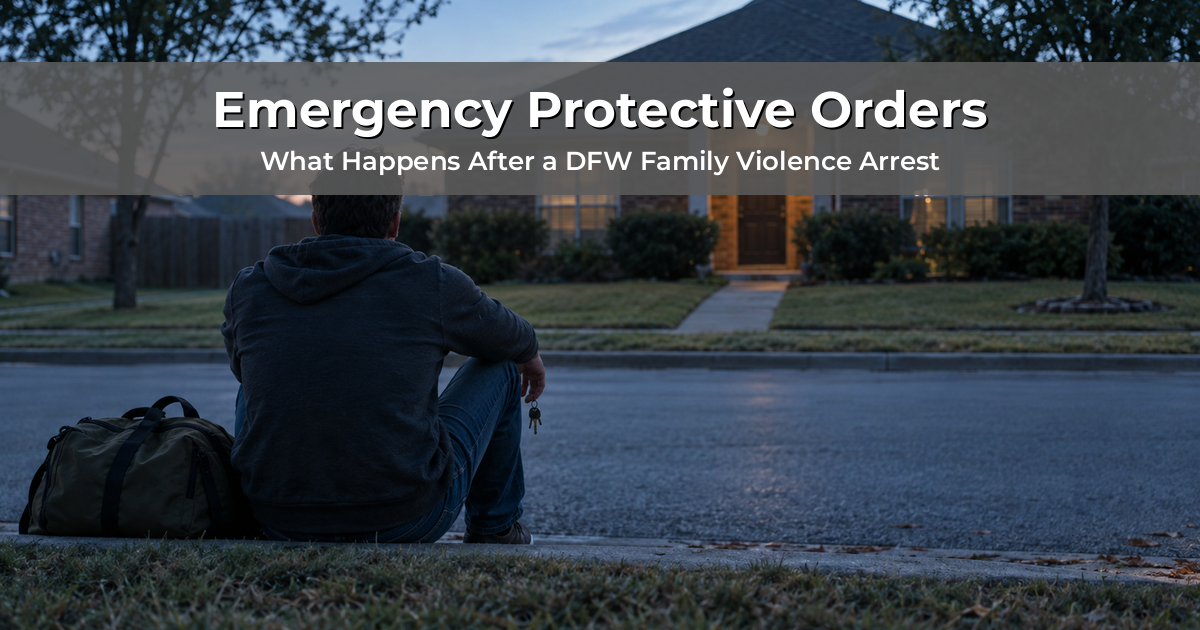
Man seen from behind sitting on a curb at dawn with a duffel bag and house keys, looking across the street at a suburban home he has been ordered to stay away from

Arrested for Family Violence in Fort Worth or Dallas? Emergency Protective Orders, Bond Conditions, and the First Days After Arrest

By Luke A. Williams · Criminal Defense

Short answer: After an arrest for family violence assault in Texas, a magistrate can, and in cases involving serious bodily injury or a deadly weapon must, issue a magistrate's order for emergency protection (often called an EPO). An EPO can bar you from going home, contacting the alleged victim, or possessing a firearm for 61 to 91 days, or up to 121 days if a deadly weapon is alleged. Violating it is a separate crime, even if the alleged victim invites you back. The alleged victim also can't simply "drop the charges"; in Tarrant County, the District Attorney's Office decides whether the case goes forward.

Man seen from behind sitting on a curb at dawn with a duffel bag and house keys, looking across the street at a suburban home he has been ordered to stay away from

A family violence arrest moves fast. One night there is an argument and a 911 call; by the next morning, you may be released from the Tarrant County or Dallas County jail with a bond, a list of conditions, and an order that says you can't go back to your own house. What you do in those first days often shapes how the case ends.

At Howard Lotspeich Alexander & Williams, PLLC (HLAW), our Fort Worth criminal defense lawyers defend family violence cases across Tarrant, Dallas, Denton, Collin, Johnson, and Parker counties. This guide covers what happens right after an arrest: the jail hold, the emergency protective order, the bond conditions, and the mistakes that turn one charge into two. For a broader overview of these cases, see our domestic violence defense page.

Key Takeaways

  • There may be a hold even after bond is posted. In some family violence arrests, the jail can hold you four hours after bond is posted, and a magistrate can extend that for up to 48 hours (Tex. Code Crim. Proc. art. 17.291).
  • An EPO can be issued at your first appearance. It is mandatory if the arrest involves serious bodily injury or a deadly weapon (art. 17.292(b)).
  • EPOs last longer than many people expect. Most remain in effect 61 to 91 days; deadly-weapon EPOs remain in effect 91 to 121 days (art. 17.292(j)).
  • The protected person can't waive it. The order itself states that no one, including the protected person, can give permission to violate it (art. 17.292(g)).
  • A violation is a new charge. Violating an EPO or a family violence bond condition is a Class A misdemeanor, and it can become a felony (Tex. Penal Code §25.07).
  • Guns must go. Possessing a firearm while subject to an EPO is a separate Class A misdemeanor for anyone other than an actively employed, full-time peace officer (Penal Code §46.04(c)).

What Happens at the Jail After a Family Violence Arrest?

Most family violence arrests in DFW are warrantless; officers respond to a call and make an arrest at the scene. You'll be booked into a city jail or the county jail and brought before a magistrate, who reads your rights, sets bond, and decides whether to issue an emergency protective order and what conditions to attach to your bond.

The four-hour (and up to 48-hour) hold

Texas has a special rule for these cases. Under article 17.291, when a person is arrested without a warrant "in the prevention of family violence" and there is probable cause to believe the violence will continue if the person is released immediately, the arresting agency "shall hold the person for a period of four hours after bond has been posted." A magistrate can extend the hold for up to 48 more hours, but only in writing and only after concluding that the violence would continue. Holds longer than 24 hours also require prior family violence arrests or a prior deadly-weapon arrest within the last 10 years.

Families are often confused when a bond is paid and their loved one still isn't released. This hold is frequently the reason. Our guide to bail bonds after a Fort Worth arrest explains the general bond process.

Don't explain your side at the jail

Calls from the jail are recorded, and officers may ask what happened. Anything you say can be used to prove the State's case. The best practice is to politely decline to discuss the incident until you've talked with a lawyer. Our article Miranda or No Miranda, Do Not Make a Statement explains why.

What Is a Magistrate's Order for Emergency Protection?

An emergency protective order is a criminal-court order that a magistrate issues at your first appearance after an arrest for an offense involving family violence (and certain other offenses, such as stalking and sexual assault). Under article 17.292(a), the magistrate may issue one on the magistrate's own motion or at the request of the alleged victim, the victim's guardian, a peace officer, or the prosecutor. It is mandatory under article 17.292(b) if the arrest also involves serious bodily injury or the use or exhibition of a deadly weapon during an assault.

An EPO is not the same as a protective order issued by a family court under Chapter 85 of the Family Code. A family-court protective order requires a separate application and hearing and can last up to two years or longer. Our article on lifting a protective order in Fort Worth covers those civil orders.

What can an EPO prohibit?

Under article 17.292(c), the magistrate can prohibit you from:

  1. Committing family violence or an assault against the protected person.
  2. Communicating with the protected person or household members in a threatening or harassing manner, or passing a threat through someone else. If the magistrate finds good cause, it can prohibit any communication except through your attorney or a court-appointed person.
  3. Going to or near the protected person's residence, workplace, or business, or the residence, child care facility, or school of a protected child.
  4. Possessing a firearm (unless you are a full-time, sworn peace officer actively employed by a state agency or political subdivision).
  5. Tracking or monitoring the protected person's property or vehicle, including with a phone tracking app or a tracking device, or by physically following them.

The "residence" restriction is often the hardest. If you live with the alleged victim, an EPO can effectively remove you from your own home, even if you own it or your name is on the lease.

How long does an EPO last?

Under the current version of article 17.292(j), an EPO takes effect immediately and:

Type of EPO Duration
Discretionary EPO, or mandatory EPO based on serious bodily injury At least 61 days, up to the 91st day after issuance
Mandatory EPO based on a deadly weapon used or exhibited during an assault At least 91 days, up to the 121st day after issuance

Read the order itself for its exact expiration date. Many people assume an EPO lasts 30 days because older versions of the law and older online articles say so, and that mistake leads to violations.

Can an EPO be changed?

Yes, but only by the court, and only after notice and a hearing. Under article 17.292(j), the issuing court may modify all or part of the order if it finds that the original order is unworkable, that the change will not place the victim at greater risk, and that the change will not endanger anyone protected by the order. Common requests include arranging a supervised pickup of clothes, work tools, or medication, or allowing communication about children through a third party. Until a judge signs a modification, the original order controls.

What Bond Conditions Are Common in Family Violence Cases?

Separate from the EPO, the magistrate can attach conditions to your bond. Article 17.49 specifically authorizes, in family violence cases:

  • Orders to stay away from a residence, school, workplace, or other location the alleged victim frequents, as specifically described in the bond
  • GPS monitoring, usually at the defendant's expense (with a sliding scale for indigent defendants)
  • A victim notification device, if the alleged victim consents
  • Orders not to track or monitor the alleged victim's property or vehicle

Magistrates can also impose other reasonable conditions, such as no-contact orders, alcohol monitoring, or counseling. Bond conditions generally last until the case is resolved or the court changes them, so they can outlast the EPO. Breaking a safety-related bond condition in a family violence case is itself a crime under Penal Code §25.07, and it can also get your bond revoked.

What Happens If You Violate an EPO or Bond Condition?

Every Texas EPO must state, in bold or capital letters, that "no person, including a person who is protected by this order, may give permission to anyone to ignore or violate any provision of this order" (art. 17.292(g)). In other words, if your spouse or partner calls and says "come home, it's fine," going home can still be a crime.

Under Penal Code §25.07, knowingly or intentionally violating an EPO or family violence bond condition by committing family violence, making prohibited communications, going to a prohibited location, possessing a firearm, interfering with a protected person's pet, tampering with a GPS monitor, or tracking the protected person is:

  • A Class A misdemeanor (up to one year in jail and a $4,000 fine) in most cases
  • A state jail felony if you violate certain provisions while possessing a deadly weapon
  • A third-degree felony if the violation involves an assault or stalking, or if you have two or more prior convictions for violating a protective order

Two or more violations within 12 months can be charged as a separate third-degree felony under Penal Code §25.072. Texts, social media messages, and messages passed through friends or relatives can all count as communication if the order prohibits it.

What to do about firearms

Under Penal Code §46.04(c), a person subject to an EPO who possesses a firearm after receiving notice of the order and before it expires commits a Class A misdemeanor. If you own guns, talk to your lawyer immediately about lawfully transferring them to a third party for the life of the order. And if your guns are kept in the home you've been ordered to stay away from, don't go back to get them yourself. Our article on firearms and DWI under Texas law discusses related firearm-possession rules.

Can the Alleged Victim Drop Family Violence Charges?

No. In Texas, the State, not the alleged victim, decides whether to prosecute. The Tarrant County Criminal District Attorney's Office says it "makes the ultimate decision of whether or not to proceed with a case based on the evidence available," that it does not generate affidavits of non-prosecution, and that "signing an affidavit will not stop prosecution."

An alleged victim may still sign an affidavit of non-prosecution. Tarrant County's published affidavit form must be notarized, and the county recommends scheduling an appointment because a meeting with an assistant district attorney is required. The affidavit is one factor the prosecutor considers, not a dismissal.

Two cautions matter here. First, the defendant should never ask, pressure, or arrange for the alleged victim to sign an affidavit or skip court. Depending on the facts and the orders in place, that contact can violate an EPO or bond condition and can lead to separate charges. Second, prosecutors often proceed without the alleged victim's testimony by using 911 recordings, body-camera video, photographs, and medical records.

Why the Outcome Matters So Much

Family violence cases carry consequences that go beyond the sentence:

  • Enhancement. A prior family violence assault conviction can turn a later Class A assault against a family member, household member, or dating partner into a third-degree felony. So can an allegation of impeding breathing or circulation (choking), even without a prior conviction (Penal Code §22.01(b)(2)). Our Texas assault offenses overview covers the assault statute.
  • State firearm restrictions. A Class A family violence assault conviction bars firearm possession under Texas law until the fifth anniversary of release from confinement or community supervision (Penal Code §46.04(b)).
  • Federal firearm restrictions. A qualifying misdemeanor crime of domestic violence conviction generally triggers a federal ban on possessing firearms or ammunition, and there is no exception for police or military personnel (ATF).
  • Record sealing. Texas bars an order of nondisclosure for a family violence offense, or when the court makes an affirmative finding that the offense involved family violence (Tex. Gov't Code §411.074). Our page on expunction and nondisclosure explains the difference.

Because these consequences can follow a person for years, how the case is resolved (dismissal, reduction to a non-family-violence offense, deferred adjudication, or trial) deserves careful attention from the start.

What Should You Do in the First Few Days?

  1. Read every order you were given. Find the EPO's expiration date, the specific addresses you must stay away from, and whether all contact or only threatening contact is prohibited.
  2. Follow the order literally. No visits, texts, social media messages, or "messages through mom," even if the other person reaches out first.
  3. Arrange a lawful place to stay. Plan for at least two to three months.
  4. Transfer firearms lawfully. Work with your lawyer to document a transfer to a third party.
  5. Retrieve belongings the right way. Ask your lawyer about a police standby or a court-approved arrangement.
  6. Save evidence. Preserve texts, call logs, photos, and the names of witnesses. Don't delete anything.
  7. Hire a defense lawyer early. Early representation can matter for bond modifications, EPO hearings, evidence preservation, and early discussions with the prosecutor.

Frequently Asked Questions

How long does an emergency protective order last in Texas?

Most EPOs remain in effect at least 61 days and up to the 91st day after issuance. If the EPO is based on a deadly weapon used or exhibited during an assault, it lasts at least 91 days and up to the 121st day (art. 17.292(j)). Always check the date written on your order.

Can I go home if my spouse says it's okay?

Not if the EPO or your bond conditions prohibit it. The order states that no one, including the protected person, can give permission to violate it (art. 17.292(g)). Only the court can change it.

Is an EPO the same as a protective order?

No. An EPO is issued by a magistrate in the criminal case at your first appearance. A protective order under Chapter 85 of the Family Code is a separate civil order that requires its own application and hearing, and it can last much longer.

Why wasn't my family member released after bond was posted?

In family violence arrests, the jail may hold a person four hours after bond is posted, and a magistrate can extend the hold for up to 48 hours in writing (art. 17.291).

Can I keep my guns while my case is pending?

Not while an EPO is in effect, unless you fall within the narrow peace-officer exception; possession is a Class A misdemeanor (Penal Code §46.04(c)). Bond conditions may also prohibit firearms.

Will an affidavit of non-prosecution get my case dismissed?

Not by itself. Tarrant County prosecutors say signing an affidavit "will not stop prosecution" and that the DA's office makes the final decision based on the evidence (Tarrant County CDA).

Talk to a Fort Worth Family Violence Defense Lawyer

The first days after a family violence arrest are when people make avoidable mistakes, like going home, sending one text, or keeping a gun in the closet, that create new charges. HLAW can review your EPO and bond conditions, request modifications when appropriate, and start building your defense right away. Call (817) 993-9249 or contact us online for a free, confidential consultation.

This article is for general informational purposes only and is not legal advice. Reading it does not create an attorney-client relationship. Laws change, and every case depends on its specific facts.


Read full article
A male defense attorney with a briefcase walks his client up the steps of a downtown justice center to arrange a planned warrant surrender

Think You Have a Warrant in Tarrant or Dallas County? How to Check and Surrender the Smart Way

By Luke A. Williams · Criminal Defense

Short answer: If you think you have an outstanding arrest warrant in Tarrant, Dallas, or another North Texas county, don't ignore it and don't walk into a police station or courthouse alone to ask. A Texas arrest warrant doesn't expire, and it can be served anywhere in the state. The safest path is usually to have a criminal defense lawyer quietly confirm the warrant, find out the charge and bond amount, and arrange a planned surrender with bond ready. That way you're booked and released as quickly as possible instead of being arrested at work, at home, or during a traffic stop.

A male defense attorney with a briefcase walks his client up the steps of a downtown justice center to arrange a planned warrant surrender

Every week we get calls from people across Dallas-Fort Worth who have heard that "there might be a warrant out." Maybe they missed a court date, a police detective left a business card at the house, an ex filed a report, or a friend saw their name online. The worst thing to do in that situation is nothing. The second worst is to guess.

At Howard Lotspeich Alexander & Williams, PLLC (HLAW), resolving warrants is one of the most common ways a criminal case first comes to us. This guide explains the types of warrants you might face in DFW, how to check for one, what happens when you surrender, and how a lawyer can make the process faster and less stressful.

Key Takeaways

  • Warrants don't expire. A Texas arrest warrant stays active until it's served or recalled. Under Code of Criminal Procedure art. 15.06, it can be executed in any Texas county.
  • There isn't one public database. Tarrant County has no single public list of active warrants. Dallas County has an online "wanted" search, but no search covers every court.
  • Checking in person can get you arrested. Asking at a police station or courthouse counter can lead to an arrest on the spot.
  • Class C warrants are different. Fort Worth Municipal Court calls itself a "Safe Harbor" court and doesn't arrest people who come in voluntarily to resolve Class C warrants.
  • A planned surrender is usually best. For felony and Class A/B misdemeanor warrants, a lawyer can confirm the bond, line up a bondsman or cash bond, and arrange a surrender to keep jail time short.
  • Ignoring it makes things worse. Missing court can lead to a separate bail jumping charge, a forfeited bond, and a higher bond the next time.

What Is an Arrest Warrant in Texas?

Under Texas Code of Criminal Procedure art. 15.01, a warrant of arrest is "a written order from a magistrate" directing a peace officer to take a person accused of an offense into custody. Once a warrant is issued, any officer who stops you and runs your name can arrest you. That includes a traffic stop on I-35W, a call to your home, or a routine ID check.

Common types of warrants in DFW

Type What it usually means Who issues it
Arrest warrant on a complaint Police presented a probable cause affidavit, and a magistrate found enough to charge you. Magistrate or judge
Capias Issued after an indictment or information is filed, often when you haven't been arrested on the case yet. District or county court
Bench warrant / bond forfeiture warrant You missed a court date, and the judge ordered your arrest. Trial court
Motion to revoke or adjudicate warrant Your probation officer reported a violation. Court supervising your probation
Class C alias or capias pro fine warrant You missed a deadline on a ticket or didn't pay a fine. Municipal or justice court

The type of warrant matters. It affects whether a bond is already set, whether you can post it on your own, and whether the judge has to see you first. For probation warrants in particular, see our article on defending against probation revocation.

How Do You Check for a Warrant in Tarrant or Dallas County?

There's no single statewide website that shows every active warrant, and each North Texas county handles this differently.

Tarrant County

Tarrant County doesn't publish a single public list of active criminal warrants. Case records live with the District Clerk (felonies) and the County Clerk (misdemeanors), and the Sheriff's Office handles warrant service. The county's Criminal Warrants page describes staff who handle the large volume of outstanding warrants from courts across the county. In practice, criminal defense lawyers and licensed bail bond agents routinely confirm warrant status, the charge, and the bond amount for clients.

Some smaller courts post limited lists. For example, Justice of the Peace Court 1 publishes an active warrants list for its own misdemeanor cases that is updated monthly. Lists like this cover only one court.

Dallas County

Dallas County offers an online Dallas County Wanted search. The Sheriff's Office also runs a warrant information line at (214) 761-9026, listed in its frequently asked questions. Even so, a clean result doesn't guarantee there's no warrant. Very recent warrants, sealed warrants, warrants from city courts, and warrants from other counties may not show up.

Fort Worth and other city courts

Traffic tickets and other Class C offenses are handled by municipal courts. The Fort Worth Municipal Court warrants page lets you look up and pay a warrant, and it notes that a $50 warrant fee is added when a warrant issues. Arlington, Dallas, Grand Prairie, and the other Metroplex cities each have their own municipal courts and separate lookups.

Why you shouldn't "just go ask"

The Fort Worth Police Department's FAQ says you can ask any officer or go to any police station for a warrant check. That's true, but if a felony or Class A/B warrant comes back, the officer can arrest you right then. Having a lawyer check first means you learn the charge, the court, and the bond before deciding when and how to surrender.

What Happens When You Turn Yourself In?

Step 1: Confirm the details

Before a planned surrender, your lawyer will confirm:

  • The charge and its level (felony, Class A, or Class B).
  • The court and cause number.
  • Whether a bond amount has already been set, and how much it is.
  • Whether there are any holds, such as warrants from other counties, probation holds, or immigration detainers.
  • Whether the bond will come with conditions, such as an ignition interlock device, a protective order, GPS monitoring, or drug testing.

Step 2: Arrange the bond in advance

Tarrant County's bond information page says bonds may be posted 24 hours a day at the Bond Desk of the Tarrant County Corrections Center, 100 N. Lamar, Fort Worth. If you post bond yourself, you must pay the full amount. Many people use a surety (bail bond) company instead and pay a non-refundable fee. Some defendants qualify for a personal bond, though art. 17.03 bars personal bonds for many violent offenses and certain other charges. Our guides to Fort Worth bail bonds and what to expect after a Fort Worth arrest explain these options in more detail.

Step 3: Booking and release

At surrender, you'll be booked: fingerprinted, photographed, and checked for other warrants. Under art. 15.17, you must be brought before a magistrate (in person or by video) within 48 hours of arrest. The magistrate will tell you about the accusation, your right to a lawyer, your right to remain silent, and your right to request appointed counsel if you can't afford one, and will admit you to bail if the law allows. When a bond is already set and ready to post, the whole process usually goes faster.

What about a walk-through bond?

You may hear the term "walk-through" or "walk-in" bond. It generally means arriving at the jail with the bond already arranged so booking and release happen in one visit. Whether that's possible depends on the county, the charge, and whether a bond has been set. The procedures change over time, and a lawyer who handles these surrenders regularly will know the current process.

How Is the Bond Amount Decided?

If no bond has been set, or if the bond is too high, the judge or magistrate applies the rules in art. 17.15. Bail must be high enough to reasonably assure you'll come back to court, but "is not to be used to make bail an instrument of oppression." The court considers:

  • The nature and circumstances of the offense, including whether it involved violence.
  • Your ability to make bail.
  • The safety of the alleged victim, law enforcement, and the community.
  • Your criminal history, including any past failures to appear.
  • Citizenship status.

A lawyer can file a motion to set a reasonable bond or reduce an excessive one, sometimes before you surrender. For more on this, see excessive bail as punishment in Texas. If you're held in jail and the State isn't ready for trial, art. 17.151 generally requires release on personal bond or a reduced bond after 90 days for most felonies, or after 30 days for misdemeanors punishable by more than 180 days in jail.

What If the Warrant Is for a Traffic Ticket or Class C Offense?

Class C warrants usually involve missed court dates or unpaid fines on traffic tickets and other fine-only offenses. The approach is different:

  • Many city courts won't arrest you if you come in voluntarily. Fort Worth Municipal Court says it is a Safe Harbor court that doesn't arrest people who come in voluntarily to resolve Class C warrants, in person or virtually. Fort Worth also holds periodic Warrant Forgiveness events, where a judge may reduce fines and fees.
  • You may have options besides paying in full. Fort Worth's court rules let a defendant without a lawyer appear in walk-in court to request deferred disposition, defensive driving, a payment plan, or community service in place of a fine. To cancel an alias warrant and set the case for a future docket, the court requires a bond.
  • Unresolved tickets can block your license renewal. Under Transportation Code §706.004, DPS may deny renewal of your driver's license for failure to appear when the city or county has contracted with DPS.

Each city's policies differ, so check with that specific court or have a lawyer do it.

Why Ignoring a Warrant Makes Things Worse

  • You can be arrested at any time. A warrant follows you into every traffic stop, airport, and police encounter, anywhere in Texas.
  • Missing court can be a new crime. Under Penal Code §38.10, intentionally or knowingly failing to appear after release on bond is a Class A misdemeanor, or a third-degree felony if the underlying case is a felony. Having a reasonable excuse is a defense.
  • Your bond history follows you. Under art. 17.15, judges consider past failures to appear when setting bail, so a prior no-show can mean a higher bond later.
  • The weekend problem. Being arrested on a Friday night can mean spending more time in jail before the case can be addressed than if you'd surrendered on a planned weekday.

Don't Talk About the Case When You Surrender

Turning yourself in is not the time to explain your side. Officers may ask casual questions during booking, and anything you say about the facts of the case can be used against you. Be polite, give identifying information, and say you want to speak with your lawyer. Read more in Miranda or No Miranda: Do Not Make a Statement. If a detective has been trying to reach you before charges are filed, talk to a lawyer before returning the call.

A Practical Checklist If You Think You Have a Warrant

  1. Don't ignore it. Write down any case or citation numbers, court letters, or detective contact information you have.
  2. Call a criminal defense lawyer. Have the lawyer confirm the warrant, the charge, the court, and the bond.
  3. Plan the bond. Decide between cash, a surety, or a request for a personal bond, and get funds or a bondsman lined up.
  4. Pick the surrender time with your lawyer. Weekday mornings are often best.
  5. Bring ID and leave valuables at home. Arrange a ride for when you're released.
  6. Follow all bond conditions from the moment you're released, and stay in contact with your lawyer.

Frequently Asked Questions

Do arrest warrants expire in Texas?

No. A Texas arrest warrant stays active until it's served or recalled by the court, and under art. 15.06 it can be served in any county in the state. Some old charges may face limitations issues, but the warrant itself doesn't disappear.

Can I check for a warrant online in Tarrant County?

Only partly. Tarrant County doesn't provide a single public list of active criminal warrants. Some courts, such as Justice of the Peace Court 1, post limited lists. Criminal defense lawyers and bail bond agents routinely confirm warrant status for clients.

Will I be arrested if I go to Fort Worth Municipal Court about a ticket warrant?

According to the court, Fort Worth Municipal Court is a Safe Harbor court that doesn't arrest people who come in voluntarily to resolve outstanding Class C warrants. That policy applies to Fort Worth municipal cases, not to county felony or misdemeanor warrants.

How long will I be in jail if I turn myself in?

It depends on the charge, whether bond is set, and how busy the jail is. Under art. 15.17, you must see a magistrate within 48 hours. With a bond already set and posting arranged, release often happens the same day, but no lawyer can guarantee a timeline.

Can a lawyer get a warrant recalled without me going to jail?

Sometimes. For certain bench warrants and Class C warrants, a court may allow a lawyer to file a motion, post a bond, or set the case on a docket without a jail booking. For new felony and Class A/B charges, booking is almost always required, but planning ahead can keep the stay short.

What if the warrant is from another county?

Because warrants extend statewide, you can be arrested in Tarrant County on a Dallas, Denton, or Collin County warrant, and the reverse. You may wait to be transferred, or you may be able to post bond on the other county's warrant locally. A lawyer can sort out the logistics, especially when several warrants are involved.

Should I talk to the detective who called me?

Not before talking to a lawyer. Detectives often call to "get your side of the story" before deciding whether to seek a warrant. You have the right to remain silent and to have counsel present.

Talk to a Fort Worth Criminal Defense Lawyer About a Warrant

A warrant is easier to handle on your own schedule than at a traffic stop. HLAW's criminal defense attorneys help clients across Tarrant, Dallas, Denton, Collin, Johnson, and Parker counties confirm warrants, arrange bonds, and plan surrenders, and then defend the case that follows. That includes assault and violent offenses, drug charges, theft, and DWI. Call (817) 993-9249 or contact us online for a free, confidential consultation.


This article is for general informational purposes only and is not legal advice. Reading it does not create an attorney-client relationship. Warrant, bond, and court procedures vary by county and court and change over time. Consult a licensed Texas attorney about your situation.

Read full article
Bail Not Excessive 8th Amendment

"Excessive Bail Shall Not Be Required" | Bail is Not Intended to be Punishment

By Brandon Barnett · Bail Bonds

Bail Not Excessive 8th AmendmentJust the other day, I read something written by one of our local mayors calling for bail reform because a certain person had been released on what she believed was an insufficient bail amount. This got me thinking about our system of bail in Texas and the real purpose behind the system. I doubt I'll ever convince the mayor that we ought not to punish people before they've had their day in court, but I thought it best to lay out the history and purpose of bail in case she ever wants to know.

The purpose of bail in the criminal justice system has been convoluted throughout the years, leaving many people with a fundamental misunderstanding about what bail actually is and the purpose behind it. Often people think bail is just another form of punishment (i.e. "Let's lock him up and throw away the key!"), when in reality it should be the exact opposite. The use of bail allows a defendant to be released and have the ability to prepare the best defense possible for trial. At the moment that bail is set, the person is presumed innocent. So what exactly is bail? What is the overarching purpose? How is the amount of bail determined?

What is Bail?

Under both the United States Constitution and the Texas Constitution, generally, criminal defendants have a right to bail and to be free from excessive bail. Tex. Const. art. I §11, §13. With that, while all non-capital crimes are eligible for bail, bail can be denied in several situations under the Texas Constitution and it is at the judge or magistrate’s discretion whether to grant bail where defendant has been charged with capital murder. Tex. Const. art. I, §11; Bill of Rights; Judiciary Act of 1789.

Bail is the guarantee given by the defendant that he will appear at his court settings. Bail includes both bail bonds and personal bonds. Tex. Code Crim. Proc. Ann. Art. 17.01. A bail bond is a written undertaking by the defendant ensuring his appearance. Art. 17.02. There are a few different ways to go about getting a bail bond:

  1. The defendant can have a family member or friend sign the bond as their surety, accepting responsibility for the amount if the defendant does not appear;
  2. A defendant can go through a commercial bail bondsman and have them be their surety; or
  3. The defendant can pay the court cash in the amount of the bond. Id.

A personal bond is when there is no surety and no money paid when the defendant is released and the defendant will be responsible for a set amount if they do not appear. Art. 17.03.

What is the Purpose of Bail?

Congress stated that, historically, the sole purpose of bail was to secure defendant’s presence in court. 110 H.R. 2286. The purpose remains the same, to reduce flight risk but also to give the defendant the best opportunity to prepare for trial. Stack v. Boyle, 342 U.S. 1 (1951). Essentially, the idea behind bail is that if a person puts down a chunk of money they are less likely to flee. Riverside v. McLaughlin, 500 U.S. 44 (1991). In no way should bail be a form of punishment for the defendant and the Eighth Amendment makes it clear that bail shall not be excessive. Further, being released on bail does not prove guilt nor affect the presumption of innocence. A person remains innocent until proven guilty when granted bail. United States v. Houston, 26 F. Cas. 379.

How is Bail Set in Texas?

In Texas, a court, judge, or magistrate setting bail should use their discretion under the Texas Constitution and the rules provided in Article 17.15 of the Texas Code of Criminal Procedure. The Code sets out 5 rules in determining bail for a defendant:

  1. The bail set must be “sufficiently high” so as to reasonably ensure the defendant’s appearance in court.
  2. Bail must not be an “instrument of oppression.” Which essentially means bail is not to be a form of punishment.
  3. The nature and circumstances of the offense are to be considered.
  4. The defendant’s ability to make bail will be considered.
  5. The future safety of the community and victim of the alleged offense must be considered.

The court is also allowed to look to other factors including criminal history, family ties, and links to the community. Gonzalez v. State, 996 S.W.3d 350. If bail is set in an amount that the defendant cannot make, the court will hear evidence on that issue and will lower it if the amount was found improper or excessive under the rules and/or the Constitution. If the court refuses then the defendant can also appeal before trial. Id.

Bail in Tarrant County

If you were to compare the standard bail amounts from county to county across Texas for similar criminal allegations, you would probably find that Tarrant County is on the lower side. Johnson County and Parker County might set a higher bail amount for the same or similar case. This does not mean that Tarrant County's bail system needs to be reformed. Clearly, if Tarrant County began to experience more folks not showing up for court, then the bail might go up (and it does in each individual case, when the defendant proves himself to be unreliable in appearing for court). Before any public officials begin calling for reform in Tarrant County, I would suggest that we determine whether, in fact, the system is broken, or if, perhaps we are trying to subject a defendant to pretrial punishment with excessive bail.

Read full article

Bail Bond Scam Alert

By Brandon Barnett · Bail Bonds

Dallas Fort Worth Bail Bond Scam

Public Service Announcement:  Attorneys beware that your clients could be the target of a Bail Bond scam that is going around.  There is a person with a Florida phone number (352-210-7464) that is calling criminal defendants in the DFW area claiming to be a representative from their bail bond office.  The caller then claims that the person (who is typically in good standing) owes some amount of money to the bail bondsman.  The caller then threatens to go off the bond if the person does not pay immediately.

This happened to one of our clients yesterday and we called the number to investigate and quickly uncovered the scam.  Please let your clients know that this is going around so that they are not fooled if they get a similar call.

Read full article

Speak with a Fort Worth attorney

Call (817) 993-9249 or send us a message to discuss your case.