Skip to content
Tag

Insurance

Page 2 of 2 · 10 articles

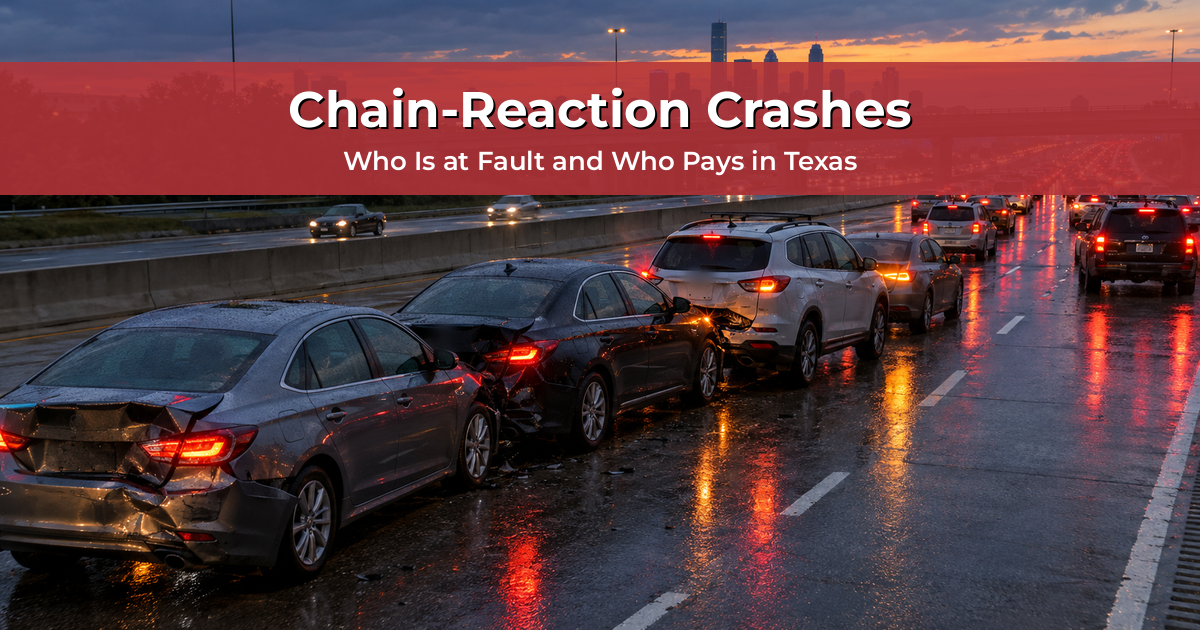
Chain-reaction rear-end crash involving several cars on a wet Dallas-Fort Worth freeway at dusk

Rear-Ended in a Chain-Reaction Crash on a DFW Highway? Who Is at Fault and Who Pays in Texas

By Jesse Lotspeich · Personal Injury

Short answer: In Texas, the driver who rear-ends you is usually, but not automatically, the one at fault. Texas law requires following drivers to keep an "assured clear distance," but courts hold that the mere fact of a rear-end collision does not prove negligence by itself. In a chain-reaction crash, a jury divides responsibility among every driver who contributed. You can recover as long as you are not more than 50% at fault, and any defendant found more than 50% responsible can be made to pay the entire judgment.

Chain-reaction rear-end crash involving several cars on a wet Dallas-Fort Worth freeway at dusk

Rear-end and chain-reaction crashes are part of daily life on DFW highways. Traffic on I-35W, I-30, I-20, Loop 820, LBJ (I-635), and Highway 121/183 can go from 70 mph to a dead stop in seconds, and when one driver doesn't stop in time, three, four, or five vehicles can end up in the same crash. In 2025, TxDOT recorded 30,433 reportable crashes in Tarrant County and 43,946 in Dallas County (TxDOT 2025 crashes and injuries by county).

At Howard Lotspeich Alexander & Williams, PLLC (HLAW), our Fort Worth trial lawyers handle personal injury claims across Tarrant, Dallas, Denton, Collin, Johnson, and Parker counties. This guide explains how Texas assigns fault in rear-end and multi-car crashes, what the other drivers' insurers will argue, and what you can do to protect your claim.

Key Takeaways

  • Following drivers have a statutory duty. Texas Transportation Code §545.062 requires a following driver to keep an "assured clear distance" so they can stop safely (Tex. Transp. Code §545.062).
  • A rear-end crash is evidence of negligence, not automatic proof of it. Texas courts, including the Fort Worth Court of Appeals, hold that the mere occurrence of a rear-end collision is not negligence as a matter of law (Campbell v. Perez).
  • Fault is divided by percentages. The jury assigns a percentage of responsibility to each claimant, defendant, settling person, and designated responsible third party (Tex. Civ. Prac. & Rem. Code §33.003).
  • The 51% bar applies. You can't recover if you are more than 50% responsible, and your recovery is reduced by your own percentage (§§33.001, 33.012).
  • Joint and several liability above 50%. A defendant found more than 50% responsible can be held liable for all recoverable damages (§33.013(b)).
  • Evidence disappears fast. Dash-cam footage, vehicle data, and witness memories can be lost within days, so early investigation matters.

Who Is at Fault in a Rear-End Collision in Texas?

Usually the following driver. Section 545.062(a) of the Transportation Code says a driver following another vehicle "shall... maintain an assured clear distance between the two vehicles so that, considering the speed of the vehicles, traffic, and the conditions of the highway, the operator can safely stop without colliding with the preceding vehicle." In other words, the law expects you to leave enough room to stop for whatever happens ahead, including a sudden slowdown on I-30 at rush hour.

But Texas doesn't treat a rear-end collision as automatic liability. Courts have said for decades that "the mere occurrence of a rear-end collision is some evidence of negligence of the rear-ending driver but is not negligence as a matter of law," and that the plaintiff must prove "specific acts of negligence on the part of the following driver as well as proximate cause" (Campbell v. Perez, Tex. App.—Fort Worth 2015). Courts have also held that a violation of §545.062 doesn't create negligence per se. It sets the same reasonable-care standard as the common law and leaves the question to the jury (Arn v. Stuart, Tex. App.—Austin 2010).

That's why "they hit me from behind" is the start of a case, not the end of it. Specific acts of negligence commonly proven in rear-end cases include:

  • Following too closely for the speed, traffic, or weather
  • Failing to keep a proper lookout
  • Speeding or driving too fast for conditions
  • Failing to brake in time
  • Texting or reading messages while driving, which is a separate traffic offense in Texas (§545.4251)
  • Driving while intoxicated

When the lead driver can share fault

The defense will look for ways to shift blame to you. Common arguments include:

  • You stopped suddenly and without reason, or "brake-checked" the other driver
  • You cut in front of the following driver and then slowed down
  • Your brake lights didn't work
  • You were stopped in a travel lane without hazard lights

In one Austin case cited often by Texas courts, a jury that believed the lead driver stopped "abruptly" and without explanation was allowed to find the following driver not negligent (Hall v. Moore). These arguments are fact-specific, and evidence like dash-cam video and vehicle data often decides them.

How Is Fault Divided in a Chain-Reaction Crash?

A chain-reaction crash (sometimes called a multi-car pileup) happens when one impact pushes vehicles into each other. A typical DFW example: Car C slams into Car B, which is pushed into Car A, which was stopped in traffic on Loop 820. Sometimes there are two separate impacts: Car B stops in time, and then Car C hits Car B and shoves it into Car A.

Texas handles these crashes under the proportionate responsibility statute, Chapter 33 of the Civil Practice and Remedies Code:

Rule What it means for you Source
Percentages for everyone The jury assigns a percentage of responsibility to each claimant, each defendant, each settling person, and each designated responsible third party §33.003
51% bar You can't recover if your share is greater than 50% §33.001
Reduction for your share Your damages are reduced by your percentage of responsibility §33.012(a)
Several liability Each defendant generally pays only its own percentage §33.013(a)
Joint and several above 50% A defendant found more than 50% responsible can be liable for all recoverable damages §33.013(b)
Responsible third parties A defendant can ask to put a non-party, such as a driver who fled, on the verdict form, generally by motion at least 60 days before trial §33.004

For a broader look at these rules, see our article on how fault works in Texas personal injury cases.

Why the percentages matter so much

Suppose you're in Car A, stopped in traffic, and you suffer $200,000 in damages. A jury finds Car C's driver 70% responsible and Car B's driver 30% responsible, and assigns you 0%. Because Car C's driver is over 50%, that driver is jointly and severally liable and can be made to pay the full $200,000. If the jury had instead split fault 50/50 between B and C, neither would be over 50%, and each would generally owe only $100,000. That matters if one of them has only minimum insurance.

Which impact caused which injury?

Multi-impact crashes raise a causation question: which collision caused which injury? The insurer for the first car may argue your injuries came from the second impact, and vice versa. Accident reconstruction, vehicle damage photos, airbag control module (event data recorder) downloads, and medical testimony are often needed to connect specific injuries to specific impacts. A thorough police crash report helps, but reports are often incomplete in multi-car crashes, especially when officers arrive after the vehicles have been moved.

What Defenses Will the Insurance Companies Raise?

Beyond blaming the lead driver, expect these arguments:

  1. Sudden emergency. Texas juries can be instructed that a driver confronted with an emergency "arising suddenly and unexpectedly," which the driver didn't cause, isn't negligent if the driver responded as a reasonably prudent person would (Dillard v. Texas Electric Cooperative, quoting the Texas Pattern Jury Charge). Drivers sometimes claim a car cut them off or debris appeared in the road.
  2. Unavoidable accident. This instruction tells jurors that an occurrence may not have been caused by any party's negligence, and it is most often raised with fog, ice, wet pavement, or obstructed views (Dillard). The Supreme Court of Texas approved its use in a rear-end crash with a car stopped on the blind side of an overpass in Reinhart v. Young, 906 S.W.2d 471 (Tex. 1995).
  3. Phantom driver. The defense may blame an unidentified vehicle that caused the chain reaction and then left. Your own uninsured motorist coverage may matter here. Our guide to UM/UIM and PIP coverage explains how it works.
  4. Minimal damage, minimal injury. Insurers often argue that low bumper damage means no real injury. Medical records, treatment consistency, and expert testimony answer that argument.

Wet pavement doesn't excuse following too closely. Section 545.062 expressly requires drivers to consider "the conditions of the highway." Drivers who know the road is wet are expected to leave more room. A police report that marks "following too closely" helps, but it is not conclusive. In one Texas case, the jury found no negligence despite that notation (Smith v. Central Freight Lines), which is why independent evidence matters.

What Evidence Wins Rear-End and Pileup Cases?

The strongest claims are built in the first few weeks:

  • Dash-cam and phone video. Your own camera, other drivers' cameras, and rideshare or commercial fleet cameras. Our article on dashcam footage after a Texas car accident explains how to preserve it.
  • Traffic and business cameras. TxDOT and city traffic cameras, toll gantry systems, and nearby business security cameras. Many are overwritten quickly, so preservation requests must go out fast.
  • Event data recorders. Most modern vehicles record speed, braking, and throttle data in the seconds before a crash.
  • Cell phone records. If distraction is suspected, phone records can show texting or app use at the moment of impact.
  • Commercial vehicle data. If a truck or delivery van was involved, electronic logging devices, telematics, and driver files are critical. See our 18-wheeler and commercial truck crash guide.
  • Witness statements. Independent witnesses are especially valuable in chain reactions, where each driver tends to blame the next.

What Should You Do After a Rear-End or Chain-Reaction Crash in DFW?

  1. Get to safety and call 911. On a highway, stay in your vehicle with your seatbelt on if it isn't safe to get out.
  2. Photograph every vehicle. Take pictures of each vehicle's damage, its position, its license plate, and the driver's insurance card.
  3. Get names and contact information for every driver and witness. In a chain reaction, you may have claims against more than one driver.
  4. Don't apologize or guess about fault. Stick to the facts.
  5. Get medical care promptly. Neck, back, and head injuries from rear impacts often get worse over the following days.
  6. Save your dash-cam footage immediately. Many cameras record over old footage in a loop.
  7. Be careful with adjusters. In a multi-car crash, several insurers may call you, each hoping to pin blame on someone else. Read about insurance adjuster tactics in Fort Worth before giving a recorded statement.
  8. Watch the deadline. Most Texas injury lawsuits must be filed within two years. If a government vehicle was involved, the notice deadline can be as short as six months. See our Texas statute of limitations guide.

Frequently Asked Questions

Is the driver who rear-ends you always at fault in Texas?

No, but usually. Texas law requires following drivers to keep an assured clear distance (§545.062), and a rear-end crash is some evidence of negligence. Still, courts hold it isn't negligence as a matter of law, so you must prove specific negligent acts and causation (Campbell v. Perez).

Who pays in a three-car chain-reaction crash?

Each driver who contributed pays their percentage of responsibility, and any driver found more than 50% at fault can be made to pay the full judgment (§33.013). Often the last car in the chain bears most of the responsibility, but not always. Middle drivers who were also following too closely can share fault.

I was in the middle car. Can I be sued?

Yes. If you were pushed into the car ahead after being hit, the evidence often shows you weren't at fault for that impact. But if you hit the car ahead first and were then struck from behind, you may share responsibility for the first impact. Each impact is analyzed separately.

Can I recover if I was partly at fault?

Yes, as long as you are not more than 50% responsible. Your damages are reduced by your percentage (§§33.001, 33.012).

What if the driver who started the chain reaction drove away?

You may be able to make a claim under your uninsured motorist coverage, and the remaining defendants may try to designate the missing driver as a responsible third party (§33.004). Report the crash to police immediately and preserve any video.

Does rain or ice excuse a rear-end crash?

Not by itself. The assured-clear-distance rule expressly considers "the conditions of the highway" (§545.062), so drivers are expected to leave more room in bad weather. A defendant may still ask for an unavoidable-accident instruction if the evidence supports it.

Talk to a Fort Worth Car Wreck Lawyer

Rear-end and chain-reaction crashes look simple, but the fault fight between multiple drivers and insurers can be complicated, and evidence disappears quickly. HLAW can preserve video and vehicle data, identify every responsible driver and policy, and build the proof Texas law requires. Call (817) 993-9249 or contact us online for a free consultation. You can also read more about what compensation is available in a Texas personal injury lawsuit.

This article is for general informational purposes only and is not legal advice. Reading it does not create an attorney-client relationship. Every case depends on its specific facts, and the laws discussed here may change.

Read full article
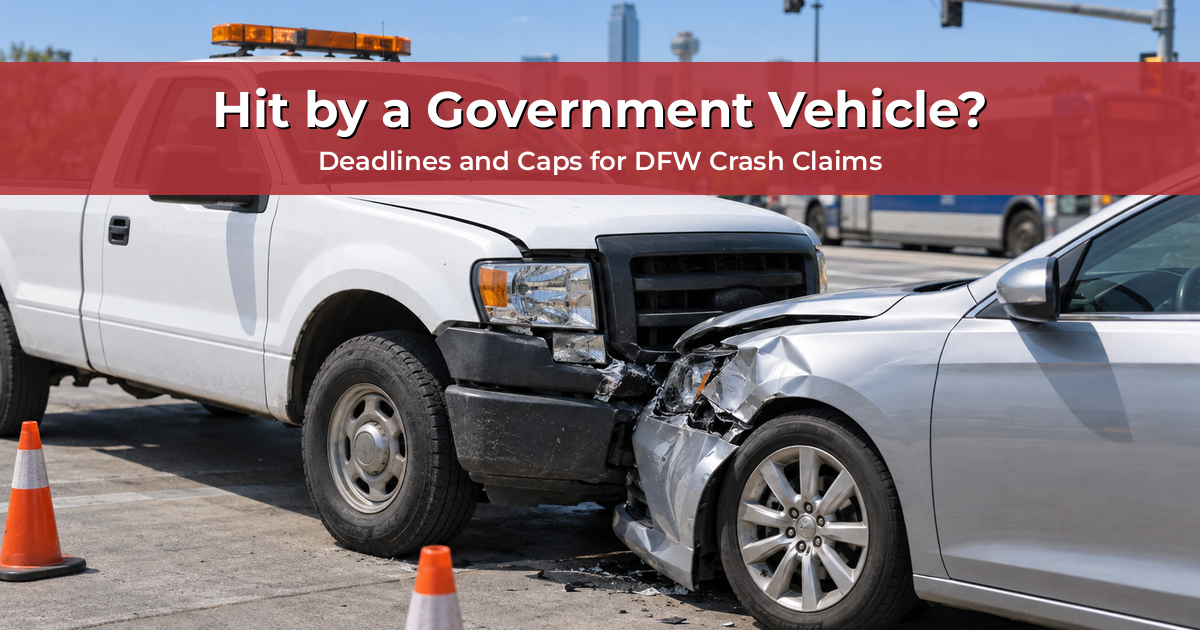
White city utility pickup truck with an amber light bar after a collision with a silver sedan at a DFW intersection, with orange traffic cones

Hit by a City Truck, Police Car, or DART Bus in DFW? Texas Tort Claims Act Deadlines and Damage Caps

By Jesse Lotspeich · Personal Injury

Short answer: If a city truck, police car, county vehicle, school bus, or DART or Trinity Metro bus hits you in Dallas-Fort Worth, you can usually still recover damages, but the Texas Tort Claims Act changes the rules. You generally must give the government written notice within six months (Fort Worth and Arlington require notice within 180 days under their city charters), and the government's liability is capped at $100,000 to $250,000 per person, depending on the type of entity. If the notice deadline passes, the claim can be thrown out even though the two-year statute of limitations hasn't run, so act quickly.

White city utility pickup truck with an amber light bar after a collision with a silver sedan at a DFW intersection, with orange traffic cones

Every week, Dallas-Fort Worth drivers share the road with garbage trucks, water department pickups, police cruisers, fire apparatus, TxDOT maintenance crews, school buses, and hundreds of DART and Trinity Metro buses. When one of those vehicles causes a crash, many people assume the claim works like any other car wreck. It doesn't. Government entities are protected by immunity unless the Legislature has waived it, and the waiver comes with short deadlines, damage caps, and procedural traps that don't apply to a claim against a private driver.

At Howard Lotspeich Alexander & Williams, PLLC (HLAW), our Fort Worth trial lawyers handle personal injury claims across Tarrant, Dallas, Denton, Collin, Johnson, and Parker counties, including claims against cities, counties, and transit agencies. This guide explains how a government-vehicle claim works in Texas, what deadlines apply in DFW, and the mistakes that most often sink these claims.

Key Takeaways

  • The Texas Tort Claims Act waives immunity for motor-vehicle crashes. A governmental unit can be liable when an employee acting within the scope of employment negligently operates a motor-driven vehicle (Tex. Civ. Prac. & Rem. Code §101.021).
  • Notice is due fast. State law requires notice within six months (§101.101), and city charters can set their own periods. Fort Worth and Arlington require 180 days, and Dallas requires six months.
  • Missing notice can end the case. Texas law makes statutory prerequisites, including notice, jurisdictional in suits against a governmental entity (Tex. Gov't Code §311.034).
  • Damages are capped. Cities and the state are capped at $250,000 per person and $500,000 per occurrence. Counties, school districts, and transit authorities like DART and Trinity Metro are capped at $100,000 per person and $300,000 per occurrence (§101.023).
  • Emergency responses get extra protection. If the officer or firefighter was responding to an emergency, the claim generally requires proof that they broke the law governing emergency driving or acted recklessly (§101.055).
  • Who you sue matters. Suing the employee instead of the agency, or suing both, can trigger the Act's election-of-remedies rules (§101.106).

Can You Sue the Government After a Car Wreck in Texas?

Yes, in many cases. Texas governmental entities are generally immune from suit, but the Texas Tort Claims Act carves out a limited waiver. Under Section 101.021, a governmental unit is liable for property damage, personal injury, and death caused by the negligence of an employee acting within the scope of employment if the harm "arises from the operation or use of a motor-driven vehicle or motor-driven equipment" and the employee would be personally liable under Texas law.

In plain English: if a city employee runs a red light on Lancaster Avenue in a city truck, or a county deputy rear-ends you on Loop 820 while driving to an ordinary call, the government can be held responsible the same way a private employer would be, subject to the limits explained below.

The motor-vehicle waiver covers most of the government vehicles you see in DFW:

  • City vehicles: police cars, fire trucks, ambulances, sanitation trucks, water and street-maintenance trucks, code-compliance cars
  • County vehicles: sheriff's patrol cars, road and bridge equipment, county-owned vans
  • State vehicles: TxDOT trucks and maintenance equipment, Department of Public Safety (DPS) trooper cars
  • School buses and district vehicles. For school districts, the Tort Claims Act applies only to claims involving motor vehicles (§101.051), so a bus crash is one of the few injury claims that can go forward against a district.
  • Public transit: DART buses and light rail in Dallas County, and Trinity Metro buses, TEXRail, and on-demand vehicles in Tarrant County

What Is the Deadline to File a Claim Against a City or County in DFW?

This is the most important section of this guide. Under Section 101.101(a), a governmental unit is entitled to receive notice of a claim no later than six months after the incident. The notice must reasonably describe the injury or damage, the time and place of the incident, and the incident itself. Section 101.101(b) also ratifies city charter provisions that set their own notice periods.

Here is how that plays out in the largest DFW cities and agencies:

Entity Notice deadline Damage cap (bodily injury) Source
City of Fort Worth 180 days, filed with the City Council (good-cause exception for late filing) $250,000 per person / $500,000 per occurrence Fort Worth City Charter, Ch. XXVII §25
City of Dallas Six months, written notice stating when, where, and how the injury occurred and the damages claimed $250,000 / $500,000 Dallas City Charter, Ch. XXIII §1
City of Arlington 180 days, filed with the City Secretary, plus a 90-day wait before suit $250,000 / $500,000 Arlington City Charter, Art. X §6
Counties, school districts, DART, Trinity Metro Six months under state law (check for any agency-specific rules) $100,000 / $300,000 §101.023(b)
State agencies (TxDOT, DPS) Six months $250,000 / $500,000 §101.023(a)

Every DFW suburb, including Grand Prairie, Irving, Mansfield, Keller, Southlake, and North Richland Hills, has its own charter, and some set different notice requirements. Always check the specific charter for the city whose vehicle was involved, and when in doubt, give notice well inside the shortest possible window.

Why the notice deadline is so dangerous

The general Texas deadline to file an injury lawsuit is two years (see our guide to the Texas statute of limitations). Many people relax because they think they have two years. But in a government case, the notice clock runs out long before then. And because Government Code §311.034 makes statutory prerequisites to suit, "including the provision of notice," jurisdictional, a government defendant can raise late notice to have the case dismissed outright.

What about "actual notice"?

Section 101.101(c) excuses formal notice if the governmental unit had actual notice that someone was injured or property was damaged. Don't count on it. Texas courts read actual notice narrowly, requiring the government's subjective awareness of the injury and its own possible fault. In one Tarrant County case, the Second Court of Appeals reviewed whether a police crash report gave the City of Arlington actual notice and found the city's evidence couldn't be deciphered (City of Arlington v. Evans). That kind of uncertainty is exactly why a formal written notice, sent early, is the safer path.

How Much Can You Recover From a Government Entity?

The Act caps the government's liability, and the cap depends on the type of entity (§101.023):

  • State government (TxDOT, DPS, state universities): $250,000 per person and $500,000 per occurrence for bodily injury or death; $100,000 per occurrence for property damage.
  • Municipalities (Fort Worth, Dallas, Arlington, and other cities): $250,000 per person and $500,000 per occurrence; $100,000 per occurrence for property damage.
  • Other local government (counties, school districts, transit authorities): $100,000 per person and $300,000 per occurrence; $100,000 per occurrence for property damage.

The Act also does not allow exemplary (punitive) damages (§101.024).

DART and Trinity Metro bus crashes

DART and Trinity Metro are regional transportation authorities, and Texas courts treat them under the $100,000-per-person local-government cap. The Dallas Court of Appeals applied that cap to a judgment against DART in Dallas Area Rapid Transit v. Morris. Many transit buses are actually operated by private contractors, but Transportation Code §452.056(d) limits a contractor performing the authority's function to the same liability the authority would have. In a Fort Worth bus case, the Supreme Court of Texas held that the transit authority and its operating contractors were cumulatively limited to a single $100,000 cap (Fort Worth Transportation Authority v. Rodriguez).

Finding other sources of recovery

Because the caps can be far below the true value of a serious injury, a careful investigation looks for every other responsible party and every available coverage:

  • Other drivers. Multi-vehicle crashes often involve a private driver who shares fault and whose insurance isn't capped.
  • Private contractors outside the transit statute. A private company doing city road work, for example, is not automatically protected by the transit-authority rule.
  • Your own coverage. Personal injury protection (PIP) pays regardless of fault, and depending on your policy language, other coverages may help. Our article on UM/UIM and PIP auto insurance explains how these coverages work.
  • Comparative fault. Texas's proportionate-responsibility rules still apply, so the government will try to shift blame to you. Our explainer on how fault works in Texas injury cases covers the 51% bar.

What If a Police Car or Fire Truck Hit You During an Emergency?

This is where many claims against cities are won or lost. Section 101.055(2) says the Act does not apply to a claim arising from an employee's action "while responding to an emergency call or reacting to an emergency situation" if the action complied with the laws applicable to emergency action or, absent such a law, if the action was not taken "with conscious indifference or reckless disregard for the safety of others."

The Supreme Court of Texas has set a high bar here. In City of San Antonio v. Maspero, a 2022 police-pursuit case, the Court held the emergency exception applied. It found that the officer's alleged violations of internal department policy weren't violations of "laws and ordinances," and that the family hadn't raised a fact issue of recklessness (Texas Supreme Court opinion summary). Reckless disregard requires more than a momentary lapse in judgment.

That doesn't mean emergency-vehicle claims are hopeless. It means the evidence has to be gathered quickly and thoroughly:

  1. Was the officer actually responding to an emergency, or driving to a routine call or back to the station?
  2. Were lights and sirens activated, and when?
  3. How fast was the vehicle going, and what were the traffic, visibility, and intersection conditions?
  4. Did the driver slow down at intersections and red lights, as Texas law generally requires of emergency drivers?
  5. What do dash-cam, body-cam, 911 audio, and computer-aided dispatch (CAD) records show?

Much of this evidence is in the government's own hands, and retention schedules vary. A prompt preservation letter and public-information requests are often the difference between a provable claim and a dismissed one. Our guide on dashcam footage after a Texas car accident explains why video evidence matters so much.

Should You Sue the Driver or the Government Agency?

Usually the agency, and the choice has permanent consequences. Under the Act's election-of-remedies provision (§101.106):

  • Filing suit under the Act against the governmental unit "immediately and forever bars" suit against the individual employee for the same subject matter.
  • Filing suit against the employee bars suit against the governmental unit unless the unit consents.
  • If both are sued, the employee must be dismissed on the government's motion.
  • If the employee was acting within the general scope of employment, a suit against the employee is treated as an official-capacity suit and must be refiled against the governmental unit within 30 days of a motion, or it will be dismissed.

Naming the wrong defendant can waste the limited time you have, or forfeit the claim. This is a technical area where getting it right at the outset matters.

What Should You Do After a Crash With a Government Vehicle in DFW?

  1. Call 911 and get a police report. Ask for the officer's name and report number. If the at-fault vehicle was a police car, a supervisor or another agency may investigate. Our article on reading a car wreck police report explains what to check.
  2. Record the vehicle details. Note the unit or fleet number on the vehicle, the department name, the route number for a bus, and the time and location. Photograph everything if it is safe to do so.
  3. Get witness names. Passengers on a bus, nearby drivers, and business employees often see what happened.
  4. Get medical care right away. Gaps in treatment are used to argue an injury wasn't serious.
  5. Calendar the shortest possible notice deadline. Assume 180 days for a Fort Worth or Arlington city vehicle and six months for most others, and don't wait until the end.
  6. Send written notice that complies with the Act and any charter. It should describe the injury, the time and place, and how the incident happened. Fort Worth's charter also asks for the amount of damages, the settlement amount, the claimant's address, and witness names. Fort Worth publishes a risk-management claim form, and Dallas publishes a notice of claim form.
  7. Be careful with the government's adjuster. Many cities and counties are handled by risk-management departments or risk pools that investigate to limit payouts. Read our tips on insurance adjuster tactics before giving a recorded statement.
  8. Talk to a lawyer early. Preservation letters, public-information requests, the right defendant, and a compliant notice all need to happen inside the notice window.

Common Mistakes That Sink Government-Vehicle Claims

  • Assuming you have two years. The notice deadline is typically six months or 180 days.
  • Treating a phone call as notice. Calling the bus agency's customer service line or the city's 311 line usually isn't written notice under the Act or a charter.
  • Sending notice to the wrong office. Charters often specify who receives notice (for example, the City Council in Fort Worth or the City Secretary in Arlington). Older Texas cases have rejected notice delivered to the wrong official.
  • Leaving out required details. A notice that doesn't describe the injury, the time and place, and the incident may be challenged.
  • Suing the employee alone. This can trigger the election-of-remedies bar described above.
  • Ignoring other parties. Failing to investigate a private driver or contractor can leave money on the table when the government's cap is low.

Frequently Asked Questions

How long do I have to file a claim after being hit by a Fort Worth city vehicle?

The Fort Worth City Charter requires written notice to the City Council within 180 days of the injury, unless good cause is shown for a late filing (Fort Worth City Charter, Ch. XXVII §25). The lawsuit itself generally must be filed within two years. Don't rely on the good-cause exception; file well before the 180th day.

Can I sue DART or Trinity Metro if a bus hit my car?

Generally yes, if the injury arose from the negligent operation of the bus. These transit authorities are treated as local governmental units, so the Tort Claims Act's six-month notice rule and its $100,000-per-person cap generally apply (§101.023; Fort Worth Transportation Authority v. Rodriguez).

What if I was a passenger on the bus when it crashed?

Passengers can bring claims too, and the same notice rules and caps generally apply. Texas courts have recognized that a common carrier like DART owes its passengers a high degree of care (Dallas Area Rapid Transit v. Morris).

Can I get punitive damages from the city?

No. The Texas Tort Claims Act does not authorize exemplary damages (§101.024).

A police officer hit me while running lights and sirens. Do I have a case?

Possibly, but it is harder. Under the emergency exception, you generally need evidence that the officer violated the laws governing emergency driving or acted with conscious indifference or reckless disregard for public safety (City of San Antonio v. Maspero). The facts, especially video and dispatch records, decide these cases.

What if a TxDOT truck caused my wreck on I-35W or I-30?

TxDOT is a state agency, so the state-government cap of $250,000 per person and $500,000 per occurrence applies, and notice is due within six months (§101.023(a); §101.101). If a private contractor was doing the work, there may be a separate claim against that company.

Talk to a Fort Worth Injury Lawyer Before the Notice Deadline Passes

A crash with a government vehicle is a race against a short clock. HLAW can identify the right government entity, calculate the correct notice deadline, send a compliant notice, preserve video and dispatch records, and look for every other source of recovery beyond the government's cap. Call (817) 993-9249 or contact us online for a free consultation.

This article is for general informational purposes only and is not legal advice. Reading it does not create an attorney-client relationship. Laws and city charters change, and every case depends on its specific facts.

Read full article
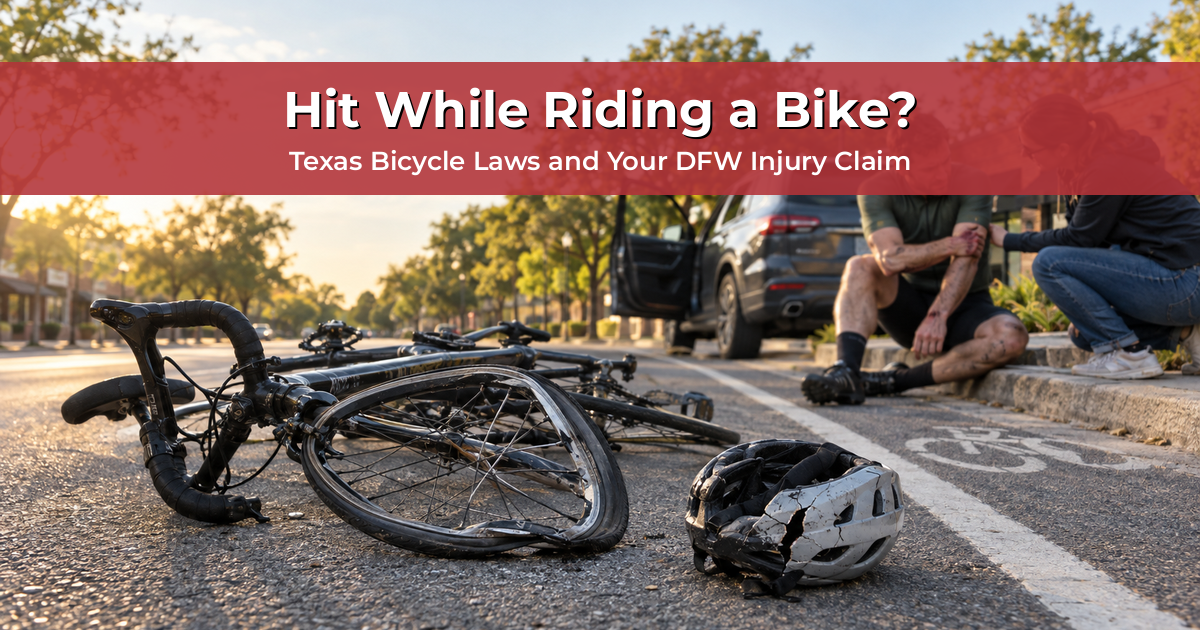
Damaged road bicycle and cracked helmet in a bike lane after a dooring crash, with an injured cyclist on the curb being helped by a passerby

Hit While Riding a Bike in Fort Worth or Dallas? Texas Bicycle Laws and Your Injury Claim

By Jesse Lotspeich · Personal Injury

Short answer: If a driver hits you while you're riding a bicycle in Fort Worth, Dallas, or elsewhere in North Texas, you can usually recover compensation from the at-fault driver's insurance for medical bills, lost income, and pain and suffering. You may also be able to use your own auto policy's PIP and uninsured motorist coverage, even though you weren't in a car. Texas treats a bicycle as a vehicle with the same rights on the road. Fort Worth and Dallas have local "vulnerable road user" ordinances that require drivers to give cyclists safe passing room. You can recover damages as long as you are not more than 50% at fault, so evidence about who caused the crash matters from day one.

Damaged road bicycle and cracked helmet in a bike lane after a dooring crash, with an injured cyclist on the curb being helped by a passerby

Bicycle crashes are some of the most serious collisions we see. A cyclist has no seatbelt, no airbag, and no steel frame, so even a low-speed impact from a right-turning SUV or an opening car door can cause broken bones, a head injury, or worse. According to TxDOT, 80 bicyclists died and another 429 were seriously injured in 2,761 Texas traffic crashes in 2024. Driver inattention, failure to yield the right of way, and speeding were the top contributing factors.

At Howard Lotspeich Alexander & Williams, PLLC (HLAW), we represent injured cyclists across Tarrant, Dallas, Denton, Collin, Johnson, and Parker counties. This guide explains the Texas bicycle laws that matter in an injury claim, how fault is decided, which insurance pays, and what to do after a crash.

Key Takeaways

  • A bike is a vehicle in Texas. Cyclists have the rights and duties of drivers. They must ride with traffic and generally keep to the right, but the law lists several exceptions that let you take the lane.
  • Texas has no statewide 3-foot law. Fort Worth and Dallas have local vulnerable road user ordinances requiring at least 3 feet of clearance for passenger vehicles and 6 feet for trucks.
  • Crosswalk crashes can be crimes. Under Transportation Code §545.428, a driver who negligently injures a cyclist in a crosswalk commits a Class A misdemeanor. It becomes a state jail felony if the cyclist suffers serious bodily injury.
  • The 51% rule. Under CPRC §33.001, you can recover damages if you are 50% or less at fault. Your recovery is reduced by your percentage of fault.
  • Your own auto policy may cover you on a bike. PIP and UM/UIM coverage often protect you as a cyclist, which matters when the driver is uninsured, underinsured, or flees.
  • No helmet doesn't bar your claim. Texas doesn't require adult cyclists to wear helmets, though insurers may still argue about it.
  • The deadline is generally two years. Texas's personal injury statute of limitations is generally two years.

What Texas Bicycle Laws Apply in DFW?

Bicycles have the same rights as cars

The City of Fort Worth's bicycle law guide, drawing on the Texas Driver Handbook, explains that a bicycle is a vehicle. A person riding one has the rights and duties of any vehicle driver, except those that by their nature can't apply to bicycling. Cyclists must obey signs and signals, stop at red lights and stop signs, and ride with traffic, not against it.

When cyclists can take the lane

Drivers and insurance adjusters often assume a cyclist must hug the curb. That's not quite the law. Under Transportation Code §551.103, a cyclist moving slower than traffic must ride "as near as practicable" to the right curb or edge, unless:

  1. They are passing another vehicle;
  2. They are preparing to turn left;
  3. A hazard prevents safe riding at the edge, such as a parked car, debris, a pedestrian, or a poor road surface; or
  4. The outside lane is less than 14 feet wide with no bike lane, or is too narrow for a bike and car to travel safely side by side.

On a one-way street with two or more marked lanes, a cyclist may also ride near the left curb. Many DFW streets have outside lanes narrower than 14 feet, so a cyclist riding in the middle of the lane is often doing exactly what the law allows.

Safe passing: no statewide 3-foot law, but Fort Worth and Dallas have rules

Texas is unusual: it has no statewide minimum passing distance. The Legislature passed a safe passing bill in 2009, but it was vetoed. Statewide, a driver overtaking another vehicle must pass to the left "at a safe distance" under Transportation Code §545.053.

Several North Texas cities have filled the gap. According to the North Central Texas Council of Governments:

City Ordinance Key requirements
Dallas City Code Ch. 28, Sec. 28-58.2 Pass at a safe distance (3 ft for cars, 6 ft for trucks/commercial vehicles); no throwing objects at cyclists; no "right hook" turns in front of a cyclist
Fort Worth City Code Ch. 22, Sec. 22-95 Same as Dallas, plus a ban on maneuvering a vehicle to intimidate or harass a vulnerable road user

BikeTexas reports that Texas cities with safe passing ordinances include Fort Worth, Denton, and Plano. In a civil case, a violation of a safety ordinance like this can be powerful evidence of negligence.

"Dooring" is against the law

One of the most common urban bike crashes happens when a parked driver or passenger opens a door into a cyclist's path. Transportation Code §545.418 says a person may not open a door on the side available to moving traffic unless it can be done "in reasonable safety without interfering with the movement of other traffic." Dooring crashes are common in busy areas like Magnolia Avenue, West 7th, Deep Ellum, and Bishop Arts, where riders pass rows of parked cars.

Crosswalks and the vulnerable road user offense

Under §545.428, a driver commits an offense if they operate a vehicle in a crosswalk with criminal negligence and injure a pedestrian or a person riding a bicycle, scooter, or similar device. It's a Class A misdemeanor, or a state jail felony if the rider suffers serious bodily injury. The statute provides an affirmative defense if the rider was violating traffic laws at the time. A criminal charge doesn't decide your civil case, but it can strengthen your claim.

Helmets and lights

Texas has no statewide helmet requirement for adult cyclists. Fort Worth's guide says wearing an approved helmet is "highly suggested" but "not required by law." At night, Texas law requires a white front lamp and a red rear reflector or lamp, and TxDOT recommends both.

Who Is at Fault in a Texas Bicycle Accident?

Fault is decided under Texas's proportionate responsibility system. A jury or the parties' negotiations assign each person a percentage of responsibility:

  • If you are 50% or less at fault, you can recover, but your damages are reduced by your percentage. For example, 20% fault on a $100,000 claim leaves $80,000.
  • If you are more than 50% at fault, you recover nothing from that defendant.

Insurers know this, so they look for ways to shift blame to the cyclist. Common arguments include riding outside the bike lane, not wearing a helmet, having no lights, wearing dark clothing, or "coming out of nowhere." Many of these arguments fall apart once the facts and the law are examined, such as when §551.103 allowed the cyclist to take the lane. We explain fault in more detail in our article on how fault works in Texas personal injury cases.

Common causes of bike crashes we see in DFW

  • Right hooks: a driver passes a cyclist, then turns right across the cyclist's path.
  • Left crosses: an oncoming driver turns left in front of the cyclist.
  • Unsafe passing: a driver passes too close, sideswipes the cyclist, or forces them off the road.
  • Dooring: a parked car door opens into the cyclist.
  • Driveway and parking-lot exits: a driver pulls out without looking for cyclists on the road or a trail crossing.
  • Distracted driving: texting, using navigation, or using a phone while driving.
  • Road defects: potholes, broken pavement, or debris, which can sometimes support a claim against a government entity, with very short notice deadlines.

Which Insurance Pays After a Bicycle Accident?

Cyclists are often surprised to learn how many coverages may apply:

  1. The at-fault driver's liability insurance. Texas requires minimum liability coverage of $30,000 per person and $60,000 per accident for bodily injury. For a serious bike injury, that's often not enough.
  2. Your own Personal Injury Protection (PIP). PIP is no-fault coverage on Texas auto policies that pays medical bills and lost wages regardless of fault. Depending on your policy language, it may cover you as a cyclist struck by a motor vehicle.
  3. Your own uninsured/underinsured motorist (UM/UIM) coverage. If the driver has no insurance, too little insurance, or leaves the scene, UM/UIM can fill the gap. See our guides on UM/UIM and PIP coverage and hit-and-run crashes in Texas.
  4. Health insurance. Health insurance pays medical bills up front, but it may have a right to be repaid from your settlement. Read more in Who Gets Paid First? Hospital Liens and Your DFW Injury Settlement.
  5. Commercial or employer policies. If a delivery van, work truck, or rideshare vehicle hits you, additional and often larger policies may apply.

Every policy is different. Get a lawyer's review before you give a recorded statement to any insurer, including your own. See insurance adjuster tactics in Fort Worth.

What Compensation Can an Injured Cyclist Recover?

Depending on the facts, damages can include:

  • Past and future medical expenses, including ER care, surgery, physical therapy, and future care.
  • Lost wages and loss of earning capacity.
  • Physical pain and mental anguish.
  • Physical impairment and disfigurement, including scarring and road rash.
  • Damage to your bicycle, helmet, clothing, and gear. High-end bikes and electronics can be expensive.
  • Wrongful death damages for families when a crash is fatal. See wrongful death claims.

In Texas, recoverable medical expenses are generally limited to amounts actually paid or incurred, not the full amount billed, so documenting your medical care carefully matters.

What Should You Do After a Bike Crash in DFW?

  1. Call 911 and get checked out. Adrenaline hides injuries. Head, neck, and internal injuries may not show up right away. Read why you should see a doctor even after a "minor" crash.
  2. Make sure a police report is made. Officers sometimes treat bike crashes as minor. A Texas Peace Officer's Crash Report (CR-3) documents the scene and the driver's information. See how to get your car wreck police report.
  3. Photograph everything. Take photos of the vehicle, its position, the lane, any bike lane markings, skid marks, debris, your bike, and your injuries.
  4. Save your ride data and video. GPS apps (such as Strava or Garmin), helmet cams, and handlebar cameras can show your speed, route, and position on the road. Ask nearby businesses for security footage quickly, and look for dash-cam video. See dash-cam footage in Texas accident cases.
  5. Don't repair or throw away the bike or helmet. Your damaged equipment is evidence.
  6. Get witness names and phone numbers. Independent witnesses are especially valuable when the driver blames the cyclist.
  7. Don't give a recorded statement or post about the crash before talking with a lawyer.
  8. Watch the deadlines. The Texas statute of limitations is generally two years, and claims involving a city or county can require written notice within months.

Frequently Asked Questions

Does Texas have a 3-foot passing law for bicycles?

Not statewide. A statewide safe passing bill was vetoed in 2009. However, Fort Worth (City Code Ch. 22, Sec. 22-95) and Dallas (City Code Ch. 28, Sec. 28-58.2) have vulnerable road user ordinances requiring drivers to pass at a safe distance: 3 feet for passenger vehicles and 6 feet for trucks and commercial vehicles. Statewide, drivers must still pass at a safe distance under §545.053.

Can I recover damages if I wasn't wearing a helmet?

Yes. Texas has no statewide helmet law for adults, so not wearing one isn't illegal. An insurer may argue a helmet would have reduced a head injury, but that doesn't bar your claim. How much it matters depends on the injury and the evidence.

Do I have to ride in the bike lane?

Texas law generally requires a cyclist moving slower than traffic to ride as near as practicable to the right edge, but §551.103 lists exceptions. These include hazards and lanes too narrow to share safely. Riding outside a bike lane isn't automatically negligent, and the specific facts and any local ordinance matter.

Will my car insurance cover me if I was hit while on my bike?

Often, yes. PIP and UM/UIM coverage on a Texas auto policy may protect you as a cyclist struck by a motor vehicle, depending on the policy language. This is especially important in hit-and-run cases and when the driver carries only minimum coverage.

What if the driver says I came out of nowhere?

That's one of the most common defenses in bike crash cases. Evidence often answers it: video, GPS data, lighting, sight lines, crash reconstruction, and witnesses. Under Texas's proportionate responsibility rule, you can still recover if you are found 50% or less at fault.

How long do I have to file a bicycle accident claim in Texas?

Generally two years from the date of the crash for a personal injury lawsuit. Claims against government entities, such as for a road defect or a city vehicle, can require formal notice much sooner. Talk to a lawyer promptly.

Is a bike crash in a crosswalk a crime for the driver?

It can be. Under §545.428, a driver who negligently injures a cyclist within the area of a crosswalk commits a Class A misdemeanor, or a state jail felony if the cyclist suffers serious bodily injury. The criminal case is separate from your civil claim, but a conviction can help prove fault.

Talk to a Fort Worth Bicycle Accident Lawyer

Cyclists are entitled to share the road, and drivers who ignore that should be held responsible. HLAW's personal injury attorneys represent injured cyclists, pedestrians, and drivers throughout Dallas-Fort Worth. We gather the evidence, deal with the insurers, and fight for full compensation. Call (817) 993-9249 or contact us online for a free consultation.


This article is for general informational purposes only and is not legal advice. Reading it does not create an attorney-client relationship. Insurance coverage depends on your specific policy language, local ordinances can change, and every case depends on its facts. Consult a licensed Texas attorney about your situation.

Read full article
Injured man in an arm sling reviewing hospital bills and a patient wristband at his kitchen table after a Dallas-Fort Worth car wreck

Who Gets Paid First? Hospital Liens, Health Insurance Reimbursement, and Your DFW Injury Settlement

By Luke A. Williams · Personal Injury

Short answer: In Texas, a hospital that treats you within 72 hours of an accident caused by someone else's negligence can place a lien on your injury claim. That lien is capped at the lesser of the hospital's charges for the first 100 days of care or 50% of your recovery. Health insurers, Medicare, and some government plans may also have a right to be repaid from your settlement. The amount you ultimately keep depends heavily on how those claims are identified, challenged, and negotiated before the case closes.

Injured man in an arm sling reviewing hospital bills and a patient wristband at his kitchen table after a Dallas-Fort Worth car wreckMost people injured in a Dallas-Fort Worth car wreck, truck crash, or fall focus on one number: the settlement offer. But the settlement number and the amount that actually reaches you are rarely the same. Between the two sits a layer of liens and reimbursement claims that many injured people never hear about until they are asked to sign a release.

At Howard Lotspeich Alexander & Williams, PLLC (HLAW), lien resolution is part of every personal injury case we handle, and it is often where a meaningful part of a client's net recovery is won or lost. This guide explains how the system works in Texas and what you can do about it.

Key Takeaways

  • Texas hospital liens arise under Chapter 55 of the Texas Property Code. They attach to your claim, judgment, or settlement, not to your home or other property.
  • The 72-hour rule matters. A hospital lien attaches only if you were admitted within 72 hours of the accident, and Texas law treats being allowed into any department of the hospital, including the emergency room, as an admission.
  • There is a 50% cap. A hospital lien cannot exceed half of what you recover, and it does not cover charges above a "reasonable and regular rate."
  • Your recoverable medical damages are limited to what was actually paid or owed. Under Texas's "paid or incurred" rule, the inflated sticker price on a hospital bill is generally not what a jury will see.
  • Health insurers usually have to share attorney's fees and are capped as well. Texas Chapter 140 limits many health plans' reimbursement claims, though self-funded employer plans and Medicare follow different rules.
  • An unresolved lien can delay or invalidate a settlement. A release signed without satisfying a properly filed hospital lien is not valid against the hospital.

What Is a Hospital Lien in Texas?

A hospital lien is a legal claim a hospital holds against the money you recover from the person or company that caused your injury. Under Texas Property Code § 55.002, a hospital has a lien on the cause of action or claim of a person who receives hospital services for injuries caused by an accident attributed to another person's negligence.

According to Section 55.003, the lien attaches to three things:

  1. Your cause of action for damages arising from the injury,
  2. Any judgment you obtain in court, and
  3. The proceeds of any settlement.

Importantly, the hospital lien statute requires the hospital's notice to tell you that the lien does not attach to real property you own. In other words, a Chapter 55 lien follows the injury claim, not your house.

The 72-Hour Requirement

For a hospital lien to attach, you must have been admitted to the hospital no later than 72 hours after the accident, as stated in Section 55.002(a). Many people assume that a trip to the emergency room without an overnight stay is not an "admission." Texas law says otherwise. Since 2019, Section 55.0015 has provided that a person is considered admitted if they are allowed access to any department of the hospital for treatment, care, or service.

Practically, that means if you were taken to an emergency room in Fort Worth, Arlington, Dallas, or anywhere else in Texas within three days of a wreck, you should assume a lien may exist.

The lien also extends to a second hospital if you were transferred for treatment of the same injury, under Section 55.002(b).

How Much Can a Texas Hospital Lien Be?

This is where the statute offers real protection. Under Section 55.004(b), a hospital lien is limited to the lesser of:

  1. The hospital's charges for services during the first 100 days of your hospitalization;
  2. 50% of all amounts you recover through a lawsuit, judgment, or settlement; or
  3. If a jury specifies the amount awarded for hospital charges, that amount minus a pro rata share of your reasonable attorney's fees and expenses.

The lien also may not include charges that exceed a reasonable and regular rate for the services, according to Section 55.004(d). That language is a frequent starting point for negotiating hospital balances that are far above what the same hospital accepts from insurers.

The lien may also include certain emergency physician charges from the first seven days of hospitalization, but not physician charges that were already paid through insurance or that the physician is entitled to collect from your health plan under an assignment of benefits, per Section 55.004(c)–(d).

What About the Ambulance?

Texas also allows emergency medical services (EMS) providers to claim a lien, but only for EMS provided in a county with a population of 800,000 or less, and the lien is capped at $1,000, as provided by Sections 55.002(c) and 55.004(f).

This has a distinctly local effect in North Texas. Tarrant, Dallas, Collin, and Denton counties each had more than 900,000 residents at the 2020 Census, according to North Central Texas Council of Governments population data. Smaller surrounding counties such as Johnson, Parker, Wise, and Hood are well under that threshold. So whether an ambulance company can assert a lien may depend on which side of a county line the wreck happened.

How a Hospital Secures (and Loses) Its Lien

A hospital does not automatically hold an enforceable lien just because it treated you. Under Section 55.005, the hospital must:

  • File a written notice of lien with the county clerk in the county where services were provided, before money is paid to the injured person; and
  • Mail notice to the injured person (or their representative) within five business days after the clerk records it.

The notice must identify the injured person, the date of the accident, the hospital, and the person alleged to be liable, if known.

Once a lien is properly secured, it has teeth. Under Section 55.007, a release of your claim is not valid against the hospital unless the hospital's charges were paid (in full, or to the extent of the consideration paid), or the hospital is a party to the release. This is why liability insurers routinely run county lien searches and add hospitals as co-payees on settlement checks.

For an injured person, this has two consequences:

  • You cannot simply ignore a lien and expect the insurance company to pay you directly.
  • Your lawyer needs to identify liens early, by checking county records in places like Tarrant, Dallas, and Denton counties, so they can be challenged and negotiated before the settlement is finalized, rather than discovered at the last minute.

The "Paid or Incurred" Rule: Why Sticker Prices Don't Control

Texas hospitals often bill at full "chargemaster" rates that few patients or insurers actually pay. Texas law limits what you can recover for past medical expenses to the amount actually paid or incurred.

Texas Civil Practice and Remedies Code § 41.0105 provides that recovery of medical or health care expenses "is limited to the amount actually paid or incurred by or on behalf of the claimant." In Haygood v. De Escabedo, the Texas Supreme Court held that this statute limits both recovery and the evidence presented at trial to expenses that the provider has a legal right to be paid. In that case, roughly $110,000 in billed charges was reduced to about $27,700 after required Medicare adjustments, as summarized by Chamberlain Hrdlicka.

Why does this matter for liens? Because the same gap between "billed" and "owed" that limits what a defendant must pay also gives an experienced attorney leverage to negotiate down hospital balances and reimbursement claims.

A note on 2025 legislation: In 2025, the Texas Legislature considered Senate Bill 30, which would have further changed how medical expenses are proven in injury cases. The bill ended in conference and did not become law, according to Phelps Dunbar, which notes it could return when the Legislature convenes on January 12, 2027. We will continue to monitor any changes.

When Your Health Insurer Wants to Be Repaid

If your own health insurance paid your medical bills after the wreck, your policy very likely contains a subrogation or reimbursement clause. That clause lets the insurer seek repayment from your injury settlement.

For many Texas-regulated health plans, Chapter 140 of the Texas Civil Practice and Remedies Code caps that recovery. When you are represented by an attorney, the payor's share is the lesser of:

  • One-half of your gross recovery, less attorney's fees and procurement costs; or
  • The total benefits the plan paid as a result of the injury, less attorney's fees and procurement costs.

Chapter 140 also states that the common-law "made whole" doctrine does not apply to these payors, according to Section 140.005(d). The statute applies to insurance companies, HMOs, and certain public employee plans listed in Section 140.002.

The important exception: Self-funded employer health plans governed by the federal ERISA statute are often not bound by state anti-subrogation rules like Chapter 140. The U.S. Supreme Court's decision in FMC Corp. v. Holliday is the foundation for that rule. These plans are governed by the specific language in the plan documents, which is why requesting and reviewing the actual plan document is a critical step in any case involving employer-provided coverage.

Medicare and Other Government Payors

If you are a Medicare beneficiary, federal law treats Medicare as a "secondary payer" when liability insurance is responsible for an injury. According to CMS, Medicare can make "conditional payments" for accident-related care, but those payments must be repaid when you receive a settlement, judgment, or award.

CMS guidance on the recovery process explains that a pending liability case must be reported to the Benefits Coordination & Recovery Center (BCRC), and that the settlement date, amount, and attorney's fees and procurement costs must be reported when the case resolves. Medicare's final demand accounts for a proportionate share of those procurement costs, as described in the Medicare Secondary Payer Manual.

Medicare claims are not something to handle casually. Federal law gives the government strong collection rights, so these claims should be resolved through the proper process, with related-versus-unrelated charges carefully reviewed before the final demand is paid. Medicaid, VA, TRICARE, and workers' compensation carriers each have their own separate recovery rules.

A Simple Example

Imagine a Fort Worth driver is rear-ended on I-35W, taken to an emergency room, and later treated with physical therapy. The case settles for $100,000.

  • The hospital files a lien for $40,000 in charges.
  • The driver's health plan paid $15,000 toward therapy and imaging.

Without careful lien work, the driver might assume that roughly $55,000 of the settlement is gone before fees and costs. In practice, the hospital lien is limited to its reasonable and regular rate (and can never exceed $50,000, which is 50% of the recovery), and a Chapter 140-governed health plan must reduce its claim by its share of attorney's fees. Negotiation of each balance can further reduce the amounts owed.

Every case is different, and the actual numbers depend on the type of plan, the bills, and the facts, but the example shows why lien resolution is not a clerical afterthought. It directly determines how much of your settlement you keep.

What You Should Do After a DFW Accident

  1. Keep every bill, explanation of benefits (EOB), and letter you receive from hospitals, ambulance companies, and insurers.
  2. Do not ignore a lien notice in the mail. It is often the first sign that a hospital has recorded a lien with the county clerk.
  3. Give your providers your health insurance information. Hospitals sometimes prefer to file a lien for full charges instead of billing your insurer at negotiated rates. Insisting that your insurance be billed can significantly reduce what is owed.
  4. Tell your attorney if you have Medicare, Medicaid, or an employer health plan, and find out whether your employer plan is fully insured or self-funded.
  5. Do not sign a release or accept a check until every lien and reimbursement claim has been identified and addressed.
  6. Talk to an injury lawyer who handles liens directly, rather than a high-volume firm that hands lien work to a settlement processor. (Learn more about why that difference matters.)

Frequently Asked Questions

Can a Texas hospital put a lien on my house after a car wreck?

No. A Chapter 55 hospital lien attaches to your injury claim, judgment, or settlement. The statute requires the hospital to tell you that the lien does not attach to real property you own, as stated in Texas Property Code § 55.005(d).

Does a hospital lien apply if I only went to the emergency room?

Usually yes. Texas treats access to any department of the hospital, including the ER, as an admission under Section 55.0015, as long as it occurred within 72 hours of the accident.

Can a hospital lien take my entire settlement?

No. A hospital lien under Chapter 55 cannot exceed 50% of the amounts you recover, and it is limited to the lesser of that cap, the first 100 days of charges, or a jury-specified amount reduced by attorney's fees, under Section 55.004(b).

Does a hospital lien attach to my own insurance coverage?

Generally, a Chapter 55 lien does not attach to proceeds of an insurance policy in favor of the injured person, except liability insurance that protects against loss from an accident or collision, according to Section 55.003(b). How this applies to a particular PIP or uninsured/underinsured motorist claim should be reviewed by your attorney. (See our guide to UM/UIM and PIP coverage in Texas.)

Does my health insurance company get paid back out of my settlement?

Often yes, if your policy has a reimbursement clause. For many Texas-regulated plans, Chapter 140 limits the insurer to the lesser of half your recovery or the benefits it paid, each reduced by attorney's fees and costs. Self-funded ERISA plans may follow different rules.

Will lien negotiations delay my settlement?

They can add time, but resolving them correctly protects you. A release given without satisfying a properly secured hospital lien is not valid against that hospital under Section 55.007, which is why insurers insist that liens be addressed before they pay.

Talk to a Fort Worth Personal Injury Attorney

At HLAW, a partner personally handles your case from the first call through the final disbursement, including the lien and reimbursement negotiations that determine how much of your settlement you actually keep. We represent injured people across Fort Worth, Keller, Southlake, Grapevine, Arlington, Dallas, and the greater Dallas-Fort Worth area in car wreck, truck accident, wrongful death, and other personal injury cases.

If you've been hurt and are worried about medical bills or hospital liens, contact Howard Lotspeich Alexander & Williams, PLLC or call (817) 993-9249 for a free consultation.


This article is for general informational purposes only and is not legal advice. Reading it does not create an attorney-client relationship. Lien and reimbursement rules depend on the specific facts, plan documents, and current law; consult an attorney about your situation.

Read full article
UM UIM Claims Texas

UM/UIM Insurance: When the At-Fault Driver's Insurance is Not Enough

By Luke A. Williams · Insurance, Personal Injury

UM UIM Claims TexasTexas law is clear that every driver must maintain financial responsibility (auto insurance). But, the truth of the matter is that there are thousands of drivers on Texas roads who are underinsured with a minimum policy or not insured at all. What this means is that if you are hit and injured in a car wreck by one of these uninsured or underinsured drivers, you may have to use your own insurance to pay for your medical bills, lost wages, lost ability to work and/or other damages.
What can you do to protect yourself if you are injured in an accident caused by an underinsured or uninsured driver?

We recommend that you carry a significant amount of uninsured motorist (UM) and underinsured motorist (UIM) protection insurance. These policies, which typically only cost you a few dollars per month, ensure that if you are injured by an underinsured or uninsured motorist you and your attorney will have a policy to pursue to properly compensate you for your injuries.

What are the minimum requirements of insurance in Texas and what else can you do to protect yourself?

Texas law requires that a driver have at least $30,000 of coverage for injuries per person, and a total of $60,000 per accident. Insurance companies also offer an option called personal injury protection (PIP). While some states require that drivers carry PIP, Texas does not. PIP is an additional option that provides coverage specifically for injuries sustained in a car wreck. Most people carry $2,500 in coverage under their PIP – this is the minimum coverage required to be “offered” in Texas when you purchase an auto insurance policy. PIP not only pays medical bills but, 80% of your lost income and reasonable household duties. You can purchase even higher limits of PIP through your insurance company and you should get as much PIP coverage as you can. Most insurance companies will sell you at least $10,000 in coverage under PIP, some even more.

Ultimately, if you are injured in a car wreck, your own PIP insurance would be the first policy to pay towards your damages before you can start to pursue the driver’s insurance who hit you.

Why the minimum coverage (and PIP) typically aren’t enough.

Often times, when you’re seriously injured, using your PIP and having the minimum amount of coverage to go after against the driver who hit you just isn’t enough. This is especially (and obviously) the case if the at-fault driver is uninsured. This is where your UIM/UM policy kicks in. If you don’t have UIM/UM coverage under your own policy, then you could be out of luck.

With UM and UIM insurance, claims that exceed your own PIP and the at-fault driver’s insurance will be covered up to the limits of your UM/UIM policy. Because of the vast amount of driver’s in Texas who are either underinsured or uninsured, in many cases UM/UIM policies are one of the only coverages available for your attorney to seek to compensate you for your injuries.

Do you need an attorney for UM/UIM cases?

Yes you do. First and foremost, you need an advocate to make sure you’re getting the most out of your claim against the at-fault driver. But if the at-fault driver is underinsured or uninsured and you have UM/UIM coverage, that doesn’t just mean that your own insurance company is going to automatically hand over the limits of your own UM/UIM policy.

When a driver seeks to be compensated out of their own UM/UIM coverage, they are often times still met with resistance by their own insurance company. The insurance company will still do what they can to pay you as little as possible (they’re a business and unfortunately, you’re often times still treated more like a number than an injured person). An attorney’s job is to break this mentality and advocate for you to be treated fairly and be taken seriously by these insurance companies – not just treated as another number in their computer programs.

What can you do if your own insurance company is not fairly compensating you under your UM/UIM policy?

The first step is to retain our firm to represent you. We’ll advocate for you and work to maximize your claim not only against the at-fault driver’s insurance company but with your insurance provider as well if you’re covered under a UM/UIM policy. Ultimately, if negotiations do not produce a fair offer from your insurance company, you may even bring suit to pursue a fair outcome against your UM/UIM policy.

To speak with an attorney about insurance policies that might be available in your case – including UM/UIM coverage – please contact our office for a free initial consultation.

Best Tarrant County Car Accident Attorney

Read full article

Speak with a Fort Worth attorney

Call (817) 993-9249 or send us a message to discuss your case.