

Skip to content

November 2026

Page 2 of 7 · 31 articles

White sympathy lilies, reading glasses and envelopes on a side table in a quiet Texas living room at dusk, illustrating survival and wrongful death claims

Survival Claims vs. Wrongful Death Claims in Texas: Who Can Sue, What Each Covers, and the Deadlines

By Luke A. Williams · Personal Injury

Short answer: When someone dies because of another person's negligence in Texas, the law usually allows two separate claims. A survival claim under Texas Civil Practice and Remedies Code § 71.021 belongs to the person who died and recovers the losses he or she suffered before death, such as conscious pain, medical bills, and lost earnings, with the recovery passing to the estate. A wrongful death claim under § 71.002 belongs to the surviving spouse, children, and parents and compensates them for their own losses from the death.

White sympathy lilies, reading glasses and envelopes on a side table in a quiet Texas living room at dusk, illustrating survival and wrongful death claims

Families who lose someone in a crash on I-35W, a trucking collision on I-20, or a workplace accident in Dallas-Fort Worth often hear the phrase "wrongful death" and assume it covers everything. It does not. Texas treats the losses the person suffered before death and the losses the family suffers after death as two different legal claims, brought by different people, with different damages and different rules about who receives the money.

At Howard Lotspeich Alexander & Williams, PLLC (HLAW), our Fort Worth personal injury lawyers represent families in Tarrant, Dallas, Denton, Collin, Johnson, and Parker counties. This guide explains what a Texas survival claim is, how it differs from a wrongful death claim, who can bring each one, and the deadlines that apply.

Key Takeaways

  • The injury claim does not die with the person. A personal injury cause of action "does not abate because of the death of the injured person," and it "survives to and in favor of the heirs, legal representatives, and estate of the injured person" (Tex. Civ. Prac. & Rem. Code § 71.021).
  • Survival damages are the decedent's own losses. The Supreme Court of Texas has said the damages recoverable "are those which he himself sustained while he was alive" (Austin Nursing Center, Inc. v. Lovato, Tex. 2005).
  • Wrongful death damages are the family's losses. A wrongful death action is "for the exclusive benefit of the surviving spouse, children, and parents of the deceased" (§ 71.004).
  • The estate usually brings the survival claim. In general, only the estate's personal representative has capacity to bring a survival claim, although heirs may do so in limited circumstances (Lovato).
  • Both claims can be brought together. Texas has long recognized that "two separate and distinct causes of action may arise where injuries wrongfully inflicted result in death" (Landers v. B. F. Goodrich Co., Tex. 1963).
  • Deadlines are short. Wrongful death suits generally must be filed within two years of the death (Tex. Civ. Prac. & Rem. Code § 16.003).

What Is a Survival Claim in Texas?

A survival claim is the injured person's own personal injury lawsuit, continued after his or her death. Texas Civil Practice and Remedies Code § 71.021 provides that a cause of action "for personal injury to the health, reputation, or person of an injured person does not abate because of the death of the injured person or because of the death of a person liable for the injury." The suit "may be instituted and prosecuted as if the liable person were alive" (§ 71.021).

The Supreme Court of Texas described the claim this way in Austin Nursing Center, Inc. v. Lovato: "The survival action, as it is sometimes called, is wholly derivative of the decedent's rights. The actionable wrong is that which the decedent suffered before his death" (Austin Nursing Center, Inc. v. Lovato).

Put simply, the survival claim asks what the person who died could have recovered if he or she had lived long enough to file the case.

How Is a Survival Claim Different From a Wrongful Death Claim?

The Texas Wrongful Death Act creates a separate cause of action. A person is liable "for damages arising from an injury that causes an individual's death if the injury was caused by the person's or his agent's or servant's wrongful act, neglect, carelessness, unskillfulness, or default" (§ 71.002(b)). That claim compensates the family members for what they lost because of the death.

The table below summarizes the main differences.

Issue Survival claim (§ 71.021) Wrongful death claim (§ 71.002)
Whose claim is it? The person who died The surviving spouse, children, and parents
What losses does it cover? Losses the decedent suffered before death Losses the family suffers because of the death
Who usually files? The estate's personal representative (or heirs in limited cases) The spouse, children, or parents, or one of them for all
Where does the money go? To the estate, then to heirs or under the will Divided among the beneficiaries as the jury finds
Can siblings benefit? Possibly, if they are heirs or will beneficiaries No, siblings are not listed beneficiaries

Both claims depend on the same basic proof that the defendant's negligence or wrongful conduct caused the injury. Because the two claims share that foundation, they are usually filed in the same lawsuit.

What Damages Can Be Recovered in a Texas Survival Claim?

Because the survival claim belongs to the person who died, the damages are limited to losses he or she sustained between the injury and death. In Landers v. B. F. Goodrich Co., the Supreme Court of Texas described the estate's recovery as including "medical and funeral expenses, property damage, physical pain and suffering, and other damage sustained by the decedent prior to his death" (Landers v. B. F. Goodrich Co.).

Common survival damages include:

  • Conscious physical pain and mental anguish the person experienced before death
  • Medical expenses for treatment between the injury and death
  • Lost earnings between the injury and death
  • Property damage, such as damage to the person's vehicle
  • Funeral and burial expenses, if not recovered in the wrongful death claim

Funeral expenses can be claimed in either action, but not twice. The court in Landers held that they may be recovered by the heirs or legal representatives "provided the defendant will not be subjected thereby to a double recovery," and Lovato notes that funeral expenses may be recovered in a survival action "if they were not awarded in a wrongful death action."

Medical expense evidence follows the same rules as any Texas injury case. Recovery is generally limited to amounts actually paid or incurred, and providers may assert liens against the recovery. Our guide to hospital liens and injury settlements explains how those liens work.

Why conscious pain matters

A survival claim for pain and suffering depends on evidence that the person was conscious after the injury. Records from first responders, emergency room notes, witness statements, and the time between the crash and death often become central evidence. When death was instantaneous, the survival claim may be limited to items like funeral expenses and property damage, while the wrongful death claim carries most of the family's damages.

What Damages Can Families Recover in a Wrongful Death Claim?

Wrongful death damages compensate each beneficiary for his or her own losses. In Moore v. Lillebo, the Supreme Court of Texas defined two of the most important categories. Mental anguish is "the emotional pain, torment, and suffering that the named plaintiff would, in reasonable probability, experience from the death of the family member." Companionship and society are "the positive benefits flowing from the love, comfort, companionship, and society the named plaintiff would, in reasonable probability, experience if the decedent lived" (Moore v. Lillebo, Tex. 1986).

The court also said a jury may consider the relationship between the family members, their living arrangements, any extended absences, the harmony of family relations, and common interests and activities. Other wrongful death damages can include lost financial support and loss of inheritance. The jury may award damages "in an amount proportionate to the injury resulting from the death," divided "in shares as found by the jury in its verdict" among the beneficiaries who are alive at that time (§ 71.010).

For a deeper look at those damages, see our page on wrongful death claims. If the death resulted from gross negligence, such as a crash caused by a heavily intoxicated driver, exemplary damages may also be available, as explained in our guide to punitive damages in Texas.

Who Can Bring a Survival Claim in Texas?

The general rule is that the estate brings the claim. The Supreme Court of Texas has stated: "In general, only the estate's personal representative has the capacity to bring a survival claim" (Austin Nursing Center, Inc. v. Lovato). A personal representative is usually an executor named in a will and appointed by the probate court, or an administrator appointed when there is no will.

There is a limited exception. "Heirs at law can maintain a survival suit during the four-year period the law allows for instituting administration proceedings if they allege and prove that there is no administration pending and none [is] necessary," citing Shepherd v. Ledford, 962 S.W.2d 28 (Tex. 1998).

Lovato also shows why getting this right matters. In that case, the daughter filed the survival suit within the limitations period but was not appointed administrator of her mother's estate until after limitations expired. The court held that the defect in her capacity "was later cured by her appointment as the estate's administrator." Families should not rely on that kind of cure. Opening the estate early, often in the probate courts of Tarrant, Dallas, Denton, or Collin County, avoids the issue.

Who Can Bring a Wrongful Death Claim in Texas?

Only three groups benefit from a Texas wrongful death claim: "the surviving spouse, children, and parents of the deceased" (§ 71.004(a)). Any of them may bring the action, or one or more may bring it for the benefit of all (§ 71.004(b)). Siblings, grandparents, and other relatives are not listed beneficiaries.

If none of the eligible family members files within three calendar months after the death, the executor or administrator "shall bring and prosecute the action unless requested not to by all those individuals" (§ 71.004(c)).

What Is the Deadline to File a Survival or Wrongful Death Claim?

The deadlines are related but not identical.

  1. Wrongful death. Suit must be brought "not later than two years after the day the cause of action accrues," and the cause of action "accrues on the death of the injured person" (§ 16.003(b)).
  2. Survival. The survival claim is the decedent's own personal injury claim, which generally carries a two-year limitations period that began when the injury occurred (§ 16.003(a)).
  3. Effect of death. The death of a person in whose favor there may be a cause of action "suspends the running of an applicable statute of limitations for 12 months after the death," but if an executor or administrator qualifies before then, limitations begins to run again at the time of qualification (§ 16.062).

Claims against government entities can have much shorter notice deadlines. Our guide to time limits for personal injury claims in Texas covers those exceptions. Because these rules interact, families should not wait to talk with a lawyer.

What Should a Family Do After a Fatal Accident?

  1. Request the crash report and medical records. Records showing the time of injury, consciousness, and treatment are key to the survival claim.
  2. Keep receipts. Save medical bills, funeral and burial invoices, and records of who paid them.
  3. Talk to a lawyer about opening the estate. A probate filing may be needed for the survival claim, even if there was a will.
  4. Do not give recorded statements to the at-fault party's insurer before getting legal advice.
  5. Preserve evidence. Vehicles, phones, dash camera video, and workplace records can be lost if no one asks for them to be preserved.

Frequently Asked Questions

Can a family file both a survival claim and a wrongful death claim?

Yes. Texas recognizes that two separate causes of action may arise when a wrongful injury causes death. They are usually filed together in the same lawsuit, with the estate's representative bringing the survival claim and the family members bringing the wrongful death claim.

Who receives the money from a survival claim?

The recovery flows to those who would have received it had the decedent obtained it immediately before death: his or her heirs, legal representatives, and estate. In practice, it passes under the will or, if there is no will, under Texas inheritance law.

Can a brother or sister recover after a sibling's death?

Siblings are not wrongful death beneficiaries under § 71.004. A sibling may benefit from a survival claim only if he or she is an heir or a beneficiary under the will.

Is there a survival claim if death was instant?

There may still be a survival claim for items like funeral expenses and property damage. Damages for conscious pain and suffering require evidence that the person was aware of the injury before death.

Do we need to open a probate case?

Often, yes. In general, only the estate's personal representative can bring a survival claim. Heirs may sue without administration only if they prove no administration is pending and none is necessary.

What if no family member files the wrongful death case?

If no eligible family member files within three calendar months after the death, the executor or administrator must bring the action unless all of the eligible family members ask the representative not to.

Can parents recover when an adult child dies?

Yes. Parents are listed wrongful death beneficiaries under § 71.004, and the Supreme Court of Texas in Moore v. Lillebo allowed parents of an adult son to seek damages for mental anguish and loss of companionship.

Talk With a Fort Worth Wrongful Death Lawyer

Losing a family member is hard enough without sorting out estates, insurers, and deadlines. If someone you love died because of another person's negligence anywhere in Dallas-Fort Worth, HLAW can explain how the survival and wrongful death claims fit together and what steps to take next. Call (817) 993-9249 or contact us online for a free consultation.

This article provides general information about Texas law and is not legal advice. Reading it does not create an attorney-client relationship. Every case depends on its specific facts, and past results do not guarantee a similar outcome. Laws change, so consult a licensed Texas attorney about your situation.
Read full article
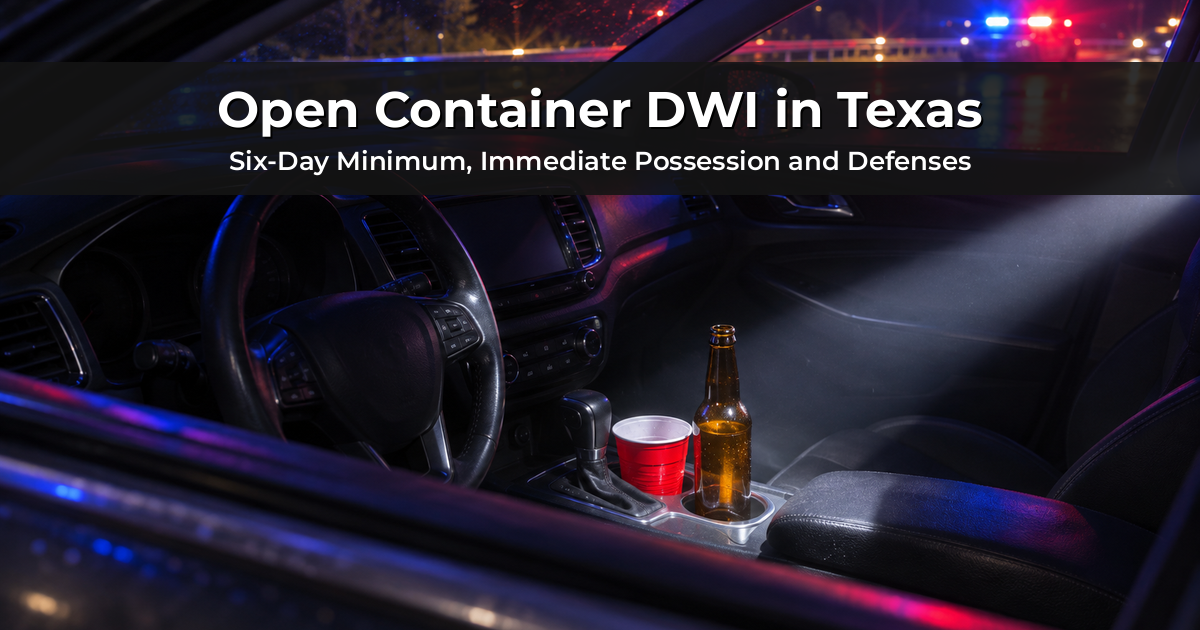
Open cup and bottle in a car center console lit by a flashlight during a nighttime DWI traffic stop in Texas

Open Container DWI in Texas: The Six-Day Minimum, "Immediate Possession," and How These Cases Are Defended

By Luke A. Williams · DWI

Short answer: In Texas, a DWI becomes an "open container DWI" when the State shows that the driver had an open container of alcohol in his or her immediate possession at the time of the offense. It is still a Class B misdemeanor, but the minimum jail term doubles from 72 hours to six days under Texas Penal Code § 49.04(c). Courts have read "immediate possession" to mean within the driver's reach, so a cup in the console can count, while an opened bottle locked in the trunk generally cannot.

Open cup and bottle in a car center console lit by a flashlight during a nighttime DWI traffic stop in Texas

An open can rolling around the floorboard may seem like a minor detail next to a DWI arrest. In Texas, it is not. That one fact can change the punishment range, show up in the police report as evidence of intoxication, and give the prosecutor more leverage in plea negotiations in Tarrant, Dallas, Denton, and Collin County courts.

At Howard Lotspeich Alexander & Williams, PLLC (HLAW), our Fort Worth DWI attorneys defend drivers charged with DWI in Tarrant, Dallas, Denton, Collin, Johnson, and Parker counties. This guide explains what the open container enhancement is, how it differs from a simple open container ticket, what the State has to prove, and where these cases are often defended.

Key Takeaways

  • Six-day minimum. A first DWI is a Class B misdemeanor with a 72-hour minimum, but if the driver had an open container in his or her immediate possession, the minimum becomes six days (Tex. Penal Code § 49.04).
  • Same fine range. An open container DWI remains a Class B misdemeanor, punishable by up to 180 days in jail and a fine of up to $2,000 (Tex. Penal Code § 12.22).
  • "Immediate possession" means within reach. Texas courts have held that the State does not have to prove the driver actually held the container, only that it was within reach (Barton v. State, Tex. App.-Houston (14th Dist.) 2004).
  • Open container alone is a ticket. Without intoxication, possessing an open container in the passenger area of a vehicle on a public highway is a Class C misdemeanor, punishable by a fine of up to $500 (Penal Code §§ 49.031, 12.23).
  • The trunk is different. A locked glove compartment, the trunk, and the area behind the last upright seat in a vehicle without a trunk are not part of the "passenger area" (§ 49.031(a)(2)).
  • Probation may still be possible. The mandatory jail conditions for DWI probation in Article 42A.401 are tied to prior convictions and intoxication assault or manslaughter, not to the open container finding (Tex. Code Crim. Proc. art. 42A.401).

What Is an Open Container DWI in Texas?

Texas does not have a separate crime called "open container DWI." The offense is still driving while intoxicated under Penal Code § 49.04(a), which makes it a crime to be "intoxicated while operating a motor vehicle in a public place." Intoxicated means either not having the normal use of mental or physical faculties because of alcohol, drugs, or another substance, or having an alcohol concentration of 0.08 or more (§ 49.01(2)).

The open container language is a punishment provision. Section 49.04(c) says that if "it is shown on the trial of an offense under this section that at the time of the offense the person operating the motor vehicle had an open container of alcohol in the person's immediate possession, the offense is a Class B misdemeanor, with a minimum term of confinement of six days" (Tex. Penal Code § 49.04(c)).

In practice, the prosecutor usually pleads the open container allegation in the charging document. In Texas county courts, you may see the case described as "DWI with open container" on the docket or in bond paperwork.

How Is an Open Container DWI Different From a Regular First DWI?

The table below compares the most common first-offense DWI categories under § 49.04.

Charge Level Minimum jail if jail is imposed Maximum jail Maximum fine
DWI, first offense Class B misdemeanor 72 hours 180 days $2,000
DWI with open container Class B misdemeanor 6 days 180 days $2,000
DWI with 0.15 or higher Class A misdemeanor None stated in § 49.04(d) 1 year $4,000
Open container only (no DWI) Class C misdemeanor No jail No jail $500

The six-day minimum is the biggest change, but it is not the only one. An open container in the car also becomes evidence. Prosecutors often argue that a cup or can within reach shows the driver was drinking while driving, and that argument can affect how a jury views field sobriety test results or a breath or blood test. If the test result was 0.15 or higher, the charge may be a Class A misdemeanor instead. Our guide to high BAC DWI charges in Texas covers that enhancement.

What Does "Immediate Possession" Mean?

The statute does not define "immediate possession" or "open container" for purposes of § 49.04(c). Texas courts have said both terms carry their plain and ordinary meaning. In a Denton County case, the court explained that "immediate possession means that the open container is within the reach of the person operating the motor vehicle," and that the record must show "there was a container of alcohol, and the container was open" (De Los Santos v. State, Tex. App.-El Paso 2018). In that case, the officer found a cup in the center console next to an empty bottle, and the defendant had pleaded true to the open container allegation.

Other courts have used the same reach-based test. The Fourteenth Court of Appeals stated that the State "is not required to prove that the person actually held the container while driving," and that "proof that the container was within the person's reach will suffice" (Barton v. State).

That standard makes the location of the container important. Questions that often matter include:

  • Was the container in the cupholder, on the driver's seat, or on the driver's floorboard?
  • Was it in the back seat, behind the passenger, or out of the driver's reach?
  • Was it actually open, or was it a sealed can that rolled out of a store bag?
  • Did it contain alcohol, or was it a soda, water, or an empty cup?
  • Did the officer photograph it, collect it, or describe it only in a report?

What Counts as an "Open Container" in Texas?

For the separate Class C offense, Penal Code § 49.031 defines an open container as "a bottle, can, or other receptacle that contains any amount of alcoholic beverage and that is open, that has been opened, that has a broken seal, or the contents of which are partially removed" (Tex. Penal Code § 49.031). That definition is broad. A bottle of wine that was opened at dinner and recorked can qualify, as can a nearly empty can.

The same section limits where the offense can occur. It applies to the "passenger area of a motor vehicle," which means the area "designed for the seating of the operator and passengers." It does not include:

  1. A glove compartment or similar storage container that is locked
  2. The trunk of a vehicle
  3. The area behind the last upright seat of the vehicle, if the vehicle does not have a trunk

There is also an exception for passengers in vehicles used primarily to transport people for compensation, such as a bus, taxicab, or limousine, and for passengers in the living quarters of a motor home or RV (§ 49.031(c)). Because § 49.04(c) focuses on the driver's immediate possession rather than the passenger area, these rules are not identical, but they often shape how the open container evidence is argued.

Is an Open Container Alone a Crime in Texas?

Yes, but a minor one. Under § 49.031(b), a person commits an offense if the person knowingly possesses an open container in the passenger area of a vehicle located on a public highway, "regardless of whether the vehicle is being operated or is stopped or parked." It is a Class C misdemeanor, punishable by a fine of up to $500 with no jail (Tex. Penal Code § 12.23).

The statute also tells officers how to handle the charge. An officer charging only this offense "shall issue to the person a written citation and notice to appear" instead of taking the person before a magistrate (§ 49.031(e)). In other words, an open container with no other offense is a ticket, not a jail booking.

For drivers who were not intoxicated, that distinction matters. A sober driver whose passenger left an open beer in the back seat faces a very different situation than a driver arrested for DWI with a cup in the console.

Who Decides Whether the Open Container Allegation Is True?

Section 49.04(c) applies when the open container is "shown on the trial of an offense." If a defendant pleads true to the allegation, that plea is enough to support the finding, as the court noted in De Los Santos. If the case goes to trial, the question of who makes the finding can depend on whether the defendant elects to have the judge or the jury assess punishment. In one Harris County case, the court of appeals rejected a challenge to a judge's open container finding where the defendant had elected to have the trial court assess punishment (Liscum v. State, Tex. App.-Houston (14th Dist.) 2005).

That election is a strategic decision that should be made with your lawyer before trial, because it affects who hears the open container evidence and how the punishment range is applied.

Can You Still Get Probation for an Open Container DWI?

Often, yes. The six-day minimum in § 49.04(c) is the minimum term if the court sentences the person to jail. Texas law also allows community supervision (probation) in many first-offense DWI cases. Article 42A.401 of the Code of Criminal Procedure requires jail as a condition of DWI probation in specific situations, such as when the defendant is punished under the repeat-offense provisions of § 49.09 or was convicted of intoxication assault or intoxication manslaughter (Tex. Code Crim. Proc. art. 42A.401). The open container finding is not on that list.

Other probation conditions still apply in DWI cases. A judge granting probation for a Chapter 49 offense must order an alcohol or drug evaluation (art. 42A.402) and, for offenses under §§ 49.04-49.08, completion of a DWI education program within 180 days (art. 42A.403). For deferred adjudication on a DWI, the judge generally must order an ignition interlock device, though it can be waived if an evaluation shows it is not necessary for community safety (art. 42A.408(e-1), (e-2)). Our page on DWI deferred adjudication explains how that option works.

How Are Open Container DWI Cases Defended?

Every case turns on its facts, and the open container allegation is only one part. Common areas of review include:

  1. The stop. Did the officer have reasonable suspicion to pull the car over? If not, the evidence that followed, including the container, may be challenged.
  2. The search. How did the officer find the container? Was it in plain view, found during a consented search, or found after an arrest?
  3. Location and reach. Body camera and dash camera video can show exactly where the container was. A container in the back seat or a closed cooler may not be within the driver's reach.
  4. Whether it was open and contained alcohol. A sealed can, an empty cup, or a container that was never tested or photographed can raise doubt.
  5. Who it belonged to. If there were passengers, the evidence may point to someone other than the driver.
  6. The intoxication evidence. The open container enhancement only matters if the State proves DWI. Field sobriety tests, breath and blood testing, and the video all deserve close review.

Separate from the criminal case, a DWI arrest usually triggers an administrative license suspension. You generally have only 15 days from the notice to request an ALR hearing. Our guide to the Texas ALR hearing deadline explains that process, and our page on Texas DWI license suspensions and occupational licenses covers driving options during a suspension.

Frequently Asked Questions

What is the minimum jail time for an open container DWI in Texas?

Under Penal Code § 49.04(c), the minimum term of confinement is six days, compared with 72 hours for a first DWI without an open container. The maximum remains 180 days because the offense is still a Class B misdemeanor.

Does the container have to be in my hand?

No. Texas courts have held that the State does not have to prove the driver held the container, only that it was within reach. The location of the container is often a key factual question.

Is an empty can an open container?

It depends. Section 49.031 defines an open container as a receptacle that "contains any amount of alcoholic beverage" and is open or partially emptied. A completely empty can or cup may raise questions about whether it qualifies, which is why photographs and testing matter.

Can my passenger's open beer lead to an enhanced DWI?

The enhancement requires an open container in the driver's immediate possession. A container within the driver's reach may be argued as qualifying even if a passenger was drinking from it, while a container out of the driver's reach is harder for the State to prove.

Is it legal to keep an opened bottle of wine in the trunk?

The trunk is not part of the "passenger area" under § 49.031(a)(2), so an opened bottle stored in the trunk generally does not violate the Class C open container law.

Is a DWI with open container a felony?

No. A first DWI with an open container is a Class B misdemeanor. A DWI can become a felony for other reasons, such as two prior DWI convictions under § 49.09(b).

Can I still get deferred adjudication?

Deferred adjudication may be available in many DWI cases, but it usually comes with an ignition interlock requirement under art. 42A.408(e-1). Eligibility depends on your record and the facts of the case.

Talk With a Fort Worth DWI Lawyer

An open container allegation raises the stakes in a DWI case, but it is an allegation the State must prove, and the facts about where the container was and how it was found matter. If you were arrested for DWI with an open container anywhere in Dallas-Fort Worth, HLAW can review the stop, the video, and the evidence with you. Call (817) 993-9249 or contact us online for a free consultation.

This article provides general information about Texas law and is not legal advice. Reading it does not create an attorney-client relationship. Every case depends on its specific facts, and past results do not guarantee a similar outcome. Laws change, so consult a licensed Texas attorney about your situation.
Read full article
Empty jury box in a wood-paneled Texas courtroom with a male trial attorney at the lectern, illustrating punitive damages in Texas

Punitive Damages in Texas: Gross Negligence, the Damages Cap, and the Drunk-Driver Exception

By Luke A. Williams · Personal Injury

Short answer: Texas law calls punitive damages "exemplary damages," and they are awarded to punish a defendant, not to compensate the injured person. To recover them, an injured person must prove by clear and convincing evidence that the harm resulted from fraud, malice, or gross negligence, and the jury must be unanimous on both liability and amount. Most awards are capped at the greater of $200,000 or two times economic damages plus up to $750,000 in noneconomic damages, but the cap does not apply when the claim is based on felony conduct such as intoxication assault or intoxication manslaughter by a drunk driver.

Empty jury box in a wood-paneled Texas courtroom with a male trial attorney at the lectern, illustrating punitive damages in Texas

Most personal injury cases are about making the injured person whole: medical bills, lost wages, pain, and the other losses a crash or fall causes. Some cases involve conduct so dangerous that Texas allows a jury to go further and punish the wrongdoer. A driver who gets behind the wheel after a night of heavy drinking, or a company that knowingly sends workers into an extreme hazard, may face that kind of claim.

At Howard Lotspeich Alexander & Williams, PLLC (HLAW), our Fort Worth personal injury lawyers represent injured people and families in Tarrant, Dallas, Denton, Collin, Johnson, and Parker counties. This guide explains when punitive damages are available in Texas, what "gross negligence" actually means, how the statutory cap works, and why drunk-driving cases are treated differently.

Key Takeaways

  • Punishment, not compensation. Texas defines exemplary damages as damages "awarded as a penalty or by way of punishment but not for compensatory purposes," and the term includes punitive damages (Tex. Civ. Prac. & Rem. Code § 41.001).
  • Higher proof is required. The injured person must prove fraud, malice, or gross negligence by clear and convincing evidence, and ordinary negligence is not enough (§ 41.003).
  • The jury must be unanimous. Exemplary damages may be awarded only if the jury is unanimous on both liability for and the amount of those damages (§ 41.003(d)).
  • Most awards are capped. The cap is the greater of $200,000 or two times economic damages plus noneconomic damages up to $750,000 (§ 41.008(b)).
  • Drunk drivers are an exception. The cap does not apply to claims based on intoxication assault or intoxication manslaughter, and for those two offenses the statute does not require proof that the conduct was knowing or intentional (§ 41.008(c)).
  • Companies are judged by their own conduct. A corporation is liable for punitive damages only when the gross negligence is attributable to the corporation itself (Mobil Oil Corp. v. Ellender, Tex. 1998).

What Are Punitive (Exemplary) Damages in Texas?

Compensatory damages pay for the harm a person suffered. Texas splits them into two groups. Economic damages cover measurable financial losses such as medical expenses and lost earnings. Noneconomic damages cover losses like physical pain, mental anguish, disfigurement, and impairment. Our guide to what a personal injury case is worth in Texas walks through those categories in detail.

Exemplary damages are different. Chapter 41 of the Texas Civil Practice and Remedies Code states that exemplary damages "are neither economic nor noneconomic damages" (§ 41.001). They exist to punish conduct and to deter others from doing the same thing. That purpose explains why the law makes them harder to get than ordinary damages and why a jury can consider facts, like a defendant's net worth, that would not matter in a normal damages calculation.

Two threshold rules apply before any punitive award can stand. First, exemplary damages may be awarded only if damages other than nominal damages are awarded (§ 41.004(a)). In plain terms, the injured person must first prove real harm. Second, a claimant who elects to have a recovery multiplied under another statute cannot also collect exemplary damages for the same harm (§ 41.004(b)).

What Does a Texas Injury Victim Have to Prove to Get Punitive Damages?

Under § 41.003(a), exemplary damages may be awarded only if the claimant proves by clear and convincing evidence that the harm resulted from one of three things:

  1. Fraud, which the statute defines as fraud other than constructive fraud.
  2. Malice, meaning "a specific intent by the defendant to cause substantial injury or harm to the claimant."
  3. Gross negligence, which is the basis for most punitive damages claims in car wreck, trucking, workplace, and premises cases.

The burden is demanding. "Clear and convincing" means proof that "will produce in the mind of the trier of fact a firm belief or conviction as to the truth of the allegations sought to be established" (§ 41.001(2)). The statute also says this burden "may not be shifted to the defendant or satisfied by evidence of ordinary negligence, bad faith, or a deceptive trade practice" (§ 41.003(b)).

Proving that a driver ran a red light or was looking at a phone usually establishes ordinary negligence. Proving gross negligence requires evidence about what the defendant knew and chose to do anyway.

What Is Gross Negligence Under Texas Law?

Texas defines gross negligence as an act or omission that has two parts (§ 41.001(11)):

  • An objective part. Viewed objectively from the defendant's standpoint at the time, the conduct "involves an extreme degree of risk, considering the probability and magnitude of the potential harm to others."
  • A subjective part. The defendant "has actual, subjective awareness of the risk involved, but nevertheless proceeds with conscious indifference to the rights, safety, or welfare of others."

The Supreme Court of Texas has explained both parts. In Medina v. Zuniga, the court said an extreme risk is "not a remote possibility of injury or even a high probability of minor harm, but rather the likelihood of serious injury to the plaintiff" (Medina v. Zuniga, Tex. 2019). For the subjective part, the court said "the plaintiff must show that the defendant knew about the peril, but his acts or omissions demonstrate that he did not care." In that case, the court held there was no evidence supporting the objective component and rendered judgment that the plaintiff take nothing on her gross negligence claim.

That outcome shows how carefully Texas courts review these findings. A serious injury alone does not prove gross negligence. The question is whether the conduct itself created a likelihood of serious harm and whether the defendant actually knew it.

Common examples of conduct that may support a gross negligence claim

Every case depends on its facts, but gross negligence claims in Dallas-Fort Worth injury cases often involve evidence like:

  • A driver who chose to drive while heavily intoxicated
  • A trucking company that kept a driver on the road after learning of repeated safety violations
  • An employer that knew about a specific, serious hazard and sent workers into it anyway
  • A property owner who knew about a dangerous condition that had already injured people and did nothing

How Much Can a Jury Award? The Texas Punitive Damages Cap

Texas caps most exemplary damages awards. Under § 41.008(b), exemplary damages awarded against a defendant may not exceed the greater of:

  • Option 1: two times the amount of economic damages, plus an amount equal to any noneconomic damages found by the jury, not to exceed $750,000; or
  • Option 2: $200,000.

To make that calculation possible, the jury must determine economic damages separately from other compensatory damages (§ 41.008(a)).

Example Economic damages Noneconomic damages Option 1 (2x economic + noneconomic up to $750,000) Maximum exemplary award
Smaller case $20,000 $30,000 $70,000 $200,000 (the floor applies)
Moderate case $100,000 $500,000 $700,000 $700,000
Large case $724,456.60 $900,000 $1,448,913.20 + $750,000 $2,198,913.20

The third row is not hypothetical. In a Denton County wrongful death case involving a worker killed at a landfill, a jury awarded $724,456.60 in economic damages, $900,000 in noneconomic damages, and $10,000,000 in exemplary damages. The trial court applied the cap and entered judgment for $2,198,913.20 (Waste Management of Texas, Inc. v. Dodd, Tex. App.-Fort Worth 2025). As discussed below, the Fort Worth Court of Appeals later reversed the gross negligence finding entirely.

Why Are Drunk-Driving Crashes Treated Differently?

Section 41.008(c) lists felonies that remove the cap. Most of them, such as murder, aggravated assault, and certain theft offenses, lift the cap only "if the conduct was committed knowingly or intentionally." Two offenses on the list are expressly excluded from that knowing-or-intentional requirement: Penal Code § 49.07 (intoxication assault) and § 49.08 (intoxication manslaughter) (§ 41.008(c)).

That matters in Dallas-Fort Worth, where intoxicated-driver crashes on I-30, I-35W, Loop 820, and US-75 cause catastrophic injuries every year. When the claim against a drunk driver is based on conduct described as intoxication assault or intoxication manslaughter, the statutory cap on exemplary damages does not apply. The injured person still has to meet the clear and convincing standard and win a unanimous jury, but the jury is not limited by the § 41.008(b) formula.

A drunk-driving case can also involve other defendants. If a bar or restaurant served an obviously intoxicated customer who then caused a crash, the injured person may have a separate claim against the business. Our guide to Texas dram shop laws and drunk driving explains how those claims work.

Can You Get Punitive Damages From a Trucking Company or Employer?

Yes, but the rules are stricter. In Mobil Oil Corp. v. Ellender, the Supreme Court of Texas held that "a corporation may be liable in punitive damages for gross negligence only if the corporation itself commits gross negligence" (Mobil Oil Corp. v. Ellender, Tex. 1998). Because a company acts only through people, Texas courts look at whether:

  • The company authorized or ratified an agent's gross negligence
  • The company was grossly negligent in hiring an unfit agent
  • The gross negligence was committed by a "vice principal," such as a corporate officer, a person with authority to hire, direct, and fire employees, or a manager in charge of a department or division

The Dodd case shows how this plays out. The Fort Worth Court of Appeals concluded "that the record lacks evidence to show that Dodd's death was caused by grossly negligent acts or omissions attributable to Waste Management" and rendered judgment that the widow take nothing on her gross negligence claim (Waste Management of Texas, Inc. v. Dodd). The court found the evidence did not show that the supervisor involved qualified as a manager under the jury charge.

For injured people, the lesson is practical. A punitive damages claim against a company depends on evidence about who knew what inside the company: safety records, internal emails, prior incidents, training files, and testimony from decision-makers. That evidence must be identified and preserved early.

Are Punitive Damages Available in a Texas Wrongful Death Case?

Yes. The Texas Wrongful Death Act provides that when "the death is caused by the wilful act or omission or gross negligence of the defendant, exemplary as well as actual damages may be recovered" (Tex. Civ. Prac. & Rem. Code § 71.009). The same Chapter 41 standards apply, including the clear and convincing burden, jury unanimity, and the cap unless an exception applies. Our page on wrongful death claims explains who can bring these cases and what damages are available.

Families may also have related claims. A spouse or child of a person who survives with serious, permanent injuries may have a loss of consortium claim, which is a compensatory claim separate from any punitive award.

How Does a Jury Decide the Amount of Punitive Damages?

The trial can be split into two phases

On a defendant's motion, the court must hold a bifurcated trial (§ 41.009). In the first phase, the jury decides liability for compensatory and exemplary damages and the amount of compensatory damages. Only if exemplary liability is established does the jury move to a second phase to decide the amount of exemplary damages. This keeps evidence like a defendant's net worth out of the first phase.

The jury considers specific factors

Under § 41.011(a), the jury must consider evidence, if any, relating to:

  • The nature of the wrong
  • The character of the conduct involved
  • The degree of culpability of the wrongdoer
  • The situation and sensibilities of the parties concerned
  • The extent to which the conduct offends a public sense of justice and propriety
  • The net worth of the defendant

Subject to the cap, whether to award exemplary damages and how much is within the jury's discretion (§ 41.010(b)).

Appellate courts must explain their review

When a Texas court of appeals reviews a punitive damages finding or amount, it must state its reasons in a written opinion that addresses the evidence "with specificity" (§ 41.013(a)). That requirement is one reason these awards receive close attention after trial.

What Should You Do If You Think Punitive Damages Apply?

If you were hurt by a drunk driver or by conduct that seemed reckless rather than careless, these steps help protect the claim:

  1. Get the police report and any criminal case number. An intoxication-related arrest or charge may bear on whether the cap exception applies.
  2. Preserve evidence quickly. Ask a lawyer to send preservation letters for dash camera footage, vehicle data, company records, and bar receipts.
  3. Do not give recorded statements to the other side's insurer before getting legal advice.
  4. Track every economic loss. Because the cap formula is based on economic damages, complete medical and wage records can affect the maximum exemplary award.
  5. Watch the deadline. Most Texas personal injury claims must be filed within two years. Our guide to time limits for personal injury claims in Texas covers the rules and exceptions.

Frequently Asked Questions

Are punitive damages and exemplary damages the same thing in Texas?

Yes. Texas statutes use the term "exemplary damages," and § 41.001 states that the term includes punitive damages. Both refer to damages awarded to punish, not to compensate.

Is ordinary negligence ever enough for punitive damages?

No. Section 41.003(b) states that the burden of proof cannot be satisfied by evidence of ordinary negligence. The injured person must prove fraud, malice, or gross negligence by clear and convincing evidence.

What is the minimum cap on punitive damages in Texas?

The cap is never lower than $200,000. Under § 41.008(b), the maximum is the greater of $200,000 or two times economic damages plus noneconomic damages up to $750,000.

Does the cap apply if a drunk driver hit me?

Not when the claim is based on conduct described as intoxication assault or intoxication manslaughter. Section 41.008(c) removes the cap for those offenses without requiring proof that the conduct was knowing or intentional. You still must prove gross negligence by clear and convincing evidence.

Does the jury have to agree unanimously?

Yes. Exemplary damages may be awarded only if the jury is unanimous on both liability and the amount, and the court must instruct the jury on that requirement (§ 41.003(d)-(e)).

Can I get punitive damages without any actual damages?

No. Section 41.004(a) allows exemplary damages only if damages other than nominal damages are awarded.

Can a family recover punitive damages after a fatal crash?

Yes. Section 71.009 allows exemplary damages in a wrongful death case when the death is caused by a willful act or omission or gross negligence of the defendant.

Talk With a Fort Worth Personal Injury Lawyer

Punitive damages claims turn on evidence about what a defendant knew and chose to do, and that evidence can disappear quickly. If you or a family member was seriously injured by a drunk driver, a reckless company, or other dangerous conduct anywhere in Dallas-Fort Worth, HLAW can review the facts and explain the options. Call (817) 993-9249 or contact us online to schedule a consultation.

This article provides general information about Texas law and is not legal advice. Reading it does not create an attorney-client relationship. Every case depends on its specific facts, and past results do not guarantee a similar outcome. Laws change, so consult a licensed Texas attorney about your situation.
Read full article
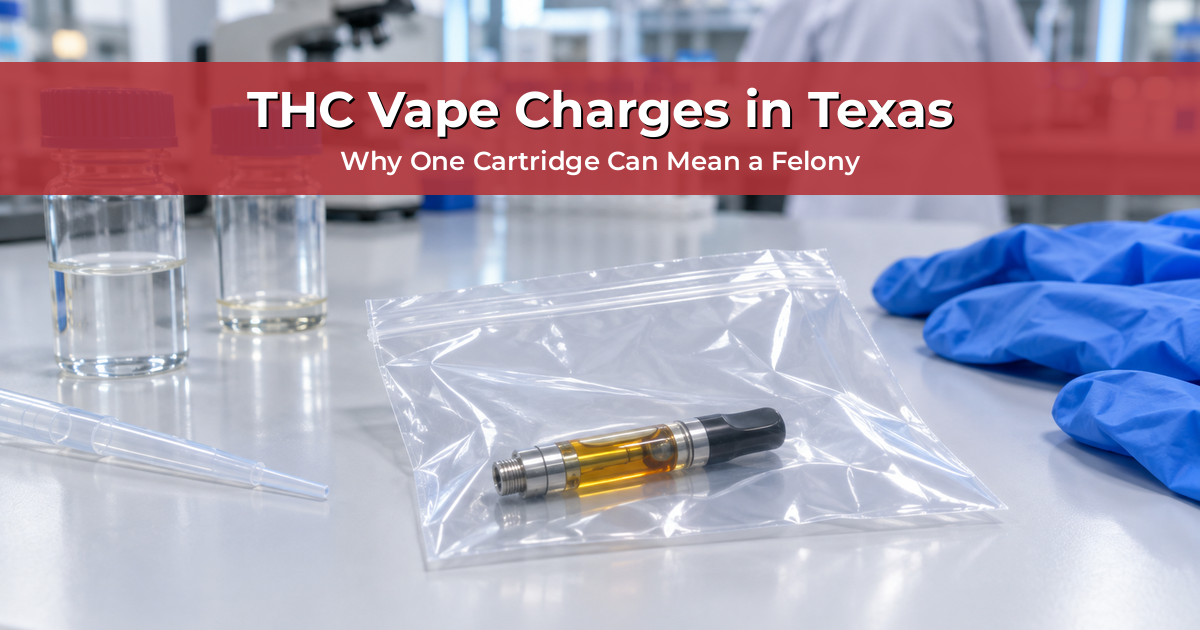
Vape cartridge with amber oil sealed in a clear evidence bag on a forensic lab bench

Is a THC Vape a Felony in Texas? Penalty Group 2 Charges, the 2026 Delta-8 Change, and Your Defenses

By Luke A. Williams · Drug Crimes

Short answer: In Texas, possessing a vape cartridge containing THC oil that is not legal hemp is generally charged as a felony, not a marijuana misdemeanor. THC concentrates fall under Penalty Group 2 of the Texas Controlled Substances Act, where less than one gram is a state jail felony and one to four grams is a third-degree felony. Products that meet the Texas definition of hemp, with no more than 0.3 percent delta-9 THC, are excluded, but since July 31, 2026, manufactured delta-8 THC is treated as a controlled substance, so many cartridges once sold openly in DFW shops can now lead to a felony charge.

Vape cartridge with amber oil sealed in a clear evidence bag on a forensic lab bench

A THC vape arrest often starts with something minor: a traffic stop on I-30, a search after an officer smells something, or a school or campus encounter. Many people are shocked to learn that a single cartridge, small enough to fit in a pocket, can carry more serious penalties than a bag of marijuana.

At Howard Lotspeich Alexander & Williams, PLLC (HLAW), our Fort Worth drug crimes defense lawyers defend people charged with THC and drug offenses in Tarrant, Dallas, Denton, Collin, Johnson, and Parker counties. This guide explains how Texas classifies THC vapes, the penalty ranges, how recent changes in hemp law affect these cases, and the defenses that often matter.

Key Takeaways

  • THC oil is Penalty Group 2. Texas lists "Tetrahydrocannabinols, other than marihuana," in Penalty Group 2, which covers THC concentrates such as vape oil (Tex. Health & Safety Code §481.103).
  • Small amounts are still felonies. Possession of less than one gram is a state jail felony, and one gram to less than four grams is a third-degree felony (Tex. Health & Safety Code §481.116).
  • Weight includes the whole mixture. Penalty Group 2 amounts are measured "by aggregate weight, including adulterants or dilutants" (§481.116).
  • Legal hemp is excluded. The definition of a controlled substance "does not include hemp" or "the tetrahydrocannabinols in hemp" (§481.002(5)).
  • Delta-8 changed on July 31, 2026. After the Supreme Court of Texas ruled for the state in Sky Marketing, the Department of State Health Services says the schedule treating delta-8 THC as a controlled substance became effective July 31, 2026 (Texas DSHS).
  • First-time small possession often means mandatory probation. For many people convicted of state jail felony possession under §481.116(b), the judge "shall suspend the imposition of the sentence and place the defendant on community supervision" (Tex. Code Crim. Proc. art. 42A.551).

Why Is a THC Vape a Felony in Texas When Marijuana Is a Misdemeanor?

The difference comes from how Texas defines marijuana. Under Health and Safety Code §481.002(26), "marihuana" means the cannabis plant and its seeds, but the term does not include "the resin extracted from a part of the plant or a compound, manufacture, salt, derivative, mixture, or preparation of the resin." Extracted THC, including the oil in a vape cartridge, falls outside the marijuana definition.

Instead, Penalty Group 2 includes "Tetrahydrocannabinols, other than marihuana, and synthetic equivalents of the substances contained in the plant, or in the resinous extractives of Cannabis" (Tex. Health & Safety Code §481.103).

The result is a sharp contrast:

Item Statute Small-amount offense level
Marijuana plant material, 2 ounces or less §481.121(b)(1) Class B misdemeanor
Marijuana, more than 2 and up to 4 ounces §481.121(b)(2) Class A misdemeanor
THC concentrate (vape oil, wax), less than 1 gram §481.116(b) State jail felony
THC concentrate, 1 gram to less than 4 grams §481.116(c) Third-degree felony
THC concentrate, 4 grams to less than 400 grams §481.116(d) Second-degree felony

For more on plant-material charges, see our guide to marijuana laws in Texas.

What Are the Penalties for THC Vape Possession?

The punishment ranges come from the Texas Penal Code (Tex. Penal Code ch. 12):

  • State jail felony (less than 1 gram): 180 days to two years in a state jail and a fine of up to $10,000.
  • Third-degree felony (1 to 4 grams): 2 to 10 years in prison and a fine of up to $10,000.
  • Second-degree felony (4 to 400 grams): 2 to 20 years in prison and a fine of up to $10,000.
  • First-degree felony (400 grams or more): 5 to 99 years or life and a fine of up to $50,000 under §481.116(e).

How much does a vape cartridge weigh?

This is often the most important number in the case. Because §481.116 measures "aggregate weight, including adulterants or dilutants," the weight of the entire liquid mixture counts, not only the THC in it. Many cartridges are sold in roughly half-gram or one-gram sizes, so a single cartridge can fall just under or just over the one-gram line between a state jail felony and a third-degree felony. Several cartridges can push the total above four grams. How the lab measured the substance, and whether the reported weight reflects only the oil rather than the hardware, can matter a great deal.

Is probation mandatory for a small THC vape case?

Often, yes. Under Article 42A.551(a), on conviction of a state jail felony under §481.116(b) punished under Penal Code §12.35(a), "the judge shall suspend the imposition of the sentence and place the defendant on community supervision." That rule has exceptions, including when the person has a prior felony conviction or the conviction follows an adjudication after deferred adjudication (Tex. Code Crim. Proc. art. 42A.551).

A court may also impose Class A misdemeanor punishment for a state jail felony under Penal Code §12.44(a), and at the prosecutor's request may allow the case to be prosecuted as a Class A misdemeanor under §12.44(b) (Tex. Penal Code §12.44). Many DFW counties also offer diversion programs for some first-time drug cases. See our overview of Tarrant County diversion programs.

Is a Hemp or Delta-8 Vape Legal in Texas?

This is where the law has changed the most, and where many people are caught off guard.

Hemp is excluded from the Controlled Substances Act

Texas excludes hemp from the definition of a controlled substance. Under §481.002(5), the term "does not include hemp, as defined by Section 121.001, Agriculture Code, or the tetrahydrocannabinols in hemp." According to the Texas Department of State Health Services, consumable hemp products "may contain delta-9 tetrahydrocannabinol at a concentration of not more than 0.3 percent on a dry weight basis" (Texas DSHS).

Delta-8 THC is now treated as a controlled substance

On May 1, 2026, the Supreme Court of Texas decided Texas Department of State Health Services v. Sky Marketing Corp. The court held that the commissioner "acted within her broad statutory discretion and followed proper procedures" when amending the state schedules to treat manufactured delta-8 THC as a Schedule I controlled substance, and it rendered judgment for the department (Justia summary of Sky Marketing; Supreme Court of Texas opinion).

DSHS states that "only trace amounts of delta-8 THC naturally produced by the hemp plant from which the consumable hemp product was manufactured are permissible" and that "the Texas schedule affecting delta-8 THC becomes effective July 31, 2026." DSHS also says products labeled as containing delta-8 THC or shown to contain more than trace amounts "may be detained and referred to law enforcement" (Texas DSHS).

Selling cannabinoid vapes is a separate crime

Since September 1, 2025, Health and Safety Code §161.0876, as amended by Senate Bill 2024, makes it an offense to market, advertise, sell, or offer for sale an e-cigarette product that "contains, is mixed with, or is marketed as containing or being mixed with any cannabinoids," among other substances. That offense is a Class A misdemeanor (S.B. 2024, 89th Leg.; Texas Comptroller FAQ). The sales ban targets sellers, but it means legitimate hemp vapes should no longer be sold in Texas stores, which can make a vape found during a stop look more suspicious to police.

What about the new federal hemp law?

Federal law is also changing. According to WFAA, a federal funding bill, H.R. 5371, targets cannabinoids that cannot be naturally produced by hemp and sets "a 0.4-milligram THC limit on hemp products, per container," with part of the restrictions in effect and a second round scheduled for December 11. Fort Worth police told WFAA, "We will enforce state law restrictions on hemp products" (WFAA). Texas lawmakers are also expected to debate cannabis and hemp policy in the next session (KUT). Because these rules are moving quickly, the law on the date of the alleged offense matters.

How Do Lawyers Defend THC Vape Charges in DFW?

Every case depends on its facts, but common defense issues include:

  1. Was the search lawful? Many vape cases start with a traffic stop or a search based on odor. Whether the officer had a legal basis to stop and search is often the first question. See our article on the smell of marijuana and warrantless searches.
  2. Did you knowingly possess it? The State must prove knowing or intentional possession. A cartridge found in a shared car or a borrowed jacket can raise real questions. Our guide to drug possession in a car explains how Texas courts analyze this.
  3. What exactly is in the cartridge? The lab must identify the substance. A product that qualifies as hemp, with no more than 0.3 percent delta-9 THC, is excluded from the Controlled Substances Act, so whether and how the lab tested THC type and concentration can be critical.
  4. Is the weight accurate? Because the felony level depends on weight, the lab's method, the number of items tested, and whether the weight reflects only the substance can change the charge.
  5. When was the offense? For delta-8 products, whether the alleged offense occurred before or after the July 31, 2026, scheduling change can matter.
  6. Is diversion or a reduction available? Even when the evidence is strong, options such as diversion, a §12.44 reduction, or deferred adjudication may protect your record.

Can a THC Vape Charge Be Removed From My Record?

Possibly. If the case is dismissed, you may be eligible for an expunction. If you complete deferred adjudication, you may be eligible to seek an order of nondisclosure, depending on the offense and your history. Learn more in our Texas expunction and nondisclosure guide.

Frequently Asked Questions

Is one THC vape cartridge a felony in Texas?

Usually, if the oil contains THC that does not qualify as hemp. Possession of less than one gram of a Penalty Group 2 substance is a state jail felony, and one gram or more but less than four grams is a third-degree felony under §481.116.

Is a delta-8 vape legal in Texas now?

Since July 31, 2026, Texas DSHS treats manufactured delta-8 THC as a controlled substance, with only naturally occurring trace amounts permitted. A delta-8 vape may therefore support a Penalty Group 2 charge if lab testing confirms it.

What if I bought the vape legally at a smoke shop?

Where you bought it does not automatically make it legal. The question is what the product actually contains and the law in effect on the date of the alleged offense. Purchase records and product testing can still be relevant to your defense.

Does the weight include the cartridge?

The statute measures the "aggregate weight, including adulterants or dilutants" of the substance. How the lab handled and weighed the oil is a common issue in these cases and should be reviewed carefully.

Can I get probation for a THC vape charge?

Often. For many first-time state jail felony possession cases under §481.116(b), Texas law requires the judge to place the person on community supervision, and diversion or deferred adjudication may also be available.

Will a THC vape charge affect my job or school?

A felony charge or conviction can affect employment, professional licenses, financial aid, housing, and firearm rights. Resolving the case in a way that protects your record is often a major goal.

Talk to a Fort Worth Drug Crimes Defense Lawyer

A THC vape charge can turn a moment into a felony record. The lab results, the weight, the search, and the date of the offense can all change the outcome, and the rules are changing quickly.

Call HLAW at (817) 993-9249 or contact us online for a free consultation about a THC or drug charge in Dallas-Fort Worth.

This article is for general informational purposes only and is not legal advice. Reading it does not create an attorney-client relationship. Laws change, and every case depends on its specific facts.

Read full article
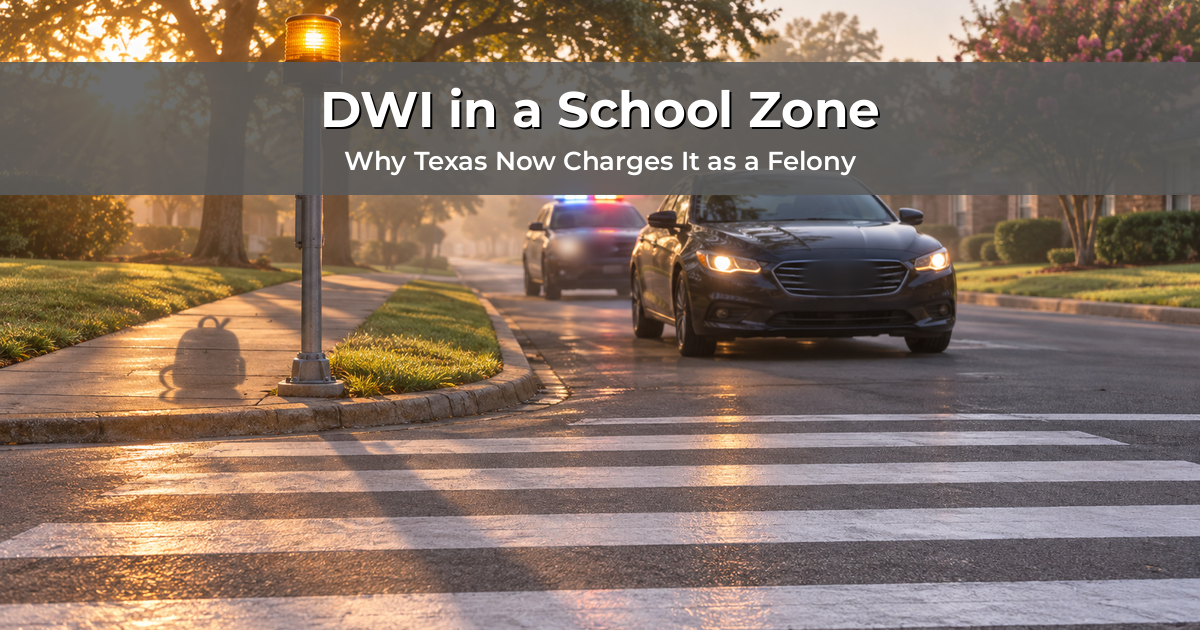
Police patrol car stopping a sedan past a crosswalk in a residential school zone with a flashing amber beacon

DWI in a School Zone in Texas: What the New State Jail Felony Law Means for DFW Drivers

By Luke A. Williams · DWI

Short answer: Since September 1, 2025, Texas law makes driving while intoxicated in a school crossing zone a state jail felony when the State proves the driver was in the zone "during the time the reduced speed limit applies." A state jail felony carries 180 days to two years in a state jail and a fine of up to $10,000, compared with a Class B misdemeanor for a typical first DWI. The enhancement depends on specific facts, including whether the zone was properly designated and whether the reduced speed limit was in effect at that moment, so those details are often central to the defense.

Police patrol car stopping a sedan past a crosswalk in a residential school zone with a flashing amber beacon

Every school day in Dallas-Fort Worth, thousands of drivers pass through school zones on their way to work, often on major roads near neighborhood schools in Fort Worth, Arlington, Keller, Frisco, and Denton. A DWI arrest at 7:30 in the morning or 3:30 in the afternoon can now carry far more serious consequences than the same arrest a block away or an hour later.

At Howard Lotspeich Alexander & Williams, PLLC (HLAW), our Fort Worth DWI attorneys defend people charged with DWI in Tarrant, Dallas, Denton, Collin, Johnson, and Parker counties. This guide explains the school crossing zone DWI law, what the State must prove, the possible penalties, and how these cases are defended.

Key Takeaways

  • It is a felony. Under Texas Penal Code §49.04(e), a DWI committed while "operating the motor vehicle in a school crossing zone during the time the reduced speed limit applies to the zone" is a state jail felony (Tex. Penal Code §49.04).
  • The law is new. Senate Bill 826 added the provision, took effect September 1, 2025, and applies prospectively (S.B. 826, 89th Leg.; Senate Research Center bill analysis).
  • Timing matters. The enhancement applies only when the reduced speed limit is in effect, not at all hours (Tex. Penal Code §49.04(e)).
  • The zone must be legally designated. A "school crossing zone" is a reduced-speed zone "designated on a street by a local authority" for children going to or leaving school (Tex. Transp. Code §541.302).
  • Punishment ranges from 180 days to two years. A state jail felony carries 180 days to two years in a state jail and up to a $10,000 fine, though a court may impose misdemeanor-level confinement in some cases (Tex. Penal Code §§12.35, 12.44).
  • The license deadline still applies. You generally have 15 days after receiving notice of a license suspension to request an administrative hearing (Tex. Transp. Code §724.041).

What Does the Texas School Zone DWI Law Say?

Texas Penal Code §49.04(a) makes it an offense to be "intoxicated while operating a motor vehicle in a public place." A first DWI is ordinarily a Class B misdemeanor with a minimum of 72 hours of confinement. Subsection (e), added in 2025, reads:

"If it is shown on the trial of an offense under this section that at the time of the offense the person was operating the motor vehicle in a school crossing zone during the time the reduced speed limit applies to the zone, the offense is a state jail felony."

The statute adopts the Transportation Code's definition of "school crossing zone" (Tex. Penal Code §49.04). Under §541.302 of that code, a school crossing zone is "a reduced-speed zone designated on a street by a local authority to facilitate safe crossing of the street by children going to or leaving a public or private elementary or secondary school during the time the reduced speed limit applies" (Tex. Transp. Code §541.302).

Why did the Legislature pass S.B. 826?

According to the Senate Research Center's analysis, the bill's supporters said school zones "are meant to be safe areas where young students can walk, bike, and be dropped off or picked up without the heightened threat of impaired drivers," and the bill "enhances a DWI that occurs in a school zone to a state jail felony" (Senate Research Center). The enrolled bill states that it "takes effect September 1, 2025" (S.B. 826 enrolled).

What Must Prosecutors Prove for a School Zone DWI?

To convict someone of the felony version, the State generally must prove all of the ordinary DWI elements plus the school zone facts. In practical terms, that includes:

  1. Intoxication. The person did not have the normal use of mental or physical faculties because of alcohol or drugs, or had an alcohol concentration of 0.08 or more.
  2. Operating a motor vehicle. The person was driving or otherwise operating the vehicle.
  3. In a public place. Public roads near schools usually qualify.
  4. Within a school crossing zone. The location was a reduced-speed zone designated by a local authority, such as a city or county, for children going to or leaving school.
  5. During the reduced speed limit period. The reduced speed limit actually applied at the time of the offense.

Because §49.04(e) says the fact must be "shown on the trial," the school zone element is something the State must prove with evidence, not simply allege. Elements four and five are new, and they can raise questions that do not exist in a typical DWI case.

When Does the Reduced Speed Limit Apply?

The answer is local. School zones in DFW are set by cities and counties, and the hours often depend on the school's schedule. Many zones use flashing beacons during posted morning and afternoon periods, while others use signs listing specific times. Some zones apply only on school days.

That means the same intersection may be a felony location at 7:45 a.m. on a Tuesday in October and an ordinary misdemeanor location at 10:00 p.m. on a Saturday in July. Evidence that can matter includes:

  • The city or county ordinance or traffic order that designated the zone.
  • The posted hours on the signs and whether beacons were flashing.
  • The school calendar for that day, including holidays, teacher workdays, and early release days.
  • Dash camera and body camera video showing the location and the signs.
  • The exact time of driving, which may differ from the time of the stop or arrest.

What Are the Penalties for DWI in a School Zone?

The table below compares the school zone offense with other common Texas DWI levels.

Charge Offense level Confinement range Maximum fine Source
First DWI Class B misdemeanor 72 hours to 180 days $2,000 Penal Code §49.04(b), §12.22
First DWI, 0.15 or more Class A misdemeanor Up to 1 year $4,000 Penal Code §49.04(d), §12.21
DWI in a school crossing zone State jail felony 180 days to 2 years $10,000 Penal Code §§49.04(e), 12.35
Third DWI Third-degree felony 2 to 10 years $10,000 Penal Code §49.09(b), §12.34

Under §12.35, a person "adjudged guilty of a state jail felony shall be punished by confinement in a state jail for any term of not more than two years or less than 180 days," and may also be fined up to $10,000 (Tex. Penal Code §12.35).

Can a school zone DWI be reduced to a misdemeanor?

Texas law provides two possible paths. Under §12.44(a), a court may impose Class A misdemeanor confinement for a state jail felony if, after considering the circumstances and the defendant's history and rehabilitative needs, the court finds that such punishment "would best serve the ends of justice." Under §12.44(b), at the prosecutor's request, the court "may authorize the prosecuting attorney to prosecute a state jail felony as a Class A misdemeanor" (Tex. Penal Code §12.44). Neither is automatic, and both depend on the facts and the prosecutor's and court's discretion.

Is probation or deferred adjudication available?

Community supervision (probation) may be available depending on the case. For deferred adjudication, Article 42A.102 excludes DWI cases in which the defendant held a commercial driver's license or had an alcohol concentration of 0.15 or more, as well as DWIs enhanced under §49.09 (Tex. Code Crim. Proc. art. 42A.102). The statute does not separately list the school crossing zone provision, but whether deferred adjudication is offered in a particular case is a question to discuss with your lawyer. Our article on DWI deferred adjudication in Texas explains how it works.

If probation is granted after a DWI conviction, the court may require an ignition interlock device, and must require one in certain cases, such as when a test showed 0.15 or more (Tex. Code Crim. Proc. art. 42A.408).

How Is a School Zone DWI Different From DWI With a Child Passenger?

They are separate offenses. DWI with a child passenger under Penal Code §49.045 applies when a passenger is younger than 15, regardless of where the vehicle is. A school zone DWI applies based on location and time, even if no child is in the car. Both are state jail felonies, and in some cases both may be alleged. See our guide to DWI with a child passenger in Texas.

What About My Driver's License?

A school zone DWI arrest can trigger the same administrative license suspension process as any other DWI. If you refused a breath or blood test, the Department of Public Safety generally will suspend your license for 180 days for a first refusal (Tex. Transp. Code §724.035). You generally have 15 days after receiving notice of the suspension to request a hearing (Tex. Transp. Code §724.041). Read more in our guide to the ALR hearing 15-day deadline and our article on Texas DWI license suspensions and occupational licenses.

How Do Lawyers Defend a School Zone DWI?

A school zone DWI is defended like any DWI, with additional issues specific to the enhancement:

  • Was the stop lawful? The officer needed reasonable suspicion to make the traffic stop.
  • Is the intoxication evidence reliable? Field sobriety tests, breath tests, and blood tests can all be challenged.
  • Was the location a legally designated school crossing zone? The State may need to show the zone was designated by a local authority.
  • Did the reduced speed limit apply at that time? The posted hours, flashing beacons, and school calendar can matter.
  • Where was the car when it was being operated? If the driving occurred outside the zone and the stop happened inside it, or the reverse, the location of the driving can become an issue.
  • Does the law apply to the date of the offense? S.B. 826 applies prospectively, so offenses before September 1, 2025, are governed by prior law.

Because the school zone fact raises the case from a misdemeanor to a felony, each of these questions can significantly change the outcome. For context on how Texas treats felony DWI more generally, see our article on a third DWI in Texas, and for high test results, see our guide to 0.15 BAC DWI charges.

Frequently Asked Questions

Is DWI in a school zone a felony in Texas?

Yes, for offenses on or after September 1, 2025, if the State proves the driver was in a school crossing zone during the time the reduced speed limit applied. It is a state jail felony under Penal Code §49.04(e).

Does the school zone law apply at night or on weekends?

The enhancement applies only "during the time the reduced speed limit applies to the zone." Many school zones are active only during posted morning and afternoon hours on school days, so a DWI at night or on a weekend in the same location may not qualify.

What if no children were present?

The statute does not require that children be present. The key facts are the designated zone and whether the reduced speed limit was in effect.

Can a school zone DWI be charged as a misdemeanor instead?

Possibly. Under Penal Code §12.44(b), the court may authorize the prosecutor to prosecute a state jail felony as a Class A misdemeanor at the prosecutor's request. This depends on the case and is not guaranteed.

Will I lose my license after a school zone DWI arrest?

You may face an administrative license suspension, especially after a test refusal or a test result of 0.08 or more. You generally have 15 days after notice to request a hearing to contest it.

What should I do after a school zone DWI arrest in DFW?

Request your ALR hearing within the deadline, write down the time and location of the stop, avoid discussing the case, and talk to a DWI defense lawyer quickly so evidence about the zone, such as signage and beacon status, can be preserved.

Talk to a Fort Worth DWI Defense Lawyer

A school zone DWI can turn an ordinary misdemeanor arrest into a felony case. The details of the zone, the time, and the evidence matter, and early action can help preserve them.

Call HLAW at (817) 993-9249 or contact us online for a free consultation about a DWI charge in Dallas-Fort Worth.

This article is for general informational purposes only and is not legal advice. Reading it does not create an attorney-client relationship. Laws change, and every case depends on its specific facts.

Read full article

Speak with a Fort Worth attorney

Call (817) 993-9249 or send us a message to discuss your case.