Skip to content
Tag

Fort Worth Drug Crimes Attorneys

Page 3 of 4 · 20 articles

Stop and Frisk Furr v. State 2016

Reasonable Suspicion to Stop and Frisk Upheld | Furr v. State (2016)

By Luke A. Williams · Reasonable Suspicion, Search & Seizure

Texas Court of Criminal Appeals Upholds a Stop and Frisk Case
Stop and Frisk Furr v. State 2016Furr v. State (Tex. Crim. App. 2016)

On September 21st the Criminal Court of Appeals decided Furr v. State. In Furr, the Court held that an anonymous tip was sufficiently corroborated to establish reasonable suspicion to stop and frisk Appellant Furr. To support the stop and frisk, the court noted that Appellant:

  • watched the officer as he drove by,
  • repeatedly looked at the officer as he walked away,
  • was nervous, anxious and sort of out of it,
  • appeared under the influence of drugs, and
  • did not initially respond as to whether he was armed.

Further, the Court stated it is not per se objectively reasonable for a police officer to execute a pat down of a suspect for weapons simply because they are accused of drug possession.

The Facts of Furr v. State

Corpus Christi Police Department received an anonymous tip that two men were doing drugs on a particular street corner, one dressed in all black and the other in a black shirt carrying a brown backpack. In response, an officer drove past the street corner. He observed two men that fit the description from the tip and noticed in his rearview mirror that the men were watching him as he drove by. The officer then approached the two men but one of the men, Furr, walked away into the nearby shelter, repeatedly looking over his shoulder at the officer. The officer described Furr's actions as furtive, “like he was trying to get away.”

When another officer arrived, the officers made contact with Furr. Furr was described as nervous, anxious, evasive, and was sweating excessively. Furr did not respond when the officers initially asked if he had any weapons on him. Officers said he appeared “kind of out of it” and “like he was under the influence of a drug. As a result, for safety reasons, officers frisked Furr for weapons and found a glass crack pipe in Furr’s front pocket. When removing the pipe, the officer also found two syringes, and after arrest, two small balloons of heroin.

Furr was charged with possession of a controlled substance. He pled guilty, reserving his right to appeal after his motion to suppress was denied. Furr argued on Appeal that officers did not have reasonable suspicion to stop and frisk him and that the trial court erred by not granting the Motion to Suppress the search.

The Court of Appeals Affirmed the Trial Courts Decision

The court of appeals held that Furr’s nervousness coupled with the observation that he seemed to be under the influence of a drug sufficiently corroborated the tip to support the investigative detention and that Furr’s failure to initially respond about being armed coupled with the other circumstances justified the frisk.

The Criminal Court of Appeals Concluded that there Was Reasonable Suspicion to Detain and Frisk Furr.

1. The Analysis of the Detention

In order to detain a person, the police officer must have reasonable suspicion based on “specific articulable facts, when combined with rational inferences from those facts, would lead him to reasonably conclude that the person detained is, has been, or soon will be engaged in criminal activity.” Wade v. State, 422 S.W.3d 661, 668 (Tex. Crim. App. 2013). Anything that happens or that is observed before the detention will be considered in determining whether the officer indeed had reasonable suspicion to detain Furr.

Furr argued that the anonymous tip alone was not enough.  The Court, however, explains that if there had only been the anonymous tip, it would not have established reasonable suspicion, but here there was more. The Court identifies several independent observations:

  • Furr and the other man were at the specified location and matched the informant’s description.
  • The area was a “high drug, high crime” area.
  • Furr and the other man watched the officer as he drove past
  • When the officer approached the two, Furr walked away “furtively.”
  • When the officers came upon Furr in the shelter he was sweaty, nervous, anxious, and appeared out of it as if he was under the influence of a drug.

Thus, the reasonable suspicion here was not solely based on the informant’s tip, but instead that tip was corroborated by independent observations made by the police officers. Looking at the totality of these circumstances, the Court held that the officers had reasonable suspicion to stop Furr and investigate the information from the anonymous tip that Furr and the other man were using and possessing a drug.

2. The Terry Frisk

The Court rejected the State’s request to adopt a rule that it is, “per se, objectively reasonable for the police to pat down a suspect for weapons if they are accused of possessing drugs,” because reasonable suspicion to frisk a suspect cannot be established by accusations of drug possession alone.

The Court further rejects the State’s argument that the officer was objectively justified in patting Furr down for weapons because this was outside of a homeless shelter for two reasons: 1) Nothing in the record shows that the shelter was a homeless shelter; and 2) Even if it was a homeless shelter, the Court does not see a correlation between being armed and dangerous and being at a homeless shelter.

Even so, the Court ultimately agrees with the court of appeals that reasonable suspicion was established here because the anonymous tip was corroborated by all of the circumstances surrounding the officers’ interactions with Furr. Specifically, the Court noted the tip, personal observations by the officers and the high drug, high crime area would warrant a belief that the safety of officers and others was in danger.

DISSENT - Stop and Frisk Should Have Been Held Unlawful

Judge Meyers dissented from the majority and opined that the stop and frisk of Furr was unlawful and that the motion to suppress should have been granted. Judge Meyers concluded that neither Furr’s action of looking over his shoulder or the anonymous tip, alone or combined, were sufficient to establish reasonable suspicion. Thus, there was no need to analyze the legality of the frisk. Judge Meyers believes that the majority made its decision “not based on law but on the feeling that Furr should not get relief.”
Read full article
THC Controlled Substance Analogue Designer Drug

Controlled Substance Analogue Ratio Equates to Higher Federal Sentence

By Brandon Barnett · Drug Crimes

THC Controlled Substance Analogue Designer DrugSynthetic Cannabinoids became popular in the 2000's when they were first marketed as "legal herbs." In 2008, chemical analysis revealed that these designer drugs were more than just herbs.  The military, in particular, had a big problem with Spice and K2 (two forms of synthetic marijuana) in the late 2000's, because they gave users a similar (or greater) high than marijuana, but they were not included in any federal schedule of controlled substances.  As these substances became more popular and widely consumed, the DEA banned their use in 2010 using emergency temporary powers and then later by placing them on Schedule I of Controlled Substance Act.

How Do Controlled Substances Analogues (Designer Drugs) Fit Into the Federal Drug Control Scheme?


United States v Malone (5th Circuit Court of Appeals - 2016)

Thomas Malone and his business partner Drew Green owned NutraGenomics Manufacturing, LLC, a distributor of JWH-018, a synthetic cannabinoid substance, also known as “Spice” and “K2” on the street. However, in 2011 federal and state legislatures banned JWH-018 and other similar designer drugs or synthetic cannabinoids. Malone and Green began selling other synthetic cannabinoids, namely, AM-2201, known as “Mr. Miyagi…a mixture of AM-2201 and vegetable material that visually resemble[s] marijuana.” Eventually, Malone and Green ordered the mass manufacture of Mr. Miyagi, selling in bulk to a distributor in Louisiana. Although labeled as potpourri, Mr. Miyagi was supposed to be smoked like marijuana.

Malone Faced Federal Indictment For Possession and Distribution of Mr. Miyagi

A federal grand jury returned an indictment, charging Malone with one count of conspiracy to distribute and possess with intent to distribute AM-2201, and, one count of conspiracy to commit money laundering. Malone decided to take a plea agreement, pleading guilty to one count of conspiracy to distribute and possess with the intent to distribute a Schedule I Controlled Dangerous Substance, a violation of 21 U.S.C. §§846, 841(b)(1)(c), 813, 802(32)(A). The district court accepted Malone’s guilty plea of distributing not less than 1400 kilograms of AM-2201, and ordered a pre-sentence report. A pre-sentence report “PSR” is a report created by a probation office in anticipation of the punishment phase of a trial—the PSR in this case set out to determine “the base offense level using the marijuana equivalency of the most closely related controlled substance to AM-2201.”

Pre-Sentencing Report’s Mathematical Formula Indicated Severe Penalty

The PSR listed Tetrahydrocannabinol, THC, as the most closely related controlled substance to AM-2201. Further, the federal Drug Equivalency Tables indicated that a 1 to 167 ration be applied to convert the 1400 kilograms of AM-2201 into marijuana for the purpose of sentences under the federal Sentencing Guidelines. Using this mathematical equation, it was determined that Malone should be sentenced for 233,800 kilograms of marijuana—the highest level set forth by the Drug Equivalency Tables. At trial, each side put forth an expert witness arguing for and against the use of the THC and the THC ratio set forth in the PSR.

Battle of the Experts at Trial

The Government’s Expert

The Government called Dr. Jordan Trecki to testify that THC is the most closely related substance to AM-2201. Dr. Trecki relied on a scientific study “showing that both THC and AM-2201 bind to the same cannabinoid receptor” in the brain. Second, he testified about a study on rats where the rats could not tell the difference between THC and AM-2201. Third, he discussed AM-2201’s potency and effects on humans. Dr. Trecki told the court that THC and AM-2201 are close in chemical make-up and in effect on the structures of the brain. Dr. Trecki said, however, that there was no scientific basis for the 1:167 ratio.

Malone’s Expert

Malone’s attorney called Dr. Nicholas Cozzi, who stressed the importance of comparison of the two drug compounds—THC and AM-2201—in humans, not just in animals. Dr. Cozzi criticized Dr. Trecki’s analysis because Trecki “combined the results of several studies” and that the studies were not conducted on humans, rather they were animal studies. Dr. Cozzi stated that marijuana, not THC, was the most closely related substance to AM-2201 because it’s smoked and inhaled, like marijuana, and because both substances are consumed for their effect. Dr. Cozzi agreed with Dr. Trecki on one point—that the 1:167 ratio was not rooted in science.

The Big Issue Before the Fifth Circuit

Relying heavily on Dr. Trecki’s expert testimony, the District Court sentenced Malone to 117 months imprisonment and three years of supervised release following prison. The court noted that “the ratios in sentencing guidelines are often arbitrary… [however] the ratios seek to outline the relative harm of certain drugs.” Malone appeals to the Fifth Circuit Court of Appeals.

The Fifth Circuit must determine whether THC really is the most closely-related substance to the controlled substance analogue, AM-2201, and if so, whether the 1:167 ratio is a reasonable conversion for sentencing purposes.

The Fifth Circuit Weighs In

Here, the Fifth Circuit points out that the district court spent a day holding an evidentiary hearing on the equivalency of AM-2201 to other drugs, “it is significant that the district court gave this matter studied attention.” The court notes that each side had the ability to present an expert witness and to cross examine. “Nothing in the record leaves us with…the conviction that a mistake [was made].”

Second, the Fifth Circuit compares AM-2201 and marijuana, disagreeing with Dr.Cozzi’s assertion that both drugs are smoked and inhaled in the same manner. “Marijuana is not consumed way…there is no evidence that a user would smoke a pure form of AM-2201, just as a user would not smoke pure THC.”

Third, the Fifth Circuit says that the district court did not have to “engage in a piece-by-piece analysis of empirical grounding behind…[the] sentencing guidelines.” United States v. Duarte, 569 F.3d 357, 366-67 (5th Cir. 2009). Accordingly, the Court says that only the Commission on sentencing guidelines can change the guidelines, and therefore, does not rule on this issue. The Fifth Circuit agrees with the holding and reasoning of the district court—Malone’s sentence is affirmed.
*This case consolidates two cases, United States v. Malone and United States v. Green.

Read full article
Movie Plot Defense Opens Door 404b

Movie Plot Defense Opens the Door to Evidence of Other Crimes

By Brandon Barnett · Drug Crimes

The Fugitive, The Doctrine of Chances, and The Texas Rules of Evidence Collide: CCA Reviews a “Movie Plot” Defense Strategy

Movie Plot Defense Opens Door 404bDabney v. State (Tex. Crim. App. 2016)

Have you ever seen a movie like The Fugitive or Double Jeopardy where the main character finds himself in suspicious circumstances, only to be arrested and convicted, with the rest of the movie focused on proving the main character’s innocence? The defense counsel in Dabney v. State used this sort of analogy as the theme of his case to the jury—that the defendant was trapped in a bad movie plot and wasn’t actually guilty of any crime.

A Mystery Meth Lab Was Constructed at the Defendant's Home

Defense counsel made a memorable opening statement at Ronnie Dabney’s trial. Dabney had been arrested and charged with manufacturing meth. Defense counsel told the jury that the evidence would show that the meth lab found on Dabney’s property was set up by others, without his knowledge, and that Dabney arrived home mere moments before law enforcement arrived to discover the lab. Defense counsel offered a movie-plot defense theory, “Have you ever seen a movie like The Fugitive or Double Jeopardy where a person is found in suspicious circumstances and [they] arrest and convict them?” The defense added, “Ronnie Dabney has been living this movie where he’s innocent, found in suspicious circumstances, and he’s trying to prove himself not guilty.”

In response to the movie-plot defense theory, the State filed a brief arguing that it should be permitted to present evidence of a previous incident years ago, in which Dabney was present when a search warrant was executed on his property and an active meth lab was found. The State argued that the opening statements about the movie-plot amounted to a defensive theory, where evidence or mistake is at issue, worthy of a rebuttal argument supported by rebuttal evidence allowed under Rule 404(b) of the Texas Rules of Evidence.

Before trial, Dabney submitted a request for “notice” of the State’s intent to use evidence of past “extraneous” offenses under the Texas Rules of Evidence 404(b). The state failed to give proper notice of any 404(b) allegations. However, after hearing the defense opening statement, the State argued that the similarities between the case at bar and a previous case “rebutted [Dabney’s] defensive theory of accident or mistake” and requested permission to use the previous incident as 404(b) evidence to show the absence of mistake. The judge concluded the evidence of the previous crime was admissible. During closing remarks, the State averred, “[Dabney is] the unluckiest man in the world…[he] wants you to think [he] is Harrison Ford from the Fugitive…[with] a confluence of unfortunate events that frame him…but…common sense says it’s not an accident if it has happened twice…it’s the Doctrine of Chances.” Ronnie Dabney was found guilty of manufacturing meth and the jury sentenced him to 30 years imprisonment.

Dabney appealed to the Second Court of Appeals arguing the State failed to give proper notice of intent to use evidence of Dabney’s past crimes in its rebuttal argument under Texas evidentiary rules. The Fort Worth Court of Appeals reversed the trial court’s judgment, holding that the evidence of Dabney’s past crimes was inadmissible without proper notice from the State. Dabney v. State, No. 02-12-00530-CR, 2014 Tex. App. LEXIS 11496 (Tex. App.—Fort Worth, Oct. 16, 2014) (mem.op., not designated for publication). The State petitioned the Court of Criminal Appeals for review, arguing that notice is not required for rebuttal evidence because defensive theories cannot be predicted ahead of time. Dabney asserts that the State has a duty to anticipate all defensive issues that may come up in rebuttal.

The Court of Criminal Appeals considered the following issues (among others not discussed in this article):

(1) Did the court of appeals incorrectly add a “notice requirement” for rebuttal evidence?
(2) Did the court of appeals improperly ignore the overwhelming evidence of Dabney’s guilt?

Texas Evidentiary Rules Regarding Other Crimes, Wrongs, or Acts

Rule 404(b) of the Texas Rules of Evidence states

evidence of crimes, wrongs, or acts is not admissible to prove the character of a person in order to show action in conformity [of the crime being prosecuted].” “However, [such evidence] may be admissible for other purposes, such as…intent, preparation…knowledge…absence of mistake or accident, provided that upon timely request by the [defendant], reasonable notice is given in advance of trial of intent to introduce in the State’s case.

A defense opening statement can open the door for the admission of extraneous-offense evidence to rebut the defensive theory presented in opening statements. Bass v. State, 270 S.W.3d 557 (Tex. Crim. App. 2008).

The Doctrine of Chances tells [the court] that highly unusual events are unlikely to repeat themselves inadvertently or by happenstance.” LaPaz v. State, 279 S.W. 3d 336, 347 (Tex. Crim. App. 2009).

Rule 404(b) is a rule of inclusion, rather than of exclusions—it excludes only evidence that is offered solely for the purpose of proving bad character and conduct in conformity with that bad character. Id. at 343.

The CCA Holds that the Court of Appeals Improperly Added a Notice Requirement for Rebuttal Evidence

Here, the CCA reversed the decision of the court of appeals, holding that the court of appeals improperly added a notice requirement for rebuttal evidence and ignored the overwhelming evidence pointing to Dabney’s guilt. Because of the exception to the notice requirement when the defense opens the door to rebuttal evidence by presenting a defensive theory that the State may rebut using extraneous-offense evidence, the evidence of the prior crime was proper at trial, even without notice to defense beforehand. “To hold otherwise would impose upon the State the impossible task of anticipating, prior to the beginning of any trial, any and all potential defenses that a defendant may raise.” Also, there was no evidence that the prosecution acted in bad faith, or attempted to willfully avoid a discovery order. “Under the Doctrine of Chances, [Dabney’s] defense that he found himself in an unfortunate, highly unlikely situation becomes less credible when presented with evidence that he has been found in the exact same situation before.”

In sum, [Dabney] presented his defensive theory in opening statements and the State could use extraneous-offense evidence to rebut this theory in its case-in-chief, instead of waiting until the defense rested. Bass at 563. Defendants who are planning to use the “movie plot” defensive theory in the future, must be prepared to have the theory tested in front of a jury with 404(b) rebuttal evidence of other crimes, wrongs, or acts.

Read full article
Reasonable Suspicion Brodnex Texas 2016

Turns Out That Walking Late at Night in a High-Crime Area Is Not Criminal Activity

By Brandon Barnett · Reasonable Suspicion, Search & Seizure

Reasonable Suspicion Brodnex Texas 2016Frequently the public’s perception as to what officers can and cannot do during encounters is convoluted and even wrong. Many people are unaware of what their 4th Amendment rights actually afford them when it comes to contact with police officers. First, it’s important to know that an officer is completely free to approach whomever he wants and have a consensual encounter with someone whether or not he has a specific reason. However, an officer cannot detain you on a simple hunch, the police officer must have reasonable suspicion of criminal activity. Then comes the question of what exactly is reasonable suspicion.
What is Reasonable Suspicion?

According to Fourth Amendment law, reasonable suspicion exists when there are specific articulable facts that, when combined with rational inferences from the facts, would lead a reasonable officer to believe crime was afoot. The police officer must have more than a hunch that a crime was in progress. If a police officer detains, frisks, or searches someone without reasonable suspicion that officer has violated the 4th Amendment and evidence coming from that unlawful detention must be suppressed.

The 4th Amendment in Action - Brodnex v State of Texas (2016)

In a case just decided by the Court of Criminal Appeals of Texas, the Court overturned a conviction because it found the officer did not have reasonable suspicion to detain the defendant, thus, violating the 4th Amendment.

In Brodnex v. State, the defendant was arrested and convicted of possession of a controlled substance. The arresting officer observed Brodnex and a female walking in an area known for narcotic activity around 2 a.m.. The officer approached the two individuals, asked them their names and what they were doing. When Brodnex identified himself, the officer asked him “Didn’t you just get picked up?” and Brodnex replied “Hell no.” The Officer then searched Brodnex and found a cigar tube with crack cocaine.

The Officer’s reasons for detaining Brodnex were:

  • The time of day;
  • The area’s known narcotic activity, and
  • His belief, based on what other officers had told him, that Brodnex was a “known criminal.”

Brodnex filed a motion to suppress challenging both the stop and search. The trial court denied the motion and the appellate court affirmed.

The CCA Overturns the Conviction for Lack of Reasonable Suspicion

The Court of Criminal Appeals of Texas held that Brodnex was illegally detained because at the time of detention, under the totality of the circumstances, the facts apparent to the officer “did not provide him with a reasonable suspicion for the detention.” Therefore, the crack cocaine should have been suppressed. The court's holding relied on the fact that the officer had simply seen Brodnex walking, not doing anything that would suggest he was engaged or about to engage in criminal activity. Additionally, the court found that the officer’s limited personal knowledge of Brodnex’s criminal history was not enough to support the belief that Brodnex was lying about not being picked up.

Know Your Rights

This case explains that the officer must have sufficient information that links the suspect to a particular crime before reasonable suspicion exists. While the time of day and high-crime area are factors that Texas courts consider, those alone are insufficient to develop reasonable suspicion. Since reasonable suspicion is based on the totality of the circumstances, it is often not completely clear as to whether a particular set of facts rises to the level of reasonable suspicion.

If you are facing criminal charges that resulted from a detention or search that might not have been supported by reasonable suspicion, any evidence found from might be able to be suppressed. Contact our criminal defense team today to discuss your case and determine whether a reasonable suspicion issue is present.

*To know your rights on the go, download our FREE Mobile App.

Read full article
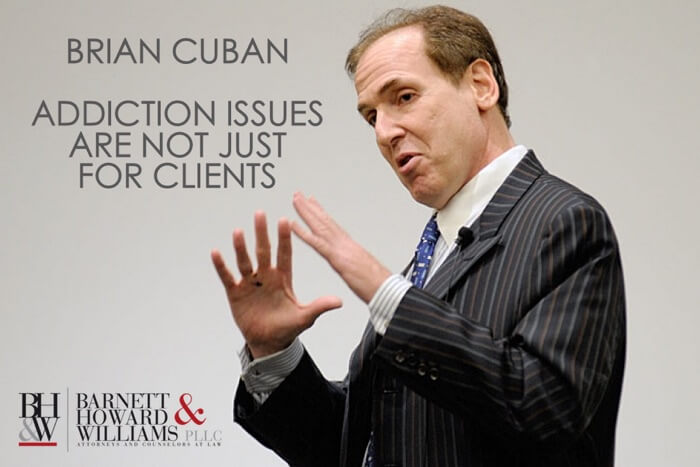
Brian Cuban The Addicted Lawyer

Addiction Issues Are Not Just for Clients

By Brandon Barnett · Drug Crimes

Brian Cuban: The Addicted Lawyer

Brian Cuban The Addicted LawyerBe it alcohol, drugs, or something else, many of our clients struggle with addiction.  We work everyday to counsel them and help them get plugged into the right places that assist in recovery.  But we sometimes forget that addiction issues aren't limited to our clients.  Many of our friends and colleagues in the legal community struggle with addiction.  Overworked and overstressed, many lawyers turn to alcohol or drugs as an escape.

Recently, a friend of mine connected me with Brian Cuban. For those of you who don't know of Brian Cuban, he is a lawyer, speaker, and activist, and the brother of Mark Cuban (the owner of the Dallas Mavericks).  Brian has been fighting (and winning) his battle against addiction since 2007.  He is also a writer with a new book coming out soon - The Addicted Lawyer.  I asked Brian if he would write a guest blog post about addiction.  The story below is from Brian.  Our hope is that this story will help to remind us to remember to help our colleagues in times of need and be on the lookout for the warning signs of addiction.

Gary Was a Lawyer, A Friend, An Addict

I drove past the same bus-stop every day. To the average person on his/her way to their next “stop” of the day, in life, nothing to set it off from any other.

That morning, I saw one such story I was intimately familiar with. There was Gary waiting for the bus. A lawyer. Undergraduate of Boston College Summa Cum Laude. Near the top of his class at Antioch School of Law. On to a great job with NBC. On to the NYC nightlife and the genetic pull of a family line ripe with alcohol use. Gary was an alcoholic and drug addict long before that bus stop. An addict trying to keep the shreds of his life and legal career together.

I had met Gary years before when we both worked of-counsel to a local Dallas firm. I was trying to hold my life together between addiction and an eating disorder. High functioning was a blessing and a curse. I needed no help. I showed up to court sober. I only did cocaine in the bathroom of the firm when I had no appointments. The pick up I needed after all night cocaine and alcohol benders. It all made perfect sense to me. In my mind, I was not an addict.

I had actually tried my last case with Gary. A bench trial contract matter. He ran the show. He was sober and brilliant. I didn’t want that show. I hated the practice of law. I was not afraid of a courtroom but I was sickened by them. A reminder of how much I hated my life and the career I had chosen for all the wrong reasons. We had a good result. Then Gary disappeared as he had sporadically done over the years since I first met him. I knew what that meant. We all knew. Periods of sobriety and stellar representation of his clients, periods of complaints of neglect and even showing up to client meetings apparently high.

Gary does not see me drive by him at the bus stop. He is looking at the ground. Waiting. My calls to him were never heard as his voicemail was full. I knew what that meant. Most addicts and their families know what that means. I went further down the road and turned around so I could drive up along side him. He got in. He had been to a 12-step meeting and was headed down to the Dallas 24-Hour club where he was a resident. He asked if I knew he had been disbarred. I had seen it in the local legal periodical. As what often happens with lawyers and addiction, clients money never made it to the client. State Bars take a dim view of stealing from clients and addiction is not an excuse. A common story. A common explanation from Gary. It was all a mistake. He had lost everything and was still in denial. I thought back to what my shrink had said to me April 8th 2007, the day I began my sobriety journey. "Brian, you have a law degree but you’re not a lawyer, you’re an addict."

I drove Gary down to the 24 Hour Club. I bought him lunch. A familiar request for money until “he got back on his feet.” It became our routine. The bus stop. The drive. The excuses. The helplessness. Then he was gone again. The full voicemail. No longer at the transitional living home. He had tested dirty.

August 2013. My cell phone rings. A 516 area code. Long Island. Where some of Gary’s family lived. He had moved back home much as I had moved to Dallas to be with my brothers after finishing Pitt Law deep in alcohol use disorders. My family would save me. If recovery was only that simple. A quick conversation. He said he was sober and working as an attorney. He was also licensed in New York. I hid my annoyance at the fact that he had just been disbarred and yet was right back participating in another jurisdiction that may not know about his past. Was I ethically bound to say something? I struggled with the conflict between my view as a lawyer and as a recovering addict. It was not my recovery. It was his.

The day is finally here! My first book, “Shattered Image” is going to be released. Looking forward to the release party! A Facebook message from Gary. I had not heard from him in a while. The message was cheerful. A photo of a plane ticket to come to Dallas for my book signing. It would be the last time I would hear from Gary.

The message came from his ex-wife. The google explosion of his name told the story.

“Gary Abrams , 54 Fatally Struck By Truck Tractor Trailer” walking along a highway.

It is unknown whether he had been drinking but it does not matter. He is gone. He never “got it” in recovery. It’s not that he didn’t want it. He tried. I miss him and wish he had gotten it. Gary was a lawyer, a friend, a husband, a sibling, an alcoholic. an addict. In his passing, he also helped me. I know my recovery is only as good as today. Thank you Gary.

***************************

Brian Cuban: An authority on body dysmorphic disorder, male eating disorders and addiction(including steroids), Brian Cuban is the author of the best-selling book, Shattered Image: My Triumph Over Body Dysmorphic Disorder. It chronicles his first-hand experiences living with, and recovering from, twenty-seven years of eating disorders, alcoholism, drug addiction and Body Dysmorphic Disorder (BDD).

www.briancuban.com

Read full article

Speak with a Fort Worth attorney

Call (817) 993-9249 or send us a message to discuss your case.