
Skip to content

November 2026

Page 3 of 7 · 31 articles

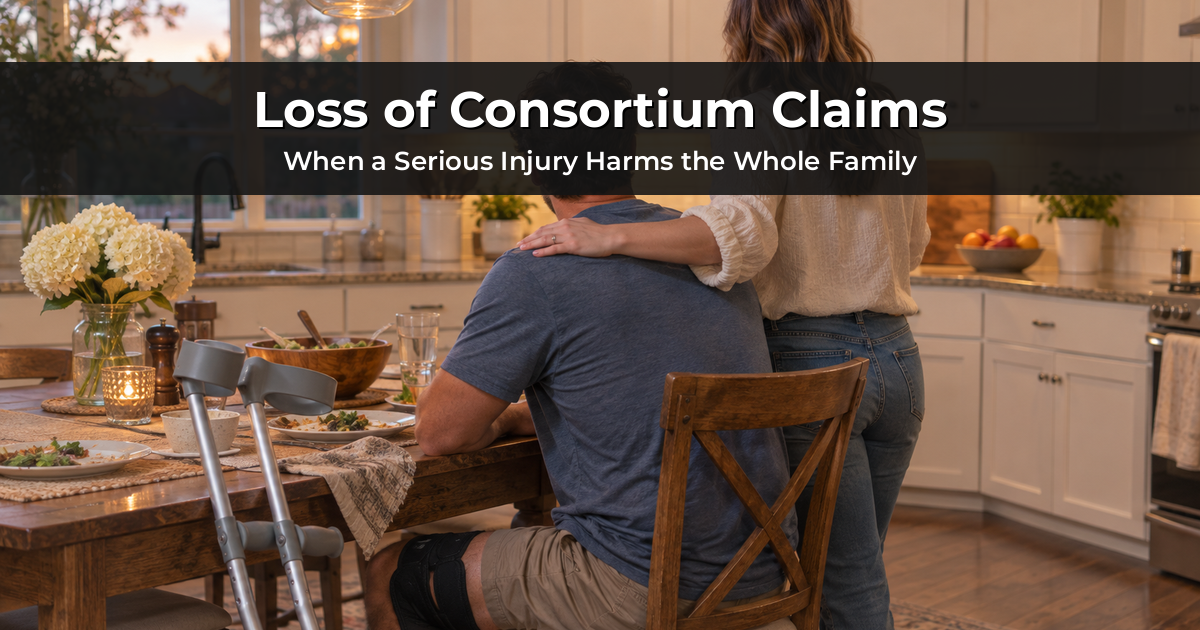
Injured man with a knee brace and crutches at a family dinner table as his wife rests a hand on his shoulder

Loss of Consortium in Texas: When Spouses and Children Can Recover After a Serious Injury

By Luke A. Williams · Personal Injury

Short answer: In Texas, a loss of consortium claim allows the spouse or child of a seriously injured person to recover damages for the harm the injury caused to their own relationship, such as lost affection, companionship, comfort, and emotional support. The Supreme Court of Texas recognized the claim for spouses in 1978 and for children of a parent with serious, permanent, and disabling injuries in 1990. However, Texas does not allow parents to recover for loss of consortium when a child is injured but survives, and because the claim is derivative, the injured person's own share of fault reduces or bars it.

Injured man with a knee brace and crutches at a family dinner table as his wife rests a hand on his shoulder

When someone is badly hurt in a crash on I-35W, a fall at a store, or a workplace accident in Dallas-Fort Worth, the injured person is not the only one who suffers. A spouse may lose a partner's companionship and help. A child may lose a parent's ability to play, teach, and be present. Texas law recognizes some of these losses, but the rules are specific, and many families do not know the claim exists until it is too late to raise it.

At Howard Lotspeich Alexander & Williams, PLLC (HLAW), our Fort Worth personal injury lawyers represent injured people and their families in Tarrant, Dallas, Denton, Collin, Johnson, and Parker counties. This guide explains who can bring a loss of consortium claim in Texas, what it covers, how it is valued, and the limits that often decide these cases.

Key Takeaways

  • Spouses can recover. In Whittlesey v. Miller, the Supreme Court of Texas held "that either spouse has a cause of action for loss of consortium" arising from an injury caused to the other spouse by a third party's negligence (Whittlesey v. Miller, Tex. 1978).
  • Children can recover when a parent is seriously injured. In Reagan v. Vaughn, the court held "that children may recover for loss of consortium when a third party causes serious, permanent, and disabling injuries to their parent" (Reagan v. Vaughn, Tex. 1990).
  • Parents of an injured child generally cannot. Texas does not recognize a common law claim for a parent's loss of consortium resulting from a non-fatal injury to a child (Roberts v. Williamson, Tex. 2003).
  • The claim is derivative. The defenses that bar all or part of the injured person's recovery have the same effect on the consortium claim, including the injured person's percentage of fault (Reagan v. Vaughn).
  • It is a noneconomic damage. Texas law lists "loss of consortium" among noneconomic damages, which matters for caps in medical malpractice cases (Tex. Civ. Prac. & Rem. Code §41.001; §74.301).
  • Deaths follow different rules. When an injury is fatal, family members' claims for loss of companionship generally proceed under the Texas Wrongful Death Act (Tex. Civ. Prac. & Rem. Code ch. 71).

What Is Loss of Consortium in Texas?

"Consortium" refers to the intangible benefits of a close family relationship. In Whittlesey, the Supreme Court of Texas explained that consortium "can generally be defined to include the mutual right of the husband and wife to that affection, solace, comfort, companionship, society, assistance, and sexual relations necessary to a successful marriage." The court added that the definition "primarily consists of the emotional or intangible elements of the marital relationship" (Whittlesey v. Miller).

In other words, a loss of consortium claim is not about medical bills or lost paychecks. It compensates a family member for the harm to the relationship itself: the spouse who can no longer share activities, travel, or intimacy with a partner, or the child whose parent can no longer coach, comfort, or guide them the way they once did.

The court also noted that in Texas, spousal consortium "does not include the 'services' rendered by a spouse to the marriage." Household services, such as a spouse's lost ability to do chores, can be handled differently, so it is important to discuss with your lawyer how each type of loss is presented.

Who Can Bring a Loss of Consortium Claim in Texas?

Texas law draws clear lines about which relationships qualify when the injured person survives.

Relationship Injured person survives Key authority
Spouse of injured person Yes, a claim is recognized Whittlesey v. Miller (1978)
Child of injured parent Yes, if the parent's injuries are serious, permanent, and disabling Reagan v. Vaughn (1990)
Parent of injured child No common law claim for a non-fatal injury Roberts v. Williamson (2003)
Siblings, unmarried partners, other relatives Generally not recognized Texas common law

Spouses

A spouse's claim is the most common type. Whittlesey involved a wife whose husband was injured in a car accident, and the court held that either spouse may bring the claim. The court also held that a settlement signed by the husband did not end the wife's claim, because there was "no showing that the husband had the authority to enter into a settlement on behalf of his wife" (Whittlesey v. Miller). That is one reason the spouse's claim should be identified and resolved together with the injured person's claim.

Children of an injured parent

Under Reagan, the child may recover non-pecuniary damages for "loss of the parent's love, affection, protection, emotional support, services, companionship, care, and society." The court declined to limit the claim to minor children, noting that adult children may also recover, while leaving it to the jury to consider the child's age in setting damages. On rehearing, the court explained that when the facts are disputed, the jury must first find that the parent's injury "was a serious, permanent, and disabling injury" before deciding consortium damages (Reagan v. Vaughn).

When the child is a minor, any settlement of the child's claim generally requires court approval. Our guide to settling a child's injury claim in Texas explains that process.

Parents of an injured child

In Roberts v. Williamson, the Supreme Court of Texas decided whether Texas recognizes "a common law cause of action for a parent's loss of consortium resulting from a non-fatal injury to a child," and it declined to recognize one (Roberts v. Williamson). Parents of a seriously injured child may still have other claims, such as for medical expenses they paid, but a separate claim for the lost relationship is not available when the child survives.

How Is a Loss of Consortium Claim Proven?

Because the claim is derivative, the family member must first prove that the defendant is legally responsible for the injured person's injuries. In Reagan, the court said the plaintiff "must show that the defendant physically injured the child's parent in a manner that would subject the defendant to liability" (Reagan v. Vaughn).

Then the family member must show how the injury changed the relationship. Evidence often includes:

  1. Testimony from the spouse or child about the relationship before and after the injury.
  2. Testimony from friends, relatives, coworkers, or clergy who saw the change.
  3. Medical evidence of the injured person's limitations, prognosis, and permanency.
  4. Photos, videos, and records showing shared activities, trips, coaching, or hobbies before the injury.
  5. Counseling or mental health records, where relevant, showing the strain on the family.

Juries often respond to concrete, specific examples rather than general statements. A spouse who describes no longer being able to go on morning walks, dance at a family wedding, or share the work of raising children can help the jury understand the loss. Our article on emotional distress and PTSD claims discusses similar proof for the injured person's own mental anguish.

How Much Is a Loss of Consortium Claim Worth?

There is no formula. The jury decides an amount based on the evidence. For children, Reagan listed factors including "the severity of the injury to the parent and its actual effect upon the parent-child relationship, the child's age, the nature of the child's relationship with the parent, the child's emotional and physical characteristics, and whether other consortium giving relationships are available to the child" (Reagan v. Vaughn; see also Reeder v. Allport, Tex. App. 2007).

For spousal claims, similar considerations often matter: the length and quality of the marriage, how severe and permanent the injury is, and how much the couple's daily life has changed.

Several legal rules can limit what a family actually recovers:

  • Comparative fault. Under Texas's proportionate responsibility statute, a claimant "may not recover damages if his percentage of responsibility is greater than 50 percent," and otherwise damages are reduced by that percentage (Tex. Civ. Prac. & Rem. Code §§33.001, 33.012). For consortium claims, Reagan held that "any percentage of negligence attributable against the parent" will reduce the child's recovery.
  • Medical malpractice caps. Loss of consortium is a noneconomic damage under §41.001. In health care liability claims, Chapter 74 limits noneconomic damages against physicians and providers to $250,000 for each claimant, with separate limits for health care institutions (Tex. Civ. Prac. & Rem. Code §74.301).
  • Insurance limits. In many DFW car wreck cases, the at-fault driver's policy limits are the practical ceiling, and the injured person and family members may be sharing the same limited coverage.
  • Workers' compensation. In Reed Tool Co. v. Copelin, the court held that a wife's negligence-based consortium claim against her husband's employer was barred where the husband was covered by workers' compensation (Reed Tool Co. v. Copelin, Tex. 1980). Claims against other at-fault parties, such as a negligent driver, may remain.

For a broader look at valuation, see what your personal injury case may be worth.

Is Loss of Consortium Different From a Wrongful Death Claim?

Yes. The cases above involve people who survive their injuries. When a person dies, the surviving spouse, children, and parents may bring a wrongful death action, which Texas law says is "for the exclusive benefit of the surviving spouse, children, and parents of the deceased" (Tex. Civ. Prac. & Rem. Code §71.004). In Sanchez v. Schindler, the Supreme Court of Texas held that parents may recover for loss of companionship and society and mental anguish for the wrongful death of a child (Sanchez v. Schindler, Tex. 1983).

So while parents cannot recover consortium damages for a child who survives, they may recover for loss of companionship if the child dies. Learn more on our wrongful death practice page.

Who Owns the Money From a Consortium Claim?

The consortium claim belongs to the family member, not the injured person. Under the Texas Family Code, a spouse's separate property includes "the recovery for personal injuries sustained by the spouse during marriage, except any recovery for loss of earning capacity during marriage" (Tex. Fam. Code §3.001). In Reed Tool, the court described the wife's intentional consortium claim as her "separate property claim." How settlement funds are characterized can matter in later family law issues, so it is worth discussing with counsel when a settlement is divided.

How Long Do You Have to File?

Most Texas personal injury claims must be filed within two years under Civil Practice and Remedies Code §16.003, and a spouse's consortium claim is typically brought alongside the injured spouse's claim within that period. For minors, §16.001 provides that the time a person is "younger than 18 years of age" is generally not included in the limitations period (Tex. Civ. Prac. & Rem. Code ch. 16). Different deadlines and notice rules may apply to claims against governmental entities and health care providers. See our guide to time limits for personal injury claims in Texas.

Frequently Asked Questions

Can I sue for loss of consortium if my husband or wife was hurt in a car accident?

Yes, Texas recognizes a spouse's claim when a third party's negligence injured the other spouse. You must show the defendant is liable for your spouse's injuries and prove how the injury harmed your marriage.

Does the injury have to be permanent for a spouse's claim?

Reagan expressly requires serious, permanent, and disabling injuries for a child's claim. For spouses, the severity and duration of the injury strongly affect the value of the claim, and minor, short-term injuries often support little or no consortium recovery. Talk with a lawyer about your specific facts.

Can my adult children bring a loss of consortium claim?

Possibly. In Reagan, the Supreme Court of Texas declined to limit the claim to minor children, while noting that the jury may consider the child's age in setting damages. The parent's injuries must still be serious, permanent, and disabling.

Can I recover loss of consortium if we are engaged but not married?

Texas generally limits spousal consortium to legally married spouses. A valid common law marriage under Texas law may qualify, but that must be proven.

Will my fault in the accident affect my spouse's consortium claim?

Yes. Because the claim is derivative, the injured person's percentage of responsibility reduces the family member's recovery, and if the injured person is more than 50 percent at fault, the claim may be barred.

Does the insurance company have to pay loss of consortium separately?

Consortium is a separate claim, but it is usually paid from the same liability policy as the injured person's claim. When coverage is limited, how the money is divided among family members becomes an important part of the settlement.

Talk to a Fort Worth Personal Injury Lawyer

A serious injury affects the whole family. Identifying every claim, including a spouse's or child's loss of consortium, helps ensure the family's losses are presented together and not left out of a settlement.

Call HLAW at (817) 993-9249 or contact us online for a free consultation about a serious injury in Dallas-Fort Worth.

This article is for general informational purposes only and is not legal advice. Reading it does not create an attorney-client relationship. Laws change, and every case depends on its specific facts.
Read full article
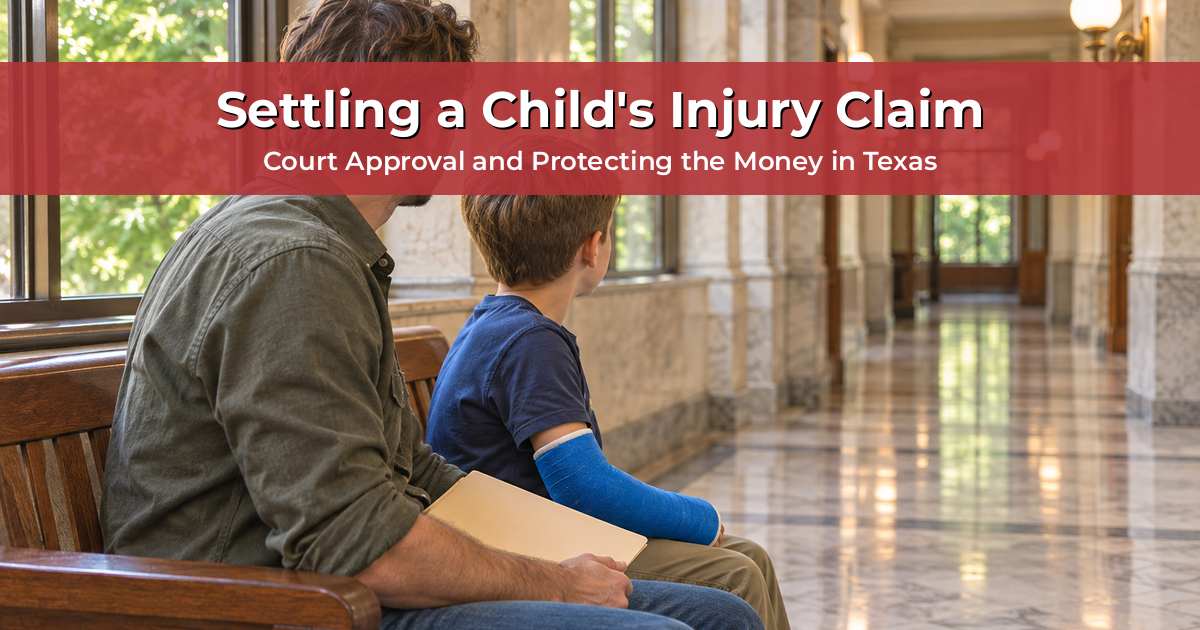
Father and young son with a blue arm cast waiting on a bench in a Texas courthouse hallway

Settling a Child's Injury Claim in Texas: Court Approval, Guardian Ad Litem, and Where the Money Goes

By Luke A. Williams · Personal Injury

Short answer: In Texas, a parent generally cannot simply sign a release and accept a check to settle a child's injury claim in a way that permanently binds the child. To make a settlement of a minor's claim final, the case is usually filed in court by a parent acting as "next friend," and the judge must approve the settlement after a hearing, often with a court-appointed guardian ad litem advising whether the deal is in the child's best interest. The child's share of the money is then protected until adulthood, often in the court registry, a court-created trust, or a structured settlement. Separately, the deadline for the child's own claim generally does not begin to run until the child turns 18, though waiting carries real risks.

Father and young son with a blue arm cast waiting on a bench in a Texas courthouse hallway

When a child is hurt in a car wreck, a dog attack, a fall, or another accident in Dallas-Fort Worth, parents often hear from an insurance company about settling quickly. Many are surprised to learn that a child's settlement follows special rules designed to protect the child, and that a release signed only by a parent may not end the child's claim.

At Howard Lotspeich Alexander & Williams, PLLC (HLAW), our Fort Worth child injury lawyers help families in Tarrant, Dallas, Denton, Collin, Johnson, and Parker counties through the full process, from the claim to court approval. This guide explains how minor settlements work in Texas, who protects the child's interests, and where the money goes.

Key Takeaways

  • Court approval makes a minor's settlement binding. Under Texas Rule of Civil Procedure 44, a next friend "may with the approval of the court compromise suits," and approved compromises "shall be forever binding and conclusive" on the child (Tex. R. Civ. P. 44).
  • A hearing and evidence are required. Courts have held that a judgment approving a minor's settlement "cannot be rendered without a hearing and evidence that the settlement serves the minor's best interest" (Byrd v. Woodruff, as quoted by a federal court).
  • A guardian ad litem often reviews the deal. When a settlement is proposed, a guardian ad litem has "the limited duty to determine and advise the court whether the settlement is in the party's best interest" (Tex. R. Civ. P. 173.4(c)).
  • The money is protected until adulthood. Texas Property Code Chapter 142 allows a child's funds to be invested through the court clerk, placed in a court-created trust, or paid through a structured settlement (Tex. Prop. Code ch. 142).
  • Smaller, uncontested amounts can go to the court registry. Texas Estates Code Chapter 1355 allows payment into the court registry, without a guardianship, of $250,000 or less owed to a minor when the right to the money is liquidated and uncontested (Tex. Est. Code ch. 1355).
  • The child's own deadline is generally paused until 18. A person younger than 18 is under a "legal disability," and "the time of the disability is not included in a limitations period" (Tex. Civ. Prac. & Rem. Code §16.001).

Why Do Child Injury Settlements Need Court Approval in Texas?

A minor cannot sign a binding contract to release a legal claim, and Texas law does not give parents unlimited power to give away a child's claim. Rule 44 of the Texas Rules of Civil Procedure provides that minors without a legal guardian "may sue and be represented by 'next friend,'" and that the next friend or the next friend's attorney "may with the approval of the court compromise suits and agree to judgments." When a court approves the compromise, it "shall be forever binding and conclusive upon the party plaintiff in such suit" (Tex. R. Civ. P. 44).

That court approval is what gives the person paying the settlement, usually an insurance company, the finality it wants, and it is also what protects the child. Without it, a release signed only by a parent may not prevent the child from bringing the claim later. For that reason, insurers and their lawyers commonly insist on court approval before paying a significant settlement of a child's claim.

How Does the Minor Settlement Process Work?

The process often goes like this:

  1. The claim is investigated and negotiated. As with any injury claim, the child's medical treatment, prognosis, and damages are documented, and the lawyer negotiates with the insurer. Our guide on what your personal injury case may be worth explains the factors involved. Mediation is common; see our guide to mediation in personal injury cases.
  2. A lawsuit is filed, often as a "friendly suit." If the case settles before a lawsuit is filed, the parties commonly file a suit so the court can approve the agreement. The parent sues as next friend of the child.
  3. The court may appoint a guardian ad litem. If the next friend appears to have an interest adverse to the child, such as when a parent and child are both receiving money from the same limited insurance policy, the court must appoint a guardian ad litem under Rule 173.2, and courts frequently do so in minor settlements.
  4. The guardian ad litem reviews the settlement. The ad litem evaluates the injuries, the settlement amount, how the money is divided, and how the child's share will be managed, and then reports to the court.
  5. The court holds a hearing. Often called a "prove-up" or "minor settlement hearing," the judge hears testimony, usually from the parent and the guardian ad litem, about the settlement and whether it is fair to the child.
  6. The court signs a judgment. The judgment approves the settlement, allocates the funds, approves attorney's fees and expenses, and orders how the child's share will be held until adulthood.

Many DFW minor settlement hearings are short, but the paperwork behind them is detailed, and the judge must be satisfied that the child is protected.

What Does a Guardian Ad Litem Do in a Child's Settlement?

A guardian ad litem is a person, usually a lawyer, appointed by the court to protect the child's interests in specific situations. Under Rule 173, a guardian ad litem serves as an officer and advisor to the court. When an offer has been made to settle the claim of a child represented by a next friend, the ad litem "has the limited duty to determine and advise the court whether the settlement is in the party's best interest" (Tex. R. Civ. P. 173).

According to the Corpus Christi-Edinburg Court of Appeals, the ad litem's duty includes "evaluating the damages suffered by the minor, the adequacy of the settlement, the proposed apportionment and manner of distribution of the settlement proceeds, and the amount of attorney's fees charged by the plaintiff's attorney" (Tex. App. Corpus Christi 2021).

Who pays the guardian ad litem?

Rule 173.6 allows a guardian ad litem to be reimbursed for reasonable expenses and "paid a reasonable hourly fee for necessary services performed." The court "must not consider compensation as a percentage of any judgment or settlement," and it "may tax a guardian ad litem's compensation as costs of court." In practice, the settlement agreement often addresses which party pays the ad litem's fee. Texas appellate courts have stressed that the ad litem's role is limited (Columbia Rio Grande Healthcare v. De Leon).

Where Does a Child's Settlement Money Go?

Texas law provides several ways to protect a child's money until adulthood. The court decides which option fits the case.

Option Legal source How it works Often used for
Court registry (Estates Code) Tex. Est. Code ch. 1355 Money is paid to the county clerk and invested for the child; it can generally be withdrawn when the child's disability ends Uncontested amounts of $250,000 or less
Court-ordered investment Tex. Prop. Code §142.004 Funds invested by the clerk on court order, or by the next friend in restricted accounts, including certain college savings plans, prepaid tuition programs, and ABLE accounts Many small and mid-size settlements
Section 142 trust Tex. Prop. Code §142.005 A court-created trust managed by a trustee, usually a financial institution, for the child's health, education, support, or maintenance Larger settlements or children with ongoing needs
Structured settlement Tex. Prop. Code §142.008 Periodic payments funded by a qualifying annuity or U.S. government obligation Long-term income planning
Guardianship of the estate Texas Estates Code A court-appointed guardian manages the funds under court supervision Situations where other options do not fit

The 142 trust in more detail

A trust under Property Code §142.005 must name the child as "the sole beneficiary of the trust." The trustee may make distributions it finds "reasonably necessary for the health, education, support, or maintenance of the beneficiary." For a minor who is not considered disabled for Supplemental Security Income purposes, the trust ends at the child's death, at an age stated in the trust, or "on the 25th birthday of the beneficiary, whichever occurs first." If the child is disabled under those federal rules, the trust ends at the child's death. Where the trust principal is more than $50,000, the court may appoint someone other than a financial institution as trustee only if no financial institution is willing to serve and the appointment is in the child's best interest (Tex. Prop. Code §142.005).

If your child receives or may need government benefits such as Medicaid or SSI, the way the money is held can matter. The statute allows the court to modify trust terms when necessary for the child to remain eligible for public benefits. Our article on how a personal injury settlement can affect government benefits explains these concerns.

Can parents use the settlement money?

Generally, the child's share belongs to the child, not the parents, and the court controls how it is used before the child reaches adulthood. A 142 trust can allow distributions for the child's health, education, support, or maintenance. Parents should not expect to use a child's funds for general household expenses.

How Are Medical Bills and Liens Handled?

A child's settlement often must account for medical bills and liens before the remaining funds are protected. Hospitals may file liens under Texas law, and health insurers or Medicaid may have reimbursement rights. These amounts are usually resolved as part of the settlement and disclosed to the court at the hearing. Our guide on hospital liens and your DFW injury settlement explains how liens work.

Parents may also have their own claims arising from the child's injury, such as for medical expenses they paid, and those claims can have different deadlines than the child's claim. A lawyer can help identify each claim and how it should be handled in the settlement.

How Long Do You Have to File a Claim for a Child's Injury in Texas?

Most Texas personal injury claims must be filed within two years under Civil Practice and Remedies Code §16.003. For minors, §16.001 provides that a person "younger than 18 years of age" is under a legal disability, and "the time of the disability is not included in a limitations period" (Tex. Civ. Prac. & Rem. Code §16.001). In general, that means the two-year period for the child's own claim does not begin to run until the child turns 18.

There are important cautions:

  • Some claims have different rules. Health care liability claims and claims against governmental entities can have their own deadlines and notice requirements, sometimes much shorter.
  • Parents' claims may not be paused. Claims belonging to the parents may be subject to the normal two-year deadline.
  • Evidence fades. Witnesses move, video is erased, and records become harder to obtain.

See our guide to time limits for personal injury claims in Texas for more.

Frequently Asked Questions

Can I just sign the insurance company's release for my child?

You should be cautious. Under Rule 44, a compromise of a minor's suit becomes "forever binding and conclusive" on the child when approved by the court. Without court approval, a parent-signed release may not bind the child, and signing it could affect your own claims. Talk with a lawyer before signing.

Does every child settlement need a lawsuit and a hearing?

Not always, but court approval is the standard way to make the settlement binding on the child, and insurers commonly require it for significant settlements. Smaller, uncontested payments to minors can sometimes be deposited in the court registry under Estates Code Chapter 1355.

Will my child have to testify at the settlement hearing?

Often not. The parent and the guardian ad litem usually provide the testimony. Some judges may want to see or hear from an older child, and practices vary by court.

When can my child get the money?

That depends on how the funds are held. Money in the court registry is generally available when the child turns 18. A 142 trust may continue until an age set in the trust, up to the child's 25th birthday for a child who is not disabled under federal SSI rules. Structured settlements pay on the schedule approved by the court.

How are attorney's fees handled in a child's settlement?

The court reviews and approves attorney's fees and expenses as part of the settlement, and a guardian ad litem may evaluate them. The fees must be disclosed and approved before the settlement is final.

What if both a parent and a child were hurt in the same crash?

When a parent and child share limited insurance coverage, their interests may conflict over how the money is divided. Rule 173 requires the court to appoint a guardian ad litem if the next friend appears to have an interest adverse to the child.

Talk to a Fort Worth Child Injury Lawyer

A child's injury claim involves more than negotiating a number. It requires careful documentation, court approval, and a plan to protect the money for your child's future. Our firm can help you understand each step.

Call HLAW at (817) 993-9249 or contact us online for a free consultation about a child's injury in Dallas-Fort Worth.

This article is for general informational purposes only and is not legal advice. Reading it does not create an attorney-client relationship. Laws change, and every case depends on its specific facts.
Read full article
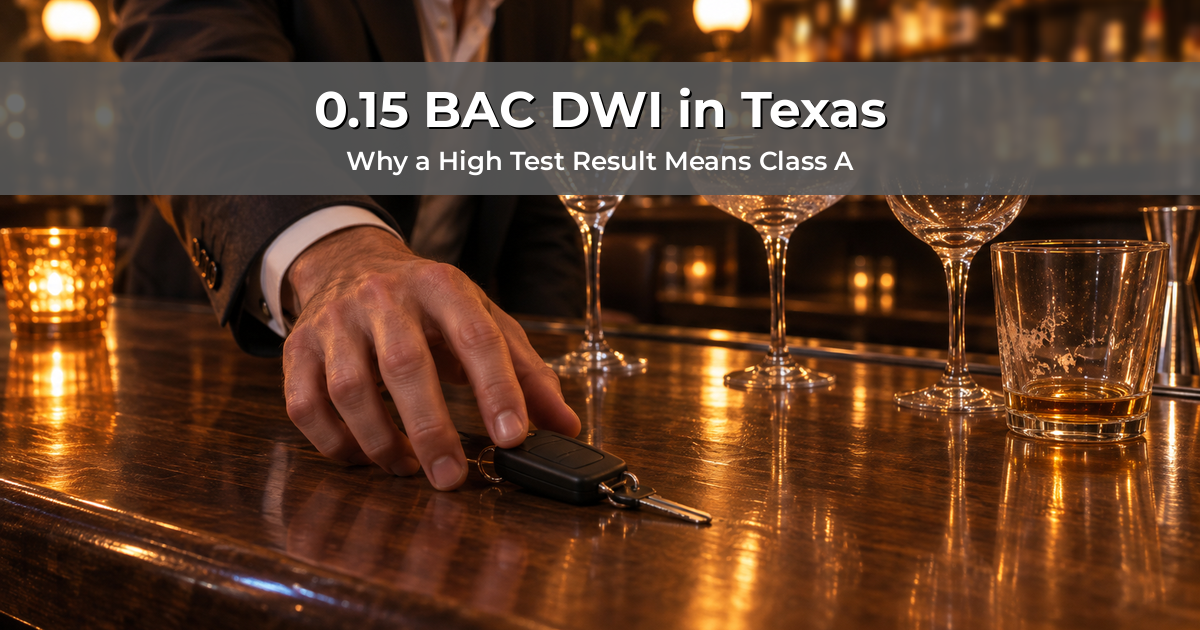
Man reaching for car keys on a bar counter beside several empty cocktail glasses late at night

0.15 BAC DWI in Texas: Why a High Test Result Makes It a Class A Misdemeanor

By Luke A. Williams · DWI

Short answer: In Texas, a first DWI is normally a Class B misdemeanor, but it becomes a Class A misdemeanor if an analysis of your blood, breath, or urine showed an alcohol concentration of 0.15 or more at the time the test was performed. That raises the maximum punishment to one year in jail and a $4,000 fine, requires an ignition interlock if you are placed on probation, rules out deferred adjudication, and, with limited exceptions, doubles the state DWI fine to $6,000. Because the 0.15 level is an element of the offense, the State must prove it beyond a reasonable doubt, and the reliability of the test result is often the central issue in the case.

Man reaching for car keys on a bar counter beside several empty cocktail glasses late at night

Many people arrested for DWI in Dallas-Fort Worth are surprised to see "Class A" on their paperwork. In most cases, the reason is a breath or blood test result of 0.15 or higher. This charge is sometimes called a "high BAC" or "aggravated" DWI, and it carries consequences that go well beyond a standard first offense.

At Howard Lotspeich Alexander & Williams, PLLC (HLAW), our Fort Worth DWI attorneys defend DWI charges in Tarrant, Dallas, Denton, Collin, Johnson, and Parker counties. This guide explains how Texas law treats a 0.15 BAC, what changes compared with a standard DWI, and the defense issues that come up most often.

Key Takeaways

  • 0.15 or more makes a first DWI a Class A misdemeanor. Texas Penal Code §49.04(d) applies when "an analysis of a specimen of the person's blood, breath, or urine showed an alcohol concentration level of 0.15 or more at the time the analysis was performed" (Tex. Penal Code §49.04).
  • The punishment range increases. A Class A misdemeanor carries up to one year in jail and a fine of up to $4,000, compared with up to 180 days and $2,000 for a Class B (Tex. Penal Code ch. 12).
  • Deferred adjudication is not available. Texas allows deferred adjudication for many first DWIs, but not when "the defendant's alcohol concentration... was 0.15 or more" (Tex. Code Crim. Proc. art. 42A.102).
  • An ignition interlock is mandatory on probation. If you are placed on community supervision after a 0.15 finding, the court "shall require" an ignition interlock device (Tex. Code Crim. Proc. art. 42A.408).
  • The state DWI fine doubles. The additional state fine after a conviction is generally $3,000 for a first conviction within 36 months, but $6,000 if the test showed 0.15 or more (Tex. Transp. Code §709.001).
  • Nondisclosure is off the table. The DWI nondisclosure statutes for people convicted of DWI exclude offenses punishable under §49.04(d) (Tex. Gov't Code §§411.0731, 411.0736).
  • The 0.15 level is an element the State must prove. Courts have held it is part of a separate offense, not just a punishment enhancement, and must be proved at the guilt stage of trial (Navarro v. State, Tex. App. Houston 2015).

What Is a 0.15 BAC DWI in Texas?

Texas defines "intoxicated" two ways: not having the normal use of mental or physical faculties because of alcohol or another substance, or "having an alcohol concentration of 0.08 or more" (Tex. Penal Code §49.01). A first DWI is a Class B misdemeanor with a minimum term of confinement of 72 hours under §49.04(b).

Section 49.04(d) creates a higher level. If the State shows that a test "showed an alcohol concentration level of 0.15 or more at the time the analysis was performed," the offense is a Class A misdemeanor.

Two features of that language matter:

  1. It measures the test, not the driving. The statute looks at the result "at the time the analysis was performed." That differs from the 0.08 per se definition, which concerns alcohol concentration at the time of driving.
  2. It requires an actual analysis. The 0.15 level must be shown by a chemical analysis of blood, breath, or urine. Observations of impairment alone cannot establish a Class A charge under §49.04(d).

If you were arrested with a result between 0.08 and 0.15, see our guide on being arrested for DWI under 0.08 BAC in Texas for related issues.

How Is a 0.15 DWI Different From a Standard First DWI?

Issue Standard first DWI (Class B) DWI with 0.15 or more (Class A)
Jail range 72 hours minimum, up to 180 days Up to 1 year
Maximum fine $2,000 $4,000
Deferred adjudication Available in many cases Not available
Ignition interlock on probation Discretionary for a first offense Mandatory
State DWI fine after conviction Generally $3,000 (first within 36 months) Generally $6,000
DWI nondisclosure after conviction Possible after waiting period Not available under §§411.0731 and 411.0736

Sources: Tex. Penal Code §49.04; Tex. Penal Code ch. 12; Tex. Code Crim. Proc. ch. 42A; Tex. Transp. Code §709.001; Tex. Gov't Code ch. 411.

What Are the Penalties for a 0.15 DWI in Texas?

Jail and fines

As a Class A misdemeanor, a first DWI with 0.15 or more is punishable by a fine of up to $4,000, confinement in jail for up to one year, or both (Tex. Penal Code §12.21). Many first-time cases are resolved with community supervision (probation), but the conditions are often stricter.

Mandatory ignition interlock

Under article 42A.408(c), when "an analysis of a specimen of the defendant's blood, breath, or urine showed an alcohol concentration level of 0.15 or more," the court must require an ignition interlock device on the vehicle you own or most regularly drive as a condition of community supervision (Tex. Code Crim. Proc. art. 42A.408). Our article on the ignition interlock breath testing device explains how these devices work.

The $6,000 state fine

Separate from the fine in the judgment, Transportation Code §709.001 imposes an additional fine on people "finally convicted" of a DWI-related offense. The amount is $6,000 "if it is shown on the trial of the offense that an analysis of a specimen of the person's blood, breath, or urine showed an alcohol concentration level of 0.15 or more" (Tex. Transp. Code §709.001). The statute contains exceptions, including for indigent defendants. For a broader look at expenses, see our guide to the real costs of a DWI in Texas.

No deferred adjudication

Texas allows deferred adjudication for many first DWI cases, which can avoid a final conviction. But article 42A.102(b)(1)(B) excludes cases in which, at the time of the offense, the defendant held a commercial driver's license or the defendant's "alcohol concentration... was 0.15 or more" (Tex. Code Crim. Proc. art. 42A.102). Our guide to DWI deferred adjudication in Texas explains how deferred works when it is available.

Record sealing limits

Texas allows nondisclosure (sealing) for some first-time DWI convictions after a waiting period. Sections 411.0731 and 411.0736 of the Government Code, however, apply only to a DWI "other than an offense punishable under Subsection (d)" of §49.04 (Tex. Gov't Code ch. 411). That makes the difference between a Class A and a Class B conviction especially important for your long-term record. Learn more in our article on DWI record sealing in Texas.

Driver's license consequences

A DWI arrest with a breath or blood test result of 0.08 or more also usually triggers an administrative license suspension through DPS, which is separate from the criminal case. You generally have only 15 days after notice to request a hearing; see our guide to the ALR hearing deadline.

Does the State Have to Prove the 0.15 Result at Trial?

Yes. In Navarro v. State, the Houston Fourteenth Court of Appeals held that a person's alcohol concentration level under §49.04(d) "is not a basis for enhancement" but "is instead an element of a separate offense," reasoning that it targets operating a motor vehicle with an especially high concentration of alcohol in the body (Navarro v. State). The Corpus Christi Court of Appeals agreed in Castellanos v. State, holding that subsection (d) "describes an element of a class A misdemeanor DWI, which the State has the burden to prove at the guilt/innocence stage" (Castellanos v. State).

Practically, this means:

  • The charging document must allege the 0.15 element for a Class A charge.
  • The jury decides, beyond a reasonable doubt, whether the test showed 0.15 or more.
  • If the jury is not convinced on the 0.15 element, the case may result in a Class B conviction on the lesser offense, or an acquittal, depending on the evidence.

What Defenses Apply to a 0.15 DWI Charge?

Every case depends on its facts, but these issues often matter.

Whether the stop and arrest were lawful

If the officer lacked reasonable suspicion for the stop or probable cause for the arrest, evidence including the test result may be suppressed. Our article on refusing field sobriety tests discusses how roadside evidence is used.

Whether the blood draw was lawful

Blood is often drawn under a search warrant, especially on "no-refusal" weekends. Problems with the warrant affidavit or a warrantless draw can lead to suppression. The Fort Worth Court of Appeals has addressed these issues; see our discussion of a warrantless DWI blood draw held unconstitutional by a Fort Worth court.

Whether the test measured "blood" correctly

In Navarro, the court also held that "blood" in the statute means whole blood. A hospital result measured only from plasma or serum was not enough by itself to prove the 0.15 element (TDCAA case summary of Navarro). This can matter when the only test came from a hospital after a crash.

Whether the result is reliable

Breath tests depend on proper instrument maintenance, operator certification, and a required observation period. Blood tests depend on collection, storage, chain of custody, and laboratory procedures. A result close to 0.15 also raises questions about the measurement uncertainty of the test.

Rising blood alcohol and retrograde extrapolation

Because §49.04(d) measures the result "at the time the analysis was performed," the State does not need to extrapolate back to the time of driving to prove the 0.15 element itself. But a result taken long after driving can still matter to whether you were intoxicated while driving. The Court of Criminal Appeals in Mata v. State held that retrograde extrapolation "can be reliable in a given case," but that courts should consider the time between driving and the test, the number of tests, and what the expert knew about the person (Mata v. State, Tex. Crim. App. 2001).

What Should You Do After a 0.15 DWI Arrest in DFW?

  1. Request the ALR hearing within 15 days of receiving the notice of suspension.
  2. Write down a timeline while it is fresh: when you last ate, what you drank and when, when you were stopped, and when the test happened.
  3. Keep all paperwork, including the bond conditions, which may already require an interlock device.
  4. Avoid discussing the case with anyone other than your lawyer, including on social media.
  5. Ask a lawyer to request the test records, including breath instrument maintenance logs or blood lab data, and video from the stop and the jail.
  6. Do not assume a Class A charge cannot change. Whether the State can prove the 0.15 element is often a central question.

Frequently Asked Questions

Is a 0.15 DWI a felony in Texas?

No. A first DWI with a test result of 0.15 or more is a Class A misdemeanor. DWI becomes a felony in other situations, such as a third offense, a child passenger under 15, or causing serious bodily injury. See our guide on third DWI felony charges in Texas.

Can I get deferred adjudication for a 0.15 DWI?

Generally no. Article 42A.102 excludes DWI cases in which the defendant's alcohol concentration was 0.15 or more at the time of the offense, as well as cases involving a commercial driver's license or learner's permit holder.

Will I have to install an ignition interlock?

If you are placed on community supervision after a 0.15 finding, Texas law requires the court to order an ignition interlock device. Courts also frequently order interlocks as a bond condition while the case is pending.

Can a Class A DWI be reduced to a Class B?

It can happen. Whether a reduction is possible depends on the evidence, including the reliability of the test result, and the policies of the prosecutor's office. A reduction can affect deferred adjudication, the state fine, and nondisclosure eligibility.

Does refusing a breath test avoid a 0.15 charge?

Refusing a breath test means there may be no immediate result, but officers in DFW frequently seek a search warrant for blood, and refusal carries its own license suspension. If a blood test shows 0.15 or more, the Class A charge can still apply. See our article on no-refusal DWI in Texas.

Can a 0.15 DWI conviction be sealed?

Not under the DWI nondisclosure statutes that apply to convictions, which exclude offenses punishable under §49.04(d). This is one reason the Class A element is worth challenging carefully.

Talk to a Fort Worth DWI Lawyer

A 0.15 allegation changes almost every part of a DWI case, from probation conditions to fines and record sealing. Careful review of the test, the stop, and the timeline can make a meaningful difference.

Call HLAW at (817) 993-9249 or contact us online for a free consultation about your Dallas-Fort Worth DWI case.

This article is for general informational purposes only and is not legal advice. Reading it does not create an attorney-client relationship. Laws change, and every case depends on its specific facts.

Read full article
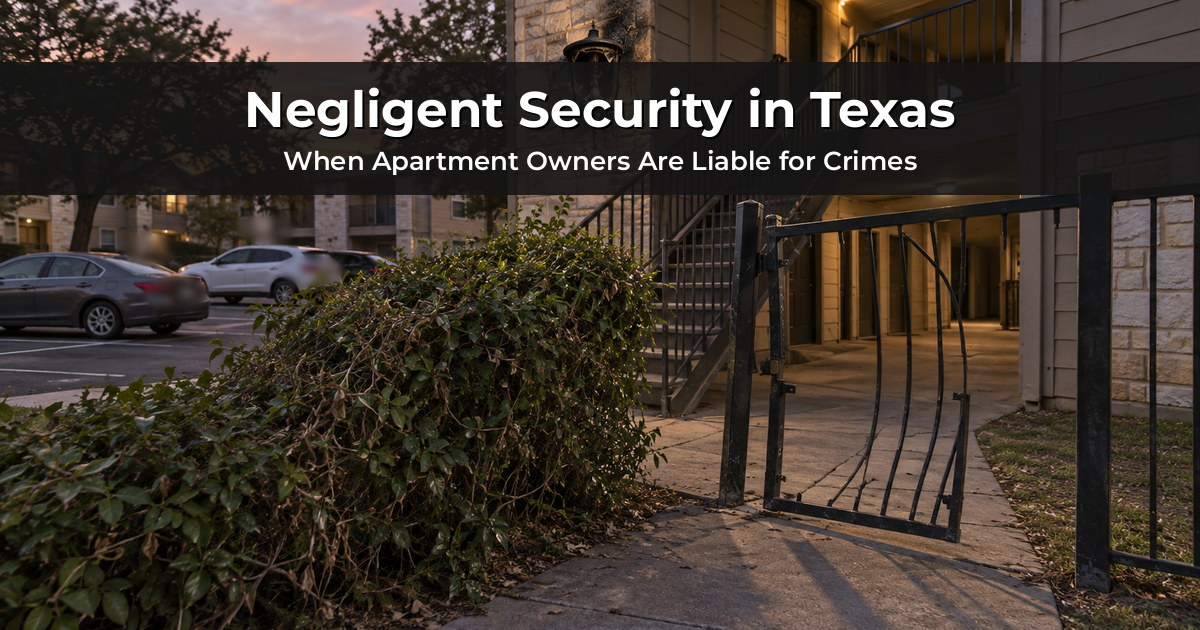
Apartment complex walkway at dusk with a broken pedestrian gate, overgrown hedge, and dim stairwell lighting

Assaulted at a DFW Apartment Complex? When Texas Landlords Are Liable for Negligent Security

By Luke A. Williams · Personal Injury

Short answer: In Texas, an apartment owner can be held liable when a tenant or guest is assaulted, robbed, or otherwise hurt by a criminal on the property, but only in limited situations. Generally, the owner must have known or had reason to know of an unreasonable and foreseeable risk of that kind of crime, usually shown by similar prior crimes on or near the property, and must have failed to take reasonable steps to reduce it. Separately, the Texas Property Code requires landlords to provide specific locks and security devices and to rekey units between tenants. These claims are generally subject to a two-year deadline to file suit.

Apartment complex walkway at dusk with a broken pedestrian gate, overgrown hedge, and dim stairwell lighting

Being attacked where you live is frightening, and it is natural to ask whether the property should have done more. Broken gates, dark parking lots, missing deadbolts, and repeated break-ins that management ignored can all be part of a negligent security claim. Texas law, however, sets demanding rules for these cases, and the details matter.

At Howard Lotspeich Alexander & Williams, PLLC (HLAW), our Fort Worth personal injury lawyers represent injured people and families throughout Tarrant, Dallas, Denton, Collin, Johnson, and Parker counties. This guide explains how negligent security claims work in Texas, what the Texas Supreme Court requires, and what evidence tends to matter most.

Key Takeaways

  • The general rule favors property owners. The Texas Supreme Court has said that "generally, a premises owner has no duty to protect invitees from criminal acts by third parties," with an exception when the owner "knows or has reason to know of a risk of harm to invitees that is unreasonable and foreseeable" (Del Lago Partners v. Smith, Tex. 2010).
  • Prior crimes usually drive foreseeability. Courts weigh five Timberwalk factors: proximity, recency, frequency, similarity, and publicity of prior crimes (Timberwalk Apartments v. Cain, Tex. 1998).
  • Foreseeable is not enough by itself. In a 2017 case involving a shooting in an apartment visitor lot, the Texas Supreme Court held that a risk must be "both foreseeable and unreasonable," which also weighs the burden of preventing it (UDR Texas Properties v. Petrie).
  • Texas law requires specific security devices. Without a tenant having to ask, a rental dwelling must have window latches, a doorknob lock or keyed dead bolt, sliding door pin locks and bars or handle latches, and a keyless bolting device and door viewer on each exterior door (Tex. Prop. Code §92.153).
  • Locks must be rekeyed between tenants. Landlords must rekey key, card, or combination devices within seven days after each tenant turnover (Tex. Prop. Code §92.156).
  • The criminal's share of fault counts. A defendant can ask the jury to assign responsibility to the attacker, even an unknown "John Doe," which can reduce what the property owner pays (Tex. Civ. Prac. & Rem. Code ch. 33).
  • Two years is the usual deadline. Personal injury suits generally must be filed "not later than two years after the day the cause of action accrues" (Tex. Civ. Prac. & Rem. Code §16.003).

What Is a Negligent Security Claim in Texas?

A negligent security claim is a type of premises liability case. The injured person argues that the owner or manager of a property failed to use reasonable care to protect people on the property from a foreseeable crime, and that this failure was a cause of the injury.

These claims often arise from:

  • Assaults or robberies in apartment parking lots, breezeways, stairwells, and laundry rooms
  • Break-ins and home invasions where locks were missing, broken, or never rekeyed
  • Attacks through broken or propped-open access gates
  • Shootings or assaults at complexes with a known history of similar violence
  • Assaults in hotels, parking garages, bars, and retail centers

The person who committed the crime is always responsible for it. A negligent security claim asks a different question: whether the property owner also carries part of the responsibility because it ignored a risk it knew about or should have known about.

When Is a Texas Apartment Owner Responsible for a Crime on the Property?

Texas courts start from the rule that a property owner is generally not responsible for the criminal acts of others. Liability turns on whether the owner owed a legal duty in the situation, and that depends heavily on foreseeability.

The Timberwalk foreseeability factors

In Timberwalk Apartments, Partners, Inc. v. Cain, a Texas Supreme Court case involving the sexual assault of an apartment tenant, the court explained that "foreseeability of an unreasonable risk of criminal conduct is a prerequisite to imposing a duty of care" on someone who owns or controls premises (Timberwalk). Courts consider "whether any criminal conduct previously occurred on or near the property, how recently it occurred, how often it occurred, how similar the conduct was to the conduct on the property, and what publicity was given the occurrences."

Factor What courts look at Examples of helpful evidence
Proximity Crimes on the property or in its immediate vicinity Police reports for the complex address and adjacent properties
Recency How recently prior crimes happened Incidents in the months before the attack
Frequency How often crimes occurred A pattern of repeated incidents in a short period
Similarity Whether prior crimes put the owner on notice of the specific danger Prior assaults, robberies, or break-ins, not just minor property crimes
Publicity Whether the owner knew or should have known Tenant complaints, incident reports, emails to management, news coverage

The court added that these factors "must be considered together." It also explained that prior crimes do not need to be identical: a string of assaults and robberies can make other violent crimes foreseeable, while unreported crimes that no one knew about are not evidence of foreseeability. Courts have also said that property owners have no duty to regularly check criminal records for their area, though widely publicized crimes can show knowledge (Jai Jalaram v. LeRibeus, Tex. App. 2006).

The risk must also be unreasonable

In UDR Texas Properties v. Petrie (2017), a visitor was robbed and shot in the knee in the public visitor parking lot of a Texas apartment complex. The Texas Supreme Court reversed a judgment for the visitor and explained: "We have consistently said that a risk must be both foreseeable and unreasonable to impose a duty on a property owner" (UDR Texas Properties v. Petrie). Because the visitor offered no evidence about the burden of preventing or reducing the risk, the court rendered judgment for the complex.

The practical lesson is that a strong case needs two kinds of proof: evidence that the crime was foreseeable, and evidence that reasonable, available steps (such as repairing a gate, fixing lighting, or responding to repeated reports) could have reduced the risk.

When danger is imminent

Foreseeability can also come from what is happening in the moment. In Del Lago Partners v. Smith, the court upheld a verdict against a resort bar that "had actual and direct knowledge that a violent brawl was imminent between drunk, belligerent patrons and had ample time and means to defuse the situation" (Del Lago). The court stressed that the duty "arose not because of prior similar criminal conduct but because it was aware of an unreasonable risk of harm at the bar that very night," and that it was not announcing a general rule.

What Security Devices Must Texas Landlords Provide?

Separate from the general negligence rules, Subchapter D of Chapter 92 of the Texas Property Code sets specific security device requirements for residential rentals (Tex. Prop. Code ch. 92).

Under §92.153, unless an exception applies, and without a tenant having to ask, a dwelling must have:

  1. A window latch on each exterior window
  2. A doorknob lock or keyed dead bolt on each exterior door
  3. A sliding door pin lock on each exterior sliding glass door
  4. A sliding door handle latch or security bar on each exterior sliding glass door
  5. A keyless bolting device and a door viewer on each exterior door

Other key rules include:

  • Rekeying: Under §92.156(a), security devices operated by a key, card, or combination must be rekeyed at the landlord's expense "not later than the seventh day after each tenant turnover date."
  • Repairs: Under §92.158, a landlord must repair or replace a security device on request or notice that it is inoperable.
  • Timing: Under §92.161, repair and rekeying requests are presumed due within seven days, but within 72 hours if the tenant told the landlord about an unauthorized entry in the unit, an attempted or actual entry in another unit in the past two months, or a crime of personal violence at the complex in the past two months.

If a landlord does not comply with §92.153 or §92.156(a), §92.164 lets a tenant seek remedies including actual damages. The statute's attorney's fee provisions do not apply in suits for personal injuries or wrongful death. In practice, a missing or broken required lock is often powerful evidence in a broader negligence claim, especially when the tenant reported it in writing.

How Does the Attacker's Fault Affect the Claim?

Texas uses proportionate responsibility. Under Chapter 33 of the Civil Practice and Remedies Code, the jury assigns a percentage of responsibility to each claimant, defendant, settling person, and designated "responsible third party" (Tex. Civ. Prac. & Rem. Code §33.003).

That matters in negligent security cases because:

  • The attacker can be on the verdict form. Even if the attacker was never identified, §33.004(j) allows a defendant to designate an unknown person as a responsible third party if it timely pleads facts showing a reasonable probability that the person's act was criminal.
  • A defendant generally pays only its own share. Under §33.013(a), a liable defendant is generally responsible for its own percentage, unless its share is greater than 50 percent, in which case it is jointly and severally liable under §33.013(b)(1).
  • The injured person's own fault can reduce or bar recovery. Under §33.001, a claimant cannot recover if his or her percentage of responsibility is greater than 50 percent. Our guide to how fault works in Texas personal injury cases explains these rules in more detail.

What Evidence Matters in a DFW Negligent Security Case?

Because these cases turn on what the owner knew before the attack, evidence often disappears quickly. Useful evidence can include:

  • Police call and incident records for the complex and nearby properties, often obtained through public information requests to the local police department
  • Management records such as incident reports, tenant complaints, work orders for gates, lights, and locks, and emails or portal messages
  • Your lease and any lease addenda, including security device and crime-related notices
  • Photos and video of broken gates, burned-out lights, damaged locks, or overgrown landscaping, taken as soon as possible
  • Surveillance video, which many properties record over within days or weeks
  • Security contracts and patrol logs, if the property used a guard or courtesy officer service
  • Witness information from neighbors who reported prior problems

A prompt written request to preserve video and records can be important. Insurance carriers for apartment owners often investigate quickly; our article on insurance adjuster tactics in Fort Worth explains what to watch for.

What Should You Do After Being Assaulted at an Apartment Complex?

  1. Get to safety and call 911. A police report documents the crime and its location.
  2. Get medical care right away, and keep records of every visit. Injuries such as head trauma and emotional harm may not be fully apparent at first.
  3. Report the incident to management in writing and keep a copy.
  4. Photograph the scene, including gates, lighting, locks, and doors, before repairs are made.
  5. Write down what you remember and the names of anyone who saw what happened or reported earlier problems.
  6. Avoid giving recorded statements to the property's insurer before getting legal advice, and be careful about what you post on social media.
  7. Talk with a lawyer early, so evidence can be requested before it is lost and the two-year filing deadline is protected.

If a loved one was killed in a crime at a property, the family may have a wrongful death claim. See our wrongful death practice page.

Frequently Asked Questions

Can I sue my apartment complex if I was robbed in the parking lot?

Possibly. You would generally need to show that the complex knew or should have known of an unreasonable and foreseeable risk of that kind of crime, often through similar prior crimes on or near the property, and that it failed to take reasonable steps that would have reduced the risk. Each case depends on its facts.

Does a single prior crime make an attack foreseeable?

Usually not by itself. The Texas Supreme Court has said that "the complete absence of previous crimes, or the occurrence of a few crimes over an extended time period, negates the foreseeability element," while a significant number of crimes in a short time strengthens it (Timberwalk). The more similar the prior crimes, the fewer may be needed.

Is a broken gate or burned-out light enough to win a case?

Not on its own. A broken gate or dark area can be important evidence that reasonable precautions were not taken, but Texas courts also require proof that the crime was foreseeable and that the risk was unreasonable. Written reports to management about the problem can strengthen the claim.

Can guests and visitors bring negligent security claims?

Yes, guests and other invitees can bring these claims. The visitor in Petrie was in a complex's visitor lot. The same foreseeability and unreasonableness rules apply.

Does it matter that the attacker was never caught?

A claim can proceed even if the attacker is unknown. The defendant may ask to designate the unknown person as a responsible third party under §33.004(j), and the jury may then assign that person a percentage of responsibility.

How long do I have to file a negligent security lawsuit in Texas?

Generally two years from the date of the injury under §16.003. Exceptions can apply, such as for minors, so it is best to get advice promptly.

Do these rules apply to hotels, bars, and stores too?

Yes. The Timberwalk foreseeability factors are applied to many kinds of commercial property, and Del Lago involved a resort bar. Our article on parking lot and sidewalk injuries in Texas covers other premises claims.

Talk to a Fort Worth Premises Liability Lawyer

Negligent security cases are fact-intensive and often hard-fought. Early investigation into prior crimes, complaints, and repairs can make a significant difference.

Call HLAW at (817) 993-9249 or contact us online for a free consultation about an injury at a Dallas-Fort Worth apartment complex or other property.

This article is for general informational purposes only and is not legal advice. Reading it does not create an attorney-client relationship. Laws change, and every case depends on its specific facts.

Read full article
Man on a city sidewalk holding his wallet while answering questions from a uniformed police officer

Do You Have to Give Police Your Name in Texas? Failure to Identify Under Penal Code 38.02

By Luke A. Williams · Criminal Defense

Short answer: In Texas, you generally do not have to give police your name if you are only being questioned or briefly detained as a pedestrian. Refusing to give your name, address, or date of birth becomes a crime under Penal Code §38.02(a) only after you have been lawfully arrested. Giving a false name, address, or date of birth is a separate and more serious offense if you have been lawfully arrested or detained, or if an officer believes you witnessed a crime. Drivers are different: a driver stopped for a traffic violation must show a license, and a driver who has no license to show and then refuses to give identifying information can be charged under a newer subsection, §38.02(b-1).

Man on a city sidewalk holding his wallet while answering questions from a uniformed police officer

"Failure to identify" is one of the most misunderstood charges in Texas. Many people believe they must always answer when an officer asks for their name. Others believe they never have to. The truth depends on whether you are being questioned, detained, or arrested, whether you are driving, and whether you tell the officer the truth.

At Howard Lotspeich Alexander & Williams, PLLC (HLAW), our Fort Worth criminal defense lawyers defend misdemeanor and felony charges in Tarrant, Dallas, Denton, Collin, Johnson, and Parker counties. This guide explains what Texas Penal Code §38.02 actually requires, how failure to identify is punished, and the defenses that often matter in these cases.

Key Takeaways

  • Refusing to identify is a crime only after a lawful arrest. Under §38.02(a), the offense requires a refusal to a peace officer "who has lawfully arrested the person and requested the information" (Tex. Penal Code §38.02).
  • Lying is broader than refusing. Under §38.02(b), giving a false or fictitious name, address, or date of birth is an offense if the officer has lawfully arrested you, lawfully detained you, or has good cause to believe you are a witness to a crime.
  • Drivers have extra duties. A driver must "display the license on the demand of a magistrate, court officer, or peace officer" (Tex. Transp. Code §521.025). Under §38.02(b-1), a lawfully detained driver who fails to show a license and intentionally refuses to give identifying information commits an offense.
  • Penalties range from a fine-only Class C to a Class A misdemeanor. Refusing is a Class C misdemeanor, punishable by a fine of up to $500. Giving false information is a Class B misdemeanor, punishable by up to 180 days in jail and a $2,000 fine. The level goes up if the person was a fugitive from justice (Tex. Penal Code ch. 12).
  • The stop itself must be lawful. In Brown v. Texas (1979), the U.S. Supreme Court reversed a conviction under an earlier version of §38.02 because El Paso officers "lacked any reasonable suspicion" when they stopped the defendant (Brown v. Texas).
  • The State must prove you knew it was a peace officer. The Texas Court of Criminal Appeals has held that the State must allege that the accused knew the person asking was a peace officer (Green v. State, Tex. Crim. App. 1997).

What Does Texas Penal Code §38.02 Say?

Section 38.02 creates three distinct offenses (Tex. Penal Code §38.02):

Offense What the State must show When it applies Usual level
Refusing to identify, §38.02(a) You intentionally refused to give your name, residence address, or date of birth Only after a lawful arrest and a request for the information Class C misdemeanor
Giving false identification, §38.02(b) You intentionally gave a false or fictitious name, residence address, or date of birth After a lawful arrest, during a lawful detention, or when the officer has good cause to believe you are a witness to a crime Class B misdemeanor
Driver refusing to identify, §38.02(b-1) A lawfully detained driver failed to provide or display a license and intentionally refused to give name, license number, residence address, or date of birth Traffic stops and other lawful detentions of a motor vehicle operator Class C misdemeanor (Class B if a false name was given)

The statute also says that giving an officer a residence address that is different from the one on your license is not a refusal under (b-1) "if the address given to the officer is the person's actual residence address."

Do You Have to Give Police Your Name in Texas?

It depends on what stage the encounter is in.

During a voluntary conversation

If an officer simply approaches and starts asking questions, and you are free to leave, Texas law does not make it a crime to decline to give your name. The U.S. Supreme Court has noted that "in the ordinary course a police officer is free to ask a person for identification without implicating the Fourth Amendment," but a request is not the same as a legal duty to answer (Hiibel v. Sixth Judicial District Court).

During a detention

If you are detained, meaning an officer has reasonable suspicion and you are not free to leave, Texas does not make a mere refusal to identify a crime for a pedestrian. Section 38.02(a) applies only after a lawful arrest. However, if you choose to answer and give a false name, address, or date of birth during a lawful detention, you can be charged under §38.02(b).

This is a key difference between Texas and some other states. In Hiibel (2004), the Supreme Court upheld a Nevada law that required a person detained on reasonable suspicion to state his name. Texas's current statute is narrower for pedestrians. It does not make refusing during a detention a crime, though it does punish lying.

After an arrest

Once you have been lawfully arrested and an officer asks for your name, residence address, or date of birth, an intentional refusal is an offense under §38.02(a). Courts have reversed convictions where the State could not prove the refusal happened after an arrest. In Curry v. State (Tex. App. Texarkana 2015), the court rendered an acquittal because "no evidence shows that Curry was under arrest at any time before he failed to identify" (Curry v. State).

What Are the Rules for Drivers at a Traffic Stop?

Drivers have duties that pedestrians and passengers do not. Under Transportation Code §521.025, a person required to hold a driver's license must have it while driving and must "display the license on the demand of a magistrate, court officer, or peace officer" (Tex. Transp. Code §521.025). Failing to do so is a separate misdemeanor punishable by a fine of up to $200 for a first offense.

Section 38.02(b-1) adds a failure-to-identify offense specific to drivers. It applies when a motor vehicle operator is lawfully detained for an alleged violation of law, fails to provide or display a license on request, and intentionally refuses to give his name, driver's license number, residence address, or date of birth. It is a Class C misdemeanor, raised to a Class B if the driver gave a false name (Tex. Penal Code §38.02).

Passengers are generally treated like pedestrians under §38.02. They are not required to identify themselves unless arrested, but they can be charged if they give false information while lawfully detained. Officers can also extend a traffic stop only in limited circumstances; see our guide to how long a Texas traffic stop can last.

What Are the Penalties for Failure to Identify in Texas?

Penalties under §38.02(c) and (d) depend on what happened and whether the person was a fugitive from justice (Tex. Penal Code §38.02; Tex. Penal Code ch. 12):

  • Refusing after arrest, or driver refusal under (b-1): Class C misdemeanor, a fine of up to $500.
  • Giving false information: Class B misdemeanor, up to 180 days in jail and a fine of up to $2,000.
  • Refusing after arrest while a fugitive from justice: Class B misdemeanor.
  • Giving false information while a fugitive from justice: Class A misdemeanor, up to one year in jail and a fine of up to $4,000.

"Fugitive from justice" situations often arise when a person has an outstanding warrant and gives a false name to avoid it. If you think you may have a warrant, our guide on what to do about an outstanding warrant in DFW explains safer options than avoiding officers.

A failure-to-identify charge often comes alongside other charges, such as evading arrest or resisting arrest. Even a Class C conviction creates a criminal record, so it is worth taking seriously.

What Defenses Apply to a Failure to Identify Charge?

Every case depends on its facts, but these issues come up frequently in DFW courts.

There was no lawful arrest or detention

The statute requires a "lawful" arrest or detention. If the officer had no reasonable suspicion for the stop, or no probable cause for the arrest, an essential element may be missing. Brown v. Texas arose from an El Paso stop where officers saw two men walking away from each other in an alley in a high-crime area. The Supreme Court held that "the fact that appellant was in a neighborhood frequented by drug users, standing alone, is not a basis for concluding that appellant himself was engaged in criminal conduct" (Brown v. Texas).

The refusal happened before the arrest

Under §38.02(a), timing matters. If the request and refusal happened during a detention but before an arrest, a refusal alone is not the offense. That was the basis for the acquittal in Curry.

The State cannot prove the person was arrested, detained, or a witness

For false identification under §38.02(b), the State must prove one of three circumstances. In Mikel v. State, a Denton County case, the Fort Worth Court of Appeals ordered an acquittal because, "without proof that Mikel was either lawfully arrested, lawfully detained, or a witness to a criminal offense, a rational jury could not have found beyond a reasonable doubt each element of the charged offense" (Mikel v. State, Tex. App. Fort Worth 2004).

The person did not know it was a peace officer

The Court of Criminal Appeals held in Green v. State that "in a prosecution under § 38.02, the State must allege that the person who refused to give identification or gave false identification knows the individual requesting the identification is a peace officer" (Green v. State). This can matter with plainclothes officers or chaotic scenes.

The information was not intentionally false

The offense requires intent. A misunderstanding, a nickname, a recent move, or a simple mistake about an address may not be an intentional false report. For drivers, (b-2) expressly protects a person who gives an actual residence address that differs from the address on the license.

What Should You Do if Police Ask for Your Name?

  1. Stay calm and polite. Do not physically resist, even if you believe the stop is unlawful. Our article on resisting an unlawful arrest in Texas explains why.
  2. Ask whether you are free to leave. The answer helps clarify whether you are in a voluntary encounter or a detention.
  3. If you are driving, show your license when asked.
  4. Never give a false name, address, or date of birth. Lying is the most common way people turn a simple encounter into a Class B or Class A charge.
  5. If you are arrested, give your name, address, and date of birth. Refusing after arrest is a separate offense. You can still decline to answer other questions and ask for a lawyer; see our guide to the pre-arrest right to remain silent.
  6. Write down what happened as soon as you can, including when the officer asked for your name and when you were told you were under arrest. Body camera and dash camera video often decide these cases.

Frequently Asked Questions

Is it illegal to refuse to show ID to police in Texas?

For a pedestrian or passenger who has not been arrested, refusing to identify is generally not a crime under §38.02. Once you are lawfully arrested, refusing to give your name, residence address, or date of birth is a Class C misdemeanor. Drivers must display a license on demand, and a lawfully detained driver who fails to show a license and refuses to give identifying information can be charged under §38.02(b-1).

Is giving a fake name to police a crime in Texas?

Yes, if the officer has lawfully arrested you, lawfully detained you, or has good cause to believe you witnessed a crime. It is generally a Class B misdemeanor, and a Class A misdemeanor if you were a fugitive from justice at the time.

Can I be arrested just for refusing to give my name?

Not lawfully, if you were only detained as a pedestrian and refusing was the only conduct, because §38.02(a) requires a prior lawful arrest. But an officer may arrest you for another offense if there is probable cause, and after that arrest, refusing to identify becomes an offense.

Do passengers have to identify themselves during a traffic stop in Texas?

Generally, passengers are not required to identify themselves under §38.02 unless they are arrested. However, giving a false name while lawfully detained is an offense. If an officer has reasonable suspicion that a passenger committed a crime, other legal rules may apply.

Can a failure to identify charge be expunged?

It may be. Eligibility for expunction or nondisclosure depends on how the case ends, such as a dismissal, an acquittal, or deferred adjudication. See our Texas expunction and nondisclosure guide.

Is failure to identify a serious charge?

It ranges from a fine-only Class C misdemeanor to a Class A misdemeanor punishable by up to a year in jail. It often travels with other charges, and any conviction can appear on a background check. It deserves a careful defense.

Talk to a Fort Worth Criminal Defense Lawyer

A failure-to-identify charge often turns on precise timing: when you were detained, when you were arrested, what was asked, and what you said. Video and police reports need to be reviewed carefully.

Call HLAW at (817) 993-9249 or contact us online for a free consultation about your Dallas-Fort Worth criminal case.

This article is for general informational purposes only and is not legal advice. Reading it does not create an attorney-client relationship. Laws change, and every case depends on its specific facts.

Read full article

Speak with a Fort Worth attorney

Call (817) 993-9249 or send us a message to discuss your case.