
Skip to content

November 2026

Page 4 of 7 · 31 articles

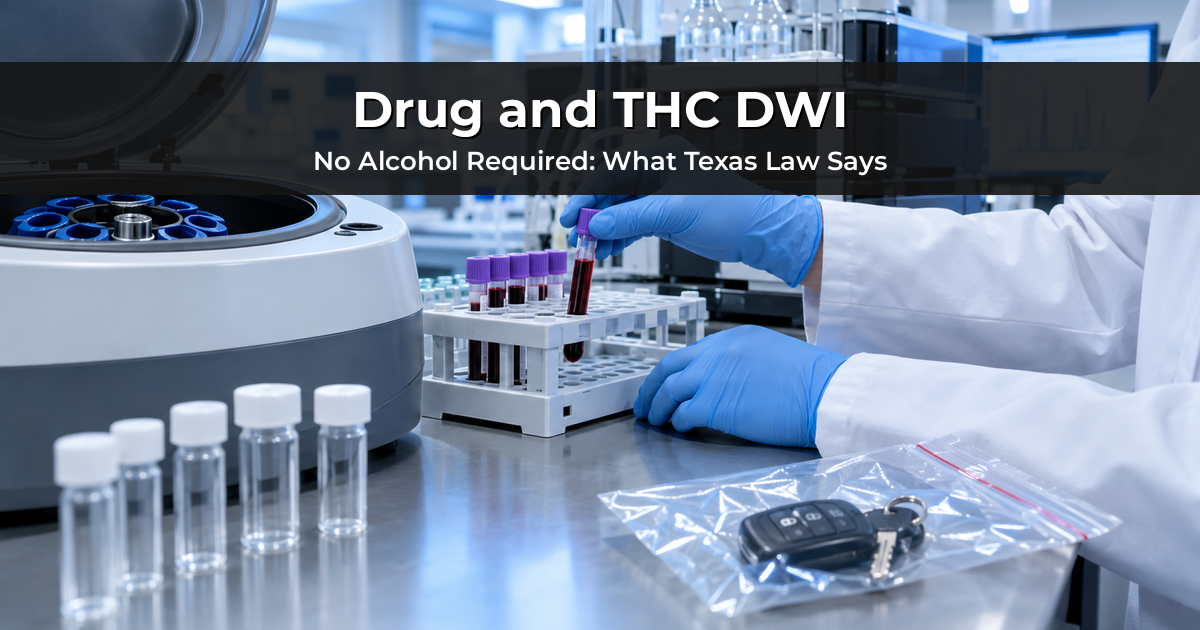
Gloved lab analyst placing a blood sample vial in a rack beside a centrifuge, with car keys in an evidence bag on the bench

DWI Without Alcohol? Drug, THC, and Prescription Medication DWI Charges in Texas

By Jason H. Howard · DWI

Short answer: Yes. In Texas you can be charged with DWI without drinking any alcohol at all. The Penal Code defines "intoxicated" to include losing the normal use of your mental or physical faculties because of a controlled substance, a drug, a dangerous drug, a combination of substances, or "any other substance," and having a valid prescription "is not a defense." Unlike alcohol, Texas has no fixed legal limit for THC or other drugs, so in a drug DWI case the State generally has to prove actual impairment, not just that a drug showed up in your blood.

Gloved lab analyst placing a blood sample vial in a rack beside a centrifuge, with car keys in an evidence bag on the bench

Many people are surprised to be arrested for DWI after a stop where the breath test showed little or no alcohol. In Tarrant, Dallas, Denton, Collin, Johnson, and Parker counties, officers often follow up with a blood warrant, a drug recognition evaluation, and a lab analysis for marijuana, prescription medications, or other drugs. Those cases look different from a typical alcohol DWI, and they are often defended differently.

At Howard Lotspeich Alexander & Williams, PLLC (HLAW), our Fort Worth DWI attorneys defend drug-related DWI charges across the Dallas-Fort Worth area. This guide explains what Texas law says about DWI by drugs, THC, and prescription medications, how the State tries to prove these cases, and the questions that often decide them.

Key Takeaways

  • Drug DWI is the same offense as alcohol DWI. Texas Penal Code §49.01(2)(A) defines intoxication to include impairment from "a controlled substance, a drug, a dangerous drug, a combination of two or more of those substances, or any other substance" (Tex. Penal Code §49.01).
  • A prescription is not a defense. Under §49.10, the fact that a person "is or has been entitled to use" the drug "is not a defense" (Tex. Penal Code §49.10).
  • There is no per se limit for drugs. The 0.08 rule in §49.01(2)(B) applies only to alcohol concentration. For drugs, the State must prove loss of normal use of mental or physical faculties.
  • THC in blood is a poor measure of impairment. NHTSA has reported that "THC level in blood (or oral fluid) does not appear to be an accurate and reliable predictor of impairment from THC" (NHTSA Report to Congress).
  • Jury instructions must match the evidence. The Texas Court of Criminal Appeals held in Burnett v. State (2017) that a trial court must submit "only the portions of the statutory definition of 'intoxicated' that are supported by the evidence" (Burnett opinion).
  • Refusing a test still has license consequences. Implied consent covers testing for drugs as well as alcohol, and a refusal generally leads to a 180-day license suspension for a first refusal (Tex. Transp. Code ch. 724).

Can You Get a DWI in Texas Without Drinking Alcohol?

Yes. Texas Penal Code §49.04(a) makes it an offense to be "intoxicated while operating a motor vehicle in a public place" (Tex. Penal Code §49.04). The key word is "intoxicated," and §49.01(2) gives two separate ways to prove it:

  1. Loss of normal use: "not having the normal use of mental or physical faculties by reason of the introduction of alcohol, a controlled substance, a drug, a dangerous drug, a combination of two or more of those substances, or any other substance into the body"; or
  2. Per se alcohol: "having an alcohol concentration of 0.08 or more."

Only the first definition applies to drugs. That means a DWI can be based on marijuana or THC products, prescription painkillers, anti-anxiety medications, sleep aids, muscle relaxers, stimulants, over-the-counter medications that cause drowsiness, or a mix of alcohol and any of these. A first DWI is generally a Class B misdemeanor with a minimum of 72 hours of confinement, regardless of which substance is alleged.

Is a Prescription a Defense to DWI in Texas?

No. Texas Penal Code §49.10 says that in a DWI prosecution, "the fact that the defendant is or has been entitled to use the alcohol, controlled substance, drug, dangerous drug, or other substance is not a defense" (Tex. Penal Code §49.10).

That does not mean anyone taking a prescription is guilty of DWI. The legal question is still whether the medication caused you to lose the normal use of your mental or physical faculties while you were driving. Many people take prescribed medications every day at stable doses and drive normally. A prescription can still matter as evidence. It can explain why a drug was in your system, show how long you had been taking it, and show that you were used to its effects. What it cannot do is serve as a complete legal excuse if impairment is proven.

Is There a Legal Limit for THC or Drugs in Texas?

No. Texas has no per se limit for THC or any other drug. The 0.08 threshold in §49.01(2)(B) is specifically an "alcohol concentration," which the statute defines as grams of alcohol per volume of breath, blood, or urine (Tex. Penal Code §49.01).

This matters because drug test results are often less meaningful than people assume. NHTSA's report to Congress on marijuana-impaired driving explained that, in the studies that have been conducted, "the consistent finding is that the level of THC in the blood and the degree of impairment do not appear to be closely related," and that "peak impairment does not occur when THC concentration in the blood is at or near peak levels" (NHTSA Report to Congress). NHTSA has also noted that THC metabolites "can be detected in the blood and urine for days to weeks after consumption, long after any impairing effects of the drug have concluded" (NHTSA Countermeasures That Work).

In other words, a lab report showing THC or a metabolite proves that the substance was present at some point. On its own, it may not prove that you were impaired at the time you were driving. For more on Texas marijuana law generally, see our guide to marijuana laws in Texas.

How Does the State Try to Prove a Drug DWI?

Because there is no drug equivalent of a 0.08 breath test, prosecutors usually build drug DWI cases from several pieces of evidence:

Type of evidence What the State uses it for Common defense questions
Driving behavior Shows impairment on the road Was there a traffic violation, or an innocent explanation such as weather, road design, or fatigue?
Officer observations Slurred speech, pupil size, unsteadiness, confusion Are these signs consistent with the specific drug alleged, or with a medical condition, nerves, or fatigue?
Field sobriety tests Divided-attention performance Were the tests designed and validated for alcohol, and were they given correctly?
Drug recognition evaluation An officer's opinion on the drug category causing impairment Was the evaluator properly certified, and did he follow the full protocol?
Blood test Shows which substances were present Does the level show impairment at the time of driving, or only past use? Was the blood properly collected, stored, and tested?
Statements Admissions about what was taken and when Were the statements voluntary, and are they consistent with the lab results?

Why expert testimony often matters

Texas courts have long treated drug intoxication differently from alcohol intoxication. Describing the Court of Criminal Appeals' decision in Smithhart v. State, 503 S.W.2d 283 (Tex. Crim. App. 1973), the Dallas Court of Appeals explained that while alcohol intoxication is common enough that "its recognition requires no expertise," intoxication by drugs requires expert testimony or evidence connecting the symptoms to a conclusion that the person was under the influence of a drug to the point of impairment (Waller v. State, Tex. App. Dallas 2009).

The Waller court also made clear that modern sufficiency review considers all of the evidence, including an officer's opinion and a refusal to test. So the absence of an expert does not automatically end a case. But the quality of the State's drug evidence is often the central battleground.

Drug recognition evaluators

Many DFW agencies use officers trained as drug recognition experts (DREs). These officers follow a standardized evaluation to form an opinion about whether a person is impaired and which drug category is involved. Texas appellate courts have admitted DRE testimony in a number of cases, including where the officer explained his training and methodology (Sanders v. State, Fort Worth Court of Appeals 2020). That does not make every DRE opinion reliable. The evaluator's training, whether each step was completed, and whether the opinion matches the toxicology results are all fair subjects for cross-examination.

What Happens When Alcohol and Drugs Are Combined?

Many DWI cases involve a small amount of alcohol plus a medication. Texas law allows the State to rely on the combined effect. In Gray v. State, 152 S.W.3d 125 (Tex. Crim. App. 2004), the Court of Criminal Appeals upheld a "synergistic effect" jury instruction where there was evidence that the defendant's prescription antidepressants made him more susceptible to the effects of alcohol. As the Texas District and County Attorneys Association summarizes it, the court "concluded that the substance that causes intoxication is not an element of the offense. Instead, it is an evidentiary matter" (TDCAA case law summary). We have written about this issue before in our posts tagged synergistic effect.

There is an important limit. In Burnett v. State (Tex. Crim. App. 2017), pills were found in the driver's jacket and an officer thought some might be hydrocodone. The Court of Criminal Appeals held that the jury charge was erroneous because it included the full drug definitions of "intoxicated" without evidence supporting them. The court explained that the trial court must submit "only the portions of the statutory definition of 'intoxicated' that are supported by the evidence. To do otherwise is error." There was no evidence showing what kind of drug hydrocodone is, whether it can cause intoxicating effects, or whether the driver's symptoms were consistent with it (Burnett opinion).

The practical lesson is that the State cannot simply point to pills in a car and ask a jury to assume they caused impairment. It needs evidence tying the substance to the person's condition.

Do You Have to Give Blood for a Drug DWI Test?

Texas's implied consent law covers drugs as well as alcohol. A person arrested for DWI "is deemed to have consented" to a breath or blood specimen "to determine the alcohol concentration or the presence in the person's body of a controlled substance, drug, dangerous drug, or other substance" (Tex. Transp. Code §724.011). A breath test only measures alcohol, so if an officer suspects drugs, he will usually ask for blood.

You can refuse, but refusal has consequences. Under §724.035, a refusal generally results in a 180-day license suspension for a first refusal. Officers in DFW also frequently obtain blood search warrants after a refusal, especially on no-refusal weekends. Our guide to refusing field sobriety tests covers the separate question of roadside tests.

If your license is suspended after a refusal, you have only 15 days from receiving notice to request an Administrative License Revocation hearing. See our guide to the ALR hearing and the 15-day deadline. At that hearing, the issues include whether there was reasonable suspicion or probable cause for the stop or arrest and whether you refused a specimen request (Tex. Transp. Code §724.042).

What Defenses Apply in a Drug or THC DWI Case?

Every case depends on its facts, but common issues in DFW drug DWI cases include:

  1. The stop. Was there reasonable suspicion of a traffic violation or criminal activity before the officer pulled you over?
  2. Probable cause for the arrest. Did the officer have enough evidence of impairment, not just a smell, a statement, or a medication bottle?
  3. Timing. How long after driving was blood drawn, and what does that mean for any opinion about impairment at the time of driving?
  4. The lab work. Chain of custody, storage, testing methods, and whether the lab reported active drug or only inactive metabolites.
  5. The DRE evaluation. Whether every step of the protocol was completed and documented, and whether the officer's drug-category opinion matches the toxicology.
  6. Alternative explanations. Medical conditions, injuries, fatigue, anxiety, or disabilities that can mimic signs of impairment.
  7. The jury charge. Whether the evidence actually supports a drug or combination theory under Burnett.

Video from dash cameras and body cameras is often the most important evidence in these cases, because it shows how you actually spoke, walked, and responded. For a related issue, see our article on being arrested for DWI under 0.08.

Frequently Asked Questions

Can I get a DWI for driving after using legal hemp or THC products?

Possibly. The DWI statute applies to impairment from "any other substance," so the legal status of a product does not control whether you can be charged with DWI. The question is whether it caused you to lose the normal use of your mental or physical faculties while driving. Because THC levels correlate poorly with impairment, these cases often turn on the officer's observations, video, and expert testimony.

Can I be convicted of DWI for taking my prescribed medication?

You can be charged, and a prescription is not a legal defense under Penal Code §49.10. But the State still has to prove that the medication caused you to lose the normal use of your mental or physical faculties. Evidence that you took it as prescribed and were used to it can be relevant to that question.

Does a positive blood test for marijuana mean I was impaired?

Not necessarily. NHTSA has reported that blood THC levels are not a reliable predictor of impairment, and that THC metabolites can be detected for days to weeks after use. A positive result shows presence, which is different from proving impairment at the time of driving.

Is a drug DWI punished differently than an alcohol DWI?

Generally no. A first DWI is a Class B misdemeanor with a minimum of 72 hours of confinement under §49.04(b), whether the alleged intoxicant is alcohol or a drug. The 0.15 Class A enhancement in §49.04(d) is based on alcohol concentration, so it does not apply to a drug-only case. Prior convictions and other factors can raise the level of the offense.

Will a drug DWI arrest suspend my license?

If you refused a breath or blood test, your license can be suspended for 180 days for a first refusal. The test-failure suspension in Chapter 724 is tied to alcohol concentration. A conviction can also bring separate license consequences. Request an ALR hearing within 15 days of receiving notice to protect your rights.

What should I do after a drug DWI arrest in Fort Worth?

Write down everything you remember, including what you took, when, and in what dose. Gather your prescription records. Do not discuss the case on social media. Then talk to a DWI defense lawyer quickly, since the ALR deadline is short and video evidence should be requested early.

Talk to a Fort Worth DWI Defense Lawyer

A drug or THC DWI charge often involves different evidence, and different defenses, than a typical alcohol case. The sooner a lawyer reviews the stop, the video, and the lab work, the more options you may have.

Call HLAW at (817) 993-9249 or contact us online for a free consultation about your Dallas-Fort Worth DWI case.

This article is for general informational purposes only and is not legal advice. Reading it does not create an attorney-client relationship. Laws change, and every case depends on its specific facts.
Read full article
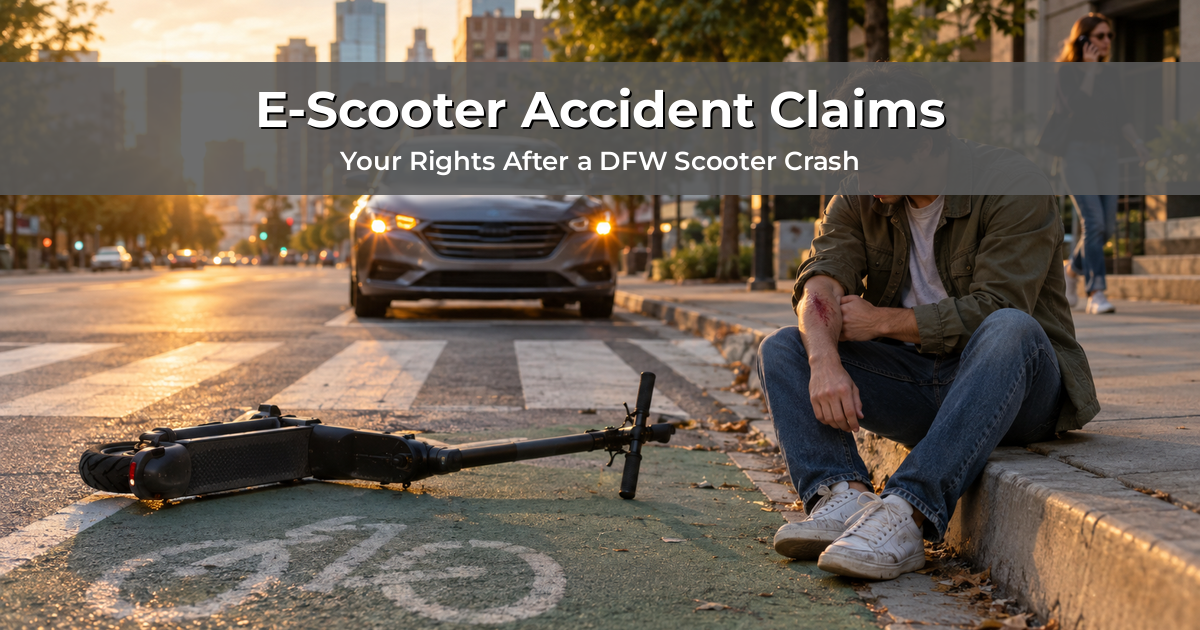
Injured rider sitting on a downtown curb beside a fallen electric scooter in a bike lane, with a stopped car nearby

Hurt on an Electric Scooter in Dallas-Fort Worth? Texas E-Scooter Accident Laws and Your Rights

By Luke A. Williams · Personal Injury

Short answer: If you were hurt on an electric scooter in Dallas-Fort Worth because a driver, property owner, or city was negligent, you can generally bring a Texas personal injury claim. You can recover as long as you were not more than 50 percent responsible, and your recovery is reduced by your share of fault. Texas law treats a motor-assisted scooter much like a bicycle, not a motor vehicle. Where you were allowed to ride, whether city rules were followed, and which insurance applies often decide these cases. Claims against a city can require written notice within six months or less, and most lawsuits must be filed within two years.

Injured rider sitting on a downtown curb beside a fallen electric scooter in a bike lane, with a stopped car nearby

Electric scooters are now part of daily traffic in Deep Ellum, downtown Fort Worth, Arlington's entertainment district, and college areas across the Metroplex. They are convenient, but a rider has almost no protection in a collision with a car or a fall caused by a pothole. The legal rules are also less familiar than those for a typical car wreck.

At Howard Lotspeich Alexander & Williams, PLLC (HLAW), our Fort Worth trial lawyers handle personal injury claims across Tarrant, Dallas, Denton, Collin, Johnson, and Parker counties. This guide explains how Texas law applies to e-scooter crashes, who may be responsible, and what to do to protect a claim.

Key Takeaways

  • Scooters follow bicycle rules, not motor vehicle rules. Under Texas Transportation Code §551.352, bicycle provisions generally apply to a motor-assisted scooter, and "a provision of this title applicable to a motor vehicle does not apply to a motor-assisted scooter" (Tex. Transp. Code §551.352).
  • State law limits scooters to streets with posted speed limits of 35 mph or less, though riders may cross faster roads at intersections. Cities can add their own restrictions.
  • Dallas bans sidewalk riding. The City of Dallas says scooters "may not be ridden on or in: sidewalks, trails, parks, plazas, on roads with a speed limit of 35 MPH or higher," with a 20 mph citywide speed limit (City of Dallas).
  • Fault is shared under the 51 percent bar. A claimant "may not recover damages if his percentage of responsibility is greater than 50 percent," and any recovery is reduced by the claimant's percentage (Tex. Civ. Prac. & Rem. Code ch. 33).
  • Claims against a city have short notice deadlines. The Texas Tort Claims Act requires notice within six months, and city charters can set shorter periods (Tex. Civ. Prac. & Rem. Code §101.101).
  • Injuries are rising nationally. The CPSC estimates 380,000 emergency department visits involving e-scooters from 2017 through 2024 (CPSC micromobility report).

What Does Texas Law Say About Electric Scooters?

Texas regulates motor-assisted scooters in Chapter 551 of the Transportation Code. A "motor-assisted scooter" is a self-propelled device with at least two wheels, a braking system, a gas or electric motor, a deck designed for the rider to stand or sit, and "the ability to be propelled by human power alone" (Tex. Transp. Code §551.351). Most rental and privately owned stand-up e-scooters in DFW fall into this category.

The key operating rules are in §551.352 (Tex. Transp. Code §551.352):

  • A scooter "may be operated only on a street or highway for which the posted speed limit is 35 miles per hour or less," but may cross a faster road at an intersection.
  • A person may ride "on a path set aside for the exclusive operation of bicycles or on a sidewalk," unless a city or county prohibits it.
  • A county or city may prohibit scooters on a street, highway, or sidewalk "in the interest of safety."
  • Rules for bicycles generally apply to scooters, while rules for motor vehicles do not.

That last point matters in an injury case. A scooter rider generally has the rights and duties of a bicyclist on the road. Drivers owe scooter riders the same care they owe cyclists. For more on those rules, see our guide to bicycle accident claims in DFW.

How Do Dallas and Fort Worth Rules Differ?

Local rules vary across the Metroplex, and they can affect both safety and fault.

Issue Texas state law City of Dallas City of Fort Worth
Sidewalk riding Allowed unless a city or county prohibits it Not allowed, except to start or end a ride Generally follows state law; riders may use sidewalks and paths unless posted otherwise
Road speed limit Streets posted 35 mph or less Not on roads posted 35 mph or higher Streets posted 35 mph or less
Scooter speed No speed cap stated in §551.352 20 mph citywide; 10 mph in slow-ride zones City code does not directly address e-scooters
Rental age Not addressed in §551.352 No rentals to people under 16 City code does not directly address e-scooters

Sources: Tex. Transp. Code §551.352; City of Dallas Dockless Vehicle Program; Fort Worth Star-Telegram; Government Technology.

In Dallas, the city also lists no-ride zones, including parks, plazas, and most trails, and says riders who break the rules can be fined up to $200 under Section 28-41.1.1 of the Dallas City Code (City of Dallas). The Fort Worth Star-Telegram reported that Fort Worth police say e-scooters "can be ridden on bike paths and sidewalks, but they are restricted to streets with a posted speed limit of 35 mph or less" (Star-Telegram). Arlington, Denton, Plano, Irving, and other cities have their own rules, so the location of a crash matters.

Who Is Liable for an E-Scooter Accident in Texas?

Most scooter injury claims fall into one of four categories.

A driver who hit the rider

The most serious scooter injuries often involve cars. CPSC staff have reported that "the top hazards in e-scooter and e-bike fatalities were incidents with motor vehicles and user-control issues" (CPSC). Common scenarios include right hooks at intersections, left turns across a bike lane, drivers opening doors into a rider's path, and drivers backing out of driveways or parking spaces. A claim against the driver is a negligence claim, usually paid through the driver's liability insurance.

A property owner or business

Falls on private property, such as a parking garage, apartment complex, or shopping center, may involve premises liability if a dangerous condition caused the crash. Our article on parking lot and sidewalk injuries in Texas explains how those claims work.

A city or other government entity

Potholes, broken pavement, missing signs, and road construction can cause serious scooter falls. Claims against a city fall under the Texas Tort Claims Act, which has special rules. For a premise defect, the government generally owes only the duty a private person owes a licensee, but that limit does not apply to the duty to warn of "special defects such as excavations or obstructions on highways, roads, or streets" (Tex. Civ. Prac. & Rem. Code §101.022). The Act also caps a city's liability at $250,000 per person for bodily injury. If a city vehicle hit you, see our guide to government vehicle accident claims in DFW.

The scooter company or manufacturer

Brake failures, throttle malfunctions, battery fires, and other defects can support a product liability or negligence claim against a manufacturer or operator. Rental apps usually require riders to accept terms of service, which may include arbitration clauses or liability waivers. Whether those terms are enforceable depends on their wording and the facts, so they should be reviewed before you assume a claim is barred.

Can You Recover if You Were Partly at Fault?

Often, yes. Texas uses proportionate responsibility. Under Civil Practice and Remedies Code §33.001, a claimant "may not recover damages if his percentage of responsibility is greater than 50 percent." If you are 50 percent or less at fault, §33.012 reduces your damages by your percentage of responsibility (Tex. Civ. Prac. & Rem. Code ch. 33).

Insurers often argue that a scooter rider was at fault for riding on a Dallas sidewalk, riding on a road posted above 35 mph, riding at night without lights, carrying a passenger, or wearing headphones. These facts can reduce a claim, but they do not automatically defeat it. A driver who runs a red light or turns into a rider's path still bears responsibility. Our guide to how fault works in Texas personal injury cases explains how juries allocate responsibility.

What Insurance Pays for a Scooter Accident?

Insurance in a scooter case can come from several sources:

  1. The at-fault driver's liability coverage. Texas requires minimum limits of $30,000 per person for bodily injury (Texas Department of Insurance).
  2. Your own auto policy. Personal injury protection (PIP) is defined by statute as coverage for the named insured, "members of the insured's household," and authorized operators or passengers of the insured's vehicle for medical expenses and lost income arising from an accident (Tex. Ins. Code §1952.151). Whether your policy covers a scooter crash depends on its specific language, so review it before assuming it does not apply.
  3. Uninsured/underinsured motorist coverage. If the driver who hit you had no insurance or not enough, your own UM/UIM coverage may help. See our guide to UM/UIM and PIP auto insurance.
  4. Health insurance. Health insurance may pay medical bills, but it may claim reimbursement from any settlement.
  5. Homeowner's, renter's, or business policies, in some cases involving private property or a commercial defendant.

If the driver left the scene, our article on hit-and-run crashes in Texas explains next steps.

What Should You Do After an E-Scooter Crash in DFW?

  1. Get medical care right away. CPSC reports that fractures, followed by contusions and abrasions, are the most common micromobility injuries, and that the head and neck are among the most frequently injured areas (CPSC). Some head injuries are not obvious at first.
  2. Call the police if a vehicle was involved or anyone was hurt, and ask for the report number.
  3. Photograph everything: the scooter, the vehicle, the road surface, the lane markings, posted speed limit signs, and your injuries.
  4. Screenshot the rental app. Save the ride history, the start and end times, and the route. Rental companies may keep GPS and speed data that can show where and how fast you were riding.
  5. Keep the scooter if you own it, and do not repair it. If it was a rental, report the crash to the operator in writing and ask them to preserve the device and its data.
  6. Collect witness names and look for cameras. Businesses, buses, and doorbell cameras often capture crashes, but footage may be overwritten quickly.
  7. Be careful with insurance adjusters. Do not give a recorded statement about fault before you understand your rights.
  8. Note the deadlines. Notice to a city may be due within six months or less, and most personal injury lawsuits must be filed within two years. See our guide to the Texas statute of limitations.

What Compensation Is Available After a Scooter Injury?

Depending on the facts, a scooter rider may seek medical expenses, lost wages and loss of earning capacity, physical pain and mental anguish, physical impairment, disfigurement, and property damage. Because riders have little protection, scooter crashes can cause broken wrists and arms, facial injuries, dental injuries, and traumatic brain injuries. These injuries can require surgery and long recovery periods.

Frequently Asked Questions

Is it legal to ride an electric scooter on the sidewalk in Texas?

State law allows scooters on sidewalks and bike paths, but cities can prohibit sidewalk riding. Dallas prohibits riding scooters on sidewalks except to start or end a ride. Fort Worth police have said scooters can be ridden on sidewalks and bike paths. Check the rules for the city where you are riding.

Can I sue if a car hit me while I was riding a rental scooter?

Generally, yes. A driver who causes a crash through negligence, such as failing to yield or turning into a bike lane, can be held responsible. The claim usually goes through the driver's liability insurance. Your own fault, if any, can reduce the recovery under Texas's proportionate responsibility rules.

Does a scooter rental waiver stop me from suing?

Not necessarily. A rental company's terms may limit claims against the company, and some require arbitration. Those terms generally do not protect a negligent driver or property owner who is not a party to the agreement. Whether a waiver applies to a claim against the company depends on its language and the facts.

What if a pothole caused my scooter crash?

You may have a claim against the city or other government entity responsible for the road, but the Texas Tort Claims Act limits these claims. You must give notice within six months, or less under some city charters, and there are damage caps and special rules for road defects.

Do I need to wear a helmet on an e-scooter in Texas?

The state scooter statute, §551.352, does not include a helmet requirement. Some cities set their own rules for children; for example, a Dallas ordinance makes it an offense for a parent to allow a child to ride a scooter without a helmet (Dallas Ordinance 20-0468). Not wearing a helmet may be raised by an insurer, but it does not by itself bar a claim against a negligent driver.

How long do I have to file a scooter accident claim in Texas?

Most personal injury lawsuits must be filed within two years. Claims against a government entity require much earlier notice, often within six months. It is best to talk to a lawyer as soon as possible.

Talk to a Fort Worth Scooter Accident Lawyer

If you or a family member was hurt in an electric scooter crash in Dallas-Fort Worth, HLAW can help you identify who was responsible, which insurance applies, and which deadlines matter.

Call HLAW at (817) 993-9249 or contact us online for a free consultation.

This article is for general informational purposes only and is not legal advice. Reading it does not create an attorney-client relationship. Laws change, and every case depends on its specific facts.
Read full article
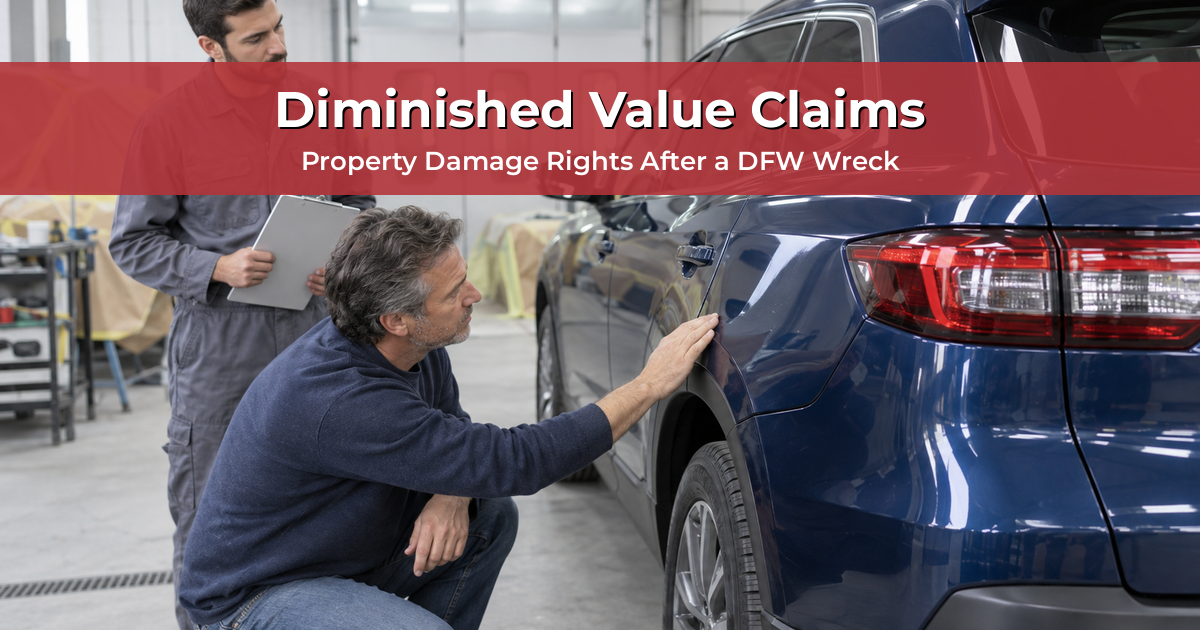
Car owner running his hand along a freshly repaired SUV panel in a body shop while a technician holds a clipboard

Car Repaired but Worth Less? Diminished Value and Property Damage Claims After a DFW Wreck

By Jesse Lotspeich · Personal Injury

Short answer: In Texas, if another driver caused your wreck, you can generally seek diminished value from that driver's liability insurance. Diminished value is the loss in your car's market value even after it is fully repaired. Your own insurance policy is different. The Texas Supreme Court held in 2003 that the standard Texas personal auto policy does not require your insurer to pay diminished value when the car is fully and adequately repaired. Texas law also allows loss-of-use damages, such as a rental car, even when a vehicle is totaled. A property damage lawsuit generally must be filed within two years.

Car owner running his hand along a freshly repaired SUV panel in a body shop while a technician holds a clipboard

After a wreck on I-30, I-35W, or Highway 121, most people in Dallas-Fort Worth focus on getting the car repaired and back on the road. But a vehicle with an accident history often sells or trades in for less than an identical car that was never damaged, even when the repair is excellent. That gap is real money, and many people never ask for it.

At Howard Lotspeich Alexander & Williams, PLLC (HLAW), our Fort Worth trial lawyers handle car wreck and personal injury claims throughout Tarrant, Dallas, Denton, Collin, Johnson, and Parker counties. This guide explains what Texas law allows you to recover for damage to your vehicle, and how to document a diminished value and loss-of-use claim.

Key Takeaways

  • Third-party diminished value claims are allowed in Texas. The Texas Department of Insurance has stated that an insurer "may be obligated to pay a third party claimant for any loss of market value of the claimant's automobile, regardless of the completeness of the repair" (TDI Bulletin B-0027-00).
  • Your own collision coverage generally does not pay diminished value. In American Manufacturers Mutual Insurance Co. v. Schaefer, 124 S.W.3d 154 (Tex. 2003), the Texas Supreme Court held the standard policy "does not require payment for diminished value when a vehicle has been fully and adequately repaired" (Schaefer opinion).
  • UM/UIM coverage may be different. TDI's bulletin says an insurer may be obligated to pay its own policyholder for loss of market value under uninsured/underinsured motorist coverage, "regardless of the completeness of the repair."
  • Loss-of-use damages are recoverable even for a totaled car. The Texas Supreme Court held in 2016 that an owner of totally destroyed property "may recover loss-of-use damages in addition to the fair market value of the property immediately before the injury" (J&D Towing v. American Alternative Insurance Corp.).
  • You choose the body shop. An insurer settling a third-party property damage claim "may not require the third-party claimant to have repairs made by a particular repair person or facility" (Texas Insurance Code §1952.301).
  • The deadline is two years. Suits for injury to property generally must be filed within two years (Tex. Civ. Prac. & Rem. Code §16.003).

What Is Diminished Value?

Diminished value is the difference between what your vehicle was worth immediately before the wreck and what it is worth after repairs. Buyers and dealers often pay less for a vehicle with a reported accident, especially one with structural or frame damage, airbag deployment, or major body work.

There are generally three ways people describe it:

  • Inherent diminished value: the loss in market value caused by the accident history itself, even after a complete and proper repair. This is the most common type of claim.
  • Repair-related diminished value: additional lost value caused by poor or incomplete repairs, such as mismatched paint or parts that do not fit correctly.
  • Immediate diminished value: the drop in value right after the crash, before repairs. This mostly matters in calculating a total loss or a settlement before repair.

Texas courts have long measured damage to personal property using market value. When property is partially damaged, the general rule is "the difference in the market value immediately before and immediately after the injury to such property at the place where the damage was occasioned," as the Texas Supreme Court summarized in J&D Towing (opinion).

Who Pays Diminished Value in Texas?

Who pays depends on whose insurance you are claiming against.

Type of claim Is diminished value available? Source
Claim against the at-fault driver's liability insurance (third-party claim) Generally yes, regardless of the completeness of the repair TDI Bulletin B-0027-00
Claim under your own collision or comprehensive coverage (first-party claim) Generally no, when the car is fully and adequately repaired Schaefer (Tex. 2003)
Claim under your own UM/UIM coverage when the at-fault driver is uninsured or underinsured May be available, regardless of the completeness of the repair TDI Bulletin B-0027-00

Why your own collision coverage usually will not pay

In Schaefer, the policyholder's car was repaired and he did not dispute the quality of the repairs, but he claimed it was still worth $2,600 less. The Texas Supreme Court looked at the policy's "Limit of Liability" language, which caps the insurer's obligation at the lesser of the vehicle's actual cash value or the amount needed "to repair or replace" it. The court held that "repair" connotes "something tangible, like removing dents or fixing parts," and does not include compensation for "the market's perception that a damaged but fully and adequately repaired vehicle has an intrinsic value less than that of a never-damaged car" (Schaefer opinion).

The court left open other situations. It noted that if repairs were faulty, incomplete, or inadequate, the insurer might be liable for breaching its obligations under the policy. TDI's bulletin similarly says loss of market value can still be used to settle a dispute where a vehicle "was repaired properly but the vehicle still does not function as it did before the accident."

Why the at-fault driver's insurer is different

A claim against the at-fault driver is not a contract claim under your policy. It is a negligence claim, and the at-fault driver is responsible for the full harm caused to your property. That is why TDI's position is that a liability insurer may owe a third-party claimant for loss of market value "regardless of the completeness of the repair." In practice, many adjusters will not offer diminished value unless you ask for it and support it with evidence.

If you are still sorting out who caused the crash, our guide to how fault works in Texas personal injury cases explains the comparative fault rules that also apply to property damage.

Can You Get Paid for a Rental Car or Loss of Use?

Yes. Loss-of-use damages compensate you for the time you cannot use your vehicle. They are often measured by the reasonable cost of a comparable rental, or by lost income for a work vehicle.

For years, many Texas courts said loss-of-use damages were available only when a vehicle could be repaired, not when it was totaled. The Texas Supreme Court rejected that rule in J&D Towing, LLC v. American Alternative Insurance Corp., 478 S.W.3d 649 (Tex. 2016). The court held that "the owner of personal property that has been totally destroyed may recover loss-of-use damages in addition to the fair market value of the property immediately before the injury" (J&D Towing opinion).

The court also set limits. Loss-of-use damages must be foreseeable and directly traceable to the wreck, they cannot be speculative, and a plaintiff may not recover them for a period longer than reasonably needed to repair or replace the vehicle. As the court put it, permitting these damages "is not a license for unrestrained raids on defendants' coffers."

TDI's auto insurance guide explains how this usually works in practice: if another driver caused the accident, that driver's insurance company will pay for you to rent a car for the time it believes is reasonable for repairs, and "if the company totals your car, it might stop paying for the rental a few days after telling you." Tell the adjuster about parts delays or newly discovered damage, because the company may extend the rental.

What If Your Car Is Totaled?

If the cost to repair is close to or more than the car's value, the insurer will usually declare it a total loss. In a total loss, the measure is generally the fair market value immediately before the wreck, plus reasonable loss-of-use damages under J&D Towing. TDI explains that insurers pay actual cash value, which reflects depreciation, so a 10-year-old car is valued as a 10-year-old used car (TDI auto insurance guide).

To push back on a low total-loss valuation, gather listings for comparable vehicles in the DFW market with similar year, mileage, trim, and options. Also gather records of recent upgrades, new tires, or major maintenance. If you want to keep the car, TDI notes that the insurer will subtract its salvage value from the settlement.

How Do You Prove a Diminished Value Claim?

Insurers rarely pay diminished value without documentation. The strongest claims usually include:

  1. The final repair invoice, showing the extent of the damage and the parts replaced. Structural, frame, or airbag repairs tend to support larger claims.
  2. Photos of the damage before repair, from multiple angles.
  3. A written appraisal from an independent vehicle appraiser who explains the pre-accident value, the post-repair value, and how the difference was calculated.
  4. Dealer statements or trade-in offers showing what dealers will pay for the vehicle now compared with a similar vehicle without accident history.
  5. The vehicle's history report, if it shows the accident.
  6. The police crash report, to establish fault. Our article on how to get and use a Texas car wreck police report explains the process.

Send a written demand to the at-fault driver's insurer with these documents, and keep copies of every communication. If the adjuster uses a formula that produces a very low number, ask how it was calculated and respond with your own evidence. Our guide to insurance adjuster tactics in Fort Worth covers common approaches insurers use.

Do You Have to Use the Insurance Company's Body Shop?

No. Texas law protects your choice. In settling a third-party property damage claim, an insurer "may not require the third-party claimant to have repairs made by a particular repair person or facility" or require particular parts (Texas Insurance Code §1952.301(b)). For your own policy, §1952.302 prohibits an insurer or adjuster from stating or suggesting that you "must use a specific repair person or facility" or one on a preferred list for the repair to be covered.

Choosing a shop that documents its work thoroughly can also help a later diminished value claim, because detailed repair records show exactly what was damaged and replaced.

What Are the Deadlines for a Property Damage Claim in Texas?

A lawsuit for injury to property generally must be filed within two years after the claim accrues (Tex. Civ. Prac. & Rem. Code §16.003). The same two-year period applies to personal injury claims from the same wreck. Claims against government entities can involve much shorter notice deadlines. Our guide to the Texas statute of limitations explains the exceptions.

Insurers also have deadlines. TDI explains that a company must acknowledge your claim within 15 days, accept or reject it within 15 business days after receiving everything it needs (with up to 45 more days if it explains why), and pay within five business days after agreeing to pay (TDI auto insurance guide).

Should You Settle Your Property Damage Claim Separately From Your Injury Claim?

Often, yes. Many people resolve the vehicle claim first so they can get back on the road, while their injury claim continues as medical treatment progresses. Before signing anything, read the release carefully. A property damage release should be limited to property damage and should not release bodily injury claims. If the at-fault driver has only minimum coverage, the property damage limit is $25,000 under Texas's 30/60/25 requirement (TDI), and your own UM/UIM coverage may need to fill the gap.

Frequently Asked Questions

Can I claim diminished value from my own insurance company in Texas?

Generally not under collision or comprehensive coverage when the car is fully and adequately repaired. The Texas Supreme Court held in Schaefer (2003) that the standard Texas personal auto policy does not require it. A claim under your UM/UIM coverage may be different, and disputes over faulty or incomplete repairs are treated differently.

How much is a diminished value claim worth?

It depends on the vehicle's age, mileage, pre-accident value, and the severity of the damage. Newer, higher-value vehicles with structural damage tend to lose the most value. An independent appraisal and dealer trade-in comparisons are the best evidence of the actual loss.

Does the at-fault driver's insurance have to pay for my rental car?

If the other driver caused the wreck, that driver's insurer typically pays for a rental for the time reasonably needed to repair the car. Under J&D Towing, loss-of-use damages are also available when a vehicle is totaled, but only for a reasonable period to replace it.

What if the repair shop did a bad job?

Poor or incomplete repairs can increase your loss. In a first-party claim, Schaefer noted that an insurer might be liable for breaching its policy obligations if repairs are faulty, incomplete, or inadequate. Document the problems with photos and a second shop's written evaluation.

Do I need a lawyer for a property damage claim?

Many vehicle-only claims are resolved without a lawyer. If you were also injured, if the insurer denies fault, or if the vehicle had high value or serious damage, a lawyer can help coordinate the property and injury claims and make sure a release does not give up more than it should.

How long do I have to file a diminished value claim in Texas?

A lawsuit generally must be filed within two years of the wreck under Civil Practice and Remedies Code §16.003. It is best to start the claim right away, while repair records and appraisals are fresh.

Talk to a Fort Worth Car Wreck Lawyer

If another driver damaged your vehicle and hurt you or your family, you may be entitled to more than the repair bill. That can include lost market value, loss of use, and compensation for your injuries.

Call HLAW at (817) 993-9249 or contact us online for a free consultation about your Dallas-Fort Worth car wreck claim.

This article is for general informational purposes only and is not legal advice. Reading it does not create an attorney-client relationship. Laws change, and every case depends on its specific facts.
Read full article
Person running down a wet downtown alley at dusk as a police flashlight beam crosses the pavement

Evading Arrest in Texas: When Running or Driving Away From Police Becomes a Felony

By Luke A. Williams · Criminal Defense

Short answer: In Texas, evading arrest or detention means intentionally fleeing from someone you know is a peace officer who is lawfully trying to arrest or detain you. Running on foot is usually a Class A misdemeanor, punishable by up to one year in jail. Fleeing in a vehicle is generally a third-degree felony, punishable by 2 to 10 years in prison, even on a first offense. The State must prove you knew an officer was trying to stop you, and that the stop itself was lawful. Those two elements are often where the defense begins.

Person running down a wet downtown alley at dusk as a police flashlight beam crosses the pavement

Evading arrest charges are common in Dallas-Fort Worth. A traffic stop on I-35W or Loop 820 turns into a short chase, a passenger runs from a car in an apartment parking lot, or someone panics and drives a few blocks before pulling over. What may feel like a split-second decision can bring a felony charge, a possible deadly weapon finding, and consequences that last far longer than the original stop.

At Howard Lotspeich Alexander & Williams, PLLC (HLAW), our Fort Worth defense lawyers handle criminal defense cases in Tarrant, Dallas, Denton, Collin, Johnson, and Parker counties. This guide explains how Texas defines evading arrest, how the penalties escalate, and what defenses may apply.

Key Takeaways

  • The offense has specific elements. Under Texas Penal Code §38.04(a), a person commits an offense "if he intentionally flees from a person he knows is a peace officer or federal special investigator attempting lawfully to arrest or detain him."
  • Fleeing on foot is generally a Class A misdemeanor, punishable by up to one year in jail and a fine of up to $4,000 (Penal Code §12.21).
  • Fleeing in a vehicle is generally a third-degree felony, even without a prior conviction. Texas courts, beginning with the Fort Worth Court of Appeals in Adetomiwa v. State, have resolved conflicting 2011 amendments that way.
  • Knowledge is an essential element. The accused "must know that the person from whom he flees is a peace officer attempting to arrest or detain him" (Hobyl v. State).
  • A car can be found to be a deadly weapon. A deadly weapon finding can limit probation options and delay parole eligibility (Code of Criminal Procedure art. 42A.054; Government Code §508.145).

What Counts as Evading Arrest in Texas?

The State must prove each part of §38.04(a) beyond a reasonable doubt:

  1. The person intentionally fled. Fleeing can mean running, driving away, or refusing to stop. Texas courts have described the offense as refusing "to yield to a police show of authority" (Redwine v. State).
  2. From a peace officer or federal special investigator. The person must know the pursuer is law enforcement.
  3. Who was attempting to arrest or detain the person. The person must know the officer was trying to stop or arrest him, not just that police were nearby.
  4. Lawfully. The statute requires that the officer was "attempting lawfully" to arrest or detain. If the officer had no legal basis for the stop, that element may fail.

Evading arrest is different from resisting arrest. Resisting arrest under §38.03 involves using force against an officer, and Texas law says it is "no defense" that the arrest was unlawful. Evading arrest is about flight, and the lawfulness of the stop is part of the offense itself. Our article on resisting an unlawful arrest in Texas explains that distinction further.

How Serious Is an Evading Arrest Charge?

The offense level depends on how the person fled, whether anyone was hurt, and the person's history.

Situation Offense level Punishment range
Fleeing on foot, no prior evading conviction Class A misdemeanor Up to 1 year in jail and up to $4,000 fine
Fleeing on foot with a prior evading conviction State jail felony 180 days to 2 years in state jail and up to $10,000 fine
Using a vehicle while in flight Third-degree felony 2 to 10 years in prison and up to $10,000 fine
Another person suffers serious bodily injury as a direct result of the officer's attempt to apprehend Third-degree felony 2 to 10 years in prison and up to $10,000 fine
Another person dies as a direct result of the officer's attempt to apprehend Second-degree felony 2 to 20 years in prison and up to $10,000 fine

Sources: Penal Code §38.04(b) and the punishment ranges in Penal Code §§12.21, 12.33, 12.34, and 12.35.

The statute also makes the offense more serious if the person uses a tire deflation device against the officer, and a 2023 amendment added a third-degree felony provision when the evading occurs during certain smuggling offenses. Section 38.04(d) adds that a person "may be prosecuted under either or both this section and the other law," so evading is often charged alongside DWI, drug possession, or other offenses arising from the same stop.

Is Evading Arrest in a Car Always a Felony?

In practice, yes. In 2011, the Texas Legislature passed three bills amending §38.04. Two of them made vehicle evading a state jail felony for a first offense, and the third made it a third-degree felony. The statute still prints both versions.

The Fort Worth Court of Appeals addressed the conflict in Adetomiwa v. State, 421 S.W.3d 922 (Tex. App.—Fort Worth 2014, no pet.). The court concluded that "Senate Bill 1416 amended the punishment scheme of section 38.04 to provide that evading arrest is a third degree felony if the actor uses a vehicle in flight," and that even if the bills were irreconcilable, the later vote on Senate Bill 1416 would prevail (Adetomiwa opinion). Other Texas appellate courts have agreed, so a first-time vehicle evading case in DFW is typically charged and prosecuted as a third-degree felony.

That matters because a third-degree felony can be enhanced by prior felony convictions, and it carries the full weight of a felony record. Our post on pleading "true" to a felony enhancement discusses how enhancements work in practice.

Can a Car Be a Deadly Weapon in an Evading Case?

Yes. A motor vehicle is not a deadly weapon by itself, but it can be one if "in the manner of its use or intended use" it is "capable of causing death or serious bodily injury" (Penal Code §1.07(a)(17)(B)). The Texas Court of Criminal Appeals uses a two-part test from Sierra v. State, 280 S.W.3d 250 (Tex. Crim. App. 2009). Courts first evaluate the manner in which the defendant used the vehicle, then consider whether, during the felony, it was capable of causing death or serious bodily injury (Sierra v. State).

Factors courts look at include intoxication, speeding, disregarding traffic signs and signals, erratic driving, and failure to control the vehicle. There must also be evidence that others were actually endangered. As the Fort Worth Court of Appeals has noted applying these cases, "a hypothetical potential for danger" is not enough (Wesson v. State).

A deadly weapon finding has major consequences:

  • No judge-ordered probation. Under art. 42A.054(b), judge-ordered community supervision is not available when a deadly weapon was used or exhibited during a felony. A jury may still recommend community supervision in some cases.
  • Delayed parole eligibility. Under Government Code §508.145(d), an inmate with a deadly weapon finding is not eligible for parole until actual time served equals one-half of the sentence or 30 years, whichever is less, and never in less than two years.
  • Future enhancement. Under Penal Code §12.35(c), a prior felony with a deadly weapon finding can cause a future state jail felony to be punished as a third-degree felony.

Because of these effects, whether the State pursues a deadly weapon finding is often one of the most important issues in a vehicle evading case.

What Are Common Defenses to Evading Arrest?

Every case turns on its facts, but these issues come up often.

The person did not know an officer was trying to stop him

Knowledge is "an essential element" of the offense (Hobyl v. State). Evidence that an officer was trying to stop a vehicle generally consists of emergency lights and a siren. In Redwine, the Houston Fourteenth Court of Appeals found the evidence legally insufficient where officer testimony about whether the patrol car's lights were on was uncertain, holding that "the gravamen of the offense is the evasion of an arrest, not the evasion of a police officer" (Redwine v. State). Dash camera and body camera video, the route driven, and the time elapsed before stopping can all matter.

The stop or arrest was not lawful

Because the statute requires that the officer was "attempting lawfully" to arrest or detain, the legal basis for the stop is part of the State's case. If the officer lacked reasonable suspicion for a detention or probable cause for an arrest, the defense can challenge that element.

The person was not "fleeing"

Slowing down, looking for a safe place to pull over, or continuing briefly to a well-lit area is not necessarily intentional flight. The facts of how and when the person stopped are important.

Challenging the enhancement or the deadly weapon allegation

Even when the evading itself is hard to contest, the defense may challenge whether a vehicle was actually used as a deadly weapon under the Sierra test, whether anyone was actually endangered, or whether a prior conviction qualifies for enhancement.

What Should You Do After an Evading Arrest Charge in DFW?

  1. Do not discuss the incident with officers, jail staff, or on recorded jail calls. Statements about why you drove or ran can be used to prove knowledge.
  2. Write down what you remember for your lawyer only: where you were, what you saw in the mirror, when lights or sirens started, and where you stopped.
  3. Ask a lawyer to preserve video quickly. Dash camera, body camera, and nearby business or doorbell footage may be lost if no one requests it.
  4. Understand your bond conditions. If you are released on bond, follow every condition. Our Fort Worth bail bonds guide explains how release works.
  5. Ask about probation and diversion options. Depending on the charge and your history, alternatives may exist. See our overview of probation and diversion options in Tarrant County.

Frequently Asked Questions

Is running from the police on foot a felony in Texas?

Usually not on a first offense. Evading on foot is generally a Class A misdemeanor under Penal Code §38.04(b). It becomes a state jail felony if the person has a prior evading conviction, and it can be a higher felony if someone suffers serious bodily injury or death as a direct result of the officer's attempt to apprehend.

Is evading arrest in a vehicle a third-degree felony even for a first offense?

Generally, yes. Texas appellate courts, including the Fort Worth Court of Appeals in Adetomiwa v. State, have held that evading arrest is a third-degree felony when the person uses a vehicle in flight, regardless of prior convictions. The range is 2 to 10 years in prison and up to a $10,000 fine.

What if I did not see the police lights?

The State must prove you knew a peace officer was trying to arrest or detain you. If the evidence of that knowledge is weak, for example because the lights or siren were not activated or the pursuit was very brief, that may be a defense. The video and the officer's testimony will be important.

Can I be charged with evading arrest if the stop was illegal?

The statute requires that the officer was "attempting lawfully" to arrest or detain you. If the stop or arrest was not lawful, that element may not be met. This is different from resisting arrest, where Texas law says an unlawful arrest is no defense.

Can I get probation for evading arrest?

Often, yes. Probation and deferred adjudication may be available for many evading charges. However, if a deadly weapon finding is made in a felony case, judge-ordered community supervision is not available under art. 42A.054(b), and parole eligibility is delayed if the person is sentenced to prison.

Can evading arrest be expunged or sealed?

It depends on how the case ends. A dismissal or acquittal may qualify for expunction, and some deferred adjudication outcomes may qualify for an order of nondisclosure. Our expunction and nondisclosure guide explains the options.

Talk to a Fort Worth Criminal Defense Lawyer

An evading arrest charge often depends on details: what the officer did, what you could see and hear, and whether the stop was lawful in the first place. Those details are captured on video and in reports that should be reviewed early.

If you have been charged with evading arrest or detention anywhere in Dallas-Fort Worth, call HLAW at (817) 993-9249 or contact us online for a free consultation.

This article is for general informational purposes only and is not legal advice. Reading it does not create an attorney-client relationship. Laws change, and every case depends on its specific facts.

Read full article
Driver holding an ignition interlock breath device in a car parked outside a courthouse at sunrise

Charged With a Third DWI in DFW? How Felony DWI Works in Texas

By Jason H. Howard · DWI

Short answer: In Texas, a third DWI is usually a third-degree felony, punishable by 2 to 10 years in prison and a fine of up to $10,000. The State must allege and prove two prior intoxication-related driving convictions, and Texas has no "look-back" limit, so a DWI from decades ago can still count. A felony DWI does not automatically mean prison. A judge can grant community supervision (probation) when the sentence is 10 years or less, but it comes with mandatory jail time, an ignition interlock, and a longer license suspension.

Driver holding an ignition interlock breath device in a car parked outside a courthouse at sunrise

A first or second DWI in Dallas-Fort Worth is a misdemeanor handled in a county criminal court. A third DWI changes everything. The case moves to a felony district court, the potential sentence jumps from months in county jail to years in prison, and a conviction leaves you with a permanent felony record that can follow you into employment, housing, professional licensing, and firearm rights.

At Howard Lotspeich Alexander & Williams, PLLC (HLAW), our Fort Worth defense lawyers represent people charged with DWI and felony DWI in Tarrant, Dallas, Denton, Collin, Johnson, and Parker counties. This guide explains how Texas turns a DWI into a felony, what penalties apply, and where the defense opportunities usually are.

Key Takeaways

  • Two prior DWI convictions make a new DWI a third-degree felony. Under Texas Penal Code §49.09(b), a DWI is a felony of the third degree if the person has previously been convicted "two times of any other offense relating to the operating of a motor vehicle while intoxicated." One prior intoxication manslaughter conviction is enough on its own.
  • The punishment range is 2 to 10 years in prison plus up to a $10,000 fine (Penal Code §12.34).
  • Old convictions still count. The subsections that once limited which prior DWIs could be used were repealed in 2005 (§49.09(e) and (f)), so Texas has no 10-year look-back period for felony DWI.
  • Deferred adjudication for a DWI now counts as a conviction for enhancement purposes under §49.09(g).
  • Probation is possible but strict. A judge granting community supervision for a felony DWI must order at least 10 days in county jail (Code of Criminal Procedure art. 42A.401) and must require an ignition interlock device (art. 42A.408).
  • The prior convictions are a key battleground. Texas courts treat the two priors as jurisdictional elements the State must prove, and a defendant may stipulate to them to keep extra prior convictions away from the jury (Tamez v. State).

When Does a DWI Become a Felony in Texas?

A standard first DWI under Penal Code §49.04 is a Class B misdemeanor with a minimum of 72 hours in jail. It becomes a Class A misdemeanor if a breath or blood test shows an alcohol concentration of 0.15 or more. A second DWI is a Class A misdemeanor with a minimum of 30 days in jail (§49.09(a)).

Several paths lead to a felony DWI charge in Texas:

Situation Offense level Statute
DWI with two prior intoxication-related driving convictions Third-degree felony (2 to 10 years) Penal Code §49.09(b)(2)
DWI with one prior intoxication manslaughter conviction Third-degree felony (2 to 10 years) Penal Code §49.09(b)(1)
DWI with a passenger younger than 15 State jail felony Penal Code §49.045
DWI in an active school crossing zone (effective September 1, 2025) State jail felony Penal Code §49.04(e)
DWI causing serious bodily injury (intoxication assault) Third-degree felony Penal Code §49.07
DWI causing death (intoxication manslaughter) Second-degree felony Penal Code §49.08

This guide focuses on the most common felony DWI charge in DFW courts: the "third DWI" under §49.09(b)(2). If a child was in the car, see our guide on DWI with a child passenger in Texas.

What Counts as a "Prior" DWI Conviction?

The statute casts a wide net. Under §49.09(c), an "offense relating to the operating of a motor vehicle while intoxicated" includes:

  • A Texas DWI under §49.04 or DWI with a child passenger under §49.045
  • Intoxication assault or intoxication manslaughter involving a motor vehicle
  • Older Texas DWI offenses under statutes that existed before 1994
  • A DWI conviction from another state, if that state's law prohibits operating a motor vehicle while intoxicated

Three rules make prior convictions easier for the State to use than many people expect.

No look-back limit. Before 2005, Texas law restricted the use of some older priors. Those subsections, §49.09(e) and (f), were repealed effective September 1, 2005. Today a conviction from 20 or 30 years ago can be one of the two priors.

Probated sentences count. Under §49.09(d), a DWI conviction on or after September 1, 1994 "is a final conviction, whether the sentence for the conviction is imposed or probated."

Deferred adjudication counts. Section 49.09(g) states that a person "is considered to have been convicted" of DWI if the person was placed on deferred adjudication for it. Texas began allowing deferred adjudication for many first-time DWI cases in 2019, and the tradeoff is that it can still be used later to raise a future charge. Our article on DWI deferred adjudication in Texas covers how that option works.

There is one limit that helps defendants. Section 49.09(g) says a conviction can be used to enhance under §49.09 "or enhancement under Subchapter D, Chapter 12, but not under both." In other words, the same prior DWI generally cannot be used both to make the case a felony and to push the punishment range even higher.

What Is the Punishment for a Third DWI in Texas?

A third-degree felony carries "any term of not more than 10 years or less than 2 years" in prison, plus a possible fine up to $10,000 (Penal Code §12.34).

The range can climb further if the State also proves unrelated prior felony convictions. Under Penal Code §12.42(a), a third-degree felony is punished as a second-degree felony if the defendant has a prior felony conviction (other than certain state jail felonies). Under §12.42(d), two properly sequenced prior felony convictions can raise the range to 25 to 99 years or life. These "habitual" enhancements are technical, and the sequence and finality of each prior conviction matter. We discuss one aspect in our post on pleading "true" to a felony enhancement.

Other consequences that commonly follow a felony DWI conviction include:

  • Driver's license suspension of 180 days to 2 years for a person punished under §49.09(a) or (b), or 1 to 2 years if the new offense came within five years of the last one (Transp. Code §521.344)
  • A state traffic fine under Transp. Code §709.001 of $3,000 for a first conviction within 36 months, $4,500 for a second or subsequent conviction within 36 months, or $6,000 if the test showed 0.15 or more, which the court must waive on a finding of indigency
  • Ignition interlock requirements at bond, during probation, and potentially as a condition of an occupational license
  • A permanent felony record, which carries collateral consequences such as restrictions on firearm possession

For a broader view of the financial impact, see our breakdown of what a DWI really costs in Texas.

Can You Get Probation for a Felony DWI?

Yes, in many cases. Under Code of Criminal Procedure art. 42A.053, a judge may place a defendant on community supervision after conviction, but a defendant is not eligible for judge-ordered supervision if sentenced to a term of imprisonment that exceeds 10 years. For a felony, the minimum period of supervision equals the minimum prison term for the offense, which is two years for a third-degree felony, and the maximum is generally 10 years.

Felony DWI probation carries mandatory conditions:

  1. Jail time as a condition of probation. A judge granting community supervision to a defendant punished under §49.09(b) must require "not less than 10 days of confinement in county jail" (art. 42A.401(a)(3)).
  2. Ignition interlock. The court "shall require" an interlock on the vehicle the defendant owns or drives most when the defendant is punished under §49.09(a) or (b) (art. 42A.408(c)).
  3. Standard supervision conditions, which often include alcohol evaluation and treatment, community service, reporting, and fees.

Deferred adjudication is not available for a DWI charge "for which punishment may be increased under Section 49.09" (art. 42A.102(b)(1)(C)). That means a felony DWI resolved by probation is usually a conviction, not a deferral.

Tarrant County's Felony Alcohol Intervention Program

Tarrant County has a specialty court for repeat DWI offenders. The Felony Alcohol Intervention Program (FAIP) is a post-adjudication program for eligible high-risk repeat offenders charged with felony DWI, with screening by the program team and the District Attorney's office. It is intensive and is not available in every case, but for the right client it can be an alternative to a prison sentence.

What Happens After a Felony DWI Arrest in DFW?

The early stages of a felony DWI move on two separate tracks: the criminal case and the driver's license case.

Bond and ignition interlock. For a defendant charged with a subsequent DWI, a magistrate "shall require" as a bond condition that an ignition interlock be installed on the defendant's vehicle within 30 days of release, unless the magistrate finds that it "would not be in the best interest of justice" (Code of Criminal Procedure art. 17.441). Violating bond conditions can result in arrest and a higher bond.

The ALR license suspension. Separately from the criminal case, DPS can seek an administrative license suspension after a breath or blood test failure or a refusal. You generally have only 15 days from the notice to request a hearing. Our guide on the 15-day ALR hearing deadline explains the process, and our article on Texas DWI license suspensions and occupational licenses covers how to keep driving legally.

Indictment and district court. A felony DWI must be presented to a grand jury. In Tarrant County, felony cases are heard in the Criminal District Courts. Once an indictment alleging the two prior convictions is presented, the district court has jurisdiction over the case.

How Do Lawyers Defend a Third DWI Charge?

A third DWI is two cases in one. The State must prove the new DWI happened, and it must prove the two prior convictions. Both parts deserve close attention.

Challenging the new arrest

Every defense available in a first DWI is still available in a third. That includes whether the officer had reasonable suspicion for the stop, whether there was probable cause to arrest, how field sobriety tests were administered, and whether a breath or blood test was properly obtained, handled, and analyzed. A prior record does not lower the State's burden to prove intoxication beyond a reasonable doubt.

Scrutinizing the prior convictions

Because the priors are elements of the offense, they must be proven. The Texas Court of Criminal Appeals has held that "the prior convictions are elements of felony DWI" and that the two priors are jurisdictional (Tamez v. State; Robles v. State). Issues worth investigating include:

  • Whether each prior was actually a final conviction and properly documented
  • Whether the State can link the defendant to each prior judgment through fingerprints, photographs, or other identifying evidence
  • Whether an out-of-state conviction was under a law that truly prohibits operating a motor vehicle while intoxicated
  • Whether a prior is really a different offense, such as obstruction or reckless driving, that does not qualify

Using a stipulation strategically

A defendant may offer to stipulate to the two jurisdictional prior convictions. In Tamez, the Court of Criminal Appeals held that when a defendant stipulates, the State may read the indictment mentioning only the two jurisdictional priors, but "prior convictions beyond the two jurisdictional elements should not be read or proven" in the State's case-in-chief. As a later opinion summarized, this is "an offer the State cannot refuse" (Martin v. State). A stipulation can keep a jury from hearing about a long record, but it also concedes an element, so it is a decision to make carefully with counsel.

Negotiating the outcome

Depending on the evidence and the client's history, possible outcomes may include a reduction to a misdemeanor, a probated sentence, placement in a specialty program, or a trial. There is no single formula, and results depend on the facts of each case.

Frequently Asked Questions

Is a third DWI always a felony in Texas?

Generally, yes, if the State can prove two prior intoxication-related driving convictions. A new DWI is a third-degree felony under Penal Code §49.09(b) when the person has two qualifying priors, or one prior intoxication manslaughter conviction. If the State cannot prove both priors, the case may proceed as a misdemeanor instead.

Does Texas have a 10-year look-back for DWI priors?

Not for the felony enhancement. The look-back provisions in §49.09(e) and (f) were repealed in 2005. A 10-year window does still appear in some other parts of the law, such as one exception to the ignition interlock rules in art. 42A.408, but it does not keep an old DWI from being used to make a new one a felony.

Will I go to prison for a third DWI?

Not necessarily. The punishment range is 2 to 10 years, and a judge may grant community supervision when the sentence is 10 years or less. Probation for felony DWI requires at least 10 days in county jail and an ignition interlock. Specialty programs like Tarrant County's FAIP may also be an option for eligible defendants.

Does a DWI from another state count toward a Texas felony DWI?

It can. Section 49.09(c)(1)(F) includes "an offense under the laws of another state that prohibit the operation of a motor vehicle while intoxicated." The details of the out-of-state statute and the conviction records matter, so they should be reviewed closely.

If I got deferred adjudication on an earlier DWI, does it count?

Under §49.09(g), a person placed on deferred adjudication for DWI under art. 42A.102 "is considered to have been convicted" for enhancement purposes. The date and terms of the earlier case should be reviewed with a lawyer.

Can I drive while my felony DWI case is pending?

Often, but with conditions. Bond conditions usually require an ignition interlock for a subsequent DWI charge, and an ALR suspension may also apply. An occupational license may be available in some situations, typically with an interlock requirement.

How long does a felony DWI stay on my record?

Texas's DWI-specific nondisclosure law, Government Code §411.0736, is limited to people convicted under §49.04 who have never previously been convicted of or placed on deferred adjudication for another offense other than a fine-only traffic offense. A person with two prior DWIs does not meet that test, so a felony DWI conviction generally stays on the record. Our article on DWI record sealing in Texas explains who does qualify.

Talk to a Fort Worth Felony DWI Lawyer

A third DWI charge is serious, but it is not a conviction. The State still has to prove the new offense and both prior convictions, and the decisions made in the first weeks, including the ALR hearing request and bond conditions, can shape the rest of the case.

If you or a family member has been charged with felony DWI anywhere in Dallas-Fort Worth, call HLAW at (817) 993-9249 or contact us online for a free consultation. We will review the arrest, the prior convictions, and your options.

This article is for general informational purposes only and is not legal advice. Reading it does not create an attorney-client relationship. Laws change, and every case depends on its specific facts.

Read full article

Speak with a Fort Worth attorney

Call (817) 993-9249 or send us a message to discuss your case.