Skip to content

November 2026

Page 5 of 7 · 31 articles

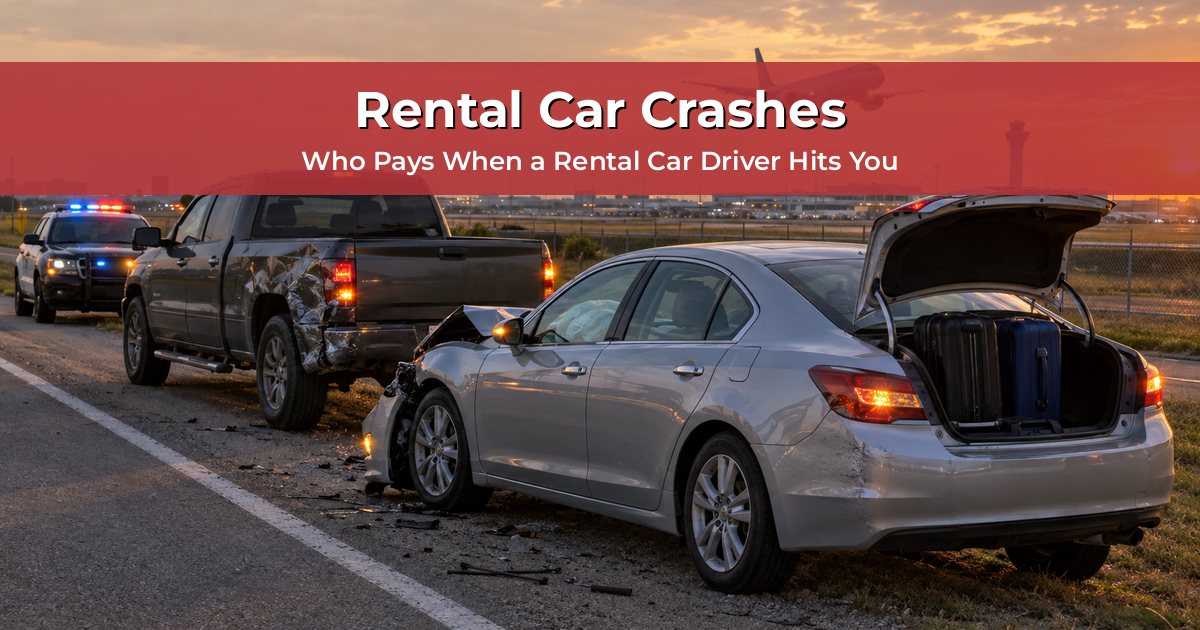
Silver rental sedan with luggage in the open trunk after a rear-end crash with a pickup near a DFW airport

Hit by a Rental Car Driver in DFW? Who Pays After a Rental Car Crash in Texas

By Jesse Lotspeich · Personal Injury

Short answer: If a driver in a rental car hits you in Texas, the claim usually runs against the driver and the insurance that covers the driver, not the rental company. A federal law known as the Graves Amendment bars holding a rental company liable just because it owns the car. Rental companies can still be liable for their own negligence, such as renting a car with known defects. Texas law also gives you a way to sue an out-of-state renter who has already flown home.

Silver rental sedan with luggage in the open trunk after a rear-end crash with a pickup near a DFW airport

With two major airports, DFW International and Dallas Love Field, Dallas-Fort Worth sees a steady stream of out-of-town drivers on unfamiliar roads like the airport's spur highways, Highway 114, Highway 183, and I-635, often tired and relying on GPS. When one of them causes a crash, injured people usually face the same questions: Who pays? Does the rental company's insurance apply? What if the driver lives in another state?

At Howard Lotspeich Alexander & Williams, PLLC (HLAW), our Fort Worth trial lawyers handle personal injury claims throughout Tarrant, Dallas, Denton, Collin, Johnson, and Parker counties. This guide explains how rental car crash claims work in Texas, whether you were hit by a renter or were driving a rental yourself.

Key Takeaways

  • The Graves Amendment generally shields rental companies from owner-based liability. A company in the rental business "shall not be liable... by reason of being the owner of the vehicle" for harm arising from the renter's use, if there is "no negligence or criminal wrongdoing" by the company (49 U.S.C. §30106).
  • Direct negligence is a different story. Federal courts in Texas have held that the Graves Amendment bars vicarious liability but "does not preempt theories of direct liability" (N.D. Tex. 2025 opinion).
  • Texas minimum liability coverage is 30/60/25: $30,000 per person, $60,000 per crash for bodily injury, and $25,000 for property damage (Tex. Transp. Code §601.072).
  • Out-of-state drivers can still be sued here. The chair of the Texas Transportation Commission is the agent for service of process on a nonresident in a suit arising from a Texas collision (Tex. Civ. Prac. & Rem. Code §17.062).
  • Your own coverage may matter most. UM/UIM and PIP can fill gaps when the renter's coverage is low or missing.

Who Is Liable When a Rental Car Driver Hits You in Texas?

The starting point is the same as any Texas car wreck: the driver who caused the crash is responsible for the harm caused by their negligence. Texas assigns fault by percentage, and you can recover as long as you're not more than 50% responsible. Our guide to how fault works in Texas personal injury cases explains those rules.

What's different in a rental car case is the question of who else might be responsible, and whose insurance pays.

What the Graves Amendment says

Before 2005, some states made rental companies liable for their customers' crashes simply because the companies owned the cars. Congress ended that with the Graves Amendment. It provides that an owner that rents or leases a vehicle "shall not be liable under the law of any State... by reason of being the owner of the vehicle... for harm to persons or property that results or arises out of the use, operation, or possession of the vehicle during the period of the rental or lease," as long as the owner is "engaged in the trade or business of renting or leasing motor vehicles" and "there is no negligence or criminal wrongdoing on the part of the owner" (49 U.S.C. §30106(a)).

Courts in Texas apply this rule regularly. In a 2025 Dallas federal case involving a leased trailer, the court held that the Graves Amendment barred the plaintiff's vicarious liability and respondeat superior claim against the leasing company, while noting that the statute "does not preempt theories of direct liability, like negligent hiring and training" (N.D. Tex. 2025).

The law also has a carve-out for financial responsibility. It doesn't override state laws "imposing financial responsibility or insurance standards on the owner of a motor vehicle," or liability on rental businesses "for failure to meet the financial responsibility or liability insurance requirements under State law" (§30106(b)).

When Can a Rental Car Company Be Held Responsible?

Because the Graves Amendment protects only against liability based on ownership, a rental company can still be responsible for its own negligence. Potential claims include:

  • Negligent maintenance. Renting out a car with bad brakes, bald tires, or a known defect, including an unrepaired safety recall.
  • Negligent entrustment. Renting to someone the company knew, or should have known, was unlicensed, incompetent, or reckless.
  • Criminal wrongdoing by the company or its employees.

These claims are hard to win. Under Texas law, negligent entrustment requires proof of "(1) entrustment of a vehicle by the owner; (2) to an unlicensed, incompetent, or reckless driver; (3) that the owner knew or should have known to be unlicensed, incompetent, or reckless; (4) that the driver was negligent on the occasion in question; and (5) that the driver's negligence proximately caused the accident" (O'Donnell v. Diaz, N.D. Tex.). Federal courts applying Texas law have also said a company that entrusts a vehicle "has no duty to investigate a driver's competency when a valid, unrestricted driver's license is presented" (Marr v. Croxton, W.D. Tex.).

Causation is another hurdle. In Allways Auto Group v. Walters, the Supreme Court of Texas held that a dealership that gave a customer a loaner car wasn't liable when the customer drove drunk and caused a crash eighteen days later, because the loan was not a proximate cause of the crash (Tex. 2017).

In practice, the rental company is most often a defendant when there's evidence of a mechanical failure. That makes it critical to preserve the vehicle and its maintenance records before the company repairs, resells, or returns the car to the fleet.

Whose Insurance Pays After a Rental Car Crash?

Several layers of coverage may be involved, and the order in which they apply depends on the policies and the rental contract. Common sources include:

Coverage source What it may cover Notes
Renter's personal auto policy Liability for injuries the renter causes Many personal policies extend to rental cars; check the policy language
Rental company coverage Liability up to the limits the company provides Often limited; Texas minimums are 30/60/25 (§601.072)
Supplemental liability insurance bought at the counter Additional liability limits Only if the renter purchased it
Your own UM/UIM coverage Your injuries when the at-fault driver has no or too little insurance See our UM/UIM and PIP guide
Your own PIP Medical bills and lost income regardless of fault Covers the named insured, household members, and authorized drivers and passengers of the named insured's vehicle (Tex. Ins. Code §1952.151)
Credit card rental benefits Usually damage to the rental car itself Generally not a source of payment for your injuries

Because rental crashes often involve minimum or uncertain coverage, your own UM/UIM policy can become the most important coverage in the case. If the renter fled the scene or had no valid coverage, see our article on what to do after an uninsured driver accident in Fort Worth.

What If the Rental Car Driver Lives in Another State?

Many renters at DFW and Love Field are visitors who are back home within days. That doesn't put them beyond the reach of a Texas court. Under Section 17.062 of the Civil Practice and Remedies Code, the chair of the Texas Transportation Commission is an agent for service of process on a nonresident "in any suit against the person or agent that grows out of a collision in which the person or the person's agent is involved while operating a motor vehicle in this state." The same rule applies to a driver who lived in Texas at the time of the crash and later moved away.

Section 17.063 sets out the mechanics: a certified copy of the process must be served on the chair at least 20 days before the return date, and the chair then mails the papers to the nonresident by registered or certified mail (§17.063). In other words, an out-of-state renter can be sued in Tarrant or Dallas County, close to where the crash happened, rather than forcing you to file in another state.

International renters raise added issues, such as foreign insurance and serving papers abroad. Those cases call for early legal advice.

What If I Was Driving the Rental Car When I Got Hurt?

If you were driving or riding in a rental car and someone else caused the crash, your claim is against the at-fault driver, just like any other wreck. A few rental-specific issues often come up:

  • Damage to the rental car. The rental company may bill you or your insurer for repairs, loss of use, and administrative fees. Don't sign anything admitting responsibility for the crash.
  • The rental company's own crash report. Rental counters often ask you to fill out an incident form. Stick to the facts and keep a copy.
  • Your PIP and UM coverage. Depending on the policy terms, your own PIP and UM/UIM coverage may apply even though you were in a rental. Read the policy or have a lawyer review it.
  • Rideshare rentals. If you rented a car to drive for a rideshare app, different coverage rules may apply. See our guide to Uber and Lyft accidents.

What Should You Do After a Crash With a Rental Car in DFW?

  1. Call 911 and get a police report. In a crash with an out-of-town driver, the police crash report is often the best record of who was involved and their insurance.
  2. Photograph the rental car's identifiers. Photograph the plate, VIN sticker, and any barcode or fleet number, plus the renter's driver's license and insurance information.
  3. Get the renter's home address and phone number, and ask whether they bought coverage at the counter.
  4. Write down the rental company and location (for example, the airport rental center or a neighborhood branch).
  5. See a doctor promptly, even if you feel fine. Our article on seeing a doctor after a minor car accident explains why.
  6. Send a preservation letter early if a mechanical defect may have played a role, so the rental company keeps the car and its maintenance records.
  7. Be cautious with multiple adjusters. You may hear from the renter's insurer, the rental company's claims administrator, and your own carrier. Read about insurance adjuster tactics before giving a recorded statement.
  8. Watch the deadline. Most Texas injury lawsuits must be filed within two years. See our Texas statute of limitations guide.

Frequently Asked Questions

Can I sue the rental car company if its customer hit me?

Usually not just because the company owns the car. The Graves Amendment bars ownership-based liability for companies in the rental business, but it doesn't protect a company from liability for its own negligence or criminal wrongdoing (49 U.S.C. §30106). Evidence of poor maintenance or a known defect can support a direct claim.

Does the rental company's insurance cover my injuries?

It may, depending on the coverage the company provides and the rental agreement. Coverage is often limited, and Texas minimum liability limits are $30,000 per person and $60,000 per crash for bodily injury (Tex. Transp. Code §601.072). The renter's own auto policy or a supplemental policy bought at the counter may also apply.

The driver who hit me flew home to another state. Can I still sue in Texas?

Yes. Texas law makes the chair of the Texas Transportation Commission the agent for service of process on nonresident drivers involved in collisions in Texas (CPRC §17.062).

Is a rental company liable for renting to a bad driver?

Only in limited situations. A negligent entrustment claim requires proof that the company knew or should have known the driver was unlicensed, incompetent, or reckless (O'Donnell v. Diaz), and courts have said there is no duty to investigate further when a valid, unrestricted license is presented (Marr v. Croxton).

What if the renter didn't have enough insurance?

Your own uninsured/underinsured motorist coverage may pay the difference, up to your policy limits. PIP can also pay medical bills and lost income regardless of fault (Tex. Ins. Code §1952.151).

How long do I have to file a claim?

Most Texas personal injury claims must be filed within two years of the crash. Claims involving government vehicles can have much shorter notice deadlines.

Talk to a Fort Worth Car Wreck Lawyer

Rental car crashes add layers of insurance, out-of-state drivers, and federal law to an already stressful situation. HLAW can identify every available policy, preserve the vehicle evidence, and serve a driver who has already left Texas. Call (817) 993-9249 or contact us online for a free consultation.

This article is for general informational purposes only and is not legal advice. Reading it does not create an attorney-client relationship. Every case depends on its specific facts, and the laws discussed here may change.

Read full article
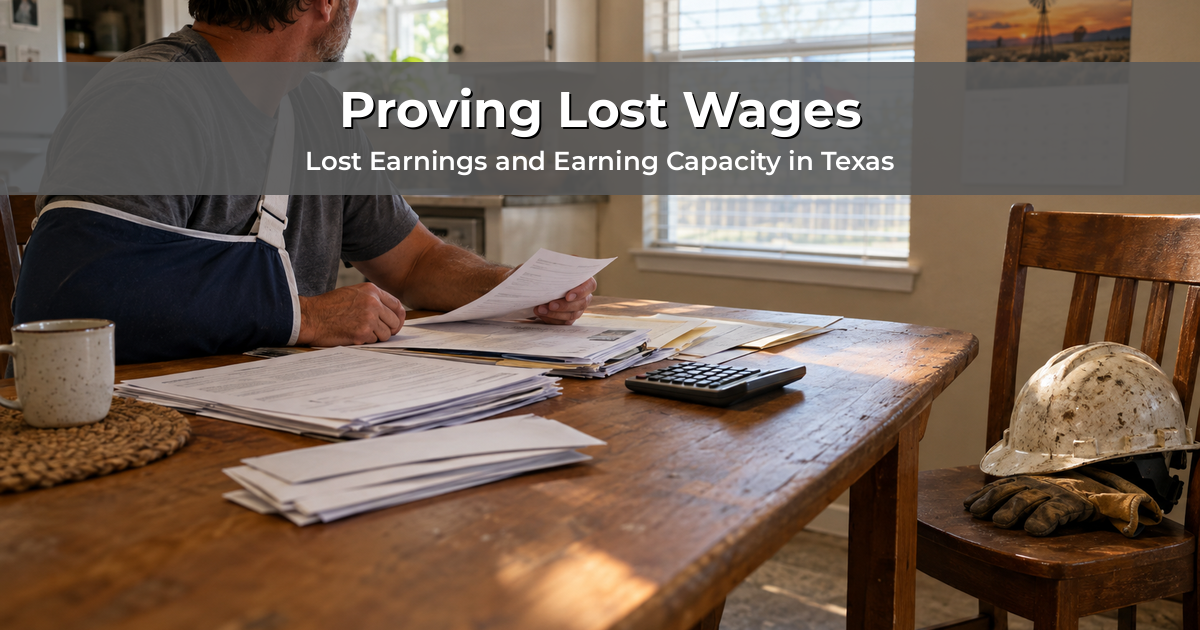
Injured worker with his arm in a sling reviewing pay records and bills at a kitchen table, hard hat on a nearby chair

Missed Work After a DFW Injury? How to Prove Lost Wages and Lost Earning Capacity in Texas

By Jesse Lotspeich · Personal Injury

Short answer: In a Texas personal injury case, you can recover the wages you've already lost and the loss of your future capacity to earn, but you have to prove both with evidence, not estimates. Texas law requires lost earnings to be presented as a net loss after federal income taxes. Courts let juries consider your past earnings, stamina, efficiency, ability to work with pain, and work-life expectancy when measuring future losses. Pay stubs, tax returns, employer statements, medical work restrictions, and, in bigger cases, vocational and economic experts are what turn a lost paycheck into a recoverable claim.

Injured worker with his arm in a sling reviewing pay records and bills at a kitchen table, hard hat on a nearby chair

After a wreck on I-30 or a fall at a Fort Worth job site, the bills that hurt most are often not the medical bills. They're the missed paychecks. Missed shifts, used-up PTO, a lost promotion, or a career you can no longer do are all real economic losses under Texas law, but insurance companies routinely discount them when they aren't documented well.

At Howard Lotspeich Alexander & Williams, PLLC (HLAW), our Fort Worth trial lawyers handle personal injury cases throughout Tarrant, Dallas, Denton, Collin, Johnson, and Parker counties. This guide explains how Texas law treats lost wages and lost earning capacity, what evidence works, and the mistakes that shrink these claims.

Key Takeaways

  • Two different claims. Past lost earnings cover income you've already missed. Loss of earning capacity covers your diminished ability to earn in the future, even if you were paid the same or more after the injury.
  • Net, after taxes. Evidence of lost earnings or earning capacity "must be presented in the form of a net loss after reduction for income tax payments" under federal income tax law (Tex. Civ. Prac. & Rem. Code §18.091).
  • Reasonable measurement in dollars. You must give the jury evidence "sufficient to permit a jury to reasonably measure earning capacity in monetary terms" (Big Bird Tree Service v. Gallegos, Tex. App.—Dallas 2012).
  • Lost wages are economic damages. Texas defines economic damages as compensation for "actual economic or pecuniary loss" (CPRC §41.001(4)).
  • PIP can help right away. Personal injury protection coverage pays "replacement of income lost as the result of the accident" for income producers, regardless of fault (Tex. Ins. Code §1952.151).

What Is the Difference Between Lost Wages and Lost Earning Capacity?

Texas law treats these as related but distinct damages.

Past lost earnings (lost wages) are the income you actually lost between the injury and trial or settlement: missed hours, missed shifts, unpaid leave, lost overtime, lost commissions, and lost bonuses that were reasonably certain.

Loss of earning capacity looks at something broader: your ability to earn money. Texas courts describe it as an assessment of the plaintiff's capacity to earn a livelihood before the injury and the extent to which the injury impaired that capacity. It "is not measured by what a person actually earned before an injury, but by the person's capacity to earn, even if he had never worked in that capacity in the past" (Tex. App.—Houston [1st Dist.] 2013).

That second point matters. Courts "have consistently upheld judgments for reduced earning capacity, even though the plaintiff was making as much or even more money after the injury than before," where pain, weakness, or diminished functional ability impaired the person's capacity to get and hold a job, or the duration, consistency, or efficiency of their work (Kelsey-Seybold Medical Group v. Roberts, Tex. App.—Houston [1st Dist.] 2024).

Past lost earnings Loss of future earning capacity
Time period Injury to trial or settlement After trial, for the rest of your work life
What it measures Income actually lost Diminished ability to earn
Typical proof Pay stubs, W-2s, tax returns, employer letter, timesheets Medical restrictions, vocational testimony, economist, past earnings history
Tax rule Net after federal income tax (§18.091) Net after federal income tax (§18.091)

How Do You Prove Lost Wages in a Texas Injury Claim?

For an hourly or salaried employee, the proof is usually straightforward, but it has to be complete:

  1. A doctor's work restriction. A note or record showing you were taken off work or placed on light duty, and for how long. Without it, insurers will argue you chose not to work.
  2. Pay records. Recent pay stubs and W-2s showing your rate, typical hours, and overtime history.
  3. An employer verification letter. A letter from HR or a supervisor confirming your position, pay rate, the dates you missed, and any lost overtime, bonuses, or promotion.
  4. Tax returns. Usually two to three years, especially if your income varies.
  5. PTO and sick leave records. If you used paid leave to cover missed days, document it.

What if I'm self-employed or a gig worker?

Self-employed claims require more proof, but they're recoverable. Courts recognize that "when the plaintiff seeks special damages for loss of earning capacity in a particular business, the amount of his earnings or the value of his services in that business must be shown with reasonable certainty" (Perez v. Perez, Tex. App.—Corpus Christi 2013). Useful evidence includes:

  • Schedule C or business tax returns for several years
  • 1099 forms and app earnings statements for rideshare and delivery drivers
  • Bank deposits, invoices, and canceled contracts or jobs you had to turn down
  • The cost of hiring someone to cover your work while you recovered
  • Testimony from regular customers or business partners

When income has been irregular, an accountant or economist can help show average earnings and what you would likely have earned during your recovery.

How Do Texas Courts Measure Lost Future Earning Capacity?

Future losses are uncertain by nature, and Texas law accepts that. "Proof of loss of earning capacity is always uncertain and is left largely to the discretion of the jury" (Big Bird Tree Service v. Gallegos). But the jury's award must rest on evidence, not speculation. Courts have said an award "must be based on something more than mere conjecture" (Durham Transportation Co., Tex. App.).

The Dallas Court of Appeals lists non-exclusive factors juries may consider: "evidence of past earnings, the plaintiff's stamina, efficiency, and ability to work with pain, and the plaintiff's work-life expectancy" (Big Bird Tree Service). Other Texas courts add "the weaknesses and degenerative changes that will naturally result from the plaintiff's injury" (Durham Transportation).

In practice, strong future-earnings claims usually include:

  • Treating doctor testimony on permanent restrictions (for example, no lifting over 20 pounds, no repetitive overhead work).
  • A vocational expert who explains which jobs you can still do and what they pay in the DFW labor market.
  • An economist who calculates the difference over your expected work life, adjusts for taxes as §18.091 requires, and reduces future amounts to present value.
  • Your own testimony and co-workers' testimony about how the injury affects your stamina and performance.

Will My Lost Wage Award Be Taxed?

Generally, damages for personal physical injuries aren't taxable as income under federal law, which is the reason for Texas's net-of-tax rule. Section 18.091(b) also requires the court to "instruct the jury as to whether any recovery for compensatory damages sought by the claimant is subject to federal or state income taxes" (CPRC §18.091). The practical effect: your lost earnings must be calculated on take-home pay, not gross pay. Tax questions about a specific settlement should go to a tax professional.

Can PIP Pay My Lost Income After a Car Wreck?

Yes, if you have it. Texas personal injury protection coverage pays, for an income producer, "replacement of income lost as the result of the accident," for expenses incurred within three years of the accident (Tex. Ins. Code §1952.151). Insurers aren't required to offer more than $2,500 per person in PIP, though many people buy more (§1952.153). The insurer must pay benefits no later than the 30th day after it receives satisfactory proof of the claim (§1952.156).

PIP applies regardless of fault, so it can help cover the gap while the liability claim is pending. Our guide to UM/UIM and PIP coverage explains how these policies fit together.

If you were hurt on the job, the rules may be different. Workers' compensation, or the lack of it with a non-subscriber employer, changes how lost income is handled. See our page on workplace accidents.

What Mistakes Hurt Lost Wage Claims?

  • Returning to work against medical advice, then trying to claim the time later.
  • Gaps in treatment, which insurers use to argue you were well enough to work.
  • Unreported cash income. If income wasn't reported on tax returns, it's very difficult to prove and can create other problems.
  • Posting on social media about physical activities or side jobs while claiming you can't work.
  • Giving the adjuster a recorded statement that downplays your limitations. Read about insurance adjuster tactics in Fort Worth.
  • Settling before you know your restrictions. If a surgeon hasn't released you, you may not yet know whether you can return to your trade.
  • Missing the deadline. Most Texas injury lawsuits must be filed within two years. See our Texas statute of limitations guide.

Lost earnings are only part of the picture. Our article on what compensation is available in a Texas personal injury lawsuit covers medical expenses, pain and suffering, and other damages. Noneconomic damages are defined separately in Texas law and include "physical pain and suffering, mental or emotional pain or anguish... physical impairment," and similar losses (CPRC §41.001(12)).

Frequently Asked Questions

Can I recover lost wages if I used PTO or sick days?

It may be possible. Paid leave you were forced to use because of the injury is a benefit you can no longer use for other purposes, and it is commonly presented as part of the earnings claim. Whether it is recoverable depends on the facts, so keep the payroll records showing the leave you used and the dates.

Can I claim lost earning capacity if I went back to the same job?

Possibly. Texas courts have upheld earning-capacity awards even when the plaintiff earned as much or more after the injury, where pain or diminished function impaired the ability to get and hold work or to work consistently and efficiently (Kelsey-Seybold v. Roberts).

Do I need an expert to prove future lost earnings?

Not always, but in cases involving permanent injury or a career change, a vocational expert and an economist are often the most persuasive way to give the jury a reasonable dollar measure, which the law requires (Big Bird Tree Service).

Are lost wages calculated before or after taxes in Texas?

After. Section 18.091 requires lost earnings and earning-capacity evidence to be presented as a net loss after federal income taxes (CPRC §18.091).

I'm self-employed. How do I prove what I lost?

Use tax returns, 1099s, invoices, bank deposits, and evidence of jobs you lost or turned down. The earnings or value of your services must be shown with reasonable certainty (Perez v. Perez).

Will my own insurance pay lost income while I wait?

If your auto policy includes PIP, it covers lost income for income producers regardless of fault, and the insurer must pay within 30 days of satisfactory proof (Tex. Ins. Code §§1952.151, 1952.156).

Talk to a Fort Worth Personal Injury Lawyer

If an injury has cost you paychecks, or your career, the way that loss is documented can make a substantial difference in what you recover. HLAW can gather your employment records, work with your doctors on restrictions, and bring in vocational and economic experts when needed. Call (817) 993-9249 or contact us online for a free consultation.

This article is for general informational purposes only and is not legal advice. Reading it does not create an attorney-client relationship. Every case depends on its specific facts, and the laws discussed here may change.
Read full article
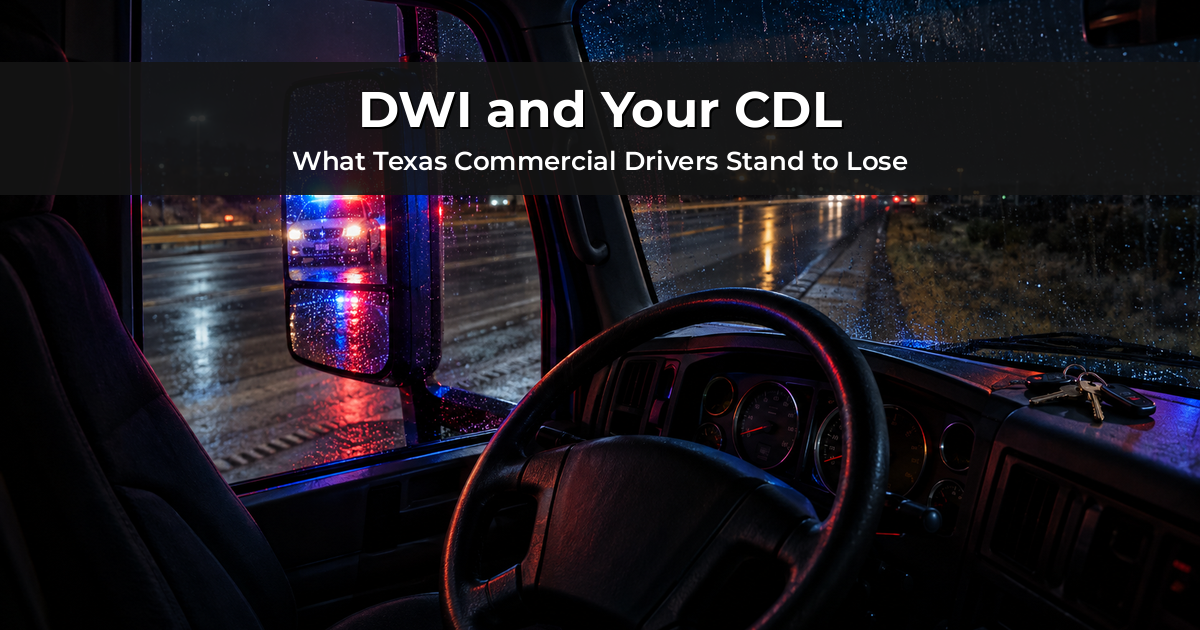
Inside a parked semi-truck cab at night with police lights reflected in the side mirror on a Texas highway

CDL Holder Arrested for DWI in Texas? How a DWI Affects Your Commercial License, Even in Your Personal Car

By Jason H. Howard · DWI

Short answer: If you hold a Texas commercial driver's license (CDL), a first DWI conviction disqualifies you from driving a commercial vehicle for one year, even if you were arrested in your personal pickup on a Saturday night. Refusing a breath or blood test, or testing at 0.08 or higher in your own car, can trigger the same one-year disqualification. A second offense means a lifetime disqualification. CDL holders also can't get deferred adjudication for DWI, can't get an occupational license to drive a commercial vehicle, and can't have the disqualification probated.

Inside a parked semi-truck cab at night with police lights reflected in the side mirror on a Texas highway

For truck drivers, bus drivers, delivery drivers, and equipment operators across Dallas-Fort Worth, a DWI arrest isn't just a criminal case. It's a threat to your livelihood. Whether the stop happened on I-35W near AllianceTexas, on I-20 in Grand Prairie, or on a farm-to-market road in Parker County, the CDL rules apply the same way.

At Howard Lotspeich Alexander & Williams, PLLC (HLAW), our Fort Worth DWI attorneys defend commercial drivers in Tarrant, Dallas, Denton, Collin, Johnson, and Parker counties. This guide explains what's at stake, the deadlines that matter, and the defense options that protect your CDL.

Key Takeaways

  • One year off the road for a first DWI conviction, in any vehicle. Texas disqualifies a CDL holder for one year on a first conviction of driving under the influence, and the rule applies while "operating any type of motor vehicle, including a commercial motor vehicle" (Tex. Transp. Code §522.081(b)).
  • Refusal or a 0.08+ test in your own car counts too. A refusal, or a test showing 0.08 or more while driving a non-commercial vehicle, is a separate one-year trigger (§522.081(b)(3)–(4)).
  • 0.04 is the limit in a commercial vehicle. A test of 0.04 or more while operating a CMV means disqualification, and any detectable alcohol puts you out of service for 24 hours (§§522.081, 522.101).
  • Hazmat means three years; a second offense means life. (§522.081(c)–(d); 49 CFR 383.51).
  • No deferred adjudication for CDL holders charged with DWI (Tex. Code Crim. Proc. art. 42A.102(b)(1)(B)).
  • No occupational license for a CMV, and no probated disqualification (§§522.085–.086).
  • You have 15 days to request an ALR hearing after receiving notice of suspension (Tex. Transp. Code §524.031).

Does a DWI in My Personal Car Affect My CDL in Texas?

Yes. This is the most common misunderstanding we hear from commercial drivers. Section 522.081(b) of the Transportation Code says the one-year disqualification applies to a violation "committed while operating any type of motor vehicle, including a commercial motor vehicle" (Tex. Transp. Code §522.081). Federal rules match: the disqualification table in 49 CFR 383.51 lists a one-year disqualification for a first DWI conviction whether you were driving a CMV or a non-CMV.

So a DWI in your own car can take you out of your truck for a year, even though your regular Class C driving privileges might be eligible for an occupational license.

What Are the CDL Disqualification Periods for DWI in Texas?

Situation CDL disqualification Source
First DWI conviction (any vehicle) 1 year §522.081(b)(2)
Refusing a breath or blood test (any vehicle) 1 year §522.081(b)(3)
Test of 0.08+ in a personal vehicle 1 year §522.081(b)(4)(B)
Test of 0.04+ (or drugs present) in a CMV 1 year §522.081(b)(4)(A)
Any of the above while hauling placarded hazmat 3 years §522.081(c)
Two or more qualifying offenses or refusals from separate incidents Life §522.081(d)
Any detectable alcohol while driving a CMV, or refusing a CMV test 24-hour out-of-service order §522.101

The lifetime rule is stricter than many drivers realize. Under §522.081(d)(3), any combination of two of the following from separate incidents triggers it: a DWI conviction, a test refusal, or a qualifying test result. For example, a refusal five years ago plus a DWI conviction today can mean lifetime disqualification. Federal rules allow a state to reinstate a driver disqualified for life after 10 years if the driver completes an approved rehabilitation program, but a second disqualifying conviction after reinstatement is permanent (49 CFR 383.51(a)(6)).

Why Can't a CDL Holder Get Deferred Adjudication for DWI?

Since 2019, Texas judges have been able to grant deferred adjudication in many first-time DWI cases. Our DWI deferred adjudication guide explains how it works. But the statute carves out an exception: deferred adjudication isn't available for a DWI charge if, at the time of the offense, "the defendant held a commercial driver's license or a commercial learner's permit" (Tex. Code Crim. Proc. art. 42A.102(b)(1)(B)(i)). The same bar applies if the alcohol concentration was 0.15 or more.

This tracks a federal rule. States "must not mask, defer imposition of judgment, or allow an individual to enter into a diversion program" that would keep a CDL holder's traffic-law conviction, in any type of vehicle, off the national CDL driver record (49 CFR 384.226). In practice, the options that help non-commercial drivers often aren't available to you, which makes the strength of the defense even more important.

Can I Get an Occupational License to Keep Driving My Truck?

No. Texas law says a person disqualified from operating a commercial motor vehicle "may not be granted an essential need or occupational driver's license that would authorize operation of a commercial motor vehicle" (§522.086). The disqualification also "may not be probated" (§522.085).

You may still qualify for an occupational license for your personal (non-commercial) driving during a regular license suspension. Our article on Texas DWI license suspensions and occupational licenses covers that process.

How Does the ALR Hearing Work for Commercial Drivers?

After a DWI arrest with a refusal or a failed test, DPS will seek to suspend your license through the Administrative License Revocation (ALR) process. For adults, the regular suspension is 90 days with no alcohol- or drug-related enforcement contact in the prior 10 years, or one year with such a contact (§524.022). You must request a hearing within 15 days of receiving notice (§524.031). See our step-by-step guide to the ALR hearing and its 15-day deadline.

For CDL holders, the ALR stakes are higher. A test result of 0.08 or more in your personal vehicle, or a refusal, is itself a basis for CDL disqualification under §522.081(b)(3)–(4), separate from any criminal conviction. When a driver stopped in a commercial vehicle refuses or tests 0.04 or more, the officer files a sworn report, and DPS disqualifies the driver beginning on the 45th day after receiving it "unless a hearing is granted" (§§522.104–.105).

The ALR hearing is also a valuable chance to question the arresting officer under oath early in the case. That testimony can expose problems with the stop, the field sobriety tests, or the breath or blood testing.

What Do I Have to Tell My Employer?

Federal regulations require commercial drivers to report certain events to their employers:

  1. Convictions. A CDL holder convicted of a traffic violation (other than parking), in any type of vehicle, must notify the employer "within 30 days of conviction" (49 CFR 383.31).
  2. Suspensions and disqualifications. If your license is suspended, revoked, canceled, or you're disqualified, you must tell your employer "before the end of the business day following the day the person received notice of the action" (49 CFR 383.33).

Many companies also have their own policies that require reporting an arrest sooner. Talk with a lawyer before you make any written statement to your employer about the facts of the arrest.

Will a DWI show up in the FMCSA Clearinghouse?

It depends on what you were driving. According to FMCSA, a DUI in a personal car "is not considered 'actual knowledge'" and "must not be reported to the Clearinghouse" (FMCSA Clearinghouse Q&A). But if you receive a citation for DUI while operating a CMV, your employer must report it as an actual-knowledge violation. That report remains for five years or until you finish the return-to-duty process, whichever is later, even if you're never convicted. You can, however, submit proof of a dismissal or acquittal (FMCSA Clearinghouse FAQ). Under FMCSA's enforcement policy, a plea to a lesser charge such as reckless driving doesn't count as a "non-conviction" (FMCSA).

What Defense Strategies Protect a CDL?

Because deferred adjudication and occupational CMV licenses are off the table, the best outcomes for commercial drivers usually come from attacking the case itself:

  • The stop. Was there reasonable suspicion for the traffic stop? Weaving within a lane, a single lane touch, or a "late-night" hunch may not be enough.
  • Field sobriety tests. Were the standardized tests administered and scored correctly? Truck drivers often have long-shift fatigue, back injuries, or footwear issues that affect balance tests.
  • Breath and blood testing. Was the breath instrument properly maintained? Was the blood draw taken under a valid warrant, and was the chain of custody intact? See our no-refusal DWI article.
  • Impairment under 0.08. Texas can charge DWI based on loss of normal use even below 0.08. Our article on DWI arrests under 0.08 explains how those cases are defended.
  • Dismissal or acquittal. A dismissal or a not-guilty verdict avoids the conviction-based disqualification under §522.081(b)(2). (A refusal or test-based disqualification is a separate issue, so the ALR fight still matters.)
  • Charge reductions, with caution. A plea to a non-alcohol offense avoids a DWI conviction, but some offenses still have CDL consequences. Reckless driving, for example, is a "serious traffic violation," and two within three years mean a 60-day disqualification (§§522.003(25), 522.081(a)).

What Should a CDL Driver Do After a DWI Arrest in DFW?

  1. Calendar the 15-day ALR deadline today.
  2. Don't drive a commercial vehicle while subject to any out-of-service order or disqualification. Doing so is a separate offense under §522.071.
  3. Write down everything you remember about the stop, the tests, and what the officer said, and share it only with your lawyer.
  4. Gather your records: your medical card, logbook or ELD data, and any dash-cam or in-cab camera footage.
  5. Know your employer reporting deadlines under 49 CFR 383.31 and 383.33.
  6. Hire a DWI lawyer who knows the CDL rules. A plea that might be fine for a regular driver can end a commercial driving career. See our overview of DWI costs in Texas for the broader financial picture.

Frequently Asked Questions

Will I lose my CDL for a first DWI in my personal car in Texas?

If you're convicted, yes. A first DWI conviction disqualifies a CDL holder from driving a commercial vehicle for one year, regardless of the vehicle you were driving (§522.081(b)). A refusal or a 0.08+ result can also trigger the one-year disqualification.

What is the legal limit for a commercial driver in Texas?

0.04 while operating a commercial motor vehicle (§522.081(b)(4)(A)). Any detectable amount of alcohol while driving a CMV results in a 24-hour out-of-service order (§522.101). In your personal vehicle, the per se limit is 0.08.

Can a CDL holder get deferred adjudication or pretrial diversion for DWI?

Texas law bars deferred adjudication for a DWI if the defendant held a CDL or commercial learner's permit at the time of the offense (art. 42A.102), and federal rules prohibit states from using deferral or diversion to keep a CDL holder's traffic-law conviction off the record (49 CFR 384.226).

Can I get an occupational license to drive my truck during the disqualification?

No. An occupational license can't authorize commercial driving for a disqualified driver, and the disqualification can't be probated (§§522.085–.086).

Is a second DWI really a lifetime CDL ban?

Two qualifying offenses from separate incidents, including combinations of convictions, refusals, and failed tests, result in lifetime disqualification (§522.081(d)). Federal rules allow a state to reinstate after 10 years with an approved rehabilitation program (49 CFR 383.51).

Does my employer find out about a DWI arrest?

Federal rules require you to report a conviction within 30 days and a suspension or disqualification by the end of the next business day (49 CFR 383.31; 49 CFR 383.33). A DUI citation in a CMV is reported to the Clearinghouse by your employer.

Talk to a Fort Worth DWI Lawyer Who Understands CDL Stakes

For a commercial driver, the wrong plea can cost a career. HLAW defends CDL holders charged with DWI throughout Dallas-Fort Worth, from the ALR hearing through trial. Call (817) 993-9249 or contact us online for a free consultation. The 15-day ALR clock starts the day you receive notice.

This article is for general informational purposes only and is not legal advice. Reading it does not create an attorney-client relationship. Every case depends on its specific facts, and the laws discussed here may change.

Read full article
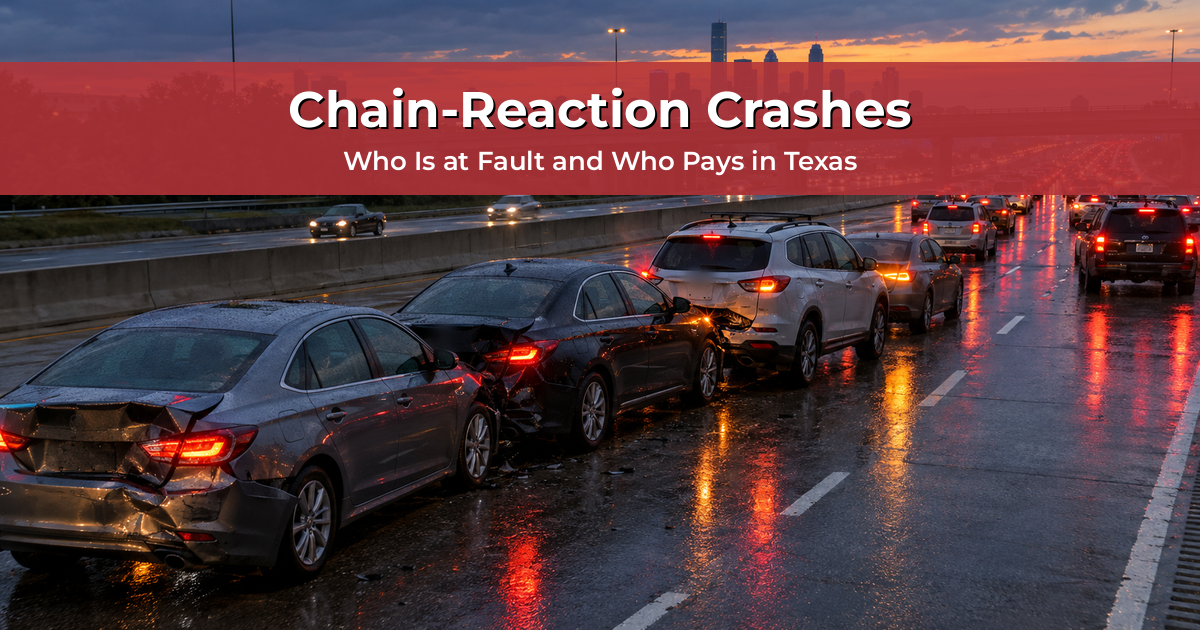
Chain-reaction rear-end crash involving several cars on a wet Dallas-Fort Worth freeway at dusk

Rear-Ended in a Chain-Reaction Crash on a DFW Highway? Who Is at Fault and Who Pays in Texas

By Jesse Lotspeich · Personal Injury

Short answer: In Texas, the driver who rear-ends you is usually, but not automatically, the one at fault. Texas law requires following drivers to keep an "assured clear distance," but courts hold that the mere fact of a rear-end collision does not prove negligence by itself. In a chain-reaction crash, a jury divides responsibility among every driver who contributed. You can recover as long as you are not more than 50% at fault, and any defendant found more than 50% responsible can be made to pay the entire judgment.

Chain-reaction rear-end crash involving several cars on a wet Dallas-Fort Worth freeway at dusk

Rear-end and chain-reaction crashes are part of daily life on DFW highways. Traffic on I-35W, I-30, I-20, Loop 820, LBJ (I-635), and Highway 121/183 can go from 70 mph to a dead stop in seconds, and when one driver doesn't stop in time, three, four, or five vehicles can end up in the same crash. In 2025, TxDOT recorded 30,433 reportable crashes in Tarrant County and 43,946 in Dallas County (TxDOT 2025 crashes and injuries by county).

At Howard Lotspeich Alexander & Williams, PLLC (HLAW), our Fort Worth trial lawyers handle personal injury claims across Tarrant, Dallas, Denton, Collin, Johnson, and Parker counties. This guide explains how Texas assigns fault in rear-end and multi-car crashes, what the other drivers' insurers will argue, and what you can do to protect your claim.

Key Takeaways

  • Following drivers have a statutory duty. Texas Transportation Code §545.062 requires a following driver to keep an "assured clear distance" so they can stop safely (Tex. Transp. Code §545.062).
  • A rear-end crash is evidence of negligence, not automatic proof of it. Texas courts, including the Fort Worth Court of Appeals, hold that the mere occurrence of a rear-end collision is not negligence as a matter of law (Campbell v. Perez).
  • Fault is divided by percentages. The jury assigns a percentage of responsibility to each claimant, defendant, settling person, and designated responsible third party (Tex. Civ. Prac. & Rem. Code §33.003).
  • The 51% bar applies. You can't recover if you are more than 50% responsible, and your recovery is reduced by your own percentage (§§33.001, 33.012).
  • Joint and several liability above 50%. A defendant found more than 50% responsible can be held liable for all recoverable damages (§33.013(b)).
  • Evidence disappears fast. Dash-cam footage, vehicle data, and witness memories can be lost within days, so early investigation matters.

Who Is at Fault in a Rear-End Collision in Texas?

Usually the following driver. Section 545.062(a) of the Transportation Code says a driver following another vehicle "shall... maintain an assured clear distance between the two vehicles so that, considering the speed of the vehicles, traffic, and the conditions of the highway, the operator can safely stop without colliding with the preceding vehicle." In other words, the law expects you to leave enough room to stop for whatever happens ahead, including a sudden slowdown on I-30 at rush hour.

But Texas doesn't treat a rear-end collision as automatic liability. Courts have said for decades that "the mere occurrence of a rear-end collision is some evidence of negligence of the rear-ending driver but is not negligence as a matter of law," and that the plaintiff must prove "specific acts of negligence on the part of the following driver as well as proximate cause" (Campbell v. Perez, Tex. App.—Fort Worth 2015). Courts have also held that a violation of §545.062 doesn't create negligence per se. It sets the same reasonable-care standard as the common law and leaves the question to the jury (Arn v. Stuart, Tex. App.—Austin 2010).

That's why "they hit me from behind" is the start of a case, not the end of it. Specific acts of negligence commonly proven in rear-end cases include:

  • Following too closely for the speed, traffic, or weather
  • Failing to keep a proper lookout
  • Speeding or driving too fast for conditions
  • Failing to brake in time
  • Texting or reading messages while driving, which is a separate traffic offense in Texas (§545.4251)
  • Driving while intoxicated

When the lead driver can share fault

The defense will look for ways to shift blame to you. Common arguments include:

  • You stopped suddenly and without reason, or "brake-checked" the other driver
  • You cut in front of the following driver and then slowed down
  • Your brake lights didn't work
  • You were stopped in a travel lane without hazard lights

In one Austin case cited often by Texas courts, a jury that believed the lead driver stopped "abruptly" and without explanation was allowed to find the following driver not negligent (Hall v. Moore). These arguments are fact-specific, and evidence like dash-cam video and vehicle data often decides them.

How Is Fault Divided in a Chain-Reaction Crash?

A chain-reaction crash (sometimes called a multi-car pileup) happens when one impact pushes vehicles into each other. A typical DFW example: Car C slams into Car B, which is pushed into Car A, which was stopped in traffic on Loop 820. Sometimes there are two separate impacts: Car B stops in time, and then Car C hits Car B and shoves it into Car A.

Texas handles these crashes under the proportionate responsibility statute, Chapter 33 of the Civil Practice and Remedies Code:

Rule What it means for you Source
Percentages for everyone The jury assigns a percentage of responsibility to each claimant, each defendant, each settling person, and each designated responsible third party §33.003
51% bar You can't recover if your share is greater than 50% §33.001
Reduction for your share Your damages are reduced by your percentage of responsibility §33.012(a)
Several liability Each defendant generally pays only its own percentage §33.013(a)
Joint and several above 50% A defendant found more than 50% responsible can be liable for all recoverable damages §33.013(b)
Responsible third parties A defendant can ask to put a non-party, such as a driver who fled, on the verdict form, generally by motion at least 60 days before trial §33.004

For a broader look at these rules, see our article on how fault works in Texas personal injury cases.

Why the percentages matter so much

Suppose you're in Car A, stopped in traffic, and you suffer $200,000 in damages. A jury finds Car C's driver 70% responsible and Car B's driver 30% responsible, and assigns you 0%. Because Car C's driver is over 50%, that driver is jointly and severally liable and can be made to pay the full $200,000. If the jury had instead split fault 50/50 between B and C, neither would be over 50%, and each would generally owe only $100,000. That matters if one of them has only minimum insurance.

Which impact caused which injury?

Multi-impact crashes raise a causation question: which collision caused which injury? The insurer for the first car may argue your injuries came from the second impact, and vice versa. Accident reconstruction, vehicle damage photos, airbag control module (event data recorder) downloads, and medical testimony are often needed to connect specific injuries to specific impacts. A thorough police crash report helps, but reports are often incomplete in multi-car crashes, especially when officers arrive after the vehicles have been moved.

What Defenses Will the Insurance Companies Raise?

Beyond blaming the lead driver, expect these arguments:

  1. Sudden emergency. Texas juries can be instructed that a driver confronted with an emergency "arising suddenly and unexpectedly," which the driver didn't cause, isn't negligent if the driver responded as a reasonably prudent person would (Dillard v. Texas Electric Cooperative, quoting the Texas Pattern Jury Charge). Drivers sometimes claim a car cut them off or debris appeared in the road.
  2. Unavoidable accident. This instruction tells jurors that an occurrence may not have been caused by any party's negligence, and it is most often raised with fog, ice, wet pavement, or obstructed views (Dillard). The Supreme Court of Texas approved its use in a rear-end crash with a car stopped on the blind side of an overpass in Reinhart v. Young, 906 S.W.2d 471 (Tex. 1995).
  3. Phantom driver. The defense may blame an unidentified vehicle that caused the chain reaction and then left. Your own uninsured motorist coverage may matter here. Our guide to UM/UIM and PIP coverage explains how it works.
  4. Minimal damage, minimal injury. Insurers often argue that low bumper damage means no real injury. Medical records, treatment consistency, and expert testimony answer that argument.

Wet pavement doesn't excuse following too closely. Section 545.062 expressly requires drivers to consider "the conditions of the highway." Drivers who know the road is wet are expected to leave more room. A police report that marks "following too closely" helps, but it is not conclusive. In one Texas case, the jury found no negligence despite that notation (Smith v. Central Freight Lines), which is why independent evidence matters.

What Evidence Wins Rear-End and Pileup Cases?

The strongest claims are built in the first few weeks:

  • Dash-cam and phone video. Your own camera, other drivers' cameras, and rideshare or commercial fleet cameras. Our article on dashcam footage after a Texas car accident explains how to preserve it.
  • Traffic and business cameras. TxDOT and city traffic cameras, toll gantry systems, and nearby business security cameras. Many are overwritten quickly, so preservation requests must go out fast.
  • Event data recorders. Most modern vehicles record speed, braking, and throttle data in the seconds before a crash.
  • Cell phone records. If distraction is suspected, phone records can show texting or app use at the moment of impact.
  • Commercial vehicle data. If a truck or delivery van was involved, electronic logging devices, telematics, and driver files are critical. See our 18-wheeler and commercial truck crash guide.
  • Witness statements. Independent witnesses are especially valuable in chain reactions, where each driver tends to blame the next.

What Should You Do After a Rear-End or Chain-Reaction Crash in DFW?

  1. Get to safety and call 911. On a highway, stay in your vehicle with your seatbelt on if it isn't safe to get out.
  2. Photograph every vehicle. Take pictures of each vehicle's damage, its position, its license plate, and the driver's insurance card.
  3. Get names and contact information for every driver and witness. In a chain reaction, you may have claims against more than one driver.
  4. Don't apologize or guess about fault. Stick to the facts.
  5. Get medical care promptly. Neck, back, and head injuries from rear impacts often get worse over the following days.
  6. Save your dash-cam footage immediately. Many cameras record over old footage in a loop.
  7. Be careful with adjusters. In a multi-car crash, several insurers may call you, each hoping to pin blame on someone else. Read about insurance adjuster tactics in Fort Worth before giving a recorded statement.
  8. Watch the deadline. Most Texas injury lawsuits must be filed within two years. If a government vehicle was involved, the notice deadline can be as short as six months. See our Texas statute of limitations guide.

Frequently Asked Questions

Is the driver who rear-ends you always at fault in Texas?

No, but usually. Texas law requires following drivers to keep an assured clear distance (§545.062), and a rear-end crash is some evidence of negligence. Still, courts hold it isn't negligence as a matter of law, so you must prove specific negligent acts and causation (Campbell v. Perez).

Who pays in a three-car chain-reaction crash?

Each driver who contributed pays their percentage of responsibility, and any driver found more than 50% at fault can be made to pay the full judgment (§33.013). Often the last car in the chain bears most of the responsibility, but not always. Middle drivers who were also following too closely can share fault.

I was in the middle car. Can I be sued?

Yes. If you were pushed into the car ahead after being hit, the evidence often shows you weren't at fault for that impact. But if you hit the car ahead first and were then struck from behind, you may share responsibility for the first impact. Each impact is analyzed separately.

Can I recover if I was partly at fault?

Yes, as long as you are not more than 50% responsible. Your damages are reduced by your percentage (§§33.001, 33.012).

What if the driver who started the chain reaction drove away?

You may be able to make a claim under your uninsured motorist coverage, and the remaining defendants may try to designate the missing driver as a responsible third party (§33.004). Report the crash to police immediately and preserve any video.

Does rain or ice excuse a rear-end crash?

Not by itself. The assured-clear-distance rule expressly considers "the conditions of the highway" (§545.062), so drivers are expected to leave more room in bad weather. A defendant may still ask for an unavoidable-accident instruction if the evidence supports it.

Talk to a Fort Worth Car Wreck Lawyer

Rear-end and chain-reaction crashes look simple, but the fault fight between multiple drivers and insurers can be complicated, and evidence disappears quickly. HLAW can preserve video and vehicle data, identify every responsible driver and policy, and build the proof Texas law requires. Call (817) 993-9249 or contact us online for a free consultation. You can also read more about what compensation is available in a Texas personal injury lawsuit.

This article is for general informational purposes only and is not legal advice. Reading it does not create an attorney-client relationship. Every case depends on its specific facts, and the laws discussed here may change.
Read full article
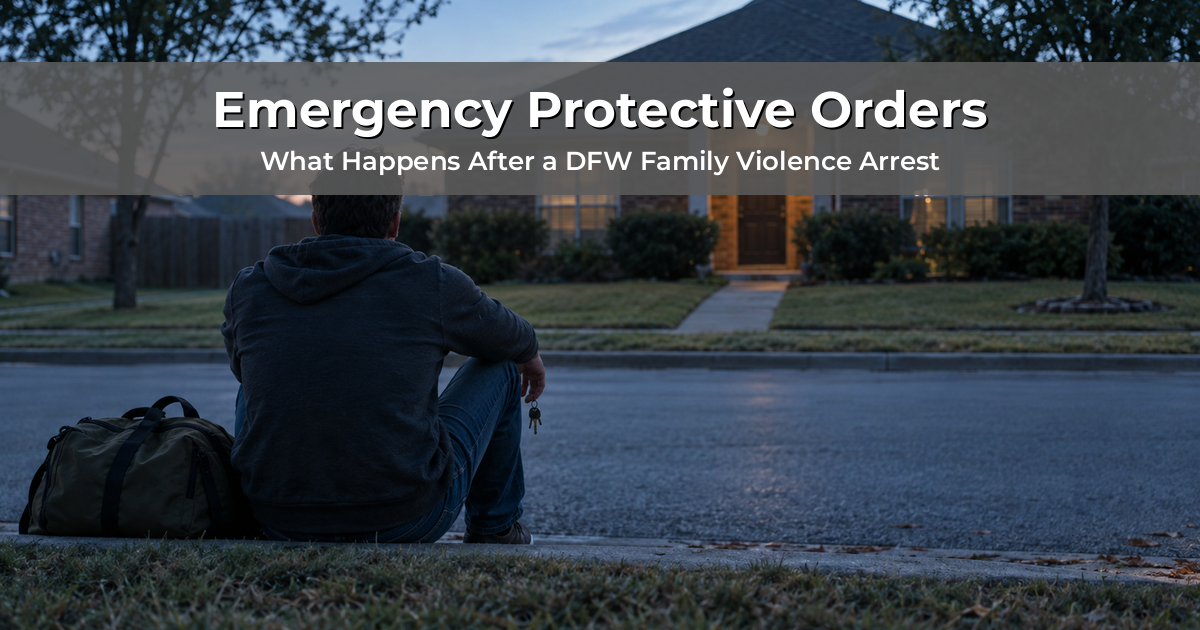
Man seen from behind sitting on a curb at dawn with a duffel bag and house keys, looking across the street at a suburban home he has been ordered to stay away from

Arrested for Family Violence in Fort Worth or Dallas? Emergency Protective Orders, Bond Conditions, and the First Days After Arrest

By Luke A. Williams · Criminal Defense

Short answer: After an arrest for family violence assault in Texas, a magistrate can, and in cases involving serious bodily injury or a deadly weapon must, issue a magistrate's order for emergency protection (often called an EPO). An EPO can bar you from going home, contacting the alleged victim, or possessing a firearm for 61 to 91 days, or up to 121 days if a deadly weapon is alleged. Violating it is a separate crime, even if the alleged victim invites you back. The alleged victim also can't simply "drop the charges"; in Tarrant County, the District Attorney's Office decides whether the case goes forward.

Man seen from behind sitting on a curb at dawn with a duffel bag and house keys, looking across the street at a suburban home he has been ordered to stay away from

A family violence arrest moves fast. One night there is an argument and a 911 call; by the next morning, you may be released from the Tarrant County or Dallas County jail with a bond, a list of conditions, and an order that says you can't go back to your own house. What you do in those first days often shapes how the case ends.

At Howard Lotspeich Alexander & Williams, PLLC (HLAW), our Fort Worth criminal defense lawyers defend family violence cases across Tarrant, Dallas, Denton, Collin, Johnson, and Parker counties. This guide covers what happens right after an arrest: the jail hold, the emergency protective order, the bond conditions, and the mistakes that turn one charge into two. For a broader overview of these cases, see our domestic violence defense page.

Key Takeaways

  • There may be a hold even after bond is posted. In some family violence arrests, the jail can hold you four hours after bond is posted, and a magistrate can extend that for up to 48 hours (Tex. Code Crim. Proc. art. 17.291).
  • An EPO can be issued at your first appearance. It is mandatory if the arrest involves serious bodily injury or a deadly weapon (art. 17.292(b)).
  • EPOs last longer than many people expect. Most remain in effect 61 to 91 days; deadly-weapon EPOs remain in effect 91 to 121 days (art. 17.292(j)).
  • The protected person can't waive it. The order itself states that no one, including the protected person, can give permission to violate it (art. 17.292(g)).
  • A violation is a new charge. Violating an EPO or a family violence bond condition is a Class A misdemeanor, and it can become a felony (Tex. Penal Code §25.07).
  • Guns must go. Possessing a firearm while subject to an EPO is a separate Class A misdemeanor for anyone other than an actively employed, full-time peace officer (Penal Code §46.04(c)).

What Happens at the Jail After a Family Violence Arrest?

Most family violence arrests in DFW are warrantless; officers respond to a call and make an arrest at the scene. You'll be booked into a city jail or the county jail and brought before a magistrate, who reads your rights, sets bond, and decides whether to issue an emergency protective order and what conditions to attach to your bond.

The four-hour (and up to 48-hour) hold

Texas has a special rule for these cases. Under article 17.291, when a person is arrested without a warrant "in the prevention of family violence" and there is probable cause to believe the violence will continue if the person is released immediately, the arresting agency "shall hold the person for a period of four hours after bond has been posted." A magistrate can extend the hold for up to 48 more hours, but only in writing and only after concluding that the violence would continue. Holds longer than 24 hours also require prior family violence arrests or a prior deadly-weapon arrest within the last 10 years.

Families are often confused when a bond is paid and their loved one still isn't released. This hold is frequently the reason. Our guide to bail bonds after a Fort Worth arrest explains the general bond process.

Don't explain your side at the jail

Calls from the jail are recorded, and officers may ask what happened. Anything you say can be used to prove the State's case. The best practice is to politely decline to discuss the incident until you've talked with a lawyer. Our article Miranda or No Miranda, Do Not Make a Statement explains why.

What Is a Magistrate's Order for Emergency Protection?

An emergency protective order is a criminal-court order that a magistrate issues at your first appearance after an arrest for an offense involving family violence (and certain other offenses, such as stalking and sexual assault). Under article 17.292(a), the magistrate may issue one on the magistrate's own motion or at the request of the alleged victim, the victim's guardian, a peace officer, or the prosecutor. It is mandatory under article 17.292(b) if the arrest also involves serious bodily injury or the use or exhibition of a deadly weapon during an assault.

An EPO is not the same as a protective order issued by a family court under Chapter 85 of the Family Code. A family-court protective order requires a separate application and hearing and can last up to two years or longer. Our article on lifting a protective order in Fort Worth covers those civil orders.

What can an EPO prohibit?

Under article 17.292(c), the magistrate can prohibit you from:

  1. Committing family violence or an assault against the protected person.
  2. Communicating with the protected person or household members in a threatening or harassing manner, or passing a threat through someone else. If the magistrate finds good cause, it can prohibit any communication except through your attorney or a court-appointed person.
  3. Going to or near the protected person's residence, workplace, or business, or the residence, child care facility, or school of a protected child.
  4. Possessing a firearm (unless you are a full-time, sworn peace officer actively employed by a state agency or political subdivision).
  5. Tracking or monitoring the protected person's property or vehicle, including with a phone tracking app or a tracking device, or by physically following them.

The "residence" restriction is often the hardest. If you live with the alleged victim, an EPO can effectively remove you from your own home, even if you own it or your name is on the lease.

How long does an EPO last?

Under the current version of article 17.292(j), an EPO takes effect immediately and:

Type of EPO Duration
Discretionary EPO, or mandatory EPO based on serious bodily injury At least 61 days, up to the 91st day after issuance
Mandatory EPO based on a deadly weapon used or exhibited during an assault At least 91 days, up to the 121st day after issuance

Read the order itself for its exact expiration date. Many people assume an EPO lasts 30 days because older versions of the law and older online articles say so, and that mistake leads to violations.

Can an EPO be changed?

Yes, but only by the court, and only after notice and a hearing. Under article 17.292(j), the issuing court may modify all or part of the order if it finds that the original order is unworkable, that the change will not place the victim at greater risk, and that the change will not endanger anyone protected by the order. Common requests include arranging a supervised pickup of clothes, work tools, or medication, or allowing communication about children through a third party. Until a judge signs a modification, the original order controls.

What Bond Conditions Are Common in Family Violence Cases?

Separate from the EPO, the magistrate can attach conditions to your bond. Article 17.49 specifically authorizes, in family violence cases:

  • Orders to stay away from a residence, school, workplace, or other location the alleged victim frequents, as specifically described in the bond
  • GPS monitoring, usually at the defendant's expense (with a sliding scale for indigent defendants)
  • A victim notification device, if the alleged victim consents
  • Orders not to track or monitor the alleged victim's property or vehicle

Magistrates can also impose other reasonable conditions, such as no-contact orders, alcohol monitoring, or counseling. Bond conditions generally last until the case is resolved or the court changes them, so they can outlast the EPO. Breaking a safety-related bond condition in a family violence case is itself a crime under Penal Code §25.07, and it can also get your bond revoked.

What Happens If You Violate an EPO or Bond Condition?

Every Texas EPO must state, in bold or capital letters, that "no person, including a person who is protected by this order, may give permission to anyone to ignore or violate any provision of this order" (art. 17.292(g)). In other words, if your spouse or partner calls and says "come home, it's fine," going home can still be a crime.

Under Penal Code §25.07, knowingly or intentionally violating an EPO or family violence bond condition by committing family violence, making prohibited communications, going to a prohibited location, possessing a firearm, interfering with a protected person's pet, tampering with a GPS monitor, or tracking the protected person is:

  • A Class A misdemeanor (up to one year in jail and a $4,000 fine) in most cases
  • A state jail felony if you violate certain provisions while possessing a deadly weapon
  • A third-degree felony if the violation involves an assault or stalking, or if you have two or more prior convictions for violating a protective order

Two or more violations within 12 months can be charged as a separate third-degree felony under Penal Code §25.072. Texts, social media messages, and messages passed through friends or relatives can all count as communication if the order prohibits it.

What to do about firearms

Under Penal Code §46.04(c), a person subject to an EPO who possesses a firearm after receiving notice of the order and before it expires commits a Class A misdemeanor. If you own guns, talk to your lawyer immediately about lawfully transferring them to a third party for the life of the order. And if your guns are kept in the home you've been ordered to stay away from, don't go back to get them yourself. Our article on firearms and DWI under Texas law discusses related firearm-possession rules.

Can the Alleged Victim Drop Family Violence Charges?

No. In Texas, the State, not the alleged victim, decides whether to prosecute. The Tarrant County Criminal District Attorney's Office says it "makes the ultimate decision of whether or not to proceed with a case based on the evidence available," that it does not generate affidavits of non-prosecution, and that "signing an affidavit will not stop prosecution."

An alleged victim may still sign an affidavit of non-prosecution. Tarrant County's published affidavit form must be notarized, and the county recommends scheduling an appointment because a meeting with an assistant district attorney is required. The affidavit is one factor the prosecutor considers, not a dismissal.

Two cautions matter here. First, the defendant should never ask, pressure, or arrange for the alleged victim to sign an affidavit or skip court. Depending on the facts and the orders in place, that contact can violate an EPO or bond condition and can lead to separate charges. Second, prosecutors often proceed without the alleged victim's testimony by using 911 recordings, body-camera video, photographs, and medical records.

Why the Outcome Matters So Much

Family violence cases carry consequences that go beyond the sentence:

  • Enhancement. A prior family violence assault conviction can turn a later Class A assault against a family member, household member, or dating partner into a third-degree felony. So can an allegation of impeding breathing or circulation (choking), even without a prior conviction (Penal Code §22.01(b)(2)). Our Texas assault offenses overview covers the assault statute.
  • State firearm restrictions. A Class A family violence assault conviction bars firearm possession under Texas law until the fifth anniversary of release from confinement or community supervision (Penal Code §46.04(b)).
  • Federal firearm restrictions. A qualifying misdemeanor crime of domestic violence conviction generally triggers a federal ban on possessing firearms or ammunition, and there is no exception for police or military personnel (ATF).
  • Record sealing. Texas bars an order of nondisclosure for a family violence offense, or when the court makes an affirmative finding that the offense involved family violence (Tex. Gov't Code §411.074). Our page on expunction and nondisclosure explains the difference.

Because these consequences can follow a person for years, how the case is resolved (dismissal, reduction to a non-family-violence offense, deferred adjudication, or trial) deserves careful attention from the start.

What Should You Do in the First Few Days?

  1. Read every order you were given. Find the EPO's expiration date, the specific addresses you must stay away from, and whether all contact or only threatening contact is prohibited.
  2. Follow the order literally. No visits, texts, social media messages, or "messages through mom," even if the other person reaches out first.
  3. Arrange a lawful place to stay. Plan for at least two to three months.
  4. Transfer firearms lawfully. Work with your lawyer to document a transfer to a third party.
  5. Retrieve belongings the right way. Ask your lawyer about a police standby or a court-approved arrangement.
  6. Save evidence. Preserve texts, call logs, photos, and the names of witnesses. Don't delete anything.
  7. Hire a defense lawyer early. Early representation can matter for bond modifications, EPO hearings, evidence preservation, and early discussions with the prosecutor.

Frequently Asked Questions

How long does an emergency protective order last in Texas?

Most EPOs remain in effect at least 61 days and up to the 91st day after issuance. If the EPO is based on a deadly weapon used or exhibited during an assault, it lasts at least 91 days and up to the 121st day (art. 17.292(j)). Always check the date written on your order.

Can I go home if my spouse says it's okay?

Not if the EPO or your bond conditions prohibit it. The order states that no one, including the protected person, can give permission to violate it (art. 17.292(g)). Only the court can change it.

Is an EPO the same as a protective order?

No. An EPO is issued by a magistrate in the criminal case at your first appearance. A protective order under Chapter 85 of the Family Code is a separate civil order that requires its own application and hearing, and it can last much longer.

Why wasn't my family member released after bond was posted?

In family violence arrests, the jail may hold a person four hours after bond is posted, and a magistrate can extend the hold for up to 48 hours in writing (art. 17.291).

Can I keep my guns while my case is pending?

Not while an EPO is in effect, unless you fall within the narrow peace-officer exception; possession is a Class A misdemeanor (Penal Code §46.04(c)). Bond conditions may also prohibit firearms.

Will an affidavit of non-prosecution get my case dismissed?

Not by itself. Tarrant County prosecutors say signing an affidavit "will not stop prosecution" and that the DA's office makes the final decision based on the evidence (Tarrant County CDA).

Talk to a Fort Worth Family Violence Defense Lawyer

The first days after a family violence arrest are when people make avoidable mistakes, like going home, sending one text, or keeping a gun in the closet, that create new charges. HLAW can review your EPO and bond conditions, request modifications when appropriate, and start building your defense right away. Call (817) 993-9249 or contact us online for a free, confidential consultation.

This article is for general informational purposes only and is not legal advice. Reading it does not create an attorney-client relationship. Laws change, and every case depends on its specific facts.

Read full article

Speak with a Fort Worth attorney

Call (817) 993-9249 or send us a message to discuss your case.